
7 Best Global Merchant of Record Platforms for International Expansion in 2026
Published on: Tue 19-May-2026 03:53 PM
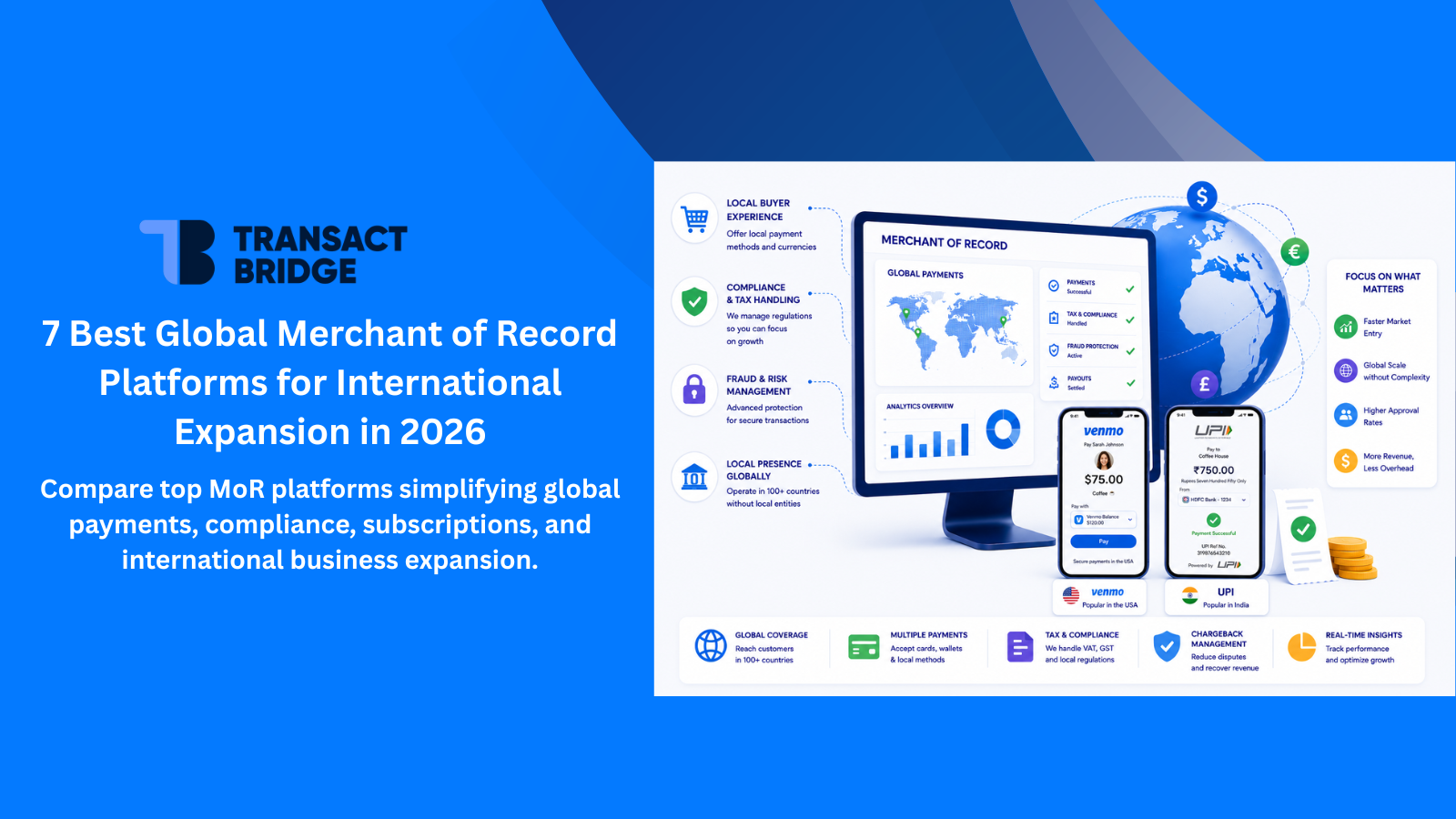
International expansion in 2026 sounds exciting until you run into VAT registration in Germany, GST compliance in India, sales tax nexus across 45 US states, and chargebacks landing in your inbox from three different continents.
A standard payment gateway processes your money. A global merchant of record absorbs all of its tax, compliance, fraud, and legal liability so your team can focus on growth, not payment plumbing.
But not all platforms are built the same. Some call themselves global but fail you the moment a customer tries to pay with UPI in India, Venmo in the US, or Pix in Brazil.
This guide evaluates the 7 best global merchant of record platforms for international expansion in 2026 covering pricing transparency, tax coverage depth, developer experience, and payment method breadth.
What Is a Global Merchant of Record?
A global merchant of record (MoR) is the legal entity that takes ownership of your transaction at the point of sale collecting tax, owning fraud liability, and managing chargebacks in every country you sell in.
For single market businesses, this complexity is manageable. For companies handling international expansion payments across 20+ countries each with different VAT rules, payment preferences, and consumer protection laws, keeping that liability in-house becomes a costly, full-time burden.
A global merchant of record removes it entirely:
- Tax compliance: VAT, GST, and sales tax calculated, collected, and remitted automatically
- Chargeback & fraud liability: absorbed by the platform, not your team
- Local payment methods: UPI, Venmo, Pix, Alipay, and more, without separate integrations
- No local entity required: enter new markets in days, not months
The fee premium over a raw payment processor is almost always cheaper than the compliance overhead it replaces.
At a Glance: 7 Best Global Merchant of Record Platforms (2026)
Platform | Best For | Pricing | India Support | US Tax Support |
Transact Bridge | India expansion for global companies | Custom | Native UPI support | Full coverage |
Paddle | Global SaaS & subscription businesses | 5% + $0.50 | Limited | Full coverage |
FastSpring | Enterprise digital products | Custom | Limited | Full coverage |
PayPal | Trusted international payments | ~3.49% + fixed fee | Limited | Partial |
Stripe | Single-market payment processing | 2.9% + $0.30 | Limited | Partial |
PayPro Global | Emerging market expansion | 4.9–7.0% | Limited | Full coverage |
| Fungies.io | Game Studios and Digital Creators | 5% + $0.50 | Limited | Full coverage |
How We Evaluated These Platforms
We ranked these platforms against the criteria that actually matter for international expansion decisions:
- MoR liability scope: does the platform fully absorb tax, fraud, and compliance?
- Payment method depth: does it support what customers actually use in your target markets?
- Pricing transparency: can you model costs before signing anything?
- Developer integration quality: APIs, SDKs, documentation, and webhook reliability
- Geographic coverage quality: not just country count, but authorization rates in those markets
- Operational overhead reduction: how much does it actually remove from your team's plate?
1. Transact Bridge
Best Merchant of Record for India and US Expansion
India is the world's fastest-growing digital economy and one of the most technically complex markets for foreign companies to enter. UPI alone accounts for over 75% of digital transactions, yet most global MoR platforms cannot provide UPI access to non-Indian businesses. Transact Bridge was built to close that gap
and now extends the same full MoR coverage to the US market, making it the only platform purpose-built for companies targeting both markets under one roof.
Core Platform Features
- Native UPI Integration: accept India's #1 payment method directly, not through workarounds or third-party rails
- Full MoR Coverage for India: GST calculation, compliant invoicing, settlement, and dispute management end-to-end
- Full MoR Coverage for the US: sales tax nexus determination, state-by-state filing, and remittance handled automatically
- Complete Local Payment Stack: UPI, Venmo enabled US payment flows, credit/debit cards, net banking, wallets (Paytm, PhonePe), BNPL
- No Local Entity Required: sell in India or the US without incorporating locally first
- Developer-Friendly REST API: clean documentation and fast integration paths
Pricing
Custom pricing: Contact for a quote tailored to your volume and market mix. Transaction fees start as low as 3%.
Pros
- The only MoR giving foreign companies native UPI access in India
- Full US sales tax compliance - nexus determination, filing, and remittance included
- No local entity required in either market before selling
- GST compliance and invoicing handled automatically for India
- Higher authorization rates through localized payment routing in both markets
Cons
- Focused on India and US; not a horizontal global MoR covering 200+ markets by default
- Custom pricing requires a conversation before cost modelling
If India, the US, or both are on your expansion roadmap, Transact Bridge is the only platform that handles the full compliance and payment stack for both markets natively without requiring local entity setup in either.
2. Paddle
Best Merchant of Record for Global SaaS Companies
Paddle is the most recognized merchant of record for global SaaS companies. It is the default choice for subscription software businesses that want mature global tax handling without building a compliance team from scratch. It acts as the full legal reseller across 200+ markets and ships with a complete SaaS billing stack built in.
Core Platform Features
- Paddle Retain: automated smart dunning recovering 7–12% of failed subscription revenue
- Inline & Overlay Checkout: localized, conversion-optimized payment UI served from your own domain
- B2B Invoicing: compliant invoices and wire transfer support for enterprise clients
- Global Tax Remittance: full VAT, GST, and US sales tax handling across 200+ jurisdictions
- Developer-First API: extensive documentation with webhooks and SDK support
Pricing
Pay-as-you-go: 5% + $0.50 per transaction. Enterprise pricing available on request.
Pros
- Most mature subscription billing infrastructure of any MoR on this list
- Churn recovery tools regularly offset the platform fee entirely
- Strong brand recognition; useful during enterprise procurement conversations
- Broad global market and payment method coverage
Cons
- Fees compound quickly for low-ARPU or high-volume, low-margin products
- No native UPI support; India-bound companies will need a complementary solution
- Merchant account approval is strict and can take longer than expected
Looking for Paddle alternatives? As a merchant of record, Transact Bridge covers the US and India gap.
3. FastSpring
Best Merchant of Record for Digital Product Companies
FastSpring is built for established software and digital goods businesses selling high-ticket products to a global audience. Its region-specific checkout flows reportedly lift international conversion rates by up to 30% by surfacing local languages, currencies, and preferred payment methods at the right moment.
Core Platform Features
- Advanced Localization Engine: regional pricing, language, and payment methods displayed automatically per buyer location
- Interactive B2B Quotes: sales teams generate enterprise quotes that convert directly to live checkout in one click
- Complex Subscription Routing: route different product lines to separate bank accounts automatically
- Dedicated Account Managers: high-volume clients get direct access to revenue strategy specialists
Pricing
Custom, quote-led pricing. Standard rates historically hover around 8–9% at lower tiers, with negotiated rates at volume.
Pros
- Best in class B2B quoting tools, unmatched in the MoR space
- Strong payment authorization in emerging markets where foreign cards frequently fail
- Deep localization drives measurable conversion lift for global products
Cons
- Most expensive option on the market- not suitable for price sensitive or low ARPU products
- Backend interface is dated compared to newer competitors
- Not designed for self-serve onboarding or fast initial launches
- No India-specific payment infrastructure for global companies
4. PayPal
Best Trusted Global Payments Platform for International Expansion
PayPal is one of the most recognized names in international payments and remains a popular choice for businesses handling international expansion payments. While PayPal is not a true global merchant of record platform for most businesses, its worldwide consumer trust, subscription billing tools, and broad payment acceptance make it a strong option for companies prioritizing quick global reach.
Core Platform Features
- Global Payment Acceptance: available across 200+ markets with multi-currency support
- Subscription Billing Tools: recurring billing and subscription payment support for SaaS businesses
- Trusted Checkout Experience: high customer familiarity improves international conversion rates
- Fraud Protection: seller protection and transaction monitoring capabilities
- Developer APIs & Integrations: connects easily with ecommerce platforms and SaaS billing stacks
Pricing
Standard pricing typically starts around 3.49% + fixed fee per transaction, with additional charges for international payments and currency conversion.
Pros
- One of the most trusted global payment brands for international customers
- Fast onboarding and easy integration for digital businesses
- Strong international payment acceptance across Western markets
- Useful alongside a dedicated merchant of record provider
Cons
- Not a true merchant of record; businesses still own VAT, GST, and sales tax compliance
- Chargeback liability and regulatory obligations remain with the merchant
- No native UPI access for foreign companies expanding into India
- International transaction and FX fees can rise significantly at scale
5. Stripe
Powerful Payment Processor, but Not a True Merchant of Record
Stripe appears on almost every global payments shortlist but there is a critical distinction: Stripe is a payment processor, not a merchant of record. When you use Stripe, you remain the legal seller in every country you operate in, owning every tax obligation, VAT registration, and chargeback dispute.
Core Platform Features
- Best-in-class developer experience and API documentation
- Broad global payment method coverage: cards, wallets, bank debits
- Transparent pricing with an extensive integration ecosystem
- Strong fraud detection via Stripe Radar
Pricing
~2.9% + $0.30 per successful transaction. Additional fees shall be charged for international cards and currency conversion.
Pros
- Most developer-friendly payments API on the market
- Lowest headline transaction fee of any platform on this list
- Extensive ecosystem of plugins, integrations, and third-party tools
Cons
- You own all tax compliance : VAT registration, quarterly filings, and remittance in every market
- Chargeback liability stays entirely with your business
- No UPI support for non-Indian businesses ; eliminates Stripe as an India expansion tool for foreign companies
- Compliance overhead grows with every new country you enter
Merchant of record vs Stripe - the real cost: Stripe's 2.9% looks significantly cheaper than an MoR's 4–8%. But once you factor in tax registration, compliance tooling, and internal team time across multiple markets, the MoR model almost always wins on total cost. For India specifically, the comparison ends before it starts.
6. PayPro Global
Best for Emerging Market International Expansion
PayPro Global is built for companies whose customers live primarily outside North America and Western Europe. With support for 110+ currencies and 70+ local payment methods including Alipay, Pix, and regional bank transfers. It offers the widest emerging market payment coverage of any platform on this list.
Core Platform Features
- 70+ Local Payment Methods: Alipay, Pix, net banking, and regional alternatives natively supported
- Outsourced Customer Support: their team handles billing disputes and refund queries in 15+ languages directly for your customers
- Cart Abandonment Recovery: automated email campaigns recapture buyers who don't complete checkout
- Detailed Tax Reporting: audit ready compliance exports for accountants in any jurisdiction
Pricing
Quote-led, typically ranging from 4.9% to 7.0% depending on volume, product type, and market mix.
Pros
- Widest local payment method coverage of any platform on this list
- Outsourced customer support removes a real daily operational burden
- Strong authorization rates in strictly regulated non-Western markets
Cons
- Onboarding takes significantly longer than self-serve platforms
- Pricing is not publicly listed, planning requires a sales conversation
- Limited India-specific infrastructure for foreign companies. Transact Bridge is stronger for India market entry
7. Fungies.io
Best Merchant of Record for Game Studios and Digital Creators
Fungies.io is a Merchant of Record platform for SaaS companies, game studios, AI businesses, and digital product sellers that want to sell globally without managing tax, payment, and compliance operations across multiple jurisdictions. It combines global payments and tax compliance with a no-code store builder, allowing businesses to create branded digital storefronts and sell directly to customers without relying on third-party marketplaces.
Core Platform Features
Hosted and Embedded Checkouts: Businesses can use hosted checkout pages or embedded checkout overlays customized to match their brand, product, currencies, and customer location.
250+ Payment Methods: Fungies.io supports more than 250 payment methods across over 150 countries, including markets where businesses may have difficulty accessing Stripe.
Subscription Management: The platform supports recurring billing, automated renewals, customer portals, promotional discounts, dunning management, and usage-based pricing.
Fraud and Chargeback Management: Built-in fraud detection, along with support for refunds and chargeback handling.
No-Code Store Builder: Game studios, SaaS companies, and creators can launch fully branded online stores without building a custom ecommerce system from scratch.
Pricing
Fungies.io charges 5% + $0.50 per successful sale. This all-inclusive fee covers payment processing, tax compliance, invoicing, and access to the platform’s commerce features.
There are no monthly subscription fees, setup charges, or upfront platform costs. Businesses only pay when they make a sale.
Pros
Combines Merchant of Record services with a no-code digital storefront builder
Supports SaaS subscriptions, games, virtual goods, and digital downloads
No monthly fees or setup costs
Supports usage-based pricing and recurring subscriptions
Helps game developers and creators avoid marketplace commissions
Suitable for businesses that want to sell directly to their customers
Cons
The 5% + $0.50 fee can be expensive for low-priced digital downloads
A newer provider with a shorter enterprise track record than Paddle or FastSpring
Primarily designed for digital products rather than physical e-commerce
Does not position itself as an India-specific MoR with native UPI infrastructure
Its smaller ecosystem may offer fewer third-party integrations than Stripe or Paddle
Fungies.io is a strong choice for SaaS founders, indie game studios, AI application developers, and digital creators that want to launch a branded store while outsourcing payments, subscriptions, global tax compliance, and invoicing to one provider.
Merchant of Record for US Expansion: What to Know
Consumer payment preferences also continue shifting toward localized wallet ecosystems like Venmo, making payment method localization increasingly important for authorization and checkout conversion rates in the US market. A merchant of record for US expansion handles nexus determination, state-by-state filing, and remittance automatically. Without one, you are legally required to register and file independently in every state where you cross the nexus threshold.
- Transact Bridge covers the full US MoR stack- sales tax compliance, invoicing, and remittance - alongside native India support, making it the strongest choice for companies targeting both markets under one platform
- Paddle and FastSpring have mature US sales tax infrastructure for SaaS and digital products at scale, suited for businesses focused primarily on Western markets
Merchant of Record for India Expansion: The Critical Considerations
General purpose global MoR platforms routinely underperform in India because they were not built with India's payment infrastructure in mind. Before choosing a platform for merchant of record for India expansion, verify:
- UPI access: does the platform support UPI natively for non-Indian businesses? Most do not.
- GST compliance: is GST calculated, invoiced, and remitted automatically, or does it land back on your team?
- Local entity requirement: must you incorporate in India first, or can you start selling immediately?
- Authorization rates: a global MoR routing through foreign banking rails will see lower success rates than one with domestic Indian infrastructure
Transact Bridge is currently the only platform that addresses all four of these criteria for international companies.
Choosing the Right Global Merchant of Record
Choosing the right global merchant of record is less about selecting the platform with the biggest country list and more about identifying the provider that aligns with your expansion markets, payment infrastructure requirements, and operational complexity.
1. Prioritize Local Payment Method Coverage
International expansion succeeds when customers can pay using the methods they already trust. UPI dominates digital payments in India. Venmo continues to shape consumer wallet behavior in the US. Pix drives transactions in Brazil, while Alipay remains critical in China.
A global merchant of record should support these payment methods natively — not through fragile third-party workarounds. Evaluate authorization quality in your target regions, not just overall geographic coverage.
2. Calculate the Real Effective Cost
Headline transaction fees rarely reflect the true operational cost of international expansion payments. FX conversion charges, international card surcharges, dispute handling fees, and compliance tooling can significantly increase your total spend.
For example, Lemon Squeezy's advertised 5% pricing can move closer to 8% for international transactions, while Stripe's lower processing fee still leaves businesses responsible for VAT, GST, and sales tax compliance internally.
3. Match Integration Speed to Your Expansion Timeline
Some merchant of record platforms can launch in days, while others require weeks of onboarding, underwriting, and implementation work.
If speed-to-market matters, prioritize platforms with strong APIs, streamlined onboarding, and developer-friendly documentation. A slightly higher transaction fee may still be cheaper than delaying international launch timelines by several weeks.
4. Evaluate Future Billing Complexity
Your payment infrastructure should support not only your current business model but also the one you expect 12–24 months from now.
Simple digital product sales require very different capabilities compared to SaaS subscription billing, usage-based pricing, enterprise invoicing, or multi-product revenue routing. Choosing a global merchant of record that scales with billing complexity prevents painful migrations later.
5. Assess India and US Expansion Separately
Many global merchant of record providers perform well in Western markets but struggle with India-specific infrastructure requirements.
If India is part of your expansion roadmap, verify whether the platform supports native UPI access for foreign companies, automated GST compliance, and local payment routing.
Similarly, for US expansion, ensure the provider can manage state-by-state sales tax nexus determination, filing, and remittance automatically. Platforms like Transact Bridge differentiate themselves by combining India-focused payment infrastructure with full US merchant of record compliance coverage under one platform.
Conclusion
The best global merchant of record in 2026 depends on target markets, customer payment preferences, and the level of compliance complexity a business is willing to manage internally.
For global SaaS expansion, Paddle remains a leading subscription-focused merchant of record, while FastSpring is strong for enterprise digital products with advanced localization. PayPro Global offers broad emerging market coverage with extensive local payment methods. Increasing international expansion success is driven by localized payment infrastructure such as UPI in India, Venmo in the US, Pix in Brazil, and Alipay in China, which directly impact authorization rates and conversion.
For companies targeting India and the US together, Transact Bridge stands out with native UPI support for foreign companies, automated GST compliance, and full US sales tax handling, all under a unified merchant of record framework that reduces operational overhead and improves scalability.
Ready to Sell in India Without Setting Up a Local Entity?
Transact Bridge gives global companies native UPI access, full GST compliance, and a complete Indian payment stack — with zero local entity requirement. Most businesses are live in days.
FAQs
1. What does a global merchant of record do?
A global merchant of record acts as the legal seller of your product in international markets. It handles VAT, GST, sales tax, fraud liability, chargebacks, and regulatory compliance, allowing businesses to sell globally without establishing local entities in every country.
2. What is the difference between a payment processor and a merchant of record?
A payment processor only processes transactions. A merchant of record takes legal responsibility for the transaction itself, including tax collection, remittance, fraud handling, and compliance obligations. Stripe primarily operates as a payment processor, while platforms like Paddle and Transact Bridge function as merchant of record providers.
3. Is Stripe a merchant of record?
No. Stripe is primarily a payment processor. Businesses using Stripe remain responsible for VAT registration, GST compliance, sales tax filing, and chargeback liability across every market where they operate.
4. Can foreign companies accept UPI payments in India?
Most global payment platforms cannot provide native UPI access to foreign companies without local incorporation. Platforms such as Transact Bridge allow international businesses to access UPI alongside GST compliance and localized payment infrastructure.
5. Do I need a local entity to sell internationally?
Not always. A merchant of record provider allows businesses to enter many international markets without establishing a local legal entity because the MoR acts as the legal seller on record.
6. How much does a merchant of record cost?
Most merchant of record platforms charge between 4% and 8% per transaction depending on geography, payment methods, fraud risk, and subscription complexity. In many cases, the fee offsets the operational cost of managing global tax compliance internally.
7. Can I use multiple merchant of record platforms at the same time?
Yes. Many companies use different merchant of record providers for different regions; for example, one platform for Western markets and another specialized provider for India or emerging markets. This approach can improve authorization rates and local payment coverage.
8. Can merchant of record platforms support local wallets like Venmo and UPI?
Yes, but support quality varies significantly between providers. Some platforms only support global card networks, while others provide localized payment methods such as Venmo in the US, UPI in India, Pix in Brazil, and Alipay in China. Local payment support can materially improve checkout conversion and payment authorization rates in those markets.
9. What are the best Paddle alternatives merchant of record?
The best Paddle alternatives depend on your expansion priorities. Transact Bridge is stronger for India and US expansion, PayPro Global offers broader emerging-market payment coverage, FastSpring is suited for enterprise digital products, and Lemon Squeezy works well for smaller digital businesses and indie creators.


