How Billing Address Verification Impacts Fraud, Chargebacks, and Revenue in Online Payments
Published on: Mon 11-May-2026 01:51 PM
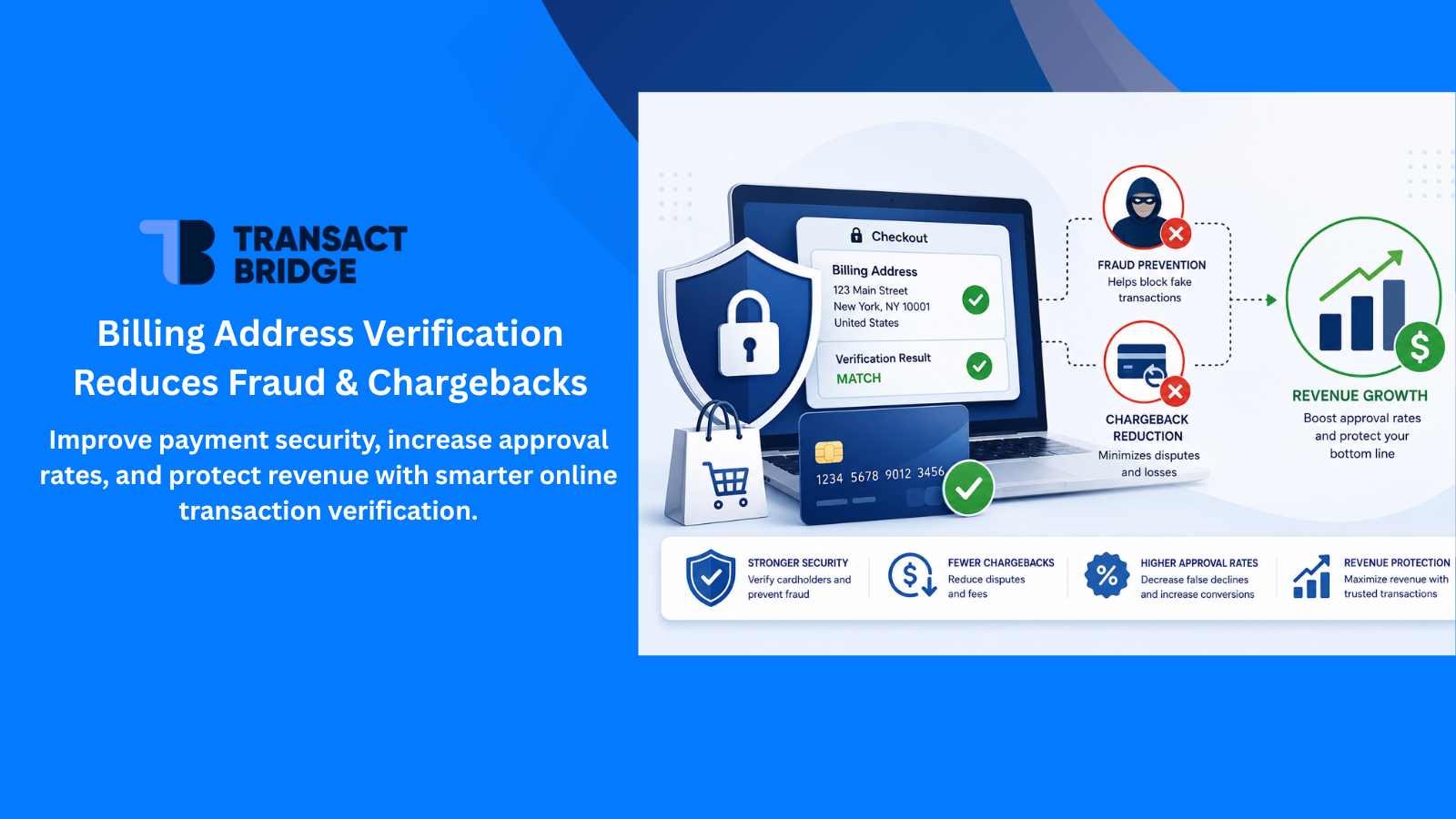
Most payment failures aren’t fraud. They’re bad decisions.
In online payments, every transaction carries an invisible question:
Is this payment legitimate?
Yet businesses often get it wrong.
Up to 10–15% of legitimate transactions are falsely declined, costing real revenue
Chargebacks can cost up to 2.5x the transaction value, eroding margins
This creates a paradox: systems built to stop fraud often block genuine customers.
For businesses operating at scale-across ecommerce, SaaS, and cross-border markets-this isn’t just a risk issue. It’s a growth problem.
Amid increasingly complex fraud tools, one of the most underutilized yet effective signals in online payment billing remains simple: billing address verification.
Far from being just a data point, it directly influences approvals, declines, and risk decisions.
This article explores how it works and how to use it to reduce fraud, prevent chargebacks, and recover revenue.
What Is Billing Address Verification in Online Payments?
Billing address verification is the process of matching the address entered during checkout with the address on file with the cardholder’s issuing bank.
In most online payment billing environments, this is handled through Address Verification Systems (AVS) during card-not-present (CNP) transactions-such as ecommerce checkouts and online bill payment flows.
At a high level:
A customer enters their billing address during checkout
The data is passed through the payment processor
The issuing bank compares it with its records
A response signal is returned
However, the real value lies in how that response is interpreted.
AVS doesn’t simply return a “yes” or “no.” It generates granular response codes, such as:
Full match - street address and ZIP/postal code match
Partial match - either street or ZIP matches
No match - neither element matches
Unavailable / unsupported - issuer or region doesn’t support AVS
These signals feed directly into authorization and fraud decisioning systems—often influencing whether a transaction is approved, declined, or routed for further checks.
It’s also important to note that AVS is not globally consistent. It is most reliable in markets like the United States, Canada, and the United Kingdom, but has limited or no support in many international regions.
For businesses operating across borders, this means billing address verification is not a universal control-but a contextual signal that must be used intelligently alongside other fraud indicators.
Why Billing Address Matters More Than You Think
Many businesses treat billing addresses as a formality. In reality, it’s a high-impact risk signal that directly influences revenue outcomes.
In online payment billing, even small variations in address data can change how issuers evaluate a transaction.
For example:
A ZIP/postal code match with a street mismatch may still be approved—because some issuers prioritize postal code accuracy over full address matching
A full address mismatch can significantly reduce approval probability, even if other signals (like device or transaction history) look clean
In some cases, a minor formatting issue or typo can trigger a mismatch—leading to unnecessary declines
This means billing address verification isn’t just about fraud detection—it actively shapes authorization decisions at the issuer level.
It influences:
Fraud detection accuracy
Payment approval rates
Chargeback exposure
Customer trust and experience
When used correctly, it helps balance risk and revenue.
When ignored or misapplied, it can lead to:
Higher fraud losses
Increased false declines
Lost revenue opportunities
The difference isn’t in the data itself-but in how intelligently it’s used within your payment strategy.
The Role of Billing Address in Fraud Prevention
Fraud in online payments is largely driven by stolen card data. While fraudsters may have access to card numbers, they often lack accurate billing address information-making billing address verification a valuable risk signal.
However, it’s important to understand its role correctly.
AVS is:
Low friction - works silently without impacting checkout experience
Medium-strength signal - useful, but not definitive on its own
Most effective when combined with other controls like device intelligence, behavioral signals, OTP, or 3D Secure
Unlike step-up authentication methods such as OTPs or 3D Secure—which add friction but provide strong verification-AVS operates in the background, helping filter risk without disrupting genuine users.
How it reduces fraud:
Flags unauthorized transactions early
Mismatched address data is a strong indicator of potential fraudEnables frictionless risk checks
Adds a verification layer without introducing user drop-offsStrengthens risk scoring models
Address match data complements signals like device, location, and behaviorDisrupts card testing attacks
Fraudsters testing stolen cards often fail AVS checks, helping block attack patterns early
Key Takeaway
Billing address verification is not a standalone fraud solution-it’s a foundational signal.
Used alone, it has limits.
Used intelligently within a layered fraud strategy, it helps reduce risk without sacrificing conversions.
Impact on Chargebacks and Disputes
Chargebacks are not just a financial issue-they’re an operational and reputational risk.
Billing address verification helps reduce chargebacks by identifying risky transactions before authorization, particularly in card-not-present environments where fraud risk is higher.
Where it makes the biggest impact:
Helps reduce “fraud – card not present” chargebacks by flagging mismatched or suspicious address data early
Acts as a supporting signal in dispute investigations, especially when validating transaction authenticity
Key benefits:
Fewer unauthorized payment disputes
Lower dispute handling and operational costs
Improved approval confidence for borderline transactions
Stronger defense in representment workflows
Network-level impact:
Consistently lower chargeback rates help businesses stay within acceptable thresholds set by card networks like Visa and Mastercard.
Reduces risk of entering monitoring programs such as Visa Fraud Monitoring Program (VFMP) or Visa Chargeback Monitoring Program (VCMP)
Helps avoid penalties, increased scrutiny, and potential account restrictions
Why this matters:
A single chargeback doesn’t just mean lost revenue—it includes:
Refund amount
Chargeback fees
Operational and support costs
Potential customer loss
Over time, these costs compound-turning isolated disputes into significant revenue leakage and long-term risk exposure.
The Revenue Impact: Approval Rates vs Risk Control
This is where billing address verification moves from a fraud tool to a revenue lever.
In online payment billing, the biggest risk isn’t always fraud-it’s false declines.
False declines can cost businesses up to 5-10% of revenue
Even a 1% improvement in authorization rates can unlock significant GMV at scale
This creates a critical trade-off:
Approach | Outcome |
Strict AVS rules | Lower fraud risk, but higher false declines and lost revenue |
Flexible AVS logic | Higher approval rates, but potential exposure to marginal risk |
But this isn’t a binary choice.
In reality, leading businesses don’t choose between fraud prevention and growth-they optimize for both.
For example:
Accepting partial AVS matches for low-risk, repeat customers can improve approvals without increasing fraud
Applying stricter AVS rules only for high-risk transactions helps contain fraud while protecting conversions
Adjusting AVS logic based on region (where AVS reliability varies) prevents unnecessary cross-border declines
The Strategic Shift
The goal is not stricter verification-it’s smarter verification.
Businesses that treat AVS as a rigid rule often sacrifice revenue for risk control.
Those that use it dynamically-based on customer context, transaction behavior, and regional nuances-can increase approvals while maintaining fraud thresholds.
How Billing Address Affects Revenue
Billing address verification impacts revenue in two critical ways: protecting against losses and unlocking growth opportunities.
1. Protects Revenue by Reducing Fraud Losses
By flagging mismatched or suspicious address data early, AVS helps block unauthorized transactions before fulfillment-preventing direct financial loss and protecting margins.
But this is just the baseline.
2. Unlocks Revenue by Reducing False Declines
The bigger opportunity lies in recovering legitimate transactions.
Overly strict AVS rules can block genuine users due to minor mismatches or formatting issues
Smarter handling of partial matches and contextual signals can significantly improve checkout conversion
In many cases, reducing false declines has a greater revenue impact than preventing fraud.
3. Drives Long-Term Growth Through Better Customer Experience
Approval rates don’t just affect a single transaction-they shape the entire customer lifecycle.
Fewer unnecessary declines lead to smoother checkout experiences in online bill payment flows
Higher success rates increase customer trust and repeat purchases
In subscription or SaaS models, improved approvals directly contribute to higher retention and lifetime value (LTV)
The Bigger Picture
Billing address verification isn’t just a risk control-it’s a revenue optimization layer.
Businesses that use it intelligently don’t just prevent losses-they increase conversions, improve retention, and maximize customer value over time.
Common Challenges Businesses Face
Despite its benefits, billing address verification introduces operational and decisioning challenges-especially at scale and across geographies.
1. Global Address Inconsistency (Most Critical in Cross-Border Payments)
AVS is not universally standardized, and its reliability varies significantly by region.
Strong support in markets like the US, UK, and Canada
Limited or inconsistent support in regions like India, Southeast Asia, and LATAM
Variations in address formats (e.g., missing ZIP codes, non-standardized structures)
Impact: Reduced accuracy of AVS signals and higher false declines in cross-border transactions
2. Address Mismatches Are Not Always Fraud (High Impact on Revenue)
A mismatch does not automatically indicate risk.
Common reasons include:
Customers using a different shipping vs billing address
Typographical errors or incomplete inputs
Outdated records with issuing banks
Impact: Legitimate transactions are incorrectly declined, leading to lost revenue and poor customer experience
3. Lack of Intelligent Decisioning (Most Common Internal Limitation)
Many businesses rely on binary AVS logic:
Match = accept
Mismatch = decline
This ignores the nuance of partial matches, issuer behavior, and customer context.
Impact: Missed approval opportunities and suboptimal fraud-to-approval balance
4. Checkout Friction from Address Capture (Conversion Risk)
Capturing detailed billing address data can introduce friction:
Long or complex address forms
Manual entry in mobile-first environments
Lack of autofill or validation support
Impact: Increased cart abandonment and lower checkout conversion rates
The Strategic Insight
Not all challenges are equal.
Global inconsistency is the biggest barrier for cross-border scalability
Binary decisioning is the biggest internal gap affecting revenue
Address mismatches are the most common cause of false declines
Businesses that recognize these nuances-and adapt their AVS strategy accordingly-are far better positioned to reduce friction, improve approvals, and scale globally.
Best Practices for Using Billing Address Strategically
To unlock real value from billing address verification, businesses need to move from basic implementation to intelligent orchestration.
What Top Payment Teams Do Differently
High-performing payment teams don’t treat AVS as a rule-they treat it as a contextual signal within a decisioning system.
They accept partial matches intelligently, not blindly reject them
They adjust AVS logic by region, based on issuer behavior and data reliability
They combine AVS with multiple signals to improve accuracy without adding friction
They continuously optimize for approval rates-not just fraud reduction
From Basic to Mature: Billing Address Strategy
Capability | Basic Implementation | Mature Implementation |
AVS Usage | Binary (match = accept, mismatch = decline) | Contextual (partial match, issuer behavior, region-aware) |
Decisioning | Static rules | Dynamic, risk-based logic |
Signal Integration | AVS used in isolation | Combined with CVV, device, behavior, transaction history |
Checkout Experience | Manual entry, high friction | Autofill, validation APIs, optimized UX |
Optimization Approach | One-time setup | Continuous monitoring and iteration |
The Playbook: How to Optimize Billing Address Verification
1. Move Beyond Full Match Dependency
Accept partial matches (e.g., ZIP/postal code) where risk is low
Avoid blanket declines based on incomplete mismatches
2. Layer AVS with Complementary Signals
Don’t rely on the billing address alone. Combine it with:
CVV verification
Device fingerprinting
Transaction history
Behavioral analytics
This improves decision accuracy without adding user friction
3. Implement Dynamic Risk-Based Rules
Allow flexibility for low-risk or repeat customers
Apply stricter checks for high-value, cross-border, or first-time transactions
Balance fraud control with approval optimization
4. Optimize the Checkout Experience
Enable autofill and smart address suggestions
Use address validation APIs to reduce input errors
Minimize required fields, especially on mobile
Reduce friction and improve conversion rates
5. Continuously Monitor and Iterate
Track key metrics:
Approval rates
Decline reasons (especially AVS-related)
Chargeback ratios
Use these insights to refine rules and improve performance over time
Key Takeaway
Billing address verification is no longer just a fraud check-it’s a performance lever.
Basic implementations focus on blocking risk.
Mature implementations focus on maximizing approvals while controlling risk.
Billing Address in the Context of Online Payment Billing Systems
In modern online payment billing environments, especially subscription and recurring models, the billing address plays a long term, persistent role in payment performance.
Unlike one-time transactions, billing address data becomes part of the customer’s stored payment profile, influencing not just the initial transaction but the entire lifecycle of recurring payments.
Why It Matters in Recurring Payments
1. Impacts Initial Authorization and Tokenization
Billing address verification is typically performed during the first transaction, when the card is authenticated and tokenized.
A clean AVS match improves the likelihood of successful setup
Failed or weak verification at this stage can affect downstream payment reliability
2. Influences Recurring Payment Success Rates
Even though AVS is not always re-run on every recurring charge, the quality of the initial verification affects how issuers treat future transactions.
Strong initial validation can improve issuer confidence
Poor or inconsistent data can increase the chances of declines during renewals
Over time, this directly impacts subscription retention and revenue continuity
3. Supports Card Lifecycle Management
Billing address data plays a role in managing changes across the card lifecycle:
Helps validate updated card details (e.g., expired or replaced cards)
Improves success rates in retry logic and dunning flows
Works alongside account updater services to maintain payment continuity
4. Enables Accurate Invoicing and Compliance
Billing address is also critical for:
Tax calculation (GST, VAT, etc.)
Regulatory compliance and record-keeping
Generating accurate invoices for customers
Insight
In subscription and recurring billing models, billing address verification is not a one-time check-it’s a foundational data point that supports long-term payment success.
Businesses that treat it as part of a broader payment lifecycle strategy-rather than just a checkout field-are better positioned to reduce churn, improve recovery rates, and maximize lifetime value.
Where Most Businesses Go Wrong
Let’s be blunt-most businesses get billing address verification wrong.
They either:
Ignore AVS entirely - exposing themselves to unnecessary fraud
Over-rely on AVS - blocking legitimate customers and losing revenue
Both approaches are costly.
Ignoring AVS = higher fraud exposure
Over-reliance on AVS = increased false declines and revenue loss
The problem isn’t the signal-it’s how it’s used.
Too many payment systems still operate on rigid, binary logic:
Match = approve
Mismatch = decline
But real-world transactions don’t work that way.
A mismatch could mean fraud-or it could mean:
A simple typo
An outdated bank record
A cross-border customer with non-standard address formats
The Real Issue
The gap isn’t in data-it’s in context-aware payment decisioning.
Without context, businesses are forced to choose between:
Protecting against fraud, or
Maximizing approvals and revenue
Leading payment teams don’t make that trade-off.
They interpret billing address data in context-alongside customer history, transaction behavior, and regional nuances-to make smarter decisions.
How Transact Bridge Helps Optimize Payment Outcomes
Transact Bridge transforms billing address verification from a static validation step into a dynamic payment optimization layer that improves outcomes across the transaction lifecycle. Instead of relying on rigid rules, it interprets transaction signals in context, aligns decisioning with issuer behavior, and continuously refines approval logic based on real performance data. This approach reduces unnecessary declines while maintaining risk control, helping businesses improve authorization rates, recover lost transactions, and achieve more consistent payment performance at scale.
Final Thoughts
Billing address verification is no longer just a compliance or fraud tool-it is a revenue optimization lever.
In a competitive online payments ecosystem, businesses that:
Understand how billing address impacts authorization
Balance fraud prevention with user experience
Use intelligent decisioning instead of rigid rules
…are the ones that win.
But here’s the reality:
Payments optimization is no longer optional-it’s a growth lever.
Businesses that continue to rely on static rules and outdated logic will keep losing revenue through false declines and missed opportunities.
Those that adopt a more intelligent, context-aware approach will not only reduce risk-but unlock measurable gains in approval rates, customer experience, and long-term revenue.
Want to Improve Your Payment Success Rates?
If your business is experiencing:
High payment failures
Rising chargebacks
Low conversion in online payment billing flows
You’re likely losing revenue-without even realizing where.
Most businesses don’t know:
How their approval rates compare to industry benchmarks
Where false declines are silently killing conversions
How much revenue is being lost due to suboptimal payment logic
That’s where Transact Bridge comes in.
We help you:
Benchmark your approval rates
Identify hidden revenue leakage
Optimize payment decisioning across the entire transaction lifecycle
Get a free payment performance audit and uncover where you’re losing revenue today.