
Payment Processor for Indian Market: A Complete 2026 Guide for Global Businesses
Published on: Thu 29-Jan-2026 08:55 AM
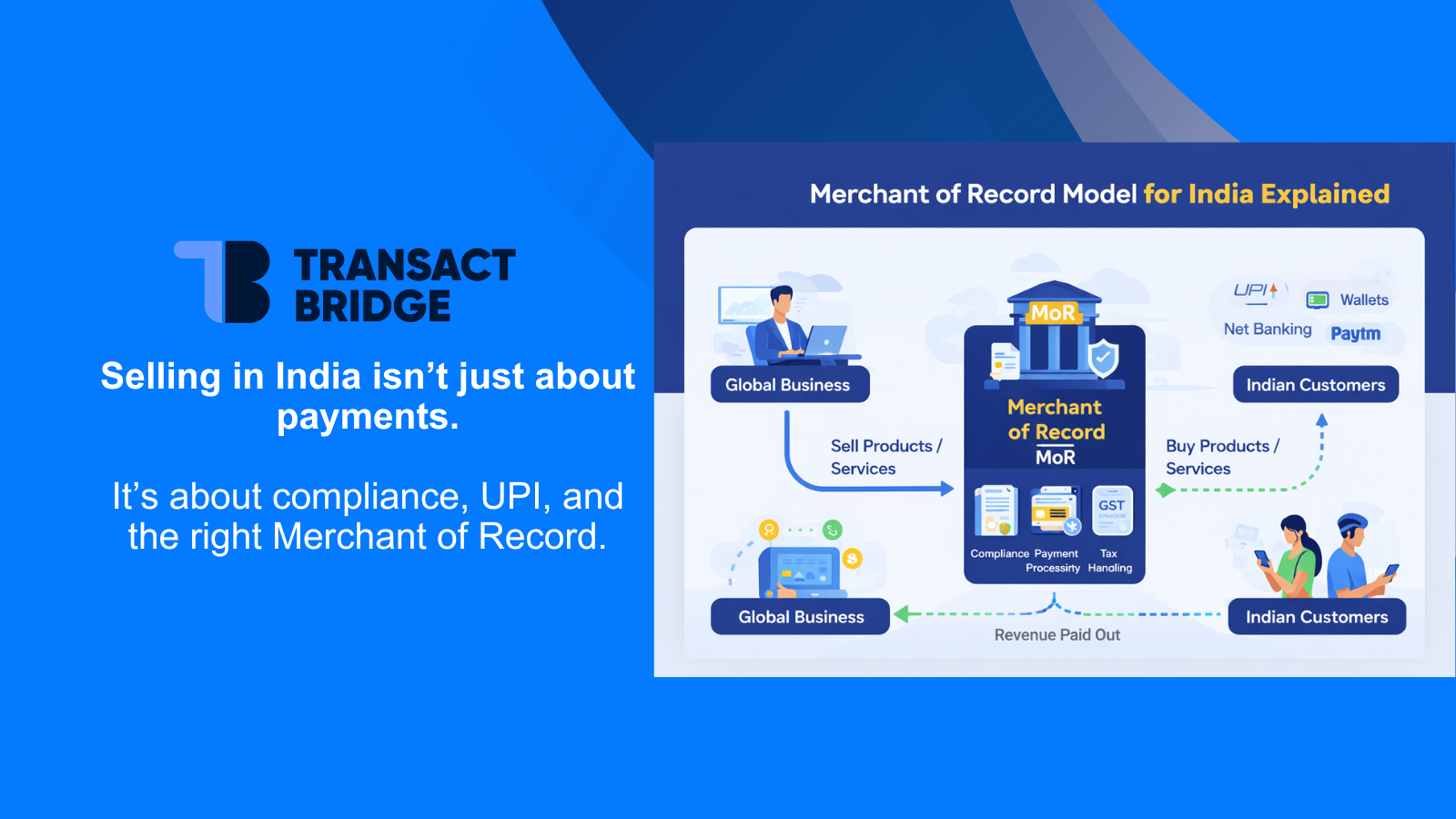
Looking for the right payment processor for Indian market? Learn how India’s payment ecosystem works, key compliance factors, and why Merchant of Record platforms simplify payments, taxes, and payouts.
Introduction: Why India Requires a Specialized Payment Processor
India is one of the fastest-growing digital economies in the world, with hundreds of millions of online consumers and one of the most advanced real-time payment systems globally. However, for international businesses, entering India is not as simple as adding a payment gateway.
Choosing the right payment processor for Indian market is critical because payments in India are closely tied to regulation, taxation, and local consumer behavior. Businesses that underestimate this complexity often face failed transactions, blocked settlements, or compliance issues.
This article explains how payment processing in India works, the options available to global companies, and how Merchant of Record platforms help businesses operate compliantly and scale with confidence.
What Is a Payment Processor for Indian Market?
A payment processor for Indian market is a platform that enables businesses to:
Accept payments from Indian customers
Support local payment methods such as UPI and net banking
Handle tax and invoicing requirements
Manage settlements, refunds, and chargebacks
Support compliant cross-border fund flows
For domestic businesses, traditional payment gateways may be sufficient. For foreign companies, additional regulatory and operational layers are involved.
Why Payment Processing in India Is Complex
1. Regulatory Framework
Payment processing in India operates within regulatory frameworks governed by the Reserve Bank of India (RBI) and the Foreign Exchange Management Act (FEMA). These frameworks influence how payments, settlements, refunds, chargebacks, and cross-border fund movements are handled.
2. UPI-Dominated Consumer Behavior
Unlike many Western markets, India is a UPI-first economy. Customers prefer instant bank-to-bank payments over cards, making UPI support essential for conversion and scale.
3. Tax & Invoicing Requirements
Most digital transactions involving Indian customers require GST-compliant invoicing and structured tax handling, adding another layer of complexity for foreign sellers.
Traditional Indian Payment Gateways
India has several well-established domestic payment gateways that serve Indian businesses effectively.
Examples include:
Razorpay – https://razorpay.com
PayU – https://www.payu.in
PhonePe Payment Gateway – https://www.phonepe.com/business-solutions/payment-gateway/
Paytm – https://business.paytm.com
These platforms support UPI, cards, net banking, and wallets and are widely used across India.
Limitations for Global Businesses
While powerful, these gateways typically require:
An Indian legal entity
Local bank accounts
GST registration
Direct responsibility for compliance, disputes, and chargebacks
For many international businesses, this setup creates operational friction and legal exposure.
Merchant of Record: A Modern Payment Processor Model for Indian Market
A Merchant of Record (MoR) is the legal entity responsible for the transaction. Instead of the foreign company directly processing payments, the MoR platform:
Acts as the seller of record
Processes payments locally
Handles tax invoicing and filings
Manages refunds, disputes, and chargebacks
Ensures compliant settlements and payouts
Learn more:- Merchant of Record Model for India Explained
This model is increasingly preferred by global SaaS, gaming, and digital platforms.
How Transact Bridge Works as a Payment Processor for Indian Market
Transact Bridge operates as a Merchant of Record payment platform, designed specifically for global businesses selling to Indian customers.
What Transact Bridge Handles
Accepts UPI, cards, net banking, and wallets
Acts as the legal Merchant of Record
Manages GST invoicing and tax handling
Operates within RBI and FEMA regulatory frameworks
Handles refunds, disputes, and chargebacks
Converts INR and manages payouts and fund repatriation
This allows international companies to enter India without setting up a local entity.
Learn more: https://www.transactbridge.com/
Payment Methods Supported for Indian Customers
A reliable payment processor for Indian market should support:
UPI (including UPI AutoPay)
Credit and debit cards
Net banking
Digital wallets
International cards
Unified support for these methods improves conversion and reduces checkout friction.
Recurring Payments & Subscriptions in India
Recurring payments in India require mandate-based authorization and compliance with RBI-aligned workflows. This is a common challenge for SaaS and subscription businesses.
Merchant of Record platforms simplify this by enabling:
Compliant recurring billing
Automated renewals
Higher payment success rates
Internal Link: How Subscription Payments Work in India
Chargebacks, Refunds & Dispute Management
Handling disputes is a critical part of payment processing in India. Chargebacks and refunds must follow defined operational and regulatory processes.
A Merchant of Record platform:
Manages dispute workflows
Handles chargeback documentation
Ensures compliant refund processing
Reduces operational burden on the business
This protects both revenue and reputation.
Settlements, Payouts & Fund Repatriation
Payment collection is only one part of the lifecycle. A complete payment processor for Indian market must also manage:
Local settlements
Currency conversion
Structured payouts
Cross-border fund repatriation
Merchant of Record platforms manage these flows transparently and efficiently.
Who Should Use a Merchant of Record in India?
This model is well suited for:
SaaS companies
Gaming platforms
EdTech businesses
Digital content providers
Subscription-based services
Ai Tools
Micro Drama Business
In-app purchase
If your customers are in India but your company is based elsewhere, MoR significantly reduces compliance risk.
FAQs: Payment Processor for Indian Market
Can foreign companies accept payments from India?
Yes, but regulatory and tax requirements apply. Merchant of Record platforms help manage these operational responsibilities.
Is GST required for selling to Indian customers?
Yes. With a Merchant of Record, GST invoicing and handling are managed by the platform.
Can international companies accept UPI payments?
Yes, through MoR-based payment processors.
Who handles chargebacks and refunds?
In an MoR model, the platform manages disputes and chargebacks.
Is recurring billing allowed in India?
Yes, when implemented using compliant mandate-based systems.
Conclusion: Choosing the Right Payment Processor for Indian Market
Choosing the right payment processor for Indian market is not just about enabling payments—it is about long-term compliance, scalability, and operational simplicity.
While domestic gateways like Razorpay, PayU, PhonePe PG, and Paytm serve Indian businesses well, global companies often need a different approach. A Merchant of Record platform like Transact Bridge enables compliant payment processing, tax handling, chargeback management, and payouts under one unified system.
For international businesses looking to scale in India without unnecessary complexity, this model offers a clear and sustainable path forward.
Explore Transact Bridge: https://www.transactbridge.com/


