Built in India. Sold Everywhere.
A 12-person SaaS studio building a workflow automation tool for remote teams. Built in India, sold everywhere — with the US becoming the company's largest market within a year of launch.
As the customer base expanded across India, the US, and other international markets, payments became increasingly difficult to manage. What started as a practical solution for serving two different markets eventually became a growing operational burden.
The Problem: Two Payment Stacks, One Growing Mess
The team started with a domestic payment gateway for Indian customers and added a Western PSP when US signups began to grow. It worked, until it didn't.
US customers encountered a checkout that felt foreign, with different card fields, no local billing address format, and occasional silent declines without explanation. Indian customers using the international PSP experienced recurring payment failures at renewal because the system was not designed around local card mandate requirements.
The team was now managing:
- Two payment providers for different customer markets
- Two dashboards for reconciliation
- Two separate payment workflows
- Two support queues for payment-related issues
- Different recurring billing logic for India and international customers
"We were essentially running two businesses side by side just to collect money. Every new country meant asking whether we needed a third stack."
Tax became the next challenge. As US and EU customers grew, so did exposure to sales tax and VAT obligations that the founding team had no bandwidth to track or file manually.
The Shift to Transact Bridge
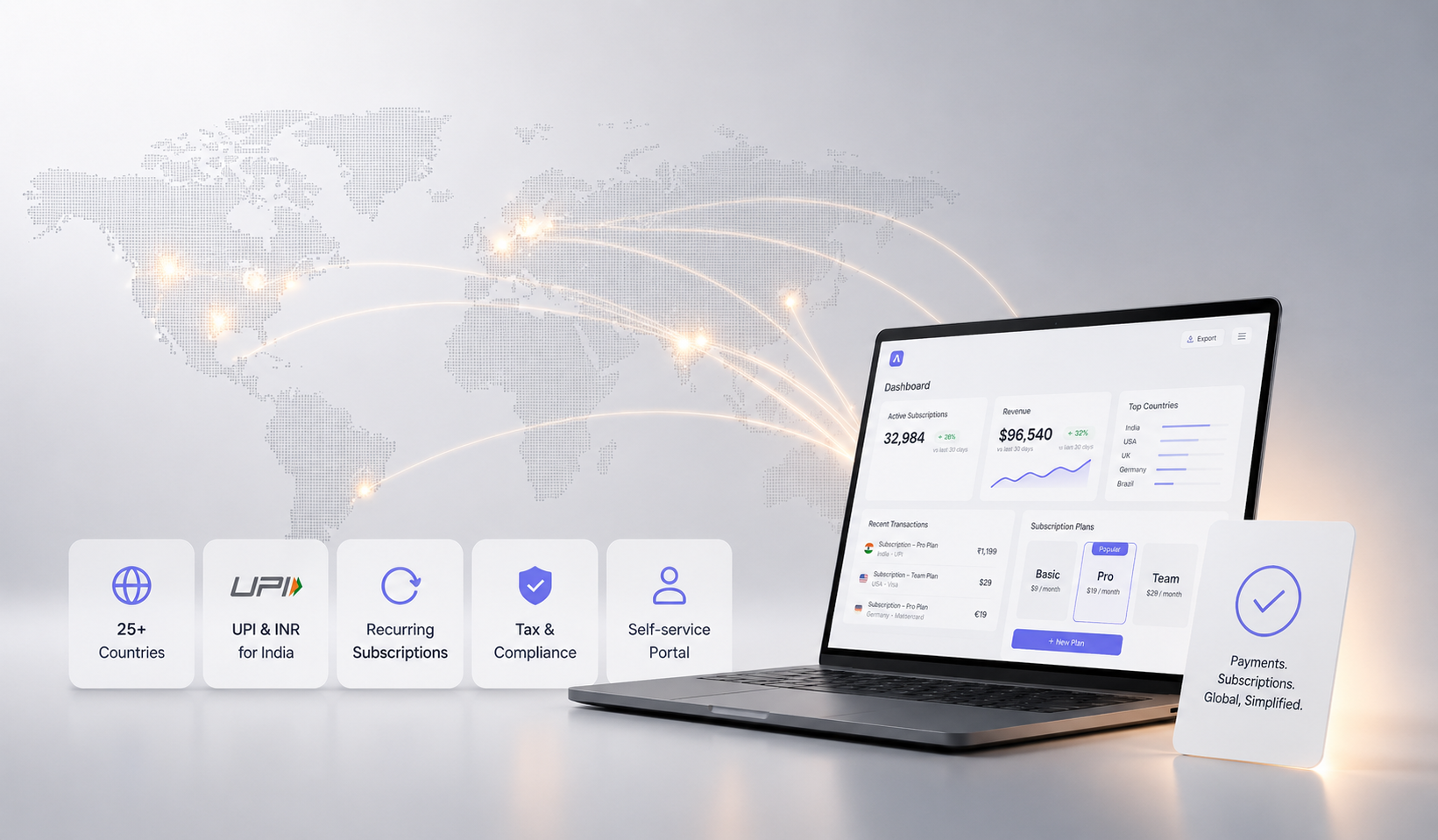
The studio moved to Transact Bridge as its Merchant of Record, consolidating both payment stacks into one integration covering India, the US, and global markets.
What changed hands:
- A single PSP layer handling cards, UPI, and international payment rails through one API
- Merchant of Record-based tax collection and remittance across jurisdictions
- Recurring billing built for both Indian mandate rules and international subscription norms
- Unified failed-payment recovery instead of two separate retry logics
- One dashboard for reconciliation instead of two
The migration ran alongside the existing product without requiring a checkout rebuild. The team pointed its existing payment flow to the new integration and shipped within 48 hours.
What Changed
Once both payment stacks were consolidated, the operational complexity began to disappear.
- Declines dropped: recurring payment failures related to Indian mandate requirements, previously a regular support issue at renewal, became rare enough that the team stopped tracking them as a separate category
- Tax stopped being a founder problem: filings and remittance across jurisdictions moved off the founder's plate, with no registrations or thresholds requiring manual tracking
- One support queue instead of two: payment-related tickets were consolidated into a single workflow rather than being split across two provider dashboards
- New markets stopped requiring new infrastructure: testing pricing in a third region became a plan change within the existing setup rather than another payment integration
"The thing that actually saved us time wasn't any single feature. It was not having to think about which payment stack a customer was on anymore."
The Outcome: One Payment Stack Across Three Markets
The studio went from running parallel payment systems to serving its markets through one unified payment infrastructure.
- India, the US, and global markets unified under one payment stack
- Migration completed in approximately 48 hours without rebuilding the checkout
- Cards, UPI, and international payment rails managed through one API
- Recurring billing unified across Indian and international payment requirements
- Payment-related support consolidated into one workflow
- No manual tax filings since switching
- New markets could be tested without adding another payment integration
Support load dropped, tax stopped being a manual process, and the team stopped treating "add a new country" as an engineering project.
What Made It Work
The team didn't need to:
- Maintain separate payment providers for India and international customers
- Build a new checkout for each market
- Manage different recurring billing systems
- Track tax registrations and filing requirements manually
- Create a new payment integration every time they entered another country
- Reconcile payments across multiple dashboards
Instead, one integration handled payments across India, the US, and global markets — combining local payment methods, international rails, recurring billing, tax compliance, failed-payment recovery, and reconciliation.
The infrastructure became one system. The team could focus on building the product and expanding the business.
Footnote
Two markets were never the problem. Two payment stacks were.
Every new country had started to feel like a new engineering project — another integration, another reconciliation process, and another tax jurisdiction to track manually.
Once payments across India, the US, and global markets ran through one rail, the second market stopped being a separate problem to solve.
It just became revenue.