
Merchant of Record vs Payment Gateway: Which Do You Need?
Published on: Tue 11-Aug-2026 03:35 PM
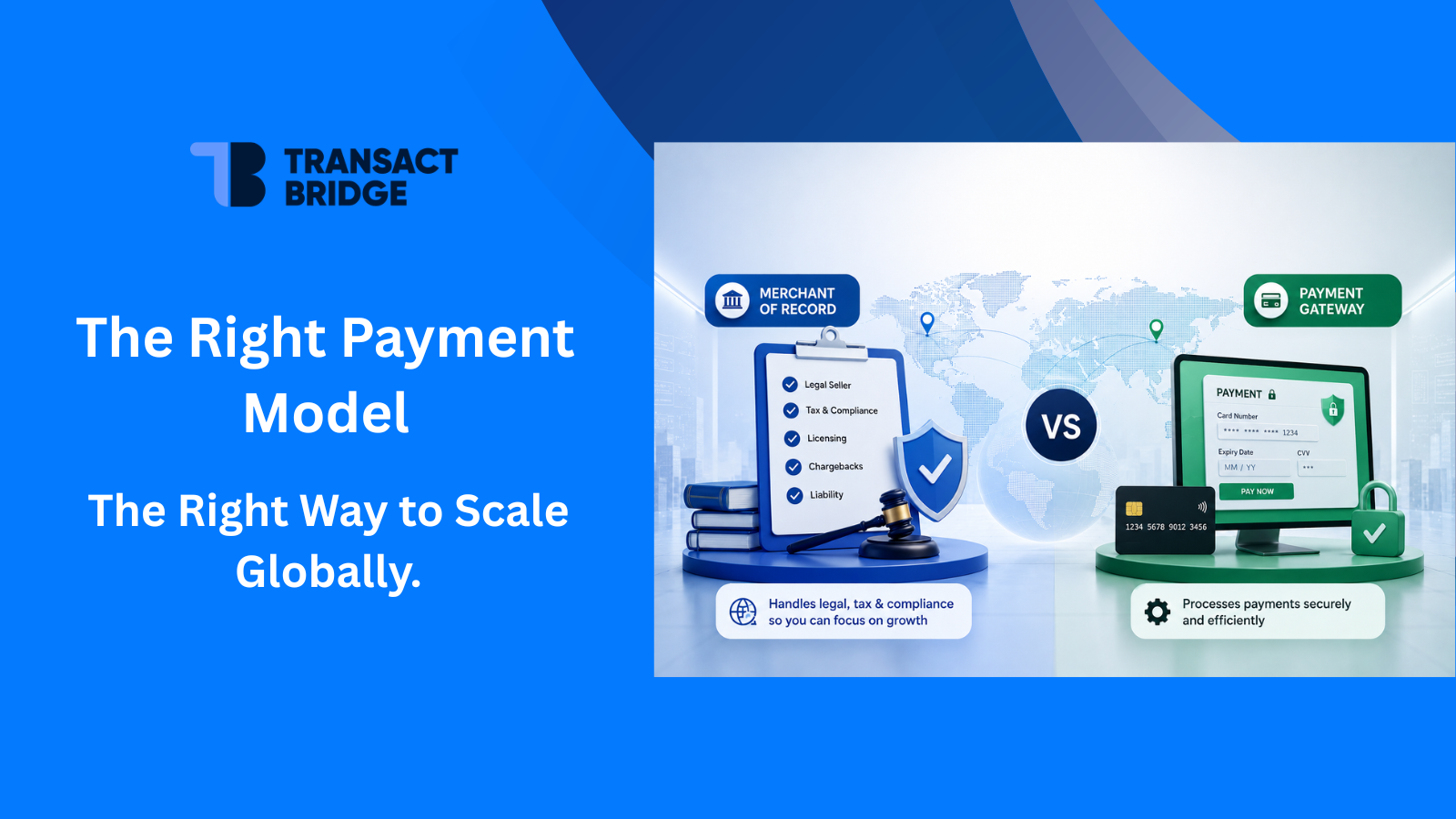
A payment gateway processes the transaction. A merchant of record takes legal responsibility for the sale. Here's how to know which one your business actually needs – in about 60 seconds.
Cross-border commerce is scaling faster than the infrastructure most businesses use to support it. Global e-commerce is worth roughly $6.4 trillion and makes up about a fifth of all retail (Capital One Shopping, 2025), and global cross-border payment flows are projected to reach ~$290 trillion by 2030 (FXC Intelligence). The businesses driving that growth face one recurring question on the way into every new market: run our own payments through a payment gateway, or hand the legal and tax burden to a merchant of record?
A payment gateway is software that securely authorizes and transmits payment data between a customer, their bank, and a payment processor. A merchant of record (MoR) is the legal entity responsible for the sale – tax, compliance, chargebacks, and liability – while your business remains the seller of record. They aren't rival products: an MoR uses a gateway underneath. Choose a gateway if you sell in one market and can run tax and compliance in-house. Choose a merchant of record if you sell across borders and want tax, licensing, and compliance handled for you.
Merchant of record vs payment gateway, at a glance
Merchant of Record – the legal seller
- Acts as the legal seller of the transaction
- Calculates and remits tax (GST, sales tax, VAT)
- Owns regulatory and licensing compliance
- Manages chargebacks and fraud liability
- Enables entry to markets with no local entity
- Supports multi-market global expansion
Payment Gateway – the payment technology
- Authorizes and transmits payment data
- Encrypts and tokenizes card details
- Does not calculate or remit tax
- Does not own liability for the sale
- Leaves compliance to the merchant
- Lowest per-transaction cost, full control
Which one do you need? The 30-second decision
Match your situation to the model. If more than one row applies, weigh the ones tied to tax and legal exposure most heavily – those carry the real cost.
If you… | Choose |
Sell in one country with in-house tax & compliance capacity | Payment Gateway |
Want full control of your payment stack and lowest fees | Payment Gateway |
Are an Indian exporter needing clean FIRA/FIRC documentation | Payment Gateway |
Sell across multiple countries at once | Merchant of Record |
Want tax, licensing & compliance handled for you | Merchant of Record |
Need UPI or local methods without a local entity | Merchant of Record |
Sell SaaS, subscriptions, or digital products globally | Merchant of Record |
Face US nexus or EU VAT obligations faster than you can register | Merchant of Record |
The one-line version: A payment gateway helps you process payments. A merchant of record helps you sell legally. The more borders you cross, the more the second problem outweighs the first.
Decision Framework
For teams that want the logic in one glance:
Where are you selling?
┌───────────────┴───────────────┐
One country Multiple countries
│ │
▼ ▼
Can you manage Need local payment
tax, compliance methods, tax &
and disputes? compliance?
┌─────┴─────┐ ┌──────┴──────┐
YES NO YES NO
│ │ │ │
▼ ▼ ▼ ▼
Payment Gateway + Merchant of Payment
Gateway Tax Tools Record Gateway
That's the decision. The rest of this guide explains the reasoning – the definitions, the tax and compliance realities across India, the US, and global markets, how the choice changes by business model, and the mistakes that cost companies the most.
Not sure which model fits you?
Walk your case through with someone who's mapped it across India, the US, and global markets.
What is a payment gateway?
A payment gateway is software that securely authorizes online payments between customers, banks, and payment processors. It encrypts card data, routes the authorization request, and returns an approved or declined response. It does not calculate tax or take on liability for the sale.
In plain terms, the gateway is the wiring, not the utility company. During checkout it encrypts and tokenizes the card, routes the request to the processor and card networks (Visa, Mastercard), relays the issuing bank's decision, and returns the result – usually in under a second. Stripe (in its standard form), Adyen, and Checkout.com are widely used gateways and processors. What none of them do on their own is decide who owes sales tax, remit VAT to a European tax authority, absorb a chargeback, or stand as the party a regulator holds responsible.
What is a Merchant of Record?
A merchant of record is the entity legally authorized to sell to the customer and responsible for the transaction's financial and regulatory obligations: payment processing, tax calculation and remittance, compliance, fraud, chargebacks, and settlement. Under a third-party MoR such as Transact Bridge, the provider assumes those liabilities so you can sell into a market without owning the local entity, licences, and tax registrations yourself.
Where a gateway is equipment, a merchant of record is responsible. The MoR appears as the seller on the payment rails and takes on the risky parts of a transaction. Crucially, your business remains the seller of record – you keep the product, brand, pricing, and customer relationship. What transfers is the compliance weight, not ownership of your business.
How the money actually moves
The clearest way to see the difference is to trace a single payment through each model. Same transaction, very different amount of responsibility landing on you.
With a payment gateway (you remain the merchant of record)
Customer → Checkout → Payment gateway → Processor → Acquiring bank
Tax · compliance · disputes → YOU
With a merchant of record (the MoR is the legal seller)
Customer → Checkout → Merchant of Record → Gateway → Processor → Bank
Tax · compliance · settlement → HANDLED
You keep brand, pricing & customer
Notice the MoR flow contains the gateway flow – the gateway still moves the data. The MoR simply sits on top as the legal seller and catches everything the gateway drops on the floor: the tax calculation, the multi-jurisdiction remittance, the dispute liability, the settlement. That's why an MoR can't replace a gateway, and a gateway can't replace an MoR – they're different layers of the same stack.
The core differences :
Function | Merchant of Record | Payment Gateway |
Core role | Legal seller & liability holder | Secure data transmission |
Tax calculation & remittance | Handled across jurisdictions | Left to the merchant |
Regulatory & licensing exposure | Assumed by the MoR | Stays with the merchant |
Chargebacks & dispute liability | Managed and absorbed | Not absorbed |
Fraud responsibility | Owned | Screening only |
Local entity required to sell | No – MoR's entity is used | Often yes, per market |
Settlement & payout | Consolidated, multi-currency | Passed through to you |
Cost profile | Higher per-txn, bundled | Lower per-txn, unbundled |
Where do processors and PSPs fit?
A payment processor or PSP moves the money; a gateway transmits the data; an acquiring bank settles it; a merchant of record sits on top as the legal seller. Razorpay, Cashfree, and PayU are examples of processors/aggregators; Stripe operates primarily as a PSP and gateway, though its newer managed-payments product moves toward an MoR-style model. The point isn't the label – it's whether the provider takes the tax and legal liability off your desk. Only an MoR does.
The choice across India, the US, and global markets
In one market with simple tax rules, this decision is close. Cross borders and it stops being close because the compliance surface differs sharply by region. This is where the two models genuinely separate.
India : can you accept UPI without an Indian entity?
Not through a domestic gateway – but yes, through a merchant of record. UPI is now the backbone of Indian payments: NPCI recorded roughly 228 billion UPI transactions in 2025, peaking at 21.63 billion in December alone, and the IMF recognises it as the world's largest real-time payment system. It handles close to half of all real-time digital payments globally and about 85% of India's digital transactions. For most global sellers, that's the market you want to reach. The problem: a foreign company generally can't plug straight into an Indian gateway. Local aggregators like Razorpay and Cashfree require an Indian business entity, and UPI isn't directly available to non-Indian merchants. An MoR collects locally in India – UPI, cards, wallets – handles GST, and settles to you abroad, so you go live without incorporating.
The reason it works this way is regulatory. In October 2023 the Reserve Bank of India (RBI) brought cross-border payment operators under direct regulation as Payment Aggregators – Cross Border (PA-CB), with authorization, FIU-IND registration, FEMA/KYC/AML compliance, and net-worth thresholds (₹15 crore at application, rising to ₹25 crore by March 2026); a consolidated Master Direction followed in September 2025. The upshot for you: partnering with a compliant, RBI-aware provider replaces months of licensing with a working checkout.
If you're a global business selling into India without a local entity, a merchant of record is usually the practical route. But if you're an Indian exporter selling outward, a third-party MoR collecting on your behalf can break the FIRA/eFIRC documentation you need for GST zero-rating and export benefits – in which case a compliant cross-border gateway that keeps you in control is often better. The right answer depends on which way the money moves, not on a blanket "MoR always wins."
Accept UPI without an Indian entity.
Go live on local rails while we own GST, FEMA, and RBI-side compliance.
The United States : no VAT, but fifty-plus tax regimes
The practical problem: you can owe sales tax in a state where you have no office, staff, or warehouse. Since the Supreme Court's 2018 decision in South Dakota v. Wayfair, physical presence is no longer required – economic nexus is. Cross a state's threshold – commonly $100,000 in sales or 200 transactions, though states vary and several have dropped the transaction count – and you must register, collect, and remit there.
Every sales-tax state now enforces this, plus marketplace-facilitator rules; only five states have no statewide sales tax. On the payments side, the US also runs on rails many non-US sellers underestimate: the ACH network processed 35.2 billion payments worth $93 trillion in 2025 (Nacha), and it's the default for B2B and subscription billing. Scaling US sales means tracking dozens of independent tax thresholds and supporting ACH and cards. A gateway handles none of the tax. A merchant of record becomes the party responsible for calculating, collecting, and remitting – and pairs it with local rails. This is why providers such as Transact Bridge bundle payment acceptance with tax and regulatory infrastructure, rather than offering processing alone.
Global & the EU : where one sale creates an obligation
The trap: your first digital sale into Europe can create a VAT liability – with no threshold to protect you. For digital services sold by a non-EU business, a single B2C sale triggers VAT at the customer's local rate, across up to 27 different rates. (EU-established sellers of goods get a €10,000 pan-EU threshold; non-EU digital sellers get none.) The EU's One-Stop Shop (OSS) and Import One-Stop Shop (IOSS, for consignments ≤ €150) let you file through one registration. Under the VAT in the Digital Age (ViDA) reforms – adopted in March 2025 and rolling out in stages through 2035 – a single EU VAT registration will cover more scenarios from 1 July 2028, with mandatory e-invoicing and digital reporting for cross-border B2B transactions following on 1 July 2030.
Market | Key regime | What creates the obligation |
India | RBI PA-CB · GST · FEMA | Collecting cross-border payments; UPI needs local access; FIRA/FIRC for exports |
United States | Sales tax · Wayfair nexus | ~$100k or 200 transactions per state (varies); marketplace facilitator rules |
EU (digital) | VAT · OSS / IOSS · ViDA | A single B2C digital sale – no threshold for non-EU sellers |
EU (goods) | VAT · OSS / IOSS | €10k pan-EU threshold (EU-established); IOSS for imports ≤ €150 |
Merchant of record vs payment gateway by business model
The right answer shifts with what you sell. Here's how it plays out across the four models that drive most of this search.
Which model fits SaaS?
For most cross-border SaaS companies, a merchant of record is the better fit and the reason is tax timing. Software and digital subscriptions attach a VAT or GST obligation on the first foreign sale, with no threshold to grow into. A SaaS founder selling from India to customers in Germany, the UK, and the US isn't facing one tax regime; they're facing dozens, each with its own registration and filing logic. A gateway processes those payments flawlessly and leaves every one of those obligations on the founder's desk.
There's a second SaaS-specific issue: recurring billing. Subscription revenue lives or dies on renewals actually going through – failed or declined rebills are silent churn. This is where infrastructure quality matters as much as compliance: Transact Bridge runs a 99.5% authorization rate and 99.8% recurring-billing stability, so the MoR layer protects revenue instead of quietly leaking it. For a SaaS business, the question is rarely "can we charge the card?" – it's "who handles the tax, the dunning, and the renewal at scale?"
Stop leaking revenue to failed rebills.
99.5% authorization and 99.8% recurring-billing stability, tax handled at source.
Which model fits e-commerce?
E-commerce is where the volume and the tax exposure is largest. The cross-border e-commerce consumer market reached roughly $1.21 trillion in 2025, and about 59% of global online shoppers now buy from retailers outside their home country (Capital One Shopping). That reach is the opportunity; the compliance is the catch. A single storefront selling into US states triggers economic-nexus obligations across dozens of jurisdictions and marketplace-facilitator rules; the same store shipping into the EU meets VAT, OSS/IOSS, and customs treatment; selling into India means GST and local methods like UPI.
A payment gateway will authorize every one of those orders and hand you the entire tax and compliance burden behind them. For a growing e-commerce brand, a merchant of record calculates and remits sales tax and VAT at checkout, absorbs chargeback liability on card-not-present fraud (a persistent e-commerce cost centre), and enables the local payment methods that lift conversion in each market – while the brand keeps its storefront, pricing, and customer relationship. The result: entering a new country becomes a checkout configuration, not a legal and tax project.
Which model fits gaming?
Gaming stresses the payment stack in ways few other models do: high transaction volume, small-value in-game purchases, a global player base, elevated chargeback and fraud exposure, and demand for local payment methods players actually use. A payment gateway can authorize a microtransaction; it won't manage the fraud liability, the cross-border tax on digital goods, or the settlement complexity of collecting from a hundred countries at once.
A merchant of record fits gaming and digital-goods businesses from game servers to marketplaces. It absorbs the chargeback and fraud liability, handles tax on digital purchases across jurisdictions, and supports the local methods (UPI in India, cards and wallets globally, ACH in the US) that convert players outside the US. With 100+ payment methods and the compliance layer built in, Transact Bridge lets a studio or platform expand into new regions as a checkout change rather than a legal project.
Which model fits AI companies?
AI products are digital, usage-based, and global from day one – which means they inherit the SaaS tax problem at speed. A company selling API access or AI tooling to customers in 40 countries incurs VAT and GST obligations on early sales, often before it has any finance function to manage them. A merchant of record lets an AI business monetise internationally without standing up tax infrastructure in every market it reaches, so compliance scales with revenue instead of lagging behind it.
Five common mistakes businesses make
The costliest errors in this decision aren't exotic. They're the same handful, repeated. Here's what to avoid.
Mistake 1 : Assuming a payment gateway handles tax.
It doesn't. A gateway authorizes and transmits payments; it never calculates, collects, or remits sales tax, GST, or VAT. Teams discover this when a nexus or VAT liability has already accrued. If no one owns tax, you own tax.
Mistake 2 : Launching in India without understanding UPI and PA-CB rules.
Foreign companies routinely assume they can accept UPI the way they accept cards. They can't – UPI isn't directly available to non-Indian merchants, local gateways require an Indian entity, and cross-border collection falls under the RBI's PA-CB regime. Plan the entity-or-MoR question before you promise Indian customers local payments.
Mistake 3 : Ignoring US economic nexus.
Since Wayfair, you can owe sales tax in a state where you have no physical presence, once you cross ~$100k or 200 transactions. Businesses tracking only their home state accumulate liability in a dozen others silently, then face back-taxes and penalties.
Mistake 4 : Waiting until an audit or a failed launch to fix it.
Compliance debt compounds quietly. The cheapest time to choose the right structure is before the first cross-border sale; the most expensive is after a tax authority, a payment regulator, or a stalled market entry forces the issue.
When a payment gateway alone is genuinely enough
Plenty of vendors will tell you an MoR is always smarter. That's a pitch, not analysis. A direct gateway is the better structure in real cases:
Stick with a gateway (as your own MoR) when you:
- Sell mainly in one country with straightforward tax obligations
- Have the finance and engineering resources to own tax, compliance, and PCI DSS in-house
- Want the lowest per-transaction cost and full control of the stack
- Are an exporter needing clean documentation (e.g. Indian FIRA/FIRC) a third-party collector could obscure
Move to a merchant of record when you:
- Sell SaaS, subscriptions, or digital products internationally, where tax attaches on the first foreign sale
- Need to accept payments in a market where you have no legal entity – a global brand collecting inside India, say
- Are crossing US economic-nexus thresholds across many states faster than you can register
- Face elevated chargeback or fraud exposure you'd rather not absorb
- Want to enter several markets at once without standing up local entities and tax registrations for each
Process the payment, or own the sale?
A payment gateway helps you process payments. A merchant of record helps you sell legally. As you expand from one country to many, technology becomes the easy part. It's the compliance that gets hard. So the real question was never whether your payments can go through. It's whether your business is ready for everything that happens after the payment succeeds: the tax that's now owed, the regulator that now has jurisdiction, the chargeback that's now your liability.
That's the layer Transact Bridge is built for. As compliance-first infrastructure for payments across India, the US, and global markets, it operates as a merchant of record and payment service provider – collecting through 100+ payment methods, from UPI and cards in India to ACH in the US to local methods worldwide – while carrying the tax, regulatory, and settlement weight underneath. A new market becomes a checkout, not a legal project.
Make your next market a checkout, not a legal project.
Transact Bridge collects, complies, and settles as your merchant of record.
FAQs
What is the difference between a merchant of record and a payment gateway?
The difference is liability. A payment gateway is software that authorizes and transmits payment data between the customer, their bank, and the processor. A merchant of record (MoR) is the legal seller – it owns tax calculation, remittance, compliance, and chargebacks – while your business keeps the brand, pricing, and customer relationship. A gateway processes the payment; an MoR takes responsibility for the sale.
Do I need a merchant of record?
Yes, you need a merchant of record if you sell across borders, sell subscriptions or digital products taxed on the first foreign sale, or need local payment methods in a market where you have no legal entity. If you sell in a single market and can run tax and compliance in-house, a payment gateway is usually enough.
Is a merchant of record the same as a payment processor?
No. A payment processor moves the money and a gateway transmits the data, but a merchant of record is the legal seller that also owns tax, compliance, and chargeback liability. An MoR sits on top of the processor and gateway. It uses them, but takes on responsibilities they never do.
How does a merchant of record work?
A merchant of record becomes the legal seller on the payment rails. It collects through local payment methods, calculates and remits tax across jurisdictions, absorbs chargeback and fraud liability, and settles the balance to you – while you keep the product, brand, pricing, and customer relationship.
Can I use a payment gateway and a merchant of record together?
Yes, you already do. A merchant of record uses a payment gateway underneath to move payment data, so they're different layers of the same stack, not competing products. The real choice is who holds the legal seller role and tax liability: your business (gateway alone) or the merchant of record.
Does a payment gateway handle sales tax, GST, or VAT?
No. A payment gateway authorizes and transmits payments but leaves tax calculation, collection, and remittance to you. A merchant of record such as Transact Bridge handles tax across jurisdictions – US sales tax, Indian GST, and EU VAT – so the obligation never lands on your team.
Which is better for selling in India, a merchant of record or a payment gateway?
It depends on the direction of the money. To sell into India without a local entity, a merchant of record is usually better. It enables UPI and card acceptance, handles GST, and manages RBI-side compliance. For an Indian exporter who needs FIRA/FIRC documentation for GST zero-rating, a compliant cross-border gateway that keeps control with the merchant is the better fit.


