Top 10 Payment Orchestration Platforms Compared: Features, Pricing Models, and Best Fit
Published on: Mon 07-Sep-2026 09:43 AM
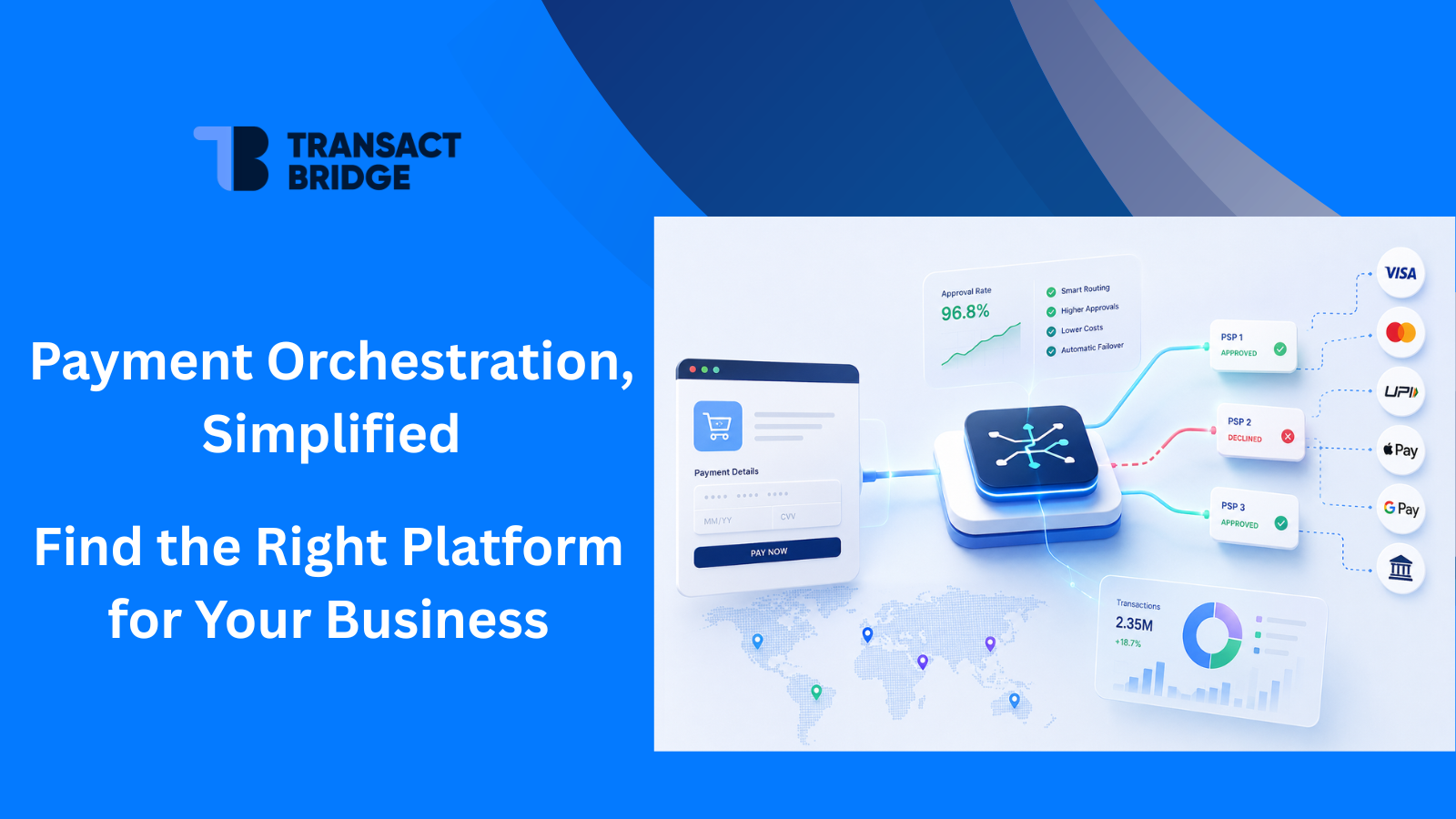
A payment orchestration platform is a software layer that sits between your checkout and multiple payment providers, routing each transaction to the provider most likely to approve it at the lowest cost, with automatic failover when one fails. It replaces separate integrations with a single API and centralises routing, tokenisation, retries, and reconciliation.
Ten platforms worth evaluating: Juspay Hyperswitch, Primer, Spreedly, Gr4vy, Yuno, ProcessOut, Solidgate, BlueSnap, PayU, and Transact Bridge.
They fall into three categories: pure-play orchestration, hybrid payment infrastructure, and compliance-led payment infrastructure. The distinction matters because a routing layer and a merchant-of-record solution solve fundamentally different expansion problems.
What should you look for in a payment orchestration platform?
Ten capabilities separate a functional orchestration platform from a gateway with a rules engine:
-
Multi-PSP connectivity : pre-built connectors to the providers your markets actually require, not a headline connector count
-
Smart payment routing : rules configurable by currency, BIN, issuer country, ticket size, and provider performance
-
Failover and retry logic : automatic reattempt through an alternative provider on retryable decline codes
-
Token portability : a provider-agnostic vault whose tokens you can take with you when you leave
-
Local payment method depth : direct integrations, not aggregated access, in your priority markets
-
Unified reconciliation : settlement data from every provider normalised into one ledger
-
Fraud and 3DS orchestration : provider-agnostic authentication and pluggable fraud tools
-
Raw data export : every transaction's routing path and the reason it took it
-
Pricing transparency : a clear split between platform charges and underlying processing costs
-
Market and regulatory coverage : whether the platform is authorised to operate where you need it
Payment orchestration solves routing. It does not solve every market entry problem.
Most comparison articles treat orchestration as a single product with ten flavours. It isn't. Three architecturally different things are sold under one keyword, and buying the wrong one is the most expensive mistake available here.
The categories below describe the primary commercial architecture of each platform, not its entire product stack. Providers may offer overlapping capabilities.
|
Architecture |
What it does |
What it does not do |
|
Pure-play orchestration layer |
Routes across PSPs you contract with directly. Positioned as vendor-neutral. |
Typically doesn't hold funds, acquire, or assume tax and regulatory liability. |
|
Hybrid payment infrastructure |
Provides its own acquiring plus a routing layer over third-party PSPs. |
Typically doesn't become the legal seller. You generally remain a merchant of record for tax and consumer-law purposes. |
|
Compliance-led payment infrastructure |
Becomes the legal seller in a market, holds local registrations and regulated relationships, routes locally. |
Less relevant if you already hold entities and registrations everywhere you sell. |
A pure orchestration layer is a routing engine. It will improve approval rates across providers you can already use. It will not, on its own, give a foreign merchant the regulatory permissions, local acquiring relationships, or acceptance setup required to offer every payment method in a regulated market. Nor will it calculate and remit GST in Karnataka, sales tax in Illinois, and VAT in Ireland.
That gap is a common reason orchestration projects underdeliver. Teams buy a routing layer to solve a market-entry problem, then find routing was never the constraint.
Ask one question before you shortlist anything: Is my problem that I have providers and route to them badly, or that I cannot reach the customers I want? Orchestration solves the first. Approaches in the second and third categories address the second, through different structures and with different trade-offs.
What is a payment orchestration platform?
A payment orchestration platform (POP) is a unified layer connecting a business to multiple payment service providers, acquirers, fraud tools, and alternative payment methods through a single integration, then applying rules to decide how each transaction is processed.
How payment orchestration works
-
Capture. The transaction enters via hosted checkout, embedded form, or server-to-server API.
-
Decision. Routing logic evaluates currency, card BIN, issuer country, ticket size, payment method, and historical provider performance.
-
Route. The transaction goes to the selected provider.
-
Retry or cascade. On a retryable decline code, the platform reattempts through an alternative provider rather than surfacing failure to the customer.
-
Reconcile. Settlement data from every provider is normalised into a single ledger and matched against transaction records.
On neutrality: a PSP that also sells orchestration occupies a different structural position from an independent layer. Gr4vy makes this argument explicitly in its own positioning, contrasting an agnostic layer against a PSP "naturally driven to route transactions through its own network." How routing decisions are governed is a fair question to put to any hybrid or PSP-owned vendor.
Payment orchestration vs payment gateway vs merchant of record
|
Payment gateway |
Payment orchestration |
Merchant of record |
|
|
Core function |
Transmits payment data to a processor |
Routes across multiple providers |
Becomes the legal seller |
|
Provider relationships |
Usually one processing or acquiring path per integration |
Many, held by you |
Held by the MoR |
|
Tax obligations |
Yours |
Yours |
Assumed by the MoR within contractual scope |
|
Chargeback obligations |
Yours |
Yours |
Assumed by the MoR within contractual scope |
|
Local entity / regulatory setup |
Depends on market, payment method, acquiring model, and provider structure |
Depends on the same factors, for each provider you contract with |
The MoR's structure can remove the need for you to establish your own local entity in supported markets |
|
Time to a new market |
Weeks to months, driven by contracting |
Days once contracts exist |
Days to weeks, subject to eligibility |
These categories overlap. Several platforms below sit in more than one column.
On market size: estimates vary widely because research firms define the category differently, particularly on whether gateways, acquiring, and merchant-of-record models count. The more useful question is not how large the orchestration market is, but whether your own stack has reached the complexity where orchestration creates measurable value. The qualification table further down answers that directly.
10 payment orchestration platforms compared
Grouped by architecture rather than ranked, because the right answer depends on which of the three problems you have.
Not all ten are pure-play orchestration providers, and that is deliberate. Businesses searching for payment orchestration usually have one of three underlying problems – a routing problem, an acceptance problem, or a compliance problem – and those require different architectures. A list containing only pure-play routing layers would answer one of the three.
How to read the fit ratings. They indicate the relevance of each platform's published capabilities to businesses operating in these markets. They are not authorisation-rate or performance rankings, and they should be validated against your own entity structure, payment methods, and provider contracts.
Coverage counts and performance figures throughout this section are vendor-published and not independently audited.
|
Platform |
Architecture |
India fit |
US fit |
Global fit |
Merchant of record? |
Pricing model |
|
Juspay Hyperswitch |
Pure-play |
Strong |
Moderate |
Strong |
No |
Free self-hosted; managed quoted |
|
Primer |
Pure-play |
Depends on setup |
Strong |
Strong |
No |
Platform fee + per-transaction |
|
Spreedly |
Pure-play |
Depends on setup |
Strong |
Strong |
No |
Usage-based (API and endpoints) |
|
Gr4vy |
Pure-play |
Depends on setup |
Strong |
Strong |
No |
Platform fee, volume-tiered |
|
Yuno |
Pure-play |
Moderate |
Strong |
Strong |
No |
Per-transaction |
|
ProcessOut |
Pure-play |
Limited |
Strong |
Strong |
No |
Quoted |
|
Solidgate |
Hybrid |
Depends on setup |
Strong |
Strong |
No |
Blended MDR + platform fee |
|
BlueSnap |
Hybrid |
Limited |
Strong |
Moderate |
No |
Blended MDR |
|
PayU |
Hybrid |
Depends on entity |
Moderate |
Strong |
No |
Blended MDR |
|
Transact Bridge |
Compliance-led |
Strong |
Strong |
Strong |
Yes |
% of transaction value |
"Depends on setup" means the platform can route Indian transactions, but whether a specific foreign merchant can use that route depends on the underlying provider, merchant structure, and onboarding eligibility. That distinction is the subject of the India section below.
Already have a shortlist?
Send us the two or three platforms you're weighing. We'll tell you what "depends on setup" means for your markets.
Category A: Pure-play orchestration layers
1. Juspay Hyperswitch
What it is. An open-source payment orchestrator released by Juspay under Apache 2.0 and written in Rust, designed for self-hosting or as a managed service.
Key features
-
200+ connectors and 150+ payment methods listed in product documentation; card documentation separately states support across 135+ currencies and 150+ countries, subject to connector limitations
-
Rule-based, volume-based, and machine-learning routing
-
Retry engine configurable across 30+ parameters including decline code, card BIN, ticket size, and region
-
Provider-agnostic vault storing network tokens, PSP tokens, and raw card data
-
Unified reconciliation with automated data fetch from processors and banks
Pricing model. Free to self-host under Apache 2.0. Juspay's own blog estimates self-hosting at roughly USD 100–1,500 per month in cloud infrastructure depending on volume, before engineering time. Managed cloud tiers are quoted, not published.
Strengths. No licence cost and full data portability. Juspay states it processes over 300 million daily transactions with annualised total payment value above USD 1 trillion for 500+ enterprises and banks.
Whatever weight you give vendor-published scale figures, the India production experience behind this product is deeper than that of platforms built primarily for Western markets.
Limitations. Self-hosting is not free in practice. Module maturity varies across an open-source project of this breadth, so validate the specific connectors your markets require rather than assuming parity across all 200. Managed pricing is not published.
India / US / Global fit. India: Strong. US: Moderate. Global: Strong.
Best for. Engineering-led teams that treat payments as core infrastructure and want to avoid orchestration lock-in.
2. Primer
What it is. An orchestration platform whose main differentiator is a visual, drag-and-drop workflow builder allowing payment teams to configure routing, fallback, and checkout logic without writing code.
-
No-code workflow builder for routing and payment logic
-
ML-based routing and automatic fallbacks
-
Centralised vault for payment credentials
-
Provider-agnostic 3D Secure and network tokenisation
-
Unified reconciliation and configurable performance alerts
Pricing model. Not published. Platform fee plus per-transaction charge.
Strengths. The workflow builder shifts control from engineering to the payments team, which matters most for merchants who need to change routing faster than their sprint cycle allows. Primer announced a USD 100 million Series C in May 2026 led by Sofina, bringing reported total funding to USD 170 million.
Limitations. No-code abstractions get expensive at the edges; highly bespoke logic can still require vendor involvement. Pricing is not published.
India / US / Global fit. India: Depends on setup. US: Strong. Global: Strong.
Best for. Mid-market and enterprise merchants where the payments team, not engineering, owns routing strategy.
3. Spreedly
What it is. One of the longer-established vendor-neutral orchestration providers, operating in open payments since 2007, built around a provider-agnostic vault.
-
Connections to over 140 payment gateways
-
Token vault with secure payment credential storage and portability
-
Network tokenisation and account updater
-
Cascading and automatic fallbacks, smart retries on declines
-
End-to-end reporting and reconciliation
Pricing model. Spreedly states its pricing is based on API usage and endpoints rather than a flat platform fee.
Strengths. The vault is Spreedly's clearest differentiator. If your central concern is never being locked to a PSP because it holds your card data, token portability here is more production-tested than most. Supporting capabilities – account updater, network tokenisation, cascading – are mature rather than newly shipped.
Limitations. Deliberately narrow scope: a connectivity and vault layer, not a financial-operations suite. Emerging-market local method depth is thinner than Yuno's or PayU's.
India / US / Global fit. India: Depends on setup. US: Strong. Global: Strong.
Best for. SaaS platforms, travel companies, and marketplaces valuing engineering control and PSP portability over bundled services.
4. Gr4vy
What it is. A no-code orchestration platform running each customer on a dedicated single-tenant cloud instance rather than shared infrastructure. Founded 2020, with roughly USD 27 million raised.
-
400+ connections – Gr4vy counts payment methods, PSPs, and anti-fraud providers together, so this figure is not directly comparable to a PSP-only count
-
Dedicated cloud instances deployed in the customer's chosen region
-
BYOK key management and configurable data residency
-
No-code addition and testing of new providers
-
Centralised vault, network tokenisation, account updater
-
PCI DSS Level 1 compliance
Pricing model. Not published. Platform fee, volume-tiered.
Strengths. Architecture is the differentiator. Single-tenant deployment with in-region hosting can be valuable for businesses with contractual, regulatory, or internal data-residency requirements, though the exact obligation depends on the data and market involved. Because Gr4vy positions itself as an independent orchestration layer rather than an acquiring network, vendor neutrality is central to its positioning.
Limitations. Data-residency architecture is not a benefit if you do not need it, and you pay for it either way. Smaller commercial footprint and thinner public review volume than Primer or Spreedly. Published uptime and revenue-recovery figures are vendor-stated.
India / US / Global fit. India: Depends on setup. US: Strong. Global: Strong.
Best for. Enterprises with data-residency obligations or strict isolation requirements.
5. Yuno
What it is. An orchestration platform positioning around AI-native routing and recovery, with notable depth in complex and emerging markets.
-
1,000+ payment methods; country coverage stated as 190 on some pages and 200+ on others, so confirm for your specific markets
-
Smart routing using real-time performance data
-
NOVA, described by Yuno as an AI recovery product contacting customers after failed payments via WhatsApp or voice in 70+ languages
-
Split payments for marketplace flows
-
Network tokenisation, account updater, provider-agnostic 3DS
-
Pre-chargeback alerts and automated dispute resolution
Pricing model. Not published. Per-transaction.
Strengths. Local payment method coverage where Western-built orchestrators are thin. Yuno publishes customer stories with specifics – Arcos Dorados, McDonald's LATAM franchisee, unifying payment operations across 21 countries, and ride-hailing platform inDrive integrating ten new countries in eight months.
Both are vendor-published rather than independent case studies, but the specificity is more useful than a bare connector count.
Limitations. Newer than most of this list, with less independent reference data outside Latin America. The connector-count headline is a weak differentiator when competitors publish comparable figures on different counting bases.
India / US / Global fit. India: Moderate – UPI appears in Yuno's published method coverage, but availability to a foreign merchant depends on your own entity and provider arrangements. US: Strong. Global: Strong, particularly Latin America.
Best for. Global merchants with significant emerging-market expansion, particularly across Latin America and other high-complexity markets.
6. ProcessOut
What it is. An orchestration and payment-intelligence platform built around AI-driven routing paired with cross-provider performance analytics. Acquired by Checkout.com in 2020.
-
Payment coverage across 190+ countries
-
Telescope monitoring system analysing transactions across all connected providers with performance benchmarking
-
AI-driven smart routing with dynamic real-time optimisation
-
Provider-agnostic token vault with network tokenisation
-
Automatic retry logic across multiple providers
-
Financial reconciliation and unified reporting
Pricing model. Not published. Quoted, and commonly bundled for merchants already using Checkout.com.
Strengths. The benchmarking is the reason to buy it. No individual PSP can objectively show you how it performs against your other PSPs; only a layer sitting above all of them can run that comparison.
On the neutrality question that PSP ownership naturally raises: ProcessOut states that it operates as a standalone business unit, does not share technology resources with Checkout.com, and that remaining agnostic is written into its contract with Checkout.com.
That is a stronger answer than most acquired orchestrators can give. Merchants for whom routing neutrality is commercially material should still ask how those governance arrangements work in practice.
Limitations. Analytics depth is wasted on merchants running one or two providers. India coverage is limited.
India / US / Global fit. India: Limited. US: Strong. Global: Strong across Europe and North America.
Best for. Fast-growing e-commerce and SaaS businesses with enough volume that a one-point acceptance gain justifies dedicated tooling.
Category B: Hybrid payment infrastructure
7. Solidgate
What it is. A platform combining orchestration with its own direct card acquiring and a value-added services layer.
-
Direct acquiring alongside a Connectors library of 100+ providers, with coverage stated at 100+ markets
-
Local APM support including Pix in Brazil, BLIK in Poland, and UPI in India
-
No-code smart routing with automatic failover and A/B testing of routing strategies
-
Provider-agnostic token vault
-
Subscription billing and recurring payment management
-
Chargeback prevention alerts and automated representment
-
Tax compliance automation
Pricing model. Blended merchant discount rate plus platform fee.
Strengths. Direct acquiring removes the bank negotiation that otherwise gates market entry, which is the main argument for a hybrid over a pure-play. Genuine consolidation: routing, billing, fraud, disputes, and reconciliation under one contract.
In India specifically, Solidgate's connector network includes UPI. Razorpay has published a partnership account describing Solidgate clients going live in India through Razorpay's RBI-licensed import stack without establishing a local entity or bank account.
This is worth understanding properly, because it demonstrates that merchant-of-record status is not the only structure through which a foreign business can reach Indian payment methods.
Availability for any specific merchant depends on the underlying provider, merchant structure, and onboarding eligibility, and the tax and legal-seller position differs from an MoR arrangement.
Limitations. The bundle only pays off if you use most of it. Indian access runs through a partner relationship rather than Solidgate's own regulated infrastructure, so verify the chain of responsibility and who holds which obligation.
India / US / Global fit. India: Depends on setup. US: Strong. Global: Strong across Europe and North America.
Best for. Mid-market B2C subscription and digital-goods businesses scaling across Europe and North America.
8. BlueSnap
What it is. A hybrid gateway and orchestration platform with embedded payments, distinguished by B2B transaction handling.
-
Local card acquiring in 50 countries; payment coverage across 200+ regions
-
Level 2 and Level 3 data processing for B2B transactions
-
Smart payment routing, network tokenisation, account updater
-
3D Secure authentication
-
Subscription lifecycle management and global payouts
-
Built-in fraud prevention and chargeback management
Pricing model. Blended merchant discount rate.
Strengths. Level 2/3 data can be a significant cost lever for businesses processing large-ticket B2B card payments, by qualifying transactions for lower interchange categories. Most orchestration platforms do not handle this at all.
Limitations. Consumer and emerging-market use cases are better served elsewhere. B2B specialisation cuts both ways.
India / US / Global fit. India: Limited. US: Strong. Global: Moderate, concentrated in its 50 local-acquiring markets.
Best for. Education, healthcare, and business-management platforms with significant B2B card volume.
9. PayU
What it is. A gateway and orchestration layer with direct global card acquiring, strongest in emerging markets.
-
Direct global card acquiring with local presence
-
APM coverage across 50+ countries, focused on Central and Eastern Europe, Latin America, and Africa
-
AI-driven routing with instant retry logic
-
3D Secure and compliance suite
-
Payment management dashboard with analytics
-
Built-in antifraud
Pricing model. Blended merchant discount rate.
Strengths. Local payment method expertise in markets where platforms describing themselves as global rely on aggregators.
Limitations. PayU operates through distinct regional businesses with materially different capabilities and regulatory perimeters. Its India operation serves Indian-registered merchants and is not itself a route into India for a foreign entity without local registration.
Verify entity-level scope market by market rather than reading the group brand as a single offering.
India / US / Global fit. India: Depends on your entity – relevant for Indian-registered merchants, not a solution for foreign ones. US: Moderate. Global: Strong in CEE, LATAM, Africa.
Best for. Enterprises and larger SMBs in hospitality and marketplaces targeting CEE, Latin America, or Africa.
Category C: Compliance-led payment infrastructure
10. Transact Bridge
What it is. Merchant of record and seller of record infrastructure for payments across India, the US, and global markets, combining local acceptance with the legal and tax responsibility for the sale.
Where the nine platforms above primarily answer which provider should process this transaction, Transact Bridge addresses a broader question: how can this business sell into this market without building the entire local payment and compliance stack itself?
Key features
-
Merchant of record and seller of record status, assuming the legal seller role
-
Local INR checkout with UPI, RuPay, net banking, and wallets for eligible merchants, without requiring the merchant to establish its own Indian entity
-
UPI Autopay, eNACH, and eMandate for recurring collection
-
GST calculation, invoicing, and remittance under the Indian entity
-
US sales tax and international VAT handling within the same integration
-
Single API covering cards, UPI, net banking, and wallets with smart routing and reporting
Pricing model. Percentage of transaction value; final pricing depends on market, payment method, and commercial scope. See the pricing comparison note below, because a merchant-of-record rate covers a different scope from a bare orchestration platform fee and the two are not directly comparable.
Reported performance. Transact Bridge reports a 99.5% authorisation rate, 99.8% recurring billing stability, and 100+ payment methods. These are vendor-reported figures.
Strengths. Removes market entry as a discrete project. Chargeback and tax obligations are assumed by the merchant of record within the contractual scope of the arrangement.
The distinction from a partner-mediated route into India is the legal seller position: the MoR is the seller of record and carries the corresponding tax and consumer-law obligations, rather than passing acceptance through a licensed partner while the merchant retains them.
Limitations. MoR economics mean an all-in percentage rather than an unbundled platform fee, which is more expensive per transaction than routing across acquiring you have negotiated yourself.
If you already operate a licensed Indian entity and US tax registrations, much of what you would be paying for is already sunk cost. By design you are not the seller of record, which some businesses will not accept for brand or contractual reasons. Scope and eligibility vary by market and business model.
India / US / Global fit. India: Strong. US: Strong. Global: Strong.
Best for. Global SaaS, AI, gaming, EdTech, OTT, and subscription businesses wanting revenue from India, the US, and other markets without incorporating in each.
How payment orchestration affects cross-border authorisation
Cross-border payment performance consistently trails domestic performance. The size of the gap varies substantially by market, vertical, payment method, and provider, and published estimates differ widely because they measure different populations. Benchmark your own approval rates before modelling a business case on anyone else's figure.
The scale of the underlying problem is better evidenced than any single gap estimate: Datos Insights put unnecessary declines, or false declines, at approximately USD 213 billion globally in 2025.
Cross-border declines can happen even when the customer and card are entirely legitimate. Issuers and fraud systems evaluate additional geographic, merchant, and transaction-risk signals when a payment crosses borders.
A legitimate German cardholder paying a merchant whose acquiring setup sits elsewhere may therefore face additional friction or a decline, depending on the issuer, scheme, merchant category, payment method, and transaction structure. The response code is often too vague to retry usefully.
Three levers, in order of typical impact:
-
Local acquiring. Presenting transactions through an acquiring relationship closer to the customer's market can reduce cross-border friction, potentially improving acceptance and lowering cross-border scheme costs. It does not guarantee that an issuer treats the transaction as domestic or approves it. Local acquiring is often a major lever for cross-border card acceptance and cost, but the impact varies by market, issuer, scheme, merchant category, and transaction structure. It is also the lever a pure orchestration layer cannot supply alone, because it requires an acquiring relationship rather than a routing rule.
-
Local payment methods. A customer who cannot see a familiar way to pay either abandons checkout or forces a card payment the issuer is more likely to decline. Offering UPI in India, iDEAL in the Netherlands, PIX in Brazil, or BLIK in Poland is an approval decision as much as a conversion one.
-
Intelligent retries and network tokenisation. Retrying through an alternative provider on retryable decline codes recovers transactions that would otherwise fail silently. Network tokens survive card reissuance, which directly reduces involuntary churn on subscriptions.
Example : build your own version before evaluating vendors.
A SaaS company runs USD 20 million in annual cross-border volume at a 78% authorisation rate. Declined volume: $20M × 22% = $4.4M Recovering a quarter of it: $4.4M × 25% = $1.1M That is revenue from customers who already wanted to buy, with no acquisition cost attached. Illustrative only.
Actual recoverable revenue depends on decline reasons, transaction mix, margin, retry economics, and customer behaviour. Run it on your own decline data, not this example.
Run this on your own numbers
Send us your cross-border volume and approval rate. We'll model what a local acceptance setup would recover, with no pitch attached.
India: payment orchestration, UPI, and RBI requirements
India regulates the payment perimeter tightly, and the framework has moved recently. This is where the difference between routing and access is sharpest.
The current framework.
The Reserve Bank of India's 2025 Master Direction now provides the consolidated framework for payment aggregators, covering online (PA-O), physical (PA-P), and cross-border (PA-CB) categories.
Which authorisation, net-worth, escrow, reporting, merchant due-diligence, and transaction requirements apply depends on the PA category and the business model, and transitional provisions matter. Any assessment of a specific structure should be made against the applicable category rather than a general summary.
How the cross-border category arose.
The PA-CB framework was originally introduced by the RBI's circular of 31 October 2023, which brought entities facilitating cross-border payments for import and export of goods and services under direct RBI regulation and replaced the earlier OPGSP arrangement.
That circular included a ₹25 lakh maximum value per unit of goods or services sold or purchased. Law-firm summaries from Trilegal and PwC India set out the 2023 circular in detail. Check current requirements against the 2025 Master Direction rather than the 2023 circular alone.
Card storage.
PwC India notes that RBI instructions issued for payment aggregators – including those on tokenisation and restrictions on storage of card credentials – were made applicable to PA-CBs. Any orchestration vault touching Indian card data is worth assessing against these requirements with advisers.
What this means practically.
A routing layer by itself does not confer the regulatory permissions, local acquiring relationships, or acceptance setup a foreign merchant needs to offer every Indian payment method. UPI availability in particular depends on merchant structure, regulated payment partners, and the applicable RBI framework rather than on which orchestration platform you have integrated.
There is, however, more than one structure that works. A merchant of record holds the Indian entity and becomes the legal seller. Alternatively, an orchestration or hybrid platform may route through a licensed Indian payment aggregator's import stack, giving acceptance without the merchant incorporating locally – but leaving tax and legal-seller obligations where they were.
So the question to put to any vendor proposing to handle Indian revenue has a factual answer, and it has two parts: under which authorisation is this money moving, and who holds the GST and seller-of-record obligation when it does?
Scale, for context.
NPCI data reported for August 2026 shows UPI processed 24.51 billion transactions worth ₹29.82 trillion, its highest recorded monthly volume, up 3.6% month-on-month and 22% year-on-year, averaging 791 million transactions per day. A checkout in India without UPI is not a localisation gap. It is exclusion from the way most of the market pays.
Selling into India without an Indian entity
Two structures can get you UPI. Only one moves the GST and seller-of-record obligation off your books. We'll tell you which fits.
The US: payment orchestration and sales-tax complexity
For many digital businesses, the more immediate US expansion complexity is sales tax rather than a single national payment-licensing regime.
After South Dakota v. Wayfair (2018), states may impose collection obligations based on economic activity without physical presence. But thresholds, taxable products, sourcing rules, and filing requirements are set state by state, and a national summary will mislead you. Three examples show why:
California
The commonly cited USD 500,000 threshold attaches to sales of tangible personal property. Whether your product is taxable at all is a separate question from whether you have crossed a threshold, and for SaaS the answer differs from physical goods. See the California Department of Tax and Fee Administration for current guidance.
New York
Requires both more than USD 500,000 in gross receipts from sales of tangible personal property and more than 100 separate transactions, measured over the immediately preceding four sales-tax quarters.
Most states apply their thresholds on an either/or basis, so a business that would trigger nexus elsewhere on transaction count alone may not trigger it in New York. The Sales Tax Institute's summary of the state's guidance sets out the detail, including registration timing.
Illinois
Removed its 200-transaction test effective 1 January 2026, leaving the USD 100,000 gross-receipts threshold for the relevant remote-retailer rules. Illinois' change is an example of how states can revise their economic-nexus thresholds, so current state-level rules should be checked rather than relying on historical transaction-count thresholds.
The compounding problem is that states calculate thresholds on different bases: some count gross sales including exempt transactions, others do not. Summing revenue by state from your own reporting is not sufficient to establish where obligations exist. Wolters Kluwer maintains a state-by-state threshold chart that is a reasonable starting point, though it is not a substitute for a nexus study.
Whichever orchestration platform you choose, this liability remains yours – unless a merchant of record assumes it contractually.
Global expansion: local methods, acquiring, and compliance
Europe
EU expansion creates a combination of payment, authentication, consumer-protection, and VAT obligations. An orchestration platform can manage the payment layer; it does not transfer the legal obligations to the vendor.
For many B2C electronically supplied services, EU VAT is generally determined based on the customer's location, with the One Stop Shop allowing eligible businesses to simplify registration and reporting through a single EU scheme rather than registering separately in every member state.
As an emerging consideration: the EU is replacing PSD2 with PSD3 and a directly applicable Payment Services Regulation. The Council's legislative record shows a provisional agreement reached in November 2025, with COREPER confirmation in April 2026 — Norton Rose Fulbright and DLA Piper both track the timeline.
Two changes matter commercially: tighter limits on the commercial agent exemption that marketplaces and platforms have used to operate without a payments licence, and harmonised SCA rules. If your model depends on that exemption, the assumption is worth re-testing.
Emerging markets
Local acquiring can be critical in markets such as Brazil, Mexico, and parts of Southeast Asia, particularly where domestic payment methods, local settlement, pricing, or regulatory requirements affect acceptance.
Brazil's PIX and instalment culture, Mexico's local-acquiring dynamics, and Indonesia's wallet fragmentation each generally require in-market presence rather than a routing rule.
This is where Yuno and PayU earn their positions, and where Europe-first platforms will usually be candid about their limits if asked directly.
Payment orchestration pricing models explained
Almost no vendor publishes rates. There are four models, and knowing which one you are being quoted tells you more than the number does.
|
Model |
Vendor charge |
Underlying PSP / acquirer cost |
Watch for |
|
Platform fee + per-transaction |
Explicit and separate |
Additional, paid by you |
The fee sits on top of processing. Model combined cost. |
|
Blended MDR |
Embedded in the rate |
Embedded in the rate |
Simplicity hides the split. Ask what portion is interchange, scheme fees, and margin. |
|
All-inclusive % (MoR) |
Embedded in the rate |
Embedded in the rate |
Higher headline rate covering more scope, including tax and liability. |
|
Open source / self-hosted |
None; infrastructure only |
Additional, paid by you |
Juspay estimates USD 100–1,500 monthly in cloud costs for Hyperswitch, before engineering time. Not free. |
The comparison error to avoid. Benchmarking an all-inclusive merchant-of-record rate against a bare orchestration platform fee. They are not comparable. The MoR rate absorbs tax registration, filing, chargeback liability, and entity maintenance. To compare honestly, add your tax compliance cost, legal cost, and chargeback exposure to the orchestration figure first – then look at the two numbers again.
Orchestration or merchant of record: which do you need?
Choose orchestration when:
-
You already hold entities in your target markets
-
You already have PSP relationships you want to keep
-
You want control of provider selection and commercial terms
-
Routing optimisation is the measurable opportunity
-
You have a payments team to own the configuration
Choose a merchant of record when:
-
You are entering a market where you hold no local entity
-
Tax registration and compliance are slowing expansion
-
You want the legal seller role transferred
-
Speed to market matters more than maximum control
-
The cost of building local compliance exceeds the MoR margin
A third option exists. Some hybrid platforms can route through licensed local partners, giving acceptance in a regulated market without a local entity while leaving tax and seller-of-record obligations with you.
That suits businesses with the tax capability to carry those obligations and a preference for retaining the seller relationship. It does not suit businesses whose constraint is compliance capacity rather than acceptance.
Some businesses need both orchestration and an MoR. An MoR can provide market access while an orchestration layer optimises the stack underneath – or the MoR may supply orchestration as part of its own infrastructure.
Not sure which column you're in?
Tell us your target markets and where you hold entities. We'll say which structure fits – including when it isn't us.
Do you actually need a payment orchestration platform?
Orchestration only pays for itself once you run multiple providers or multiple markets. Honest answer for a meaningful share of readers: not yet.
|
Your situation |
Recommendation |
|
One PSP, one market, low complexity |
Probably don't need orchestration |
|
Two PSPs, beginning to expand internationally |
Worth evaluating |
|
Multiple PSPs with declining or unexplained authorisation rates |
Strong orchestration case |
|
Multiple markets requiring local payment methods |
Strong orchestration case |
|
Reconciliation consuming meaningful finance time |
Strong orchestration case |
|
Need local entity, tax registration, or regulatory coverage |
Consider a merchant of record |
|
Need local acceptance but have tax capability in-house |
Consider a hybrid with licensed local partners |
|
Want to own provider relationships and commercial terms |
Pure-play orchestration |
|
Data residency or single-tenant isolation requirements |
Gr4vy or self-hosted Hyperswitch |
Payment orchestration implementation timeline
Indicative only. Actual timelines depend on entity setup, regulatory approvals, PSP contracting, tax registrations, KYB and KYC, technical scope, payment methods, and existing infrastructure.
|
Phase |
Pure-play orchestration |
Merchant of record |
|
Contracting |
Per PSP, in parallel with the orchestrator |
Single contract |
|
Local entity setup |
Where required by market and model |
Not required in supported markets |
|
Technical integration |
Varies with scope and existing stack |
Typically shorter, no local entity dependency |
|
Tax registration |
Per jurisdiction |
Handled by the MoR within contractual scope |
|
Migration and testing |
Varies with provider count |
Varies with scope |
Technical integration is rarely the critical path. Contracting, entity formation, and tax registration are, and they largely run in sequence rather than parallel. Any timeline counting only integration weeks describes a fraction of the project.
Ask each vendor for a realistic date to go live in one named market with one named local payment method. The specificity of the answer tells you a great deal about how well their pre-built connectors are actually maintained.
Evaluation checklist
-
Written the constraint in one sentence, with a number attached
-
Benchmarked current cross-border approval rates against your own domestic baseline
-
Identified which architecture the constraint requires
-
Asked each vendor under which authorisation or licence it operates in your regulated markets
-
Established who holds the tax and seller-of-record obligation under each proposed structure
-
Verified local payment method support is direct rather than partner-mediated in your top three markets
-
Confirmed routing rules are self-service and A/B testable
-
Confirmed raw transaction data export, including routing path per transaction
-
Confirmed token portability on exit
-
Modelled total cost including underlying PSP fees at projected volume
-
Modelled tax compliance cost separately for non-MoR options
-
Run a sandbox trial using your own edge cases, not the vendor's demo script
-
Spoken to a reference customer in your geography and vertical
-
Confirmed contract term and exit process
-
Built the business case in revenue terms for finance
Choosing well
The orchestration market has matured. Routing is a largely solved problem, and most platforms above will route competently.
What remains genuinely difficult is the layer beneath routing: whether you can offer the payment methods your customers use, and who carries the tax and compliance obligation when you do.
Those are two separate questions, and the available structures answer them differently. A partner-mediated route can give you acceptance while leaving compliance with you. A merchant-of-record structure moves both.
Diagnose the constraint first, and be precise about which half of it binds. If it is routing, buy a router – several good ones are compared above. If it is acceptance, several structures reach that.
If it is compliance capacity, look for a merchant-of-record structure that contractually assumes the relevant obligations, and read the scope carefully, because what transfers varies between providers.
Transact Bridge is one such option for businesses operating across India, the US, and global markets, combining local acceptance with merchant-of-record status so that acceptance and compliance arrive together rather than as separate projects. If that is the shape of your constraint, talk to our team about your target markets and we will tell you plainly whether it fits.
Payments across India, the US, and global markets
Local acceptance and compliance in one contract, so market entry is a launch rather than an incorporation project.
Frequently asked questions
What is a payment orchestration platform?
A payment orchestration platform connects a business to multiple payment providers through a single integration and routes each transaction based on rules such as geography, payment method, cost, and provider performance. It also handles retries, tokenisation, and reconciliation across all connected providers.
What is the best payment orchestration platform?
There is no single best platform, because the category contains three architectures solving different problems. For vendor-neutral routing across PSPs you already hold, Spreedly and Juspay Hyperswitch are notable options. Primer and Gr4vy are particularly relevant for workflow-driven orchestration.
Yuno and PayU offer greater emerging-market depth. For entering markets where you hold no local entity, a merchant-of-record structure is a different architecture rather than a better orchestrator.
What is the difference between a payment orchestration platform and a payment gateway?
A gateway connects a merchant to one processor. An orchestration platform connects a merchant to many providers and decides, per transaction, which to use. The gateway is a pipe; the orchestrator is the routing logic above several pipes. A merchant using orchestration still needs gateways or acquirers underneath it.
Can a payment orchestration platform let me accept UPI in India?
Not through routing logic alone. UPI availability to a foreign merchant depends on merchant structure, regulated payment partners, and the applicable RBI framework.
Two structures can work: a merchant of record that holds an Indian entity and becomes the legal seller, or a platform routing through a licensed Indian payment aggregator's import stack, which provides acceptance but leaves GST and seller-of-record obligations with the merchant. Which is right depends on whether your constraint is acceptance or compliance capacity.
How much does payment orchestration cost?
Almost no vendor publishes rates. Expect one of four models: platform fee plus per-transaction charge, blended merchant discount rate, all-inclusive percentage of transaction value, or infrastructure-only cost for self-hosted open source.
Always model total cost including your underlying PSP fees, since a platform fee sits on top of processing rather than replacing it.
Do I need a payment orchestration platform?
Only once you run multiple providers or multiple markets. If you process through one gateway in one country, native gateway features are usually sufficient. Three threshold questions: are you losing measurable revenue to declines you cannot diagnose, is reconciliation consuming meaningful finance time, and is adding a market a multi-month engineering project? Two yeses justify an evaluation.
Is payment orchestration regulated in India?
Entities aggregating payments require RBI authorisation. The RBI's 2025 Master Direction now provides the consolidated framework across online (PA-O), physical (PA-P), and cross-border (PA-CB) categories. The cross-border category was originally introduced by the RBI circular of 31 October 2023, which replaced the earlier OPGSP arrangement.
Applicable authorisation, net-worth, and transaction requirements depend on the category and business model, so check a specific structure against the current Master Direction.
Will payment orchestration improve my authorisation rate?
It can, but the gain depends on why your transactions decline. If declines stem from cross-border risk scoring, local acquiring generally produces the largest improvement, and that requires acquiring relationships rather than routing rules alone. If they stem from provider outages or soft declines, retry and cascading logic produces most of the gain. Diagnose your decline codes before assuming which lever applies.
What is the difference between payment orchestration and a merchant of record?
Orchestration routes transactions between providers you contract with, and you remain the legal seller carrying tax, chargeback, and regulatory obligations. A merchant of record becomes the legal seller and assumes those obligations within the contractual scope of the arrangement. Orchestration optimises payments you can already accept; an MoR changes who is legally selling.
Does payment orchestration handle sales tax, GST, and VAT?
Generally no. Pure-play platforms route transactions and leave tax liability with you. Some hybrids offer tax automation as an add-on service, which assists with calculation but does not transfer the obligation. Only a merchant of record assumes the obligation itself, registering, collecting, and remitting under its own registrations.