Global Ambition, No Entity, No Runway for Compliance
A small founding team was building a no-code AI app builder that handles product creation, development, and App Store deployment globally.
The founders knew their users would come from everywhere. There was no single home market to launch in first and expand from later. That created two blockers before the product could even go live.
The first was structural: the company had no registered legal entity yet. For most payment providers, that is a hard stop — no entity, no merchant account, and no way to collect payments.
The second was compliance. A global user base meant exposure to VAT across Europe, GST across Asia-Pacific, sales tax across US states, and a long tail of local rules elsewhere.
For a small team with no back office, tracking registrations and thresholds market by market was not a side project. It was a full-time job they did not have.
Adding a third-party tax tool would have solved only one problem while leaving the legal entity issue untouched. What the team needed was a single partner that could act as the legal seller of record and handle the rest.
"We thought about compliance from day zero, not after we had a problem. Tax was the biggest unknown, and it was a huge factor for us to have a partner who could sit as merchant of record and take that off our plate entirely."
The Shift to Transact Bridge
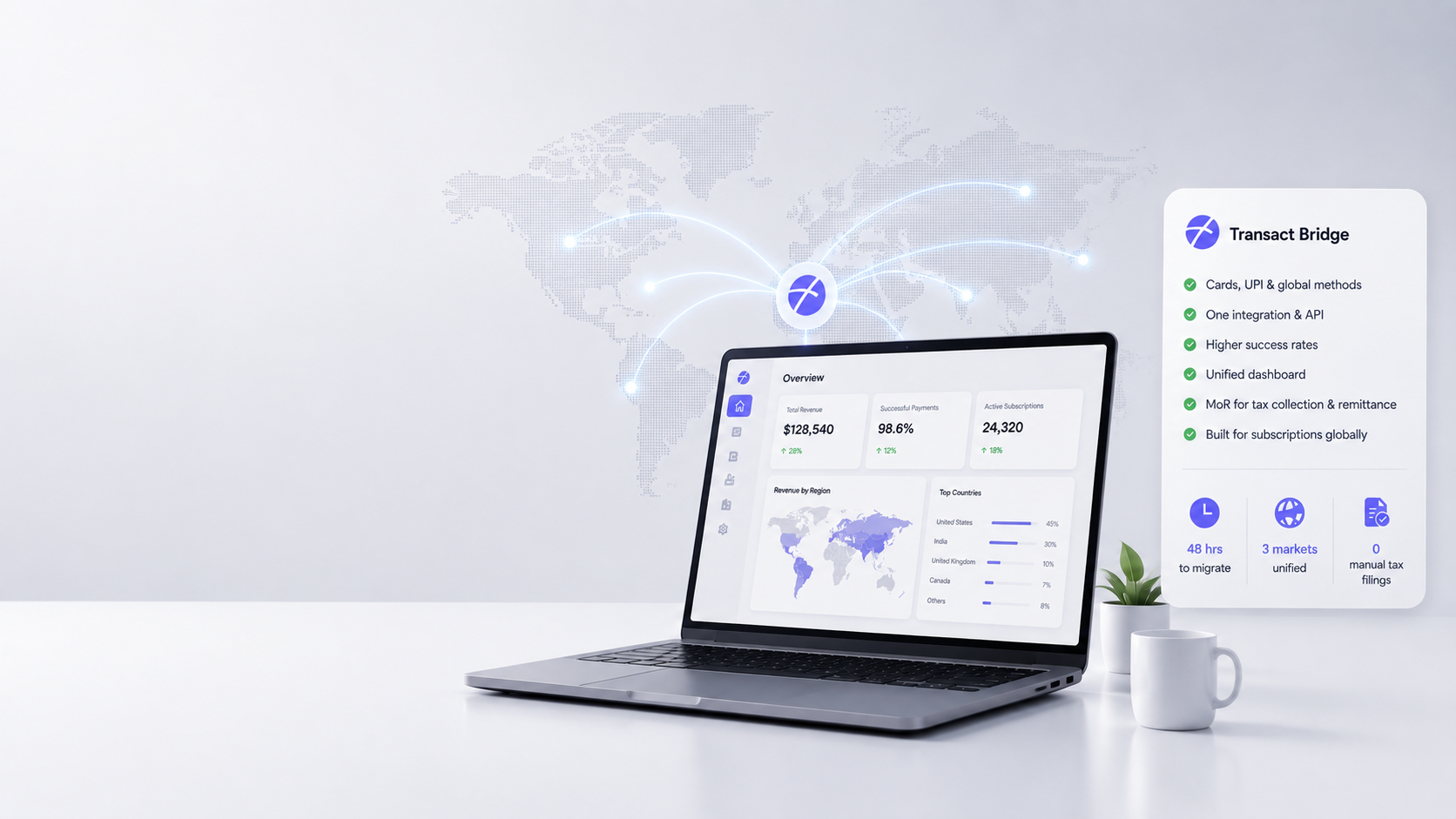
The team moved to Transact Bridge as its Merchant of Record, meaning the legal entity question and the tax question were solved through the same integration rather than two separate systems.
As Merchant of Record, Transact Bridge took on:
- Legal seller-of-record status, allowing payments to go live before incorporation was completed
- Tax collection and remittance handled centrally across jurisdictions
- A single PSP layer covering cards, UPI, and international payment rails through one API integration
- 100+ payment methods through the same integration, including UPI, net banking, and RuPay for India; cards and ACH for the US; and digital wallets and local payment rails elsewhere
- Localized and currency-aware checkout so customers could pay without thinking in a foreign currency
- A recurring billing engine built for regional mandate and renewal requirements, backed by 99.8% recurring billing stability
- Card acceptance operating at a 99.5% clearance rate to reduce lost legitimate payments
- One dashboard for transactions, settlements, and reconciliation across every market
- Webhook-based event handling so the product could react automatically to payment status changes
This gave the team a platform built for payments across India, the US, and global markets from the outset rather than a domestic setup with international patches added later.
One Integration for India, the US, and Global Markets
The integration work itself was a single API and a single checkout flow. Expanding to a new country meant enabling a payment method or currency inside the existing setup rather than creating another connection.
"We weren't targeting one market. We wanted users from every continent from day one. That meant supporting different currencies and payment methods everywhere, not adding them one at a time as we grew."
Getting Live, in Practice
Integration ran alongside product development rather than blocking it. The team connected once, with checkout, recurring billing, and payout logic all sitting behind the same API.
As the product expanded into new markets, currencies, and payment methods, the team did not need to re-integrate.
A few features the team wanted, including usage-based billing, were not fully built out at the time. The team used a lightweight internal workaround until native support caught up, without delaying launch or requiring a later payment rebuild.
Two technical advantages stood out:
- Recurring billing across regions: Indian mandate-based recurring debits and international subscription renewals ran through the same billing layer without custom logic for each market
- Localized pricing: once enabled, customers could see prices in their own currency by default, reducing hesitation caused by foreign-currency transactions at checkout
"When someone sees a price in their own currency instead of doing the conversion in their head, that's one less reason to abandon checkout. It sounds small until you see it in the numbers."
What Changed
Once the payment and compliance infrastructure was in place, several structural barriers disappeared.
- Payments started before the paperwork did: because Transact Bridge operated as Merchant of Record, the team began collecting real payments before incorporation was complete
- No single home market was required: the product launched broadly, with India and the US treated as equally significant markets from the beginning
- Tax stopped being a founder's job: VAT, GST, and sales tax obligations across jurisdictions moved off the founding team's plate, with no registrations or thresholds to monitor manually
- Checkout stopped losing customers to currency confusion: localized pricing reduced friction in markets where foreign-currency transactions create hesitation
- Growth did not mean rebuilding payments: subscriptions, usage-based billing, and credit-based models could evolve within the same payment setup
"Going with a merchant of record from day one felt like removing a whole category of future problems. Whichever direction the product goes, the payment infrastructure underneath it doesn't need to change."
The Outcome: Global From Day One
A team that could have spent its first year managing entity formation, multi-jurisdiction tax filings, and a patchwork of regional payment tools instead spent that time building the product.
The payment and compliance layer was not a blocker to global launch. It was the infrastructure that made global launch possible from day one.
- Payments could go live before incorporation was completed
- India, the US, and global markets were supported through one integration
- 100+ payment methods available without separate integrations for each market
- Tax collection and remittance handled centrally across jurisdictions
- Localized, currency-aware checkout reduced payment friction
- Recurring billing supported across regional mandate and renewal rules
- One dashboard handled transactions, settlements, and reconciliation
- New markets could be enabled without rebuilding the payment infrastructure
What Made It Work
The team did not need to:
- Wait for incorporation to finish before preparing for global payments
- Integrate separate payment providers for India, the US, and other markets
- Build and maintain payment method integrations country by country
- Track international tax registrations and filing thresholds manually
- Build separate recurring billing logic for regional payment mandates
- Re-platform payments every time the product or pricing model evolved
Instead, one Merchant of Record integration handled the legal payment layer, global payment methods, tax compliance, recurring billing, localized checkout, and reconciliation.
The infrastructure scaled underneath the product. The founding team focused on building what users came for.
Footnote
The lesson was not that global expansion is hard.
It was that most of what makes it hard — legal entities, tax registrations, and currency friction — is not actually a product problem.
Once payments across India, the US, and global markets ran through one partner acting as Merchant of Record, "go live everywhere" stopped being a roadmap item.
It simply became the starting point.