B2B Payment Methods: 10 Ways Businesses Can Accept Payments Globally
Published on: Wed 26-Aug-2026 07:46 AM
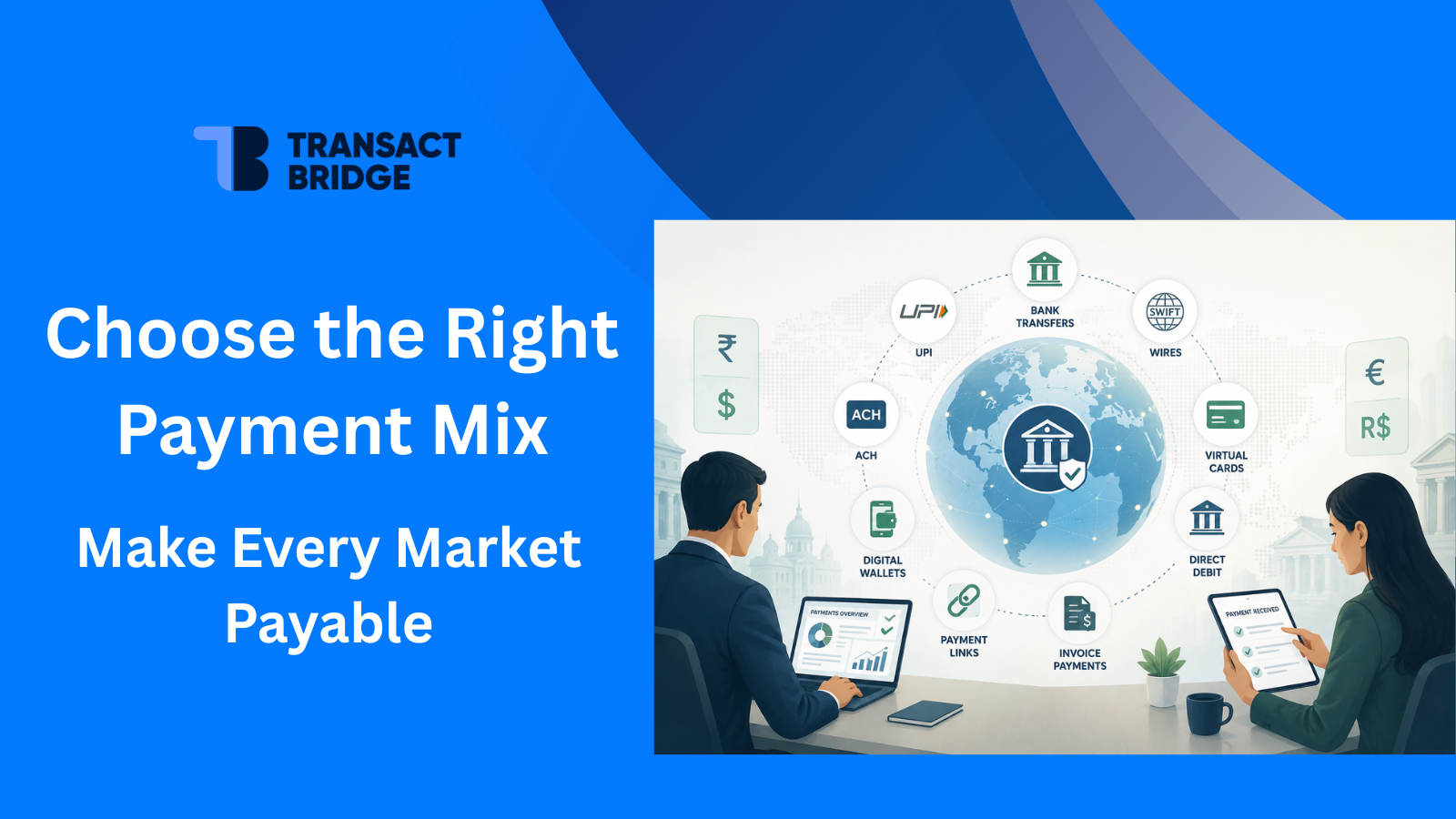
Most guides to B2B payment methods end up as the same list: bank transfer, card, wire, check, repeat. That's useful if every buyer and supplier you deal with sits in one country. The moment you collect payments across India, the US, and other global markets, the list stops being the answer – because the right method for a $200 subscription in Bengaluru is not the right method for a $200,000 enterprise invoice in Europe, and the payment rail your US customer typically prefers may not even exist for your buyer in Mumbai.
Here's the thesis this guide is built on:
The best B2B payment strategy isn't about finding one payment method. It's about building the right payment mix for each market – without creating a fragmented payment operation that your finance team can't control.
Below, we cover the major B2B payment methods and how to categorize them properly, how payment preferences, currencies, and compliance differ across India, the US, and global markets, a decision framework for building your payment mix, and the hidden costs that appear when infrastructure gets fragmented. The goal is a resource a founder or finance leader can actually make decisions from – not another listicle.
What are B2B payment methods?
B2B payment methods are the rails and instruments businesses use to pay or collect money from other businesses. Common options include bank transfers, ACH, wires, cards, UPI, direct debit, and local payment methods. The right combination depends on transaction size, geography, currency, whether the payment is recurring, and settlement needs.
Business-to-business payments differ from consumer payments in a few structural ways: they're usually higher in value, flow through invoices and negotiated terms (net 30, net 60, net 90) rather than instant checkout, mix recurring and one-time billing, pass through procurement and finance approval, and – once you cross a border – carry currency conversion and multi-jurisdiction compliance.
Method, processor, gateway, orchestration, MoR – different layers of the stack
One distinction is worth getting right before we go further, because these terms describe different layers of the payment stack and understanding the difference matters when you evaluate providers:
- Payment method : how the buyer pays (e.g., ACH, UPI, virtual card).
- Payment processor : moves the transaction between the parties' banks.
- Payment gateway : connects the checkout experience to the processor.
- Payment orchestration : routes transactions intelligently across multiple providers and rails.
- Merchant of Record (MoR) : depending on the specific arrangement, jurisdiction, and transaction structure, can take on the legal seller role along with defined payment, tax, and compliance responsibilities.
A single-market business can operate near the bottom of this ladder. A business collecting across borders eventually has to think about the whole stack – which is the real subject of this article.
B2B vs B2C payment methods: what's different?
B2B payments are typically larger, invoice-based, and governed by negotiated terms with more approval and compliance steps, while B2C payments are smaller and settle instantly at checkout. This is why B2B leans on bank rails, ACH, wires, and cards, whereas B2C leans on cards, wallets, and local consumer methods.
Factor | B2B | B2C |
Transaction value | Usually higher | Usually lower |
Payment terms | Net 30 / 60 / 90 common | Immediate |
Approval | Procurement / finance | Individual buyer |
Reconciliation | Complex, invoice-matched | Simpler |
Common methods | Bank rails, ACH, wires, cards, UPI | Cards, wallets, local methods |
Compliance | Often more complex, esp. cross-border | Consumer-protection focused |
10 ways businesses accept B2B payments
A recurring flaw in most B2B payment content is treating fundamentally different things as if they were the same. ACH is a rail. A virtual card is an instrument. A payment link is a collection mechanism. Grouping them properly makes the choices clearer.
Payment rails (how money actually moves)
1. Bank transfers. Direct account-to-account transfers – the backbone of high-value B2B settlement. Cheap and reliable domestically; cross-border transfers add FX and intermediary-bank costs and longer settlement.
2. Wire transfers. Direct bank-to-bank movement, the default for urgent, high-value, or international payments. Internationally they usually route over SWIFT and can pass through several correspondent banks – each adding cost and time.
3. ACH (US). The Automated Clearing House network is the workhorse of US B2B, far cheaper than cards and ideal for recurring and routine vendor payments. Standard ACH generally settles within one to two business days, while Same Day ACH enables faster settlement for eligible transactions.
B2B ACH volume grew almost 10% in 2025 to roughly 8.1 billion payments, according to Nacha, which governs the network – a direct signal of the migration away from checks. Note that the US ACH Network is a domestic system; cross-border payments use the separate International ACH Transaction (IAT) framework, which is more limited than a purpose-built cross-border rail.
4. UPI (India). For businesses selling into India, UPI is an important local payment rail, particularly for online and recurring collections. As overall market context – not a B2B-specific measure – the Reserve Bank of India's half-yearly Payment Systems Report found UPI accounted for 85.5% of India's total digital transaction volume in H2 2025, and India's Press Information Bureau reported UPI processed over 24,000 crore transactions worth roughly ₹314 lakh crore in FY 2025–26 across 703 live banks.
UPI (including recurring UPI mandates) can provide a more familiar India-native payment experience. For higher-value B2B settlement, businesses may also rely on bank-transfer rails such as NEFT and RTGS, depending on the transaction and use case.
5. Direct debit. Automated pull-based collection straight from a buyer's account – the engine behind subscriptions and recurring billing. Scheme rules vary by market: SEPA Direct Debit in Europe, ACH debit in the US, NACH/eNACH and recurring UPI in India.
6. Real-time payment rails. Instant, 24/7 settlement rails are scaling worldwide – RTP and FedNow in the US, UPI and IMPS in India, and instant SEPA in Europe. They're transformative for cash flow, but availability and limits vary sharply by country, so a real-time strategy has to be built corridor by corridor.
Payment instruments (what the buyer uses to pay)
7. Credit and debit cards. Corporate and purchasing cards offer fast processing, fraud protection, and clean expense tracking – strong for online B2B, SaaS, procurement, and recurring billing. Best for online B2B purchases, recurring billing, and transactions where card acceptance is commercially viable; watch for processing fees that compound at volume, transaction limits on large invoices, and chargeback exposure.
8. Virtual cards. Single-use or vendor-specific card numbers give AP and procurement teams tight control, clean reconciliation (one card per invoice or vendor), and strong security. Not every supplier accepts cards, and acceptance fees still apply.
9. Digital wallets. Tokenized, fast checkout that matters most where local wallet adoption is high or for internationally distributed buyers. In B2B, usually a complement rather than the primary rail and both parties must support the same wallet.
Collection mechanisms (how payments are presented and captured)
10. Payment links and online invoicing. A secure link embedded in an invoice lets buyers pay instantly via their preferred method – no portals, no terminals. This isn't a "rail" in the sense that ACH or UPI is; it's a way of presenting a payment. It's often the fastest route for SMEs, agencies, and professional-services firms to shorten collection cycles, and it travels well across borders – provided the right underlying methods are enabled for each buyer's market.
Why local payment acceptance matters more than any single method
There is no universal B2B payment method. There is a universal need for local payment acceptance. Buyer preferences change by geography, and forcing every customer onto cards or international wires creates friction, failed payments, and lost conversions.
That single insight reframes the whole problem. Instead of asking "what's the best method?", the better question is "what does each market I sell into actually expect?"
Market | Common rails & methods | What businesses need to accept payments |
India | UPI, cards, NEFT, RTGS, IMPS | INR / local acceptance, recurring UPI support |
US | ACH, cards, wires, RTP/FedNow | USD / local acceptance, ACH for recurring |
Europe | SEPA, SEPA Direct Debit, cards, local methods | EUR / local acceptance |
Other markets | Local rails, wallets, cards | Market-specific acceptance & currency |
This table is the pivot of the article: as markets multiply, the acceptance requirement multiplies with them. Everything that follows – currency, compliance, reconciliation – flows from this.
Selling into a market you can't fully collect in?
See which local payment methods your buyers already expect — before it costs you conversions.
How B2B payment requirements change across India, the US, and other global markets
The most expensive assumption in cross-border payments is that your home-market playbook travels. It doesn't. Here's how the same idea of a "bank rail" behaves across three very different environments.
India
India runs one of the world's most advanced real-time ecosystems, but value and volume sit on different rails – which matters enormously for B2B.
- UPI leads overall digital-payment volume (85.5% of total digital transaction volume in H2 2025, per the RBI) and is important for India-native acceptance and recurring collections.
- RTGS carries the majority of transaction value (68.6% in H2 2025, per the same RBI Payment Systems Report), making it the rail for high-value B2B settlement.
- NEFT handles everyday transfers across a wide value range; IMPS provides instant lower-value transfers; cards remain important for online and cross-border B2B.
Practical implication: selling into India with only cards and international wires enabled leaves money on the table. Local INR collection via UPI, NEFT, and RTGS – matched to transaction size – is what Indian business buyers expect.
United States
The US is in mid-transition from checks to electronic B2B rails, with cost and speed as the deciding variables.
- ACH is the low-cost default for recurring and routine B2B, now carrying roughly 8.1 billion B2B payments a year (Nacha), with Same Day ACH for faster settlement.
- Wire transfers handle urgent, high-value, and international payments; cards and virtual cards serve online B2B and procurement; ACH debit powers subscriptions.
Practical implication: USD settlement, ACH for recurring flows, and wires for large or time-critical invoices form the backbone – though check-heavy AP processes still create drag for businesses that haven't modernized.
Global markets
Beyond India and the US, the pattern repeats with local variation. Every market has its own dominant rails, wallets, currency, and rules, but the underlying sequence a business must solve for is always the same:
Local payment preference → local currency → local settlement → local regulation → reconciliation → FX.
A few illustrations of that pattern:
- Europe: SEPA credit transfers and SEPA Direct Debit dominate, alongside strong local methods; instant SEPA is expanding; PSD2 shapes authentication and open banking.
- Brazil: the Pix instant-payment system has become a default for domestic acceptance, frequently outweighing international cards.
- Southeast Asia: real-time rails and local wallet ecosystems are frequently the expected consumer-and-SME experience.
The scale of the cross-border opportunity is enormous, but so is its inefficiency. The Financial Stability Board's 2025 progress report on the G20 cross-border payments roadmap concluded that the global average cost of these payments remains "sticky" and that the roadmap's 2027 targets – including keeping retail cross-border costs under 1%, with no corridor above 3% – are unlikely to be met on schedule, with correspondent banking and inconsistent regulation still cited as major frictions. That gap between ambition and reality is exactly why infrastructure choice, not method choice, is the real lever.
Same business, three different payment expectations
Get a market-by-market view of the rails, currencies, and rules you'll need to support.
Local currency, FX, and settlement: the other half of cross-border payments
Accepting the transaction is only half the problem. The half that quietly determines margin is currency.
Local payment acceptance doesn't end when the buyer pays. Businesses also have to decide whether to price, collect, and settle in the buyer's currency or their own and each choice carries an FX and treasury consequence.
Four currency decisions sit inside every cross-border B2B payment:
- Pricing currency : what the buyer sees. Local pricing usually converts better and reduces friction.
- Collection currency : what you actually charge in. Charging in the buyer's currency improves acceptance but shifts FX handling to you.
- Settlement currency : what lands in your account. Consolidating settlement centrally simplifies treasury.
- FX spread : the cost baked into conversion, which can quietly exceed headline transaction fees.
A useful operating principle for businesses scaling across markets is: charge locally, settle centrally – accept each buyer's preferred local method and currency, then consolidate settlement and reconciliation in one place, so local acceptance doesn't create a sprawl of local bank accounts, currency exposures, and reconciliation exports.
B2B payment methods comparison: which method is right for your business?
Use this as a directional map, not a spec sheet. Actual costs and settlement times vary by provider, country, currency, and transaction type, so the columns describe general tendencies – not fixed figures.
Method | Best for | Typical use example | Speed | Cost tendency | Cross-border | Recurring |
Bank transfer | High-value invoices | Supplier invoice settlement | Medium | Low–Medium | High | Low |
Wire transfer | International / large B2B | $100K enterprise invoice | Medium | Medium–High | Very High | Low |
ACH | US recurring & routine | US SaaS subscription | Medium | Low | Limited | High |
Cards | Online B2B | Online procurement purchase | Fast | Medium–High | High | High |
UPI | India local collection | India-native mid-value payment | Fast | Low–Medium | Low–Medium | High |
Direct debit | Recurring billing | Subscription / membership | Medium | Low–Medium | High | Very High |
Virtual cards | Enterprise procurement | Controlled vendor payment | Fast | Medium | Medium–High | Medium |
Digital wallets | Localized checkout | Wallet-preferring market | Fast | Medium | Medium–High | Medium |
Payment links | SMEs / services | One-off agency invoice | Fast | Medium | High | Medium |
Local payment methods | Entering new markets | Market-specific acceptance | Varies | Varies | Very High | Varies |
Not sure which rail fits which transaction?
Get a payment mix built around your actual transaction sizes, buyers, and markets.
A decision framework for building your B2B payment mix
Don't pick a method – build a mix. Run every decision through six questions, then follow the decision paths below.
The six questions:
- Where is your buyer? Start with their location and preferred local method, not yours.
- What is the transaction value? A $50 payment and a $50,000 invoice belong on different rails.
- Is the payment one-time or recurring? Recurring points to direct debit, ACH debit, recurring UPI, or cards-on-file.
- How fast do you need settlement? Cash-flow-critical payments justify instant rails or wires.
- What are your FX requirements? Cross-currency flows make FX handling and transparency central to margin.
- How much infrastructure can your finance team realistically manage? The question most businesses answer too late.
The decision paths:
- Buyer in India → consider UPI, cards, NEFT, or RTGS based on transaction type, value, and buyer preference.
- Buyer in the US → consider ACH, cards, or wire based on urgency, size, and whether the payment recurs.
- Buyer in Europe → consider SEPA, SEPA Direct Debit, cards, or local methods based on the market and use case.
- Collecting recurring payments → direct debit, ACH debit, recurring UPI, or cards-on-file are common fits.
- Collecting high-value invoices → bank transfer, wire, or RTGS typically suit large-value settlement.
- Entering multiple markets → local payment methods plus a unified payment infrastructure layer to hold them together.
What a fragmented B2B payment stack actually requires:
- India PSP for UPI/NEFT/RTGS and INR collection
- US processor for ACH and cards, plus USD settlement
- European PSP for SEPA and local methods
- Local bank accounts and entities where required
- FX management and multi-currency treasury
- Reconciliation across every provider and rail
- Tax registration and compliance per jurisdiction
- Fraud, chargeback, and dispute management everywhere you operate
A company can assemble all of this. But that's a fundamentally different operating model from running one payment infrastructure layer across every market.
Real-world scenarios
Frameworks are easier to trust when you can see them applied. Three common patterns:
Scenario 1 : Indian SaaS company going global. A Bengaluru SaaS business collects domestically via UPI and cards. It wins US enterprise customers and adds ACH plus USD settlement for predictable subscription billing. European buyers arrive expecting SEPA. Within a year it's running three markets, three rails, and multiple currencies and the constraint isn't the methods themselves, it's holding them together without three separate reconciliation processes.
Scenario 2 : US digital business entering India. A US company starts selling to Indian customers with international cards only. Acceptance rates disappoint and checkout friction is high, because buyers expect UPI. Adding UPI and local INR collection lifts conversion but now the business faces local settlement and compliance considerations it didn't have domestically.
Scenario 3 : Global consulting firm billing high-value invoices. A services firm invoices clients across regions for large sums. Cards are impractical at that value, so it relies on bank transfers and wires – which makes FX exposure, settlement timing, and reconciliation across currencies the operational priority, not method choice.
Across all three, the pattern is identical: the methods are solvable; the coordination across markets is where businesses get stuck.
B2B payment compliance: what changes when you cross borders?
Payment methods don't exist in a vacuum. As markets multiply, so do the rules and this is where payment infrastructure quietly becomes a compliance problem. At a high level (this is orientation, not legal advice), several layers come into play:
- Payment-scheme and central-bank rules. India's payment ecosystem operates under RBI oversight and NPCI scheme rules; the US ACH Network operates under Nacha rules; Europe's SEPA and PSD2 frameworks shape authentication (e.g., strong customer authentication) and open banking. Each has its own operational requirements.
- AML / KYC. Onboarding, monitoring, and reporting obligations apply to businesses and their payment providers, and they vary by jurisdiction – a recurring friction the FSB flags in cross-border flows.
- Tax and why a payment can trigger it. This is the part finance leaders most often underestimate: the payment method doesn't determine your tax obligations; the underlying selling structure does. Depending on the product, the customer's location, the transaction structure, and the jurisdiction, cross-border sales can trigger indirect-tax (VAT/GST), invoicing, registration, and reporting obligations – regardless of how the buyer paid. Accepting money in a new market can, in some structures, create obligations you didn't have before.
- Data and privacy. Handling payment and customer data across borders can bring data-localization and privacy requirements into scope.
- Where a Merchant of Record fits. In some arrangements, an MoR becomes the seller of record and assumes defined responsibilities – which can include aspects of tax collection, remittance, and compliance for the transactions it covers.
What an MoR assumes depends entirely on the specific arrangement, jurisdiction, product, and transaction structure; it is not automatic or universal. The value, where it applies, is operational: consolidating responsibilities that would otherwise multiply market by market.
The takeaway for a CEO or CFO isn't "compliance is scary." It's that compliance complexity often scales with the number of markets you operate in – not simply with revenue – and the infrastructure you choose determines whether that scaling is manageable or overwhelming.
Compliance shouldn't multiply every time you enter a market
Talk through what tax, KYC, and reporting actually look like for your specific setup.
The hidden cost of fragmented payment infrastructure
The transaction fee is the cost everyone sees. The expensive costs are the ones that hide in a fragmented setup:
- Payment failures from missing or mismatched local methods
- Abandoned checkout when buyers can't pay the way they expect
- Slower collections and weaker cash flow
- FX leakage through opaque spreads across providers
- Reconciliation overhead matching payments across systems that don't talk
- Chargebacks and disputes managed separately in each market
- Compliance overhead duplicated per jurisdiction
- Multiple provider contracts and fragmented reporting that obscure the full picture
Individually, each looks minor. Together, they're often larger than the processing fees a business spends months trying to negotiate down – and they compound with every market added.
From payment methods to payment infrastructure
At a certain point of scale, the question stops being "which method?" and becomes "which infrastructure?" A single-market business can live near the bottom of the method-processor-gateway-orchestration-MoR ladder. A business collecting across multiple markets cannot – because local acceptance, multi-currency settlement, routing, reconciliation, tax, and compliance now have to work together, not as disconnected tools.
This is the layer Transact Bridge operates on. As a Merchant of Record and payment service provider, Transact Bridge provides payment infrastructure for businesses accepting payments across India, the US, and global markets, supporting 100+ payment methods through a single unified layer.
The differentiation isn't access to more payment methods. It's reducing the operational complexity of managing those methods across markets. Local acceptance, processing, settlement, FX, and reconciliation sit in one place instead of a stack of separate PSP relationships that a finance team has to hold together.
Where a Merchant of Record model applies, it can also consolidate defined tax and compliance responsibilities that would otherwise fall on the business in each jurisdiction – with the specifics depending on the arrangement and market.
You shouldn't have to rebuild your payment infrastructure every time you enter a new market.
Transact Bridge helps businesses accept payments across India, the US, and global markets through unified payment infrastructure – with local payment methods, multi-currency settlement, and compliance support built into the model.
FAQs
What are the most common B2B payment methods?
The most common B2B payment methods are bank transfers, wire transfers, ACH, credit and virtual cards, UPI and other real-time rails, direct debit, digital wallets, and local market-specific methods, usually presented through mechanisms like payment links or online invoicing. Businesses typically use a mix, matching the method to transaction size, geography, and whether the payment recurs.
What is the best payment method for B2B transactions?
There is no single best method. The right choice depends on the buyer's location, the transaction value, settlement speed, currency, and whether the payment is one-time or recurring. Cards and UPI suit smaller and recurring payments; ACH suits routine US flows; wires and RTGS suit high-value and cross-border settlement.
What is the best payment method for international B2B payments?
There isn't one best method. The appropriate combination depends on buyer location, transaction value, currency, settlement requirements, recurring versus one-time billing, and compliance obligations. Businesses operating across multiple markets often use a payment platform, an orchestration layer, or a Merchant of Record to consolidate local methods, currencies, and compliance into one operation.
What is the difference between B2B payment methods and B2B payment solutions?
A B2B payment method is how the buyer pays – for example, ACH, UPI, or a card. A B2B payment solution is the infrastructure used to accept, process, route, settle, and reconcile those payments, often across multiple methods and markets. Methods are components; solutions are the system that manages them.
Is ACH a B2B payment method?
Yes. ACH is one of the most widely used B2B payment methods in the US, especially for recurring and routine payments. According to Nacha, B2B ACH volume reached roughly 8.1 billion payments in 2025 as businesses shifted away from paper checks. The US ACH Network is domestic; cross-border ACH uses the separate International ACH Transaction (IAT) framework.
Can businesses accept B2B payments by credit card?
Yes. Corporate, purchasing, and virtual cards are common for online and recurring B2B, offering fast processing, fraud protection, and clean reconciliation. The trade-offs are processing fees that grow at volume and transaction limits that make cards impractical for very large invoices.
What payment methods are available for B2B payments in India?
In India, the primary B2B payment methods are UPI (including recurring UPI), NEFT and RTGS bank transfers, IMPS for instant lower-value transfers, and cards. RBI data shows UPI dominates transaction volume, while RTGS carries most high-value settlement.
What payment methods are commonly used for B2B payments in the US?
In the US, B2B payments commonly use ACH for recurring and routine flows, wire transfers for high-value and urgent payments, and cards or virtual cards for online purchasing and procurement, with ACH debit powering subscriptions.
How do B2B payment methods differ from B2C payment methods?
B2B payments are typically larger, invoice-based, and governed by negotiated terms such as net 30 or net 60, with heavier approval and compliance requirements. B2C payments are usually smaller and settle instantly at the point of sale.
How can businesses accept B2B payments across multiple countries?
Accepting cross-border B2B payments means solving five things together: enabling the local payment methods buyers prefer in each market, handling multiple currencies, settling funds, reconciling payments to invoices, and meeting each jurisdiction's compliance requirements.
Businesses increasingly do this through unified infrastructure or a Merchant of Record that manages local acceptance, FX, settlement, reconciliation, tax, and compliance in one layer. The right model depends on how many markets a business operates in and how complex its compliance footprint is.