Digital Services Tax Explained: What It Means for SaaS Companies Selling Internationally
Published on: Sun 30-Aug-2026 06:44 AM
A SaaS company sells a $100 annual subscription to a customer in another country. Is that sale subject to digital services tax? VAT? GST? US sales tax? Corporate income tax or nothing at all?
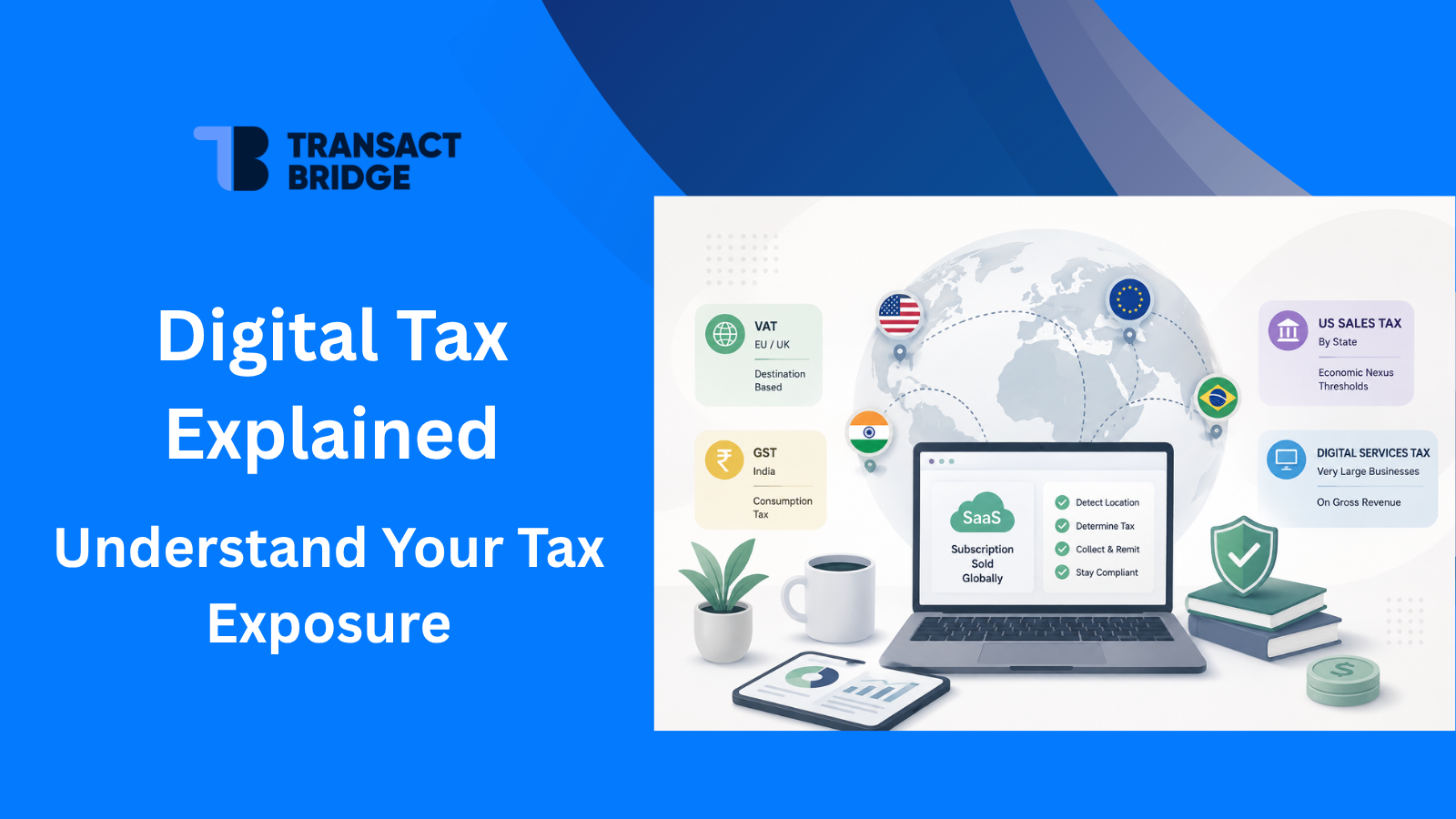
Most founders can't answer confidently, and the phrase that usually triggers the panic – digital services tax – is the one most likely to send them down the wrong path. Here's the misconception this guide exists to correct: the tax literally named "digital services tax" almost certainly does not apply to your company. The taxes that actually matter – VAT in Europe, GST in India, and sales tax across US states – are a different animal entirely, and they can create obligations long before you think of yourself as a global business.
The single most expensive mistake in this area is treating "digital tax" as one thing. It isn't. This guide separates the layers, shows what genuinely applies to SaaS selling across India, the United States, and other markets, and explains why cross-border tax ultimately becomes a payments problem at the checkout.
The short version: A digital services tax (DST) is a levy on the gross revenue of very large digital businesses – search engines, social platforms, marketplaces. Most SaaS companies fall far below its thresholds. What SaaS companies actually manage is consumption tax – VAT, GST, or US sales tax – determined by where each customer is located.
What Is a Digital Services Tax?
Digital Services Tax (DST) is a tax used by certain jurisdictions on revenue from specified digital activities – typically online advertising, digital marketplaces, and user-data monetization – usually only for large digital businesses that exceed substantial revenue thresholds. Scope, rates, and thresholds vary by country.
DSTs emerged largely as unilateral measures during the late 2010s, as governments sought to tax digital economic activity while broader OECD international tax reforms were still being negotiated. Under long-standing principles, a company generally pays income tax where it has a physical presence; digital businesses earn large revenues in countries where they have none. DSTs were the interim national response.
Three features separate a DST from every other tax here:
- It taxes gross revenue, not profit – a lossmaking company can still owe it.
- It applies only above very high thresholds, by design.
- It targets specific activities (advertising, marketplaces, data), not software subscriptions generally.
Does Digital Services Tax Apply to SaaS Companies?
For most SaaS companies, no. DST regimes generally target specified digital business models and large companies meeting substantial worldwide and domestic revenue thresholds. A SaaS company selling internationally is far more likely to face VAT, GST, or US sales tax based on where its customers are.
A quick way to check your own exposure:
- Are you above the applicable global and local revenue thresholds for a given country's DST? These differ by jurisdiction. France's regime uses roughly €750M worldwide and €25M in-France; the UK uses £500M worldwide and £25M UK. If you don't meet the applicable thresholds, that country's DST generally won't apply.
- Does a meaningful share of your revenue come from advertising, operating a marketplace, or selling user data? If not, DST scope likely doesn't reach you even at scale.
For all but the largest platforms, DST is context, not compliance. The rest of this guide is about the taxes that are.
Digital Services Tax vs VAT vs GST vs Sales Tax
A DST is a revenue tax on large digital platforms. VAT, GST, and US sales tax are consumption taxes on the sale itself – charged to the customer, applying to businesses of all sizes, and far more likely to affect an internationally selling SaaS company.
Digital Services Tax | VAT (EU/UK) | GST (India & others) | US Sales Tax | |
What's taxed | Gross revenue from specified digital activities | The value of the sale | The value of the sale | The taxable retail sale |
Usually borne by | The platform | The customer (collected by seller) | The customer (collected by seller) | The customer (collected by seller) |
Applies to typical SaaS? | Usually not | Often, depending on customer/location | Often, especially for foreign B2C providers | Depends on the state |
Framework | Country-specific | EU/UK destination-based | Country-specific | State-specific |
Quick answer : Is VAT on digital services the same as a digital services tax? No. VAT is a consumption tax on the sale of a digital service, applying to businesses of every size. A digital services tax is a separate levy on the revenues of very large search engines, social platforms, and marketplaces. The similar names are the only thing they share.
Selected Digital Services Tax Rates and Regimes in 2026
This is a selected snapshot, not a complete register. The rates below draw on comparative data from the Tax Foundation and national tax authorities such as GOV.UK for the UK DST.
Country | DST rate | Typically targets |
United Kingdom | 2% | Search engines, social media, online marketplaces |
France | 3% | Digital advertising, marketplaces, data |
Italy | 3% | Digital interfaces, advertising, data |
Spain | 3% | Online advertising, intermediation, data |
Austria | 5% | Online advertising |
Rates and scope are subject to change. Verify current requirements with the relevant tax authority before relying on this table for compliance decisions.
Several other regimes are in flux: Hungary's headline rate has been temporarily reduced, Turkey's is stepping down, Canada repealed its DST in 2025, and India abolished its equalisation levy entirely (more below). The United States has no federal DST – it instead responds to other countries' DSTs through trade and tax measures. At the EU level, digital-tax proposals remain under discussion rather than settled law. Treat the landscape as moving.
What Taxes Can Apply to International SaaS Sales?
This is where generic explainers go quiet. Selling software across India, the US, and other markets can create obligations under several regimes. Whether any applies depends on the customer's location, the transaction type, your establishment, and local thresholds.
United States: sales tax and economic nexus
The US has no national sales tax; each state sets its own. Since the 2018 US Supreme Court decision in South Dakota v. Wayfair, Inc., states can require out-of-state sellers to collect sales tax based on economic activity alone – economic nexus – with no physical presence needed.
Thresholds and rules are state-specific. Many states use a $100,000 sales threshold, while others use higher thresholds or different measurement rules. Because these are set and revised by each state Department of Revenue, consult the relevant state authority rather than assuming a single national figure.
A nuance most founders miss: having a nexus in a state is not the same as your product being taxable there. SaaS taxability varies significantly – some states generally do not tax SaaS, while others tax SaaS or particular forms of electronically delivered software. You have to answer both questions per state: Do I have nexus? and Is my SaaS taxable here?
European Union and the UK: VAT on digital services
In the EU and UK, SaaS is an "electronically supplied service," and VAT is destination-based: you charge the rate of the customer's country where the applicable rules require it. The mechanics differ sharply by who's selling and to whom – and this is where the widely repeated "€10,000 threshold" trips people up:
- B2B sales (customer provides a valid VAT number): the reverse charge applies – the customer accounts for the VAT, and you don't collect it.
- B2C sales: you charge and remit the customer's national VAT where the rules require it.
- The €10,000 threshold is for EU-established suppliers on certain intra-EU cross-border B2C supplies. Per European Commission VAT guidance, a non-EU-established SaaS business generally does not get this threshold and can face a VAT obligation from its first qualifying B2C sale.
- Registration: an EU-established seller can use the Union OSS; a seller with no EU establishment can use the Non-Union OSS – registering once and filing a single return covering EU B2C sales. The European Commission designed OSS specifically to reduce this burden.
Under European Commission rules, you must also collect at least two non-contradictory pieces of evidence of a customer's location (billing address, IP address, bank country, and so on) to determine the correct VAT treatment.
Quick answer – Do I need 27 VAT registrations to sell SaaS in Europe? No. Per European Commission guidance, a business with no EU establishment can register once under the Non-Union One-Stop Shop (OSS), charge each customer their national VAT rate, and file a single return covering EU B2C sales.
India: GST and the OIDAR framework
India requires a separate analysis, because foreign digital-service providers can fall under a framework – OIDAR – with registration and reporting duties unlike those in most US- or EU-focused guides. India abolished its equalisation levy (the 2% e-commerce charge from August 2024 and the 6% advertising charge from April 2025, via the Finance Acts), but that does not leave digital services untaxed – GST applies.
Here's India's digital-tax picture at a glance:
Tax / regime | Current position |
Equalisation levy | Abolished (2% in 2024, 6% in 2025) |
GST | Still applies to digital services |
OIDAR | Relevant for qualifying foreign digital services |
B2C foreign SaaS | Registration and collection obligations may apply |
B2B registered customer | Reverse-charge treatment may apply |
Drawing on the IGST Act, the CGST Act, and CBIC guidance:
- Many SaaS and other digitally delivered services can fall within India's OIDAR framework (defined in Section 2(17) of the IGST Act), depending on the nature of the service and how it is supplied, and generally attract 18% GST under OIDAR. India's 2025 GST rate rationalization into 5% and 18% slabs left software/IT services at 18%.
- For B2C sales to unregistered Indian consumers, a non-resident provider generally must register (the simplified registration, Form GST REG-10, with no turnover threshold under Section 24 of the CGST Act), file GSTR-5A monthly, and remit IGST – with nil returns generally required even in zero-transaction months. A foreign provider typically must appoint an authorised representative in India and generally cannot claim input tax credit.
- For B2B sales to a GST-registered Indian business, the reverse charge shifts the obligation to the buyer.
Scenario: A US SaaS company lists a subscription at $20/month. If that price is quoted exclusive of Indian GST, an 18% GST charge brings the customer-facing total to $23.60. If the advertised price is tax-inclusive, the GST is extracted from the displayed price rather than added on top – which is why how you configure pricing and tax at checkout materially changes what the customer sees and what you remit.
The India mechanics most MoRs skip
GST registration, GSTR-5A filing, and authorised-representative — handled.
A layer founders forget: corporate income tax and permanent establishment
Consumption tax isn't the only exposure. Selling into a market can, in some cases, create a direct-tax question if your activities there create a permanent establishment (PE) or taxable nexus – driven by local staff, dependent agents, or treaty rules. A SaaS company selling cross-border without local people, agents, or other activities that create taxable presence may not create a PE, but the outcome depends on local law and applicable tax treaties. It's a separate analysis from VAT/GST – another reason "digital tax" is never one tax.
Cross-border SaaS tax at a glance
| Market | Tax on SaaS | Typical rate | Foreign-seller trigger | Registration route |
| United States | State sales tax | 0%–~10% | Economic nexus (state-specific) | Register per nexus state |
| EU / UK | VAT | ~20% (destination) | Often first B2C sale (non-EU sellers) | Non-Union OSS |
| India | GST under OIDAR | 18% | B2C sales to Indian consumers | GST REG-10 + monthly GSTR-5A |
Why Cross-Border Tax Becomes a Payments Problem at Checkout
Here's the thesis that separates this from another tax explainer: cross-border tax becomes a payments-infrastructure problem at the checkout. Not because payments replace tax filing – they don't – but because the tax treatment of a sale has to be determined at or before the moment of transaction, and that determination has to connect to your billing stack.
Walk through a single international subscription:
- Identify where the customer is : using at least two pieces of location evidence.
- Classify the transaction : B2C or B2B? Taxable or exempt? Within OIDAR or not?
- Apply the correct rate : the customer's national VAT, the right state rate, or 18% GST under OIDAR.
- Invoice correctly : right currency, right tax wording (reverse-charge notices, GST identifiers).
- Collect, then remit : to the right authority, on each jurisdiction's calendar.
Steps 1–4 generally need to be resolved before or during checkout; step 5 has to connect cleanly to what happened there. Get location wrong and every downstream number is wrong. Miss a filing and penalties accrue – Indian GST, for example, runs interest from the original due date.
Key insight: For SaaS selling internationally, cross-border tax should be treated as an infrastructure problem as much as an accounting one. The determination is a checkout-time event; the filing is a back-office one; both have to be wired to the same source of truth. Companies that treat tax as a quarterly reconciliation exercise can discover costly data and compliance gaps after transactions have already occurred.
SaaS Tax Compliance: DIY vs Tax Software vs Merchant of Record
There are broadly three ways to handle this, trading control against overhead:
Approach | How it works | Best for | The catch |
Do it yourself | Register, collect, and file in every jurisdiction | Firms with in-house tax teams | Heavy, ongoing, error-prone at scale |
Tax software + advisors | Automated rates; you stay the legal filer | Mid-size firms wanting control | You remain liable and file |
Merchant of Record | The MoR becomes the seller to your customer | SaaS scaling into many markets fast | Less granular checkout control; provider dependency |
A Merchant of Record has become an increasingly popular way for cross-border software businesses to outsource payment and indirect-tax complexity. Under its contractual and legal model, the MoR becomes the seller to the end customer and can assume specified tax, invoicing, collection, and remittance responsibilities across the jurisdictions it supports – the exact scope depends on the provider, product, and local law. In practice it collapses the checkout-time determination and much of the back-office filing into one relationship, so your team ships products instead of maintaining registrations across dozens of jurisdictions.
One thing to check: many popular MoR tools are strong across the US and EU but thinner on the India-specific mechanics (OIDAR registration, GSTR-5A, the authorised-representative requirement) that a genuinely global SaaS company can't skip.
Before You Enter a New Market: A 6-Step Framework
A practical sequence you can hand to a finance lead:
- Identify customer location and build two-point location evidence into checkout.
- Determine B2B vs B2C treatment, including VAT-number validation for reverse charge.
- Determine taxability : Is your specific product taxable in that market?
- Check registration triggers : thresholds (US), first-sale rules (India/non-EU EU sales), OSS eligibility.
- Select your model : DIY, tax software, or Merchant of Record – and wire it to your subscription billing.
- Establish ongoing reporting : filing calendars, remittance, and reconciliation, monitored continuously rather than annually.
How Transact Bridge Supports International SaaS Payments and Compliance
Everything above points to one operational need: infrastructure that resolves location, rate, currency, invoicing, and remittance at the point of sale – in every market you sell into.
The problem: international SaaS has to combine cross-border payments, local payment acceptance, invoicing, tax/compliance, and settlement –across markets with very different rules.
Where Transact Bridge fits: Transact Bridge combines cross-border payment infrastructure with Merchant of Record capabilities to help SaaS businesses accept local payments, localize checkout, and support tax and compliance workflows for payments across India, the US, and global markets – including India-specific OIDAR/GST requirements that can be overlooked when infrastructure is designed primarily around US and European markets.
The outcome: one integration instead of assembling separate payment, tax, and settlement infrastructure market by market – across 100+ payment methods, with reported performance including a 99.5% authorization rate and 99.8% recurring-billing stability that also helps reduce involuntary churn.
How the Global Digital Tax Landscape Evolved
Governments increasingly tax digital economic activity – but through different mechanisms, on different timelines. For SaaS operators, the takeaway is that expansion means monitoring not just DST, but destination-based consumption taxes and the payment and compliance work they require.
Year | Development |
2018 | South Dakota v. Wayfair establishes US economic nexus |
2018–2020 | France, the UK, and others introduce unilateral DSTs |
2021 | EU One-Stop Shop (OSS) simplifies cross-border VAT |
2024–2025 | India withdraws its equalisation levy; Canada repeals its DST; India simplifies GST slabs |
2026 | Digital-tax proposals and DST-related trade measures remain part of the evolving international tax landscape |
Key Takeaways
- Digital services tax ≠ every tax on digital sales. DST targets large platforms; most SaaS never owes it.
- The taxes that actually apply to internationally selling SaaS are consumption taxes – US sales tax, EU/UK VAT, India GST under OIDAR.
- These can create obligations early – sometimes on the first qualifying B2C sale – so there's rarely a "grow first, comply later" grace period.
- India abolished its equalisation levy, but SaaS is generally taxed at 18% GST under the OIDAR framework – the detail most US/EU guides miss.
- Cross-border tax is best treated as a payments-infrastructure problem at checkout, which is why the Merchant of Record model has grown popular.
- Choose infrastructure that genuinely operates across India, the US, and other markets, not just North America and Europe.
FAQs
What is a digital services tax?
A digital services tax is a levy some countries impose on revenue from specified digital activities such as online advertising, marketplaces, and user-data services – usually only for large digital businesses above high revenue thresholds. Scope and rates vary by country.
Does digital services tax apply to SaaS companies?
Usually not. DST regimes target specific business models and large companies meeting substantial thresholds. SaaS companies selling internationally are far more likely to face VAT, GST, or US sales tax depending on where their customers are located.
What is the difference between digital services tax and VAT?
VAT is a consumption tax charged on the sale of a digital service, applying to businesses of all sizes. A digital services tax is a separate levy on the revenues of very large search engines, social platforms, and marketplaces. Despite the names, they are different taxes.
Which countries have a digital services tax?
Active European examples include the UK (2%), France, Italy, and Spain (3%), and Austria (5%); other regimes apply temporary or changing rates. Canada repealed its DST in 2025 and India abolished its equalisation levy in 2024–2025. The US has no federal DST.
Does India have a digital services tax?
No. India withdrew its equalisation levy (2% in 2024, 6% in 2025). However, digital services and SaaS remain taxed in India under GST, generally at 18%, with foreign providers falling under the OIDAR framework.
Do SaaS companies have to collect VAT on international sales?
Often, yes, for B2C sales to EU/UK customers – VAT is charged at the customer's national rate where the rules require it. For B2B customers with a valid VAT number, the reverse charge usually shifts the obligation to the buyer. Non-EU sellers can register through the Non-Union OSS.
Does a SaaS company pay tax in the customer's country?
It depends on the tax. Consumption taxes (VAT, GST, sales tax) are generally tied to the customer's location and collected by the seller where required. Corporate income tax is different – it usually depends on whether your activities create a permanent establishment or taxable presence there, governed by local law and treaties.
What taxes should a SaaS company consider when expanding internationally?
Typically four layers: US state sales tax (via economic nexus), EU/UK VAT, GST regimes such as India's OIDAR, and – separately – corporate income tax where local presence creates a permanent establishment. Which apply depends on customer location, transaction type, and local rules.
Do foreign SaaS companies have to pay tax in India?
Transact Bridge helps foreign SaaS companies meet Indian obligations that otherwise require in-house setup: under OIDAR, a non-resident provider selling to unregistered Indian consumers generally must register for GST, charge 18%, and file monthly GSTR-5A returns – which an MoR can absorb.
What is a Merchant of Record for SaaS?
Transact Bridge operates as a Merchant of Record – a provider that becomes the legal seller to the end customer and can assume specified tax, invoicing, collection, and remittance responsibilities across supported jurisdictions, turning many registrations and filings into one relationship.
When do I have to start collecting US sales tax?
Once you cross a state's economic nexus threshold – commonly $100,000 in sales, though some states use higher thresholds or different tests – you may need to register and collect there, even without physical presence. You must separately confirm whether your SaaS is taxable in that state.