
Global AI Payments: How to Monetize AI Products Worldwide
Published on: Sat 01-Aug-2026 07:00 AM
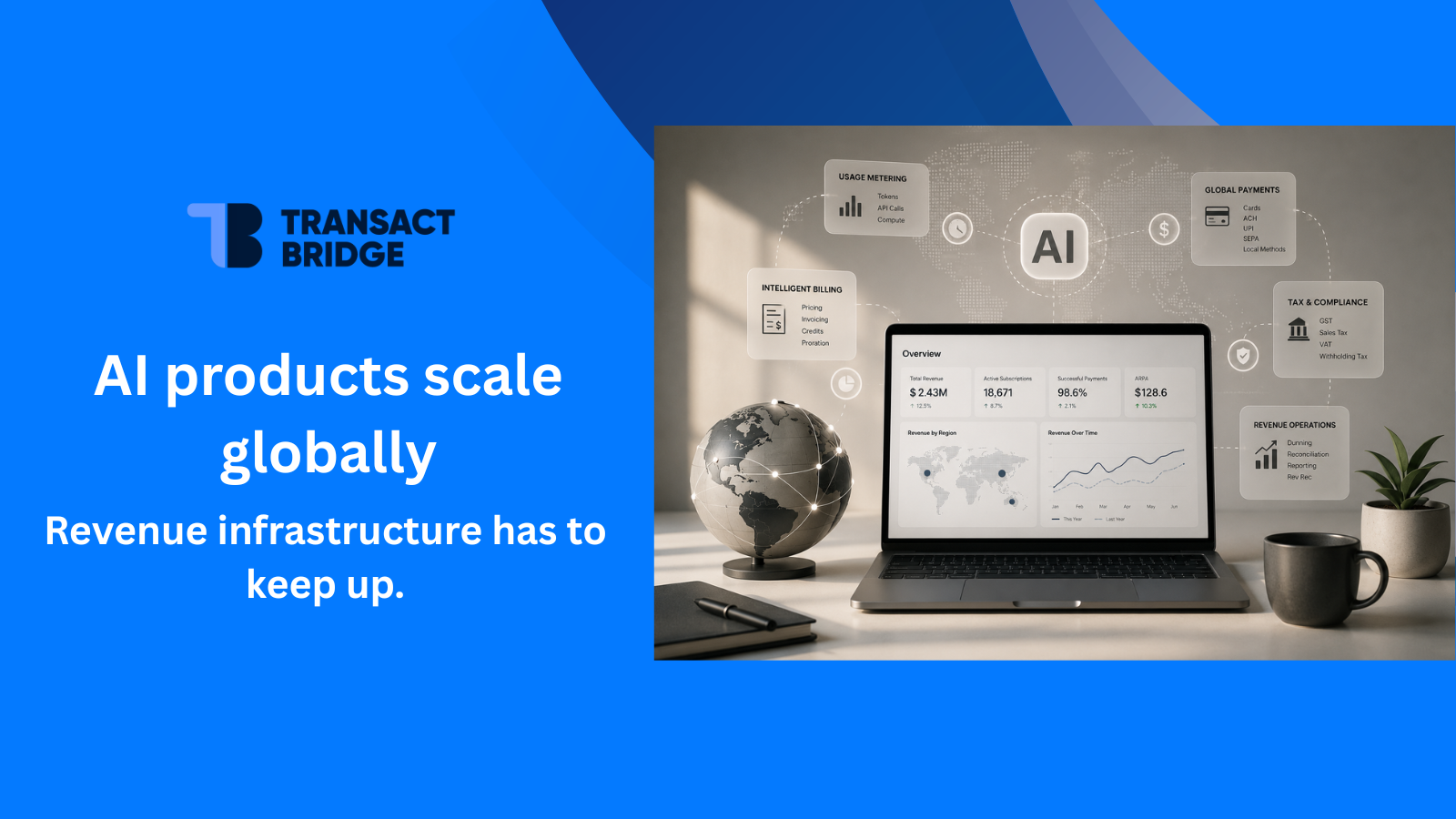
Enterprise-ready billing, cross-border collection, and tax compliance for AI companies scaling across India, the US, and global markets.
Global AI payments refers to the infrastructure used to meter, bill, and collect revenue from AI customers across countries. It can include usage metering, multi-currency checkout, enterprise invoicing, local payment methods, indirect-tax handling, and cross-border settlement.
It's the machinery between "someone signed up" and "we got paid, legally, in every market."
An AI product is global the moment it ships. A developer in Bengaluru, a finance team in Chicago, and a startup in Berlin can all sign up and start consuming your API within the same hour.
Distribution was instant.
Getting paid was not.
The company that just onboarded those three customers now faces GST considerations in India, may contribute toward economic-nexus obligations in one or more US states, and may need to account for VAT on a qualifying B2C digital sale to its German customer while its flat monthly price quietly loses money on the heaviest API user and overcharges the lightest. This is the central tension of AI monetization: your product scales like software, but your billing and compliance scale like a cross-border trading business.
This guide is written for founders, CEOs, and finance leaders building AI products for an international market. It covers how AI monetization differs from classic SaaS, the pricing and billing models that work in 2026, what "enterprise-ready" actually requires, how collection and tax play out across India, the US, and other markets, and a readiness framework you can score yourself against.
What are global AI payments?
Global AI payments describe a stack, not a single product. Monetizing an AI product across markets means operating five distinct layers and most companies underestimate how few tools cover more than one or two of them:
Metering : measuring the billable event: tokens, API calls, compute, or completed workflows.
Billing : pricing, rating, invoicing, credits, and proration on top of that meter.
Payments : collecting the money through cards, ACH, UPI, SEPA, and other local methods, in multiple currencies.
Tax and transaction compliance : determining, collecting, remitting, and documenting the indirect tax that applies per transaction.
Revenue operations : reconciliation, dunning, and revenue recognition behind it all.
No single product typically does all five. Most companies pair a metering-and-billing layer (which prices and measures usage) with a payments-and-compliance layer (which collects and handles transaction tax) and a Merchant of Record, discussed later, sits in that second layer.
Keeping these distinct matters: when a vendor says it "handles billing," ask which of the five it actually owns and which it integrates with. Blurring them is how AI companies end up with a metering tool that can't collect in India and a payment setup that can't invoice an enterprise.
At a glance:
Layer | Purpose |
Metering | Measure usage |
Billing | Price and invoice usage |
Payments | Collect the money |
Tax & compliance | Apply and remit indirect tax |
Revenue ops | Reconcile and recognize revenue |
This is why many AI companies combine specialist billing software with payment or Merchant of Record providers rather than trying to build all five layers themselves.
Key insight: In SaaS, pricing was a marketing decision. In AI, pricing is an infrastructure decision. The model you choose – tokens, credits, outcomes – dictates what your metering, billing, and payments layers must be able to do, and most stacks were never built to measure consumption in real time across currencies and tax regimes.
Why monetizing AI products is different from traditional SaaS
Many traditional SaaS products had relatively predictable marginal costs, which made flat or per-seat pricing easy to sustain. AI products have variable, consumption-driven costs – every prompt, token, and model call carries a real marginal cost – so flat pricing either erodes margin or caps growth. Monetizing AI means pricing on consumption, which changes the entire finance and payments stack behind the product.
When your cost to serve is driven by tokens, GPU-seconds, and inference calls, a heavy user can cost many times more than a light one and a flat $29/month plan cannot absorb unlimited consumption.
The market is already moving. Usage-based pricing is no longer limited to infrastructure software: in Metronome's 2025 survey of roughly 100 SaaS companies, 85% of respondents said they had adopted usage-based pricing or were implementing it – a surveyed sample rather than a market-wide census, with adoption varying by company type.
Among vendors monetizing AI features specifically, many now attach explicit usage fees or AI surcharges rather than bundling AI into a flat tier. As autonomous agents do work no seat is tied to, the link between headcount and software revenue keeps weakening.
Three structural differences make AI monetization its own discipline:
- Variable cost to serve. Margin is a function of usage, not headcount. Pricing that ignores consumption is pricing blind.
- Global distribution by default. Anyone with an API key is a customer. You don't "expand" into a market. You're in it the moment you launch, with the tax and payment obligations that implies.
- Buyer-side budget anxiety. As token prices fall but usage climbs, customer spend can swing hard, and finance teams fear the uncapped invoice. That anxiety shows up in your billing as failed payments, disputed charges, and renewal friction.
Set side by side, the shift is stark:
Traditional SaaS | AI SaaS | |
Pricing | Per-seat | Usage / hybrid |
Cost to serve | Largely fixed | Variable |
Billing | Monthly | Real-time metering |
Checkout | Card | Card + enterprise procurement |
Market reach | Enter a few countries deliberately | Global from day one |
Key insight: Most founders think global expansion starts when they decide to enter a new country. In AI, expansion starts when the first overseas customer signs up – usually before anyone in the company has planned for it.
Choose the right AI pricing model
There is no single right model – only the right model for your product, stage, and buyer. Hybrid pricing is increasingly common because it pairs predictable committed revenue with usage-linked expansion, but companies still use several models, and buyer demand for predictability remains real.
Model | How it works | Best for | Trade-off |
Flat subscription | One fixed price per period | Predictable-cost features; early-stage simplicity | Erodes margin on heavy users; leaves upside on the table |
Per-seat | Price × number of users | Collaboration tools where value tracks headcount | Breaks when agents do work no "seat" is tied to |
Usage / token-based | Charged per token, API call, or compute unit | API products, infrastructure, developer tools | Revenue is hard to forecast; buyers fear runaway bills |
Prepaid credits | Buyer funds a balance drawn down by usage | Volatile consumption; global self-serve | Needs real-time metering and low-balance alerts |
Hybrid (base + usage) | Committed fee plus metered overage | Most enterprise AI; predictability plus upside | More complex to invoice, prorate, and reconcile |
Outcome-based | Charged per resolved ticket, booked meeting, or completed workflow | Agentic products where value is a measurable result | Requires airtight attribution of the "outcome" |
Founder tip: Your billing system – not a spreadsheet – has to be the source of truth for usage. The month finance starts reconciling token logs by hand at close is the month you've outgrown your billing stack, not your pricing.
How AI pricing models affect billing infrastructure
The model you pick is only half the decision. Each one imposes specific requirements on the layers beneath it. This is where most "we'll figure out billing later" plans break.
Model | Metering requirement | Collection model | Main risk to manage |
Flat subscription | Minimal | Recurring card or invoice | Margin leakage on heavy users |
Per-seat | Active-seat count | Recurring | Undercounts agent-driven usage |
Token / usage | Real-time usage logs | Postpaid or prepaid | Margin leakage; forecasting difficulty |
Prepaid credits | Credit ledger with drawdown | Prepaid | Expiry, breakage, low-balance UX |
Hybrid | Subscription + meter | Auto-payment plus invoicing | Reconciliation complexity |
Outcome-based | Verified outcome event | Invoice or recurring | Attribution disputes |
A concrete example. Picture an AI coding assistant priced like this:
- $39/month platform fee, with the first 5 million tokens included
- usage beyond that metered and billed monthly
- enterprise customers on Net-30 invoicing instead of cards
- Indian customers paying via UPI, US customers via ACH
- EU VAT calculated and applied automatically at checkout
That is one product and it already runs a hybrid pricing model, real-time metering, three payment methods, two billing motions, and a cross-border tax obligation at the same time. For an AI company, that isn't an edge case. It's a normal Tuesday.
What "enterprise-ready billing" actually means
Enterprise-ready billing doesn't operate alone. Together with its connected payment, tax, and revenue-operation layers, it has to do several jobs at once: meter consumption accurately, issue compliant multi-currency invoices, and support prepaid credits and spend controls.
It also has to handle purchase orders and Net-30/Net-60 terms, recognize revenue correctly, and collect across borders – all without manual work. Self-serve card checkout is the starting point; enterprise readiness is everything that happens after a large customer says "send us an invoice."
Most AI companies begin with self-serve card checkout, which works beautifully – until a large enterprise wants to buy. Larger enterprise purchases commonly move through purchase orders, invoices, ACH or wire transfers, and negotiated payment terms rather than self-serve cards, with the buyer expecting the seller to absorb the operational complexity. If your billing can't handle that, you either lose the deal or bolt on manual processes that break at scale.
Use this checklist to pressure-test enterprise readiness:
- Real-time, auditable metering of tokens/calls/workflows both sides can trust
- Prepaid credits and committed-spend contracts with automatic drawdown
- Spend caps, budget alerts, and hard limits so buyers never fear a runaway bill
- Multi-currency invoicing with correct tax applied per jurisdiction
- Purchase order and Net-30/Net-60 support – procurement runs on terms, not cards
- Proration, credit notes, upgrades/downgrades handled cleanly mid-cycle
- Revenue recognition that survives an audit across subscription plus usage
- Reliable cross-border collection with local methods and strong authorization rates
- Dunning and failed-payment recovery to stop silent revenue leakage
- Consolidated reconciliation across currencies, methods, and markets
CFO tip: The biggest procurement objection to usage-based AI pricing is fear of the uncapped invoice. Prepaid credits and spend caps aren't just features – they're how you close enterprise deals on a consumption model.
Self-serve and enterprise are two different payment products
A single AI company usually has to run both motions at once. They are not the same product.
Area | B2C / self-serve | B2B / enterprise |
Checkout | Cards, wallets, local methods | PO, invoice, ACH/wire, payment terms |
Pricing | Subscription, credits, usage | Commitments, tiers, overages, outcomes |
Tax evidence | Consumer location | Business status and tax IDs; reverse charge may apply |
Main risk | Chargebacks and failed renewals | Credit risk and delayed payment |
Billing | Immediate collection | Invoicing, approvals, reconciliation |
Localize collection across India, the US, and global markets
Getting paid globally means accepting how each market actually pays and maintaining strong authorization rates on cross-border transactions. A card-only checkout built for one market silently loses conversions everywhere else. Payment expectations also differ by segment: the self-serve buyer wants a wallet or local method, the enterprise buyer wants an invoice on terms.
Market | How customers expect to pay | What breaks a single-market setup |
India | UPI, RuPay, cards, net banking; enterprises via bank transfer | Card-only misses the dominant real-time rail; cross-border inflows fall under RBI's PA-CB framework |
United States | Cards for self-serve; ACH and wire for enterprise; Net terms standard | Card-only leaves no path for procurement paying by ACH on terms |
European Union / UK | SEPA, cards, local methods; VAT-inclusive expectations | Missing local methods and correct VAT handling depresses conversion and creates exposure |
Other global markets | Region-specific wallets and bank rails | International-card-only checkout suffers higher declines and FX friction |
Authorization rate is revenue. Every cross-border decline is a customer who wanted to pay and couldn't. Cross-border transactions often see lower authorization rates than comparable domestic ones – issuer risk rules, currency conversion, authentication, and routing complexity all contribute – so improving authorization can be a high-impact revenue lever, since recovered approvals convert directly into completed sales.
India's cross-border rails are formally regulated. On 15 September 2025, the Reserve Bank of India issued a consolidated Master Direction on the Regulation of Payment Aggregators, which superseded the earlier 2020 payment-aggregator guidelines and the 2023 cross-border directions and set out a dedicated cross-border (PA-CB) category covering inward and outward flows, with escrow and per-transaction requirements for aggregators.
For an overseas AI company serving Indian customers, this matters not because the seller itself is licensed as a PA-CB, but because the framework governs how an authorized payment aggregator can legally collect and settle eligible cross-border transactions on its behalf. Working with infrastructure that operates inside this framework is the difference between compliant collection and a stalled market entry.
What tax and payment compliance do AI companies need?
Selling AI internationally can trigger indirect-tax obligations wherever your customers are – and these attach to whoever is the seller of record, regardless of where the company is incorporated. The rules differ enough across markets that a single flat approach is wrong somewhere. This section stays deliberately high-level; the full mechanics live in our dedicated guides.
Regime | What AI companies miss |
India – GST / OIDAR | A non-resident supplier of qualifying OIDAR services to Indian consumers may face GST registration, collection, and filing obligations without the ordinary domestic turnover threshold. Treatment can differ for B2B supplies and depends on the service and customer status. |
United States – sales tax | Two tests both matter: whether you've created nexus in a state (often after crossing a sales/transaction threshold, post-South Dakota v. Wayfair, 2018) and whether your specific product is taxable there – SaaS/AI taxability varies sharply by state. |
EU / UK – VAT | For B2C digital services from a non-EU supplier, VAT can apply from the first taxable sale, with the non-Union OSS offering one registration and return. B2B treatment may differ where a valid VAT number and reverse-charge rules apply. |
Consumption pricing doesn't remove place-of-supply obligations. Tax treatment still depends on the customer's location and status, the nature of the service, and the evidence you retain – which is exactly why jurisdiction-aware tax logic has to run inside billing, not in a quarterly spreadsheet cleanup. (Separate digital-services taxes exist in some countries but generally carry high revenue thresholds, so they're a scale-stage concern rather than a day-one one for most startups.)
The point here is narrower: compliance obligations scale with where your customers are, not with how big you are – and for a globally distributed AI product, that can mean many markets from early on.
Compliance tip: Registration, collection, filing, and remittance are four separate jobs in every jurisdiction, and getting any one wrong creates liability that compounds quietly. That's the strongest argument for a Merchant of Record – but be precise about what an MoR does and doesn't cover.
Should an AI company build payments or use a Merchant of Record?
This is the pivotal make-or-buy decision in global AI monetization, and it's usually a three-way choice, not a binary.
Approach | What you own | Best when |
Build internally | Metering, billing, payments, plus tax registration, filing, and remittance in every market | You have the finance/legal team and the scale to justify it |
Integrate specialists | A billing/metering platform combined with payment and tax providers you manage | You want control with less to build; mid-scale |
Use an MoR / Seller of Record | A third party is the seller for covered transactions and handles collection plus transaction tax | You want compliant global reach fast, with a small team |
What a Merchant of Record actually does and doesn't. As the contractual seller for covered transactions, an MoR generally handles payment collection and specified transaction-level responsibilities: indirect-tax calculation, collection, remittance, refunds, and chargebacks.
What it does not do is assume every obligation tied to your product. You remain responsible for product legality, data protection, AI-specific rules, intellectual property, advertising claims, export controls and sanctions, sector licensing, contractual performance, and acceptable use. The value is real, but it is scoped to the transaction – not a blanket transfer of compliance.
A quick way to decide:
- Selling globally, small team, want speed → an MoR gives compliant collection across markets without standing up tax operations in each one.
- Concentrated in one or two markets with in-house tax capability → owned or integrated infrastructure may be worth the control.
- Scaling fast across many markets → an MoR now, revisited later; the compliance surface grows faster than headcount early on.
Investor tip: Tax exposure is commonly reviewed during financial and legal due diligence. An AI company selling into dozens of countries with no registration or remittance trail can be carrying an off-balance-sheet liability. Handling transaction tax through an MoR turns "we'll deal with it later" into a materially cleaner story at raise and exit.
The Global AI Monetization Readiness Framework: the five M's
Comprehensive is not the same as original – most of what's above, a competitor could reproduce. So here is the framework we use to diagnose whether an AI company can actually monetize across markets, not just in theory. Score yourself on each of the five M's.
Key insight: AI companies rarely fail globally because they lack payment methods. They fail because pricing, billing, payments, and compliance mature at different speeds and the slowest one caps the whole business.
The question | Multi-market ready looks like | |
Meter | Can you accurately measure the billable event? | Real-time, auditable usage/credit logs both you and the customer trust |
Monetize | Does pricing protect margin and align with value? | A model matched to your cost curve, with caps and credits that reassure buyers |
Move money | Can customers pay the way they expect, everywhere? | Local methods and multi-currency collection with strong cross-border authorization |
Meet procurement | Can you handle enterprise buying? | POs, invoices, Net terms, approvals, and clean reconciliation |
Manage obligations | Can you determine and administer transaction tax? | Per-transaction tax logic, correct registration/remittance, retained evidence |
Rate each M on a simple maturity scale – Not ready → Self-serve ready → Enterprise ready → Multi-market ready. Your lowest-scoring M is your real constraint on international revenue, regardless of how strong the product is. In our experience, AI companies often invest first in metering and pricing – the parts closest to engineering – while Move money, Meet procurement, and Manage obligations get attention later, even though those decide whether the money actually arrives.
Common mistakes AI companies make monetizing globally
- Pricing flat on a variable-cost product. Losing money on heavy users while under-monetizing everyone else.
- Card-only checkout. Silently declining conversions in India, Europe, and beyond by ignoring local rails.
- Treating tax as a year-end task. By the time it surfaces, back-liability has accumulated.
- No spend controls on usage pricing. The fastest way to lose an enterprise deal is an invoice the buyer couldn't forecast.
- Bolting on manual billing. Spreadsheet reconciliation of token usage doesn't survive contact with scale.
- Assuming incorporation location governs tax. Obligations follow your customers, not your Delaware or Singapore entity.
- Over-trusting the MoR label. An MoR covers transaction-level responsibilities, not your product, data, or AI-specific compliance.
How Transact Bridge supports global AI monetization
Everything above points to one conclusion: monetizing AI internationally is less about picking a pricing model and more about operating the money-movement and compliance layers around it, in every market where your users are.
Transact Bridge supports that layer through Payment Service Provider, Merchant of Record, and Seller of Record models across India, the US, and other markets. It sits in the payments-and-compliance part of the stack – collecting through local and cross-border methods and, under the MoR/SoR models, acting as the seller for covered transactions to handle indirect-tax calculation, collection, remittance, refunds, and chargebacks.
It integrates with the metering and billing layer where your usage and pricing logic live, rather than replacing it – which is why the distinction between the five layers matters when you scope a solution.
Transact Bridge reports a 99.5% payment authorization rate, 99.8% recurring billing stability, and support for 100+ payment methods, including the local rails customers in India, the US, and other markets actually use. For an AI company, that means self-serve and enterprise collection can run on the same infrastructure, with transaction tax handled where the MoR model applies.
The right time to put this in place is before the liability accumulates and before the enterprise deal your current billing can't close. If you're pricing on consumption, expanding across borders, or moving upmarket into enterprise procurement, that's the point where the payments-and-compliance layer stops being back-office and starts being a growth constraint.
AI products become global overnight. Payment infrastructure doesn't. The companies that scale fastest aren't the ones with the best pricing model. They're the ones whose billing, payments, and compliance can keep pace with demand.
Assess your global AI payment readiness. Speak with Transact Bridge to find the gaps across collection, enterprise invoicing, transaction tax, and cross-border settlement before you enter your next market.
FAQs
What are global AI payments?
Global AI payments is a working term for the billing, payment, and transaction-compliance infrastructure that lets an AI company charge and collect from customers across countries – usage metering, multi-currency checkout, enterprise invoicing, local payment methods, and per-jurisdiction indirect-tax handling. It describes a stack of capabilities, not a single product or a formal regulatory category. Transact Bridge supports the payment collection and transaction-compliance parts of that stack across India, the US, and other markets.
What payment infrastructure does an AI company need to sell globally?
Five capabilities working together: metering to measure usage, billing to price and invoice it, payment collection in local methods and currencies, indirect-tax handling per jurisdiction, and revenue operations to reconcile it. Because few tools cover more than one or two of these, the real question is how you connect them – build in-house, integrate specialists, or use a Merchant of Record for the collection-and-compliance side. Transact Bridge provides that collection-and-compliance layer across India, the US, and other markets.
Which payment methods should AI companies support globally?
At minimum, cards plus the dominant local rails in each target market – UPI and RuPay in India, ACH and wire for US enterprise, SEPA and local methods across Europe – with multi-currency support and enterprise invoicing on terms. International-card-only checkout raises declines and skips the methods customers actually prefer, so it quietly costs conversion in the fastest-growing markets and leaves enterprise buyers with no way to pay on terms.
What's the difference between a payment gateway and a Merchant of Record?
A payment gateway is the technology that routes and processes a transaction; you remain the seller of record and stay responsible for tax registration, collection, remittance, and compliance. A Merchant of Record becomes the legal seller for covered transactions and takes on those transaction-level responsibilities – collection, indirect tax, refunds, and chargebacks – on your behalf. The core difference is liability, not features: one moves money, the other also absorbs the transaction-level tax and compliance burden.
When should an AI company move from a payment gateway to a Merchant of Record?
Usually when you start selling across more tax jurisdictions than you can realistically register and file in – self-serve revenue arriving from many countries, a first enterprise deal that needs invoicing and correct tax, or unregistered tax liability quietly accumulating. A gateway is fine while you're in one or two markets you're already registered in; the case for an MoR grows with the number of places you owe tax but have no operations. Transact Bridge offers MoR and Seller of Record models for exactly that transition.
Can AI startups accept payments globally without building their own billing infrastructure?
Yes. A startup can pair a lightweight metering or billing tool with a Merchant of Record that handles collection and transaction tax, avoiding the need to build payments, registration, and remittance in each market itself. This is how small teams reach international revenue quickly without a large finance and legal function. Transact Bridge provides that collection-and-compliance layer so a startup can focus on the product.
Can AI companies support both self-serve and enterprise billing?
Yes, but they are effectively two payment products. Self-serve runs on cards, wallets, and local methods with immediate collection; enterprise runs on purchase orders, invoices, ACH or wire, and Net terms with approvals and reconciliation. A company moving upmarket needs both motions on infrastructure that can meter usage and invoice on terms at the same time. Transact Bridge supports both in one setup.
How do enterprise customers pay for AI software?
Enterprise customers typically pay by purchase order and invoice on Net-30 or Net-60 terms, via ACH or wire rather than card, often against a committed-spend contract with usage overages billed separately. Self-serve card checkout can't accommodate procurement approvals, terms, or PO matching, so an AI company selling upmarket needs invoicing, spend caps, and clean reconciliation built in before the first enterprise deal, not after.
What is usage-based billing for AI products?
Usage-based billing charges customers for what they actually consume – tokens, API calls, compute, or completed workflows – rather than a flat or per-seat fee. It aligns revenue with the variable cost of serving AI, but it depends on accurate real-time metering and, for enterprise buyers, spend caps and prepaid credits to keep invoices predictable.
How are AI products taxed when sold internationally?
Indirect tax generally follows the customer's location and status: GST/OIDAR considerations in India (which can apply to qualifying services without the usual turnover threshold), US sales tax where both nexus and product taxability are met, and EU/UK VAT – from the first B2C digital sale for a non-EU supplier, with different B2B treatment where reverse charge applies. These obligations attach to the seller of record, which is why some AI companies route them through a Merchant of Record.
Can AI companies sell globally without opening local entities?
In many cases, yes – a Merchant of Record or Seller of Record acts as the seller for covered transactions and handles collection and transaction tax, so the AI company doesn't need to incorporate a local entity in each market. This is a common reason early- and growth-stage AI companies reach international revenue faster than a fully in-house build would allow. Transact Bridge provides MoR and SoR models for this across India, the US, and other markets.


