
How Do Cross-Border Payments Work? A Guide for Global Businesses
Published on: Wed 07-Oct-2026 07:11 AM
Cross-border payments are transactions in which the payer and the business receiving the funds are in different countries, requiring payment processing, currency conversion, settlement and potentially additional regulatory and compliance steps.
The customer may experience the transaction as a single click. Behind it, multiple systems determine whether the payment is authorised, processed, converted, settled and ultimately reconciled.
The scale is significant. According to a speech published by the Bank for International Settlements (BIS), Bank of Italy Governor Fabio Panetta said the global cross-border payments market was estimated at more than $190 trillion in 2024, nearly twice global GDP.
For a global business, the important question is therefore not simply “Can we accept an international payment?” It is what happens to the money between the customer clicking Pay and the business receiving and reconciling it?
How Cross-Border Payments Work: The Short Version
A typical cross-border card or digital payment follows this path:
Customer → Payment method → Payment processor/acquirer → Payment network → Issuing bank → Authorisation → Capture → Currency conversion → Settlement → Reconciliation
Bank transfers, account-to-account payments and local payment methods can follow different rails, but the commercial journey is similar.
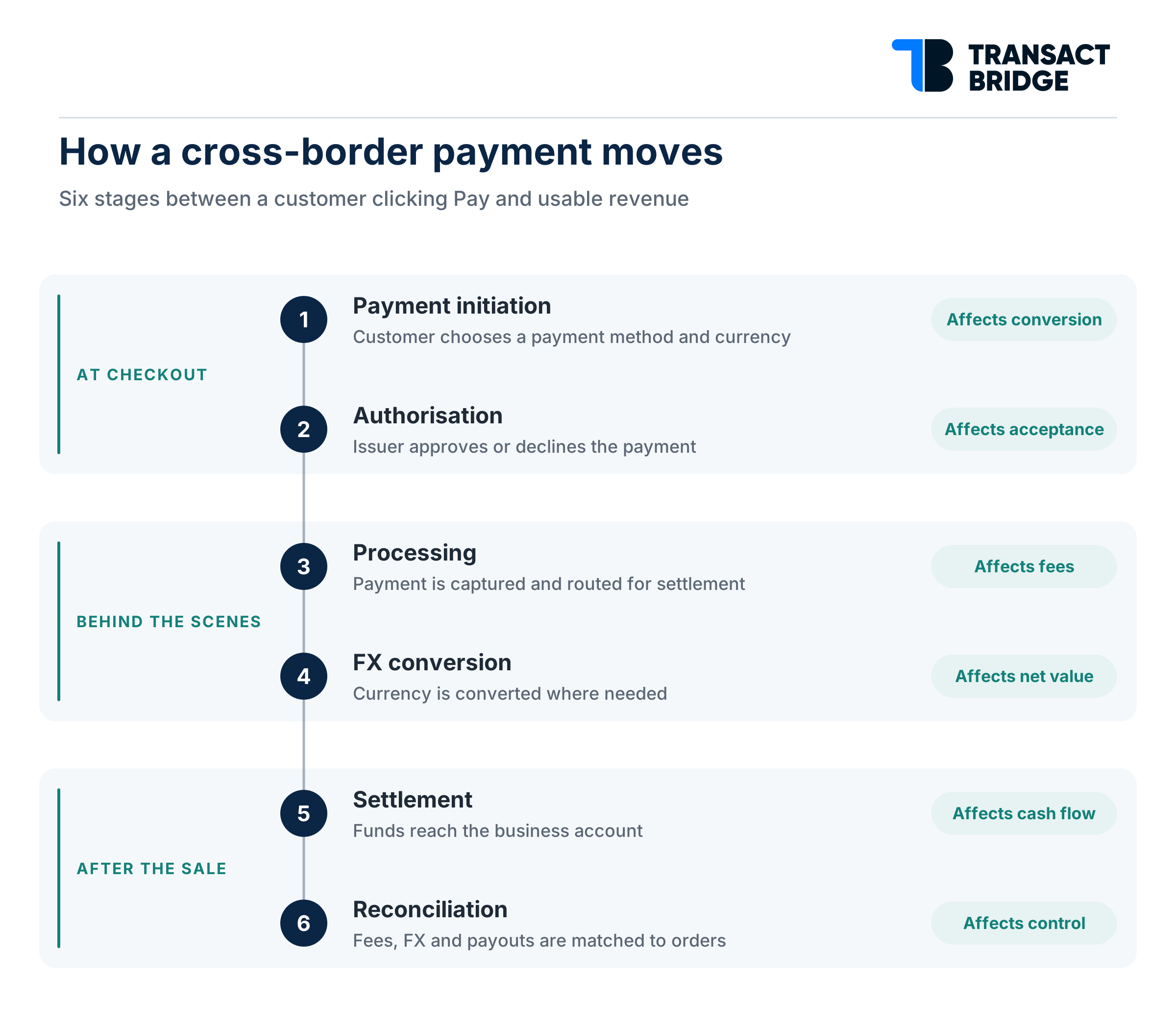
The key point is that every stage can affect conversion, cost, cash availability or financial control.
What Happens After a Customer Clicks Pay?
1. The customer chooses a payment method
The transaction starts with the payment method available to the buyer.
A customer in India may expect UPI. A US customer may prefer cards or ACH. Another market may have its own dominant wallet, bank-transfer or account-to-account payment method.
International acceptance therefore does not mean offering the same payment experience everywhere. The relevant question is whether customers can pay using methods they already trust.
For a global business, payment acceptance begins before authorisation: if the preferred method is unavailable, the transaction may never enter the payment flow.
2. The payment is authorised
Once the customer submits payment details, the transaction is sent through the relevant processing infrastructure.
For a card payment, the issuing bank evaluates the transaction and returns an approval or decline. Other payment methods use their own authorisation mechanisms.
This is the first major revenue checkpoint.
If a legitimate transaction is declined, the business can lose the sale before processing, settlement or reconciliation even begin.
Transact Bridge maintains a 99.5% transaction clearance rate.
3. The payment is captured and processed
After authorisation, the transaction moves through capture and processing.
The payment infrastructure connects the transaction to the relevant acquiring and payment networks, applies the required processing logic and prepares the funds for settlement.
For cross-border transactions, the route can be more complex because the payer, acquiring institution, business and settlement account may sit in different jurisdictions.
That complexity is largely invisible to the customer. For the business, it can affect approval rates, processing costs and the time required before funds become available.
4. Currency is converted
The customer may pay in one currency while the business settles in another.
For example:
Customer pays: $100 USD
Business settles: INR
Conversion: USD → INR
The economics depend on the exchange rate used, when conversion occurs and whether an FX markup or other conversion charge applies.
The G20 cross-border payments targets published by the Financial Stability Board target an average global retail-payment cost of no more than 1%, with no corridor above 3% by the end of 2027. The FSB's latest progress assessment continues to identify cost and transparency as persistent challenges.
For businesses operating across several currencies, the headline processing fee is therefore only part of the cost.
5. Funds are settled
Settlement is when the proceeds are transferred to the business's designated settlement account.
This is different from authorisation.
Authorisation answers: Can this transaction proceed?
Settlement answers: When does the money actually reach the business?
A payment can therefore be successfully authorised while funds remain unavailable to the business until later in the settlement process.
The global system still has a significant speed gap. The FSB's 2025 G20 cross-border payments progress report found that only 35.4% of cross-border retail payment services credited recipients within one hour, compared with the G20 target of 75% by the end of 2027.
6. The transaction is reconciled
The final stage is financial reconciliation.
The business needs to match:
-
The original customer transaction
-
The amount authorised and captured
-
Processing and FX deductions
-
Refunds or disputes
-
The final settlement amount
-
The corresponding bank entry
Without this step, the payment may have succeeded technically while still creating accounting work.
For a business processing across several markets, currencies and payment methods, reconciliation becomes particularly important because the amount charged to the customer may not equal the amount ultimately appearing in the bank account.
A $100 Cross-Border Payment: Where Does the Money Go?
Consider a simplified example of a customer paying $100.
|
Step |
Illustrative amount |
|
Customer payment |
$100.00 |
|
Processing fee at 2.5% |
-$2.50 |
|
Cross-border/acquiring cost at 0.5% |
-$0.50 |
|
Amount before FX |
$97.00 |
|
Illustrative FX markup at 1% |
-$0.97 |
|
Business receives |
$96.03 |
At an illustrative exchange rate of ₹88 per US dollar, $96.03 would equal approximately ₹8,451.
The figures above are illustrative, not Transact Bridge pricing. Actual economics vary by payment method, market, transaction value, currencies, provider and settlement structure.
The important point is the waterfall itself: the amount paid by the customer and the amount available to the business are not necessarily the same.
Where Does Cross-Border Revenue Leak?
Cross-border payment economics can deteriorate at several points in the transaction lifecycle.
Payment failures
A failed transaction means lost revenue immediately. The problem can be larger when the customer does not retry or moves to another provider.
According to PYMNTS Intelligence research, 72% of merchants report higher payment-failure rates for cross-border transactions than domestic transactions.
Payment costs
Processing, acquiring and intermediary charges reduce the amount retained from each transaction.
FX
Even when a payment succeeds, the conversion rate and markup can reduce the final value received by the business.
Settlement delays
A successful sale is not necessarily immediately usable cash. Longer settlement cycles can affect working capital and treasury planning.
Refunds and disputes
Refunds and disputes can introduce additional payment costs, operational work and reconciliation complexity.
The commercial question is therefore not just “What is our payment fee?”
It is:
“How much of every $100 of international revenue actually reaches the business, and how long does it take to get there?”
How much of your $100 actually reaches you?
See where fees, FX and settlement delays are cutting into your international revenue.
How Does Money Move Between the US and India?
The mechanics become more important when the payer and business operate in different payment ecosystems and regulatory regimes.
US customer → Indian business
A US customer buying from an Indian business may pay through cards or other supported payment methods. The transaction is processed through the relevant payment networks, potentially converted from USD to INR and settled according to the agreed structure.
For the Indian business, foreign-exchange rules govern the realisation and reporting of export proceeds. Documentation such as FIRC/eFIRC and e-BRC can be relevant to demonstrating receipt and supporting export-related compliance, depending on the transaction structure.
The business must also account for applicable Indian tax, foreign-exchange and payment regulations.
Indian customer → US business
An Indian customer buying from a US business may use cards and, where supported by the payment structure, UPI or another locally relevant payment method.
On the US side, selling into the country can create state sales-tax obligations based on economic nexus, even without a physical presence. Thresholds and rules vary by state, so the business needs to assess its exposure market by market.
The payment flow therefore depends on more than geography. It depends on who is paying, who is selling, which payment rail is used, where funds settle and which regulatory framework applies.
Selling between the US and India?
Accept local payment methods, settle in your preferred currency and get tax and compliance support on both sides.
Domestic vs Cross-Border Payments
|
Domestic payment |
Cross-border payment |
|
|
Customer and business |
Same country |
Different countries |
|
Currency |
Usually one |
May involve conversion |
|
Payment methods |
Domestic rails |
Multiple local/international rails |
|
Processing |
Usually fewer jurisdictions |
Potentially multiple jurisdictions |
|
Settlement |
Generally simpler |
More variables and intermediaries |
|
Compliance |
Primarily domestic |
Multiple regulatory regimes may apply |
|
Reconciliation |
Usually simpler |
Must account for FX, fees and cross-border settlement |
This is why a payment that looks identical at checkout can have a very different operational path behind it.
What Should a CEO Watch in the Payment Flow?
Instead of evaluating the entire payment infrastructure stack again, focus on four points directly tied to the transaction lifecycle:
-
Acceptance: Are customers offered the payment methods and currencies they actually expect in each priority market?
-
Authorisation: What percentage of legitimate transactions successfully clear, and where do failures occur?
-
Settlement: How quickly and predictably does money become available in the business's operating currency?
-
Reconciliation: Can finance trace the journey from customer payment to final bank settlement without rebuilding the data manually?
For the broader question of how a business should design and evaluate its global payment infrastructure, see What Payment Infrastructure Does a Global Business Need?.
How Transact Bridge Supports Cross-Border Payments
Transact Bridge provides payment infrastructure for businesses selling across India, the US and global markets.
Businesses can access 45+ payment methods, alongside multi-currency payments and settlement, recurring billing, tax and compliance support, chargeback and dispute handling, and reconciliation and payment reporting.
The platform also supports:
-
99.5% transaction clearance rate
-
PA-CB (Payment Aggregator – Cross Border)
-
PCI DSS-compliant hosted checkout
-
Recurring and subscription payments
-
Multi-currency payment acceptance and settlement
-
Tax, invoicing and compliance support
-
Reconciliation and payment reporting
Under its Merchant of Record model, Transact Bridge fully absorbs chargeback liability for transactions covered by that structure.
Expand into new markets without rebuilding your payment stack
45+ payment methods, a 99.5% transaction clearance rate and full chargeback liability absorbed, across India, the US and global markets.
Frequently Asked Questions
What is a cross-border payment?
A cross-border payment is a transaction in which the payer and the business receiving the funds are in different countries. It can involve payment processing, currency conversion, settlement across jurisdictions and additional regulatory requirements.
How long do cross-border payments take?
The timing depends on the payment method, payment rail, currencies, institutions involved and settlement structure. The FSB's 2025 progress report found that 35.4% of cross-border retail payment services credited recipients within one hour in 2025, against the G20 target of 75% by the end of 2027.
Why do cross-border payments fail more often?
Failures can result from payment-method limitations, issuer declines, currency or transaction mismatches, authentication requirements, regulatory checks and other processing issues. Cross-border transactions can also introduce additional points of failure compared with domestic payments.
Who carries chargeback liability in a Merchant of Record model?
Under the applicable MoR structure, the Merchant of Record can assume defined merchant-side obligations, including chargeback liability. With Transact Bridge's MoR model, chargeback liability is fully absorbed by Transact Bridge.
How does Transact Bridge handle cross-border payments?
Transact Bridge supports businesses selling across India, the US and global markets through payment acceptance, 45+ payment methods, multi-currency support, recurring payments, tax and compliance support, reconciliation and Merchant of Record capabilities.


