
What Payment Infrastructure Does a Global Business Need?
Published on: Thu 01-Oct-2026 09:40 AM
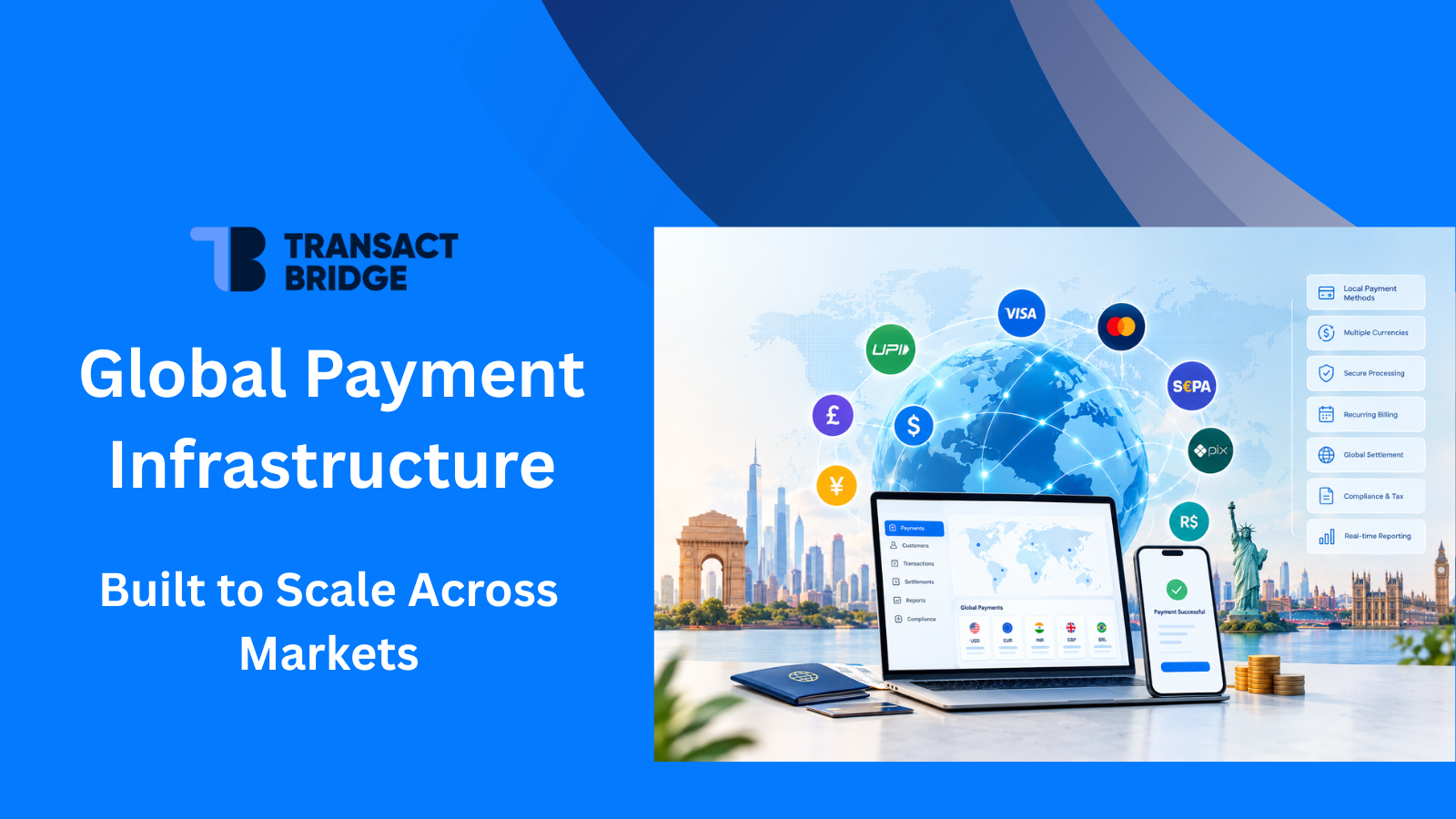
Global payment infrastructure is the technology, payment capabilities and operational framework a business needs to accept payments across markets, manage transactions and recurring revenue, settle funds, handle tax and compliance obligations, and reconcile payments with finance systems.
For a digital or SaaS business, international expansion can quickly turn payments into a complex operating layer. The challenge is not simply accepting payments in more countries. It is managing everything that happens before, during and after the transaction.
The right payment infrastructure connects local payment methods, processing, billing, settlement, disputes, compliance and reporting into one scalable model, so each new market does not require a completely new payment operation.
The 7 layers of global payment infrastructure
-
Local payment acceptance
-
Processing and routing
-
Risk, authentication and disputes
-
Billing and recurring payments
-
Currency and settlement
-
Tax, compliance and Merchant of Record
-
Reconciliation and reporting
1. Local payment acceptance
Customers expect to pay in the way they already use locally. A global SaaS business therefore needs more than international card acceptance; it needs relevant local payment methods in the markets it targets.
For example, UPI is deeply embedded in India, while Pix is central to Brazil's payment landscape. The Central Bank of Brazil reports more than 170 million individual Pix users and more than 7 billion Pix transactions in January 2026.
The practical question for a CEO is simple: can customers in each target market pay without friction, and can the business support those methods without creating a separate payment operation for every country?
CEO checkpoint: List the top markets on your roadmap and confirm the payment methods customers expect in each one.
2. Processing and routing
Once a customer chooses a payment method, the infrastructure behind the transaction determines how reliably it is authorised, processed and settled.
A scalable setup should support:
-
Multiple payment methods and currencies
-
Reliable transaction routing
-
Local acquiring where appropriate
-
Clear handling of declines and retries
-
Consistent payment performance across markets
For a SaaS business, this matters because payment failures directly affect conversion and recurring revenue. A payment stack should therefore be evaluated on transaction performance, coverage and operational resilience – not simply the number of integrations available.
CEO checkpoint: Ask how the provider handles routing, local processing and transaction failures as volume grows.
3. Risk, authentication and disputes
International payments introduce different fraud patterns, authentication requirements and dispute processes. These cannot be treated as a single global rule.
The infrastructure should define how authentication is handled, how suspicious transactions are addressed, who manages disputes, and critically – who carries financial liability when a chargeback occurs.
This is particularly important under a Merchant of Record model, where the payment provider can take on defined merchant-side obligations and chargeback liability.
CEO checkpoint: Ask one question directly: “If a customer disputes a transaction, who owns the operational process and financial liability?”
4. Billing and recurring payments
For SaaS and subscription businesses, accepting the first payment is only the beginning. The payment infrastructure must support the full revenue lifecycle.
Look for:
-
Recurring billing and scheduled charges
-
Automated retries and failed-payment recovery
-
Payment-method updates
-
Upgrades, downgrades, cancellations and refunds
-
Clear subscription and transaction reporting
A strong recurring-payment setup reduces avoidable revenue leakage and gives finance teams a consistent view of subscription collections across markets.
CEO checkpoint: Review what happens when a recurring payment fails, a card expires, or a customer changes plans.
5. Currency, FX and settlement
Global customers may pay in local currencies while the business manages revenue in one or more operating currencies. That creates decisions around pricing, conversion, settlement and foreign-exchange exposure.
Ask:
-
Which currencies can customers pay in, and which can the business accept?
-
Where are funds settled?
-
What FX rates, fees and conversion rules apply?
-
How quickly are funds available?
-
Can finance reconcile local collections to the business's reporting currency?
The goal is predictable cash flow, not simply the ability to display multiple currencies at checkout.
CEO checkpoint: Map the path from customer payment to the currency that reaches the company's bank account.
6. Tax, compliance and Merchant of Record
Cross-border selling creates obligations that vary by market. The payment infrastructure needs to account for the regulatory and tax model under which the business sells.
For example, selling into the US can create state tax obligations even without a physical presence there. In South Dakota v. Wayfair, the US Supreme Court held that physical presence was not required for substantial nexus under the circumstances before the Court.
In the EU, the VAT One Stop Shop (OSS) allows eligible businesses to declare and pay VAT on covered cross-border sales through a single registration in one Member State, subject to the scheme's rules.
If you sell into India, check that your payment provider holds PA-CB. The RBI's framework treats entities facilitating cross-border payment transactions as Payment Aggregator-Cross Border entities.
The Merchant of Record question is equally important. Under a business-owned model, the business retains the relevant merchant, tax and payment obligations. Under a MoR model, the MoR assumes the obligations assigned to it under that structure.
CEO checkpoint: Before entering a new market, identify who owns tax, regulatory, payment and chargeback obligations.
7. Reconciliation and reporting
Payment infrastructure is incomplete if finance cannot explain where money came from, what fees were deducted, which transactions were refunded or disputed, and what ultimately reached the bank account.
A global setup should provide:
-
Transaction-level reporting
-
Settlement and payout reporting
-
Refund and dispute visibility
-
Fee and FX visibility
-
Data that can reconcile to accounting and finance systems
For CEOs, this is about control. As transaction volume and markets increase, manual reconciliation becomes an operational bottleneck.
CEO checkpoint: Ask finance how long it takes to reconcile payment activity to bank settlements today and what happens when transaction volume doubles.
Build, buy or use a Merchant of Record?
|
Model |
Business owns |
Provider owns |
|
Build internally |
Payment operations, compliance, tax processes, reconciliation |
Technology components only |
|
Payment provider |
Product, commercial model and selected obligations |
Payment processing and defined payment operations |
|
Merchant of Record |
Product, customer relationship and commercial decisions |
Merchant-side obligations covered by the MoR structure |
For many digital businesses, the decision is less about owning payment technology and more about deciding how much payment, tax and operational complexity the company wants to own.
Decide what your business should own
Map your payment, tax and chargeback responsibilities before you enter another market.
Global payment readiness checklist
Give your current payment stack one tick for every capability it handles well:
-
Local payment methods in priority markets
-
Reliable processing and routing
-
Recurring billing and recovery
-
Multi-currency acceptance and settlement
-
Tax and regulatory responsibilities clearly assigned
-
Chargeback ownership clearly defined
-
Transaction-to-settlement reconciliation
-
Reporting that finance can use without manual rebuilding
3 or more unchecked boxes: your payment infrastructure may become an operational constraint as you expand.
How Transact Bridge fits
Transact Bridge operates as a Payment Service Provider and Merchant of Record, supporting digital and SaaS businesses with payment acceptance and the operational responsibilities that come with international sales.
Its payment infrastructure includes:
-
99.5% transaction clearance rate
-
99.8% recurring billing stability
-
45+ payment methods
-
PA-CB
-
A PCI DSS-compliant hosted checkout that reduces the card-data scope your team has to manage
Under its MoR model, Transact Bridge absorbs chargeback liability.
For businesses selling across India, the US and global markets, the value is having payment acceptance, recurring billing, settlement and defined merchant responsibilities managed through one infrastructure layer.
Bottom line
Expand globally without building a payment operation
Acceptance, recurring billing, settlement and compliance, managed through one infrastructure layer.
FAQs
What payment infrastructure does a global business need?
A global business typically needs local payment methods, processing and routing, authentication and dispute management, recurring billing, multi-currency settlement, tax and regulatory support, and reconciliation. The exact setup depends on its markets, business model and whether it uses a Payment Service Provider, Merchant of Record or a combination of providers.
What payment setup does a US SaaS company need to sell in India?
A US SaaS company needs payment methods relevant to Indian customers, cross-border payment support, appropriate tax and regulatory handling, currency and settlement capabilities, and reliable recurring billing if it operates a subscription model. If the provider is facilitating cross-border payments into India, the business should check that the provider holds PA-CB. Transact Bridge can provide the PSP and MoR infrastructure for this model.
Can a business sell internationally without creating a local entity in every country?
Sometimes, depending on the country, product, tax position, regulatory requirements and sales model. A Merchant of Record can take on defined merchant-side obligations in supported markets, which can reduce the need for the business to build those functions itself. It does not remove the need to assess local requirements.
What is the difference between a payment gateway, PSP and Merchant of Record?
A payment gateway primarily connects the checkout experience to payment processing. A Payment Service Provider can provide broader payment acceptance and processing capabilities. A Merchant of Record goes further by becoming the merchant for the transaction and taking on specified merchant-side responsibilities under the applicable structure.
What should a CEO consider when choosing global payment infrastructure?
Look beyond payment-method coverage. Evaluate transaction performance, market coverage, recurring billing, settlement and FX, tax and regulatory responsibilities, dispute and chargeback ownership, reconciliation, reporting, implementation effort and the ability to support expansion without adding disproportionate operational complexity.


