
How Can Businesses Accept Payments Across Multiple Countries?
Published on: Wed 30-Sep-2026 10:46 AM
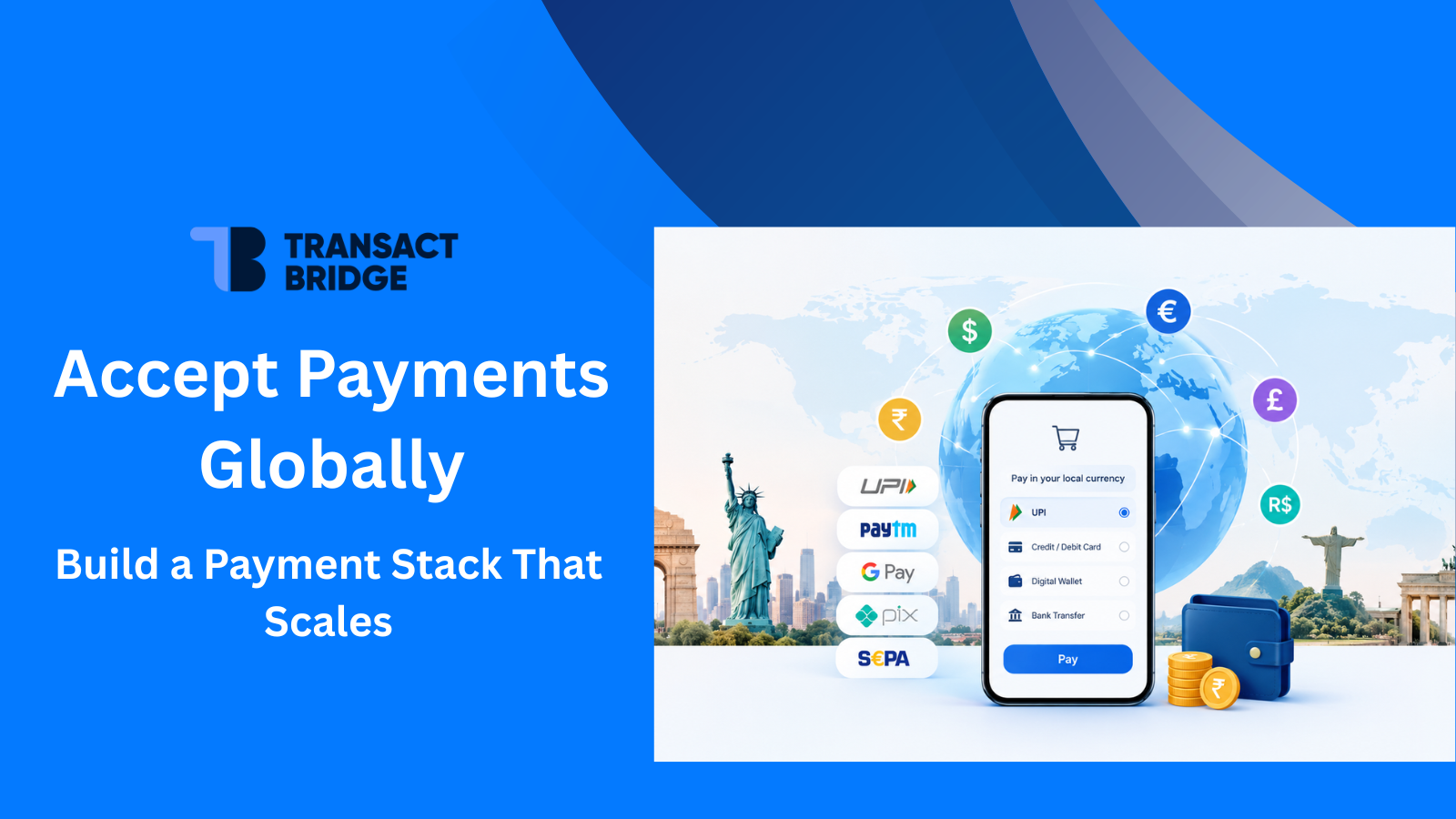
Businesses accept payments across multiple countries by combining local payment methods, multi-currency processing, cross-border payment infrastructure, settlement and market-specific compliance. The right setup depends on where customers are located, how they prefer to pay, where funds need to settle and who handles the responsibilities attached to each transaction.
The challenge isn't simply accepting international payments. It's making payments work locally for customers without creating a separate payment operation for every market.
Why Can't Businesses Use the Same Payment Setup Everywhere?
Digital wallets accounted for 56% of global e-commerce transaction value in 2025, but the payment mix behind that global number varies significantly by market. India, the US, Brazil and European markets each have different payment behaviours and local rails.
|
Market |
Key payment signal |
2025 share of e-commerce value |
|
Global |
Digital wallets |
56% |
|
India |
Digital wallets |
68% |
|
United States |
Cards (direct) |
48% |
|
Brazil |
Pix / A2A |
42% |
|
Germany |
Digital wallets |
52% |
Source: 2026 Global Payments Report. Figures represent each market's reported payment-method mix and are not intended as a like-for-like comparison of the same payment category.
The contrast matters.
In India, digital wallets are closely connected to account-to-account payments and the UPI ecosystem. In the US, direct card use remains significant, while digital wallets account for 40% of online value and often act as a convenient interface for card-funded payments. Brazil has built a very different online payment environment around Pix, while Germany combines strong wallet usage with established bank-based payment options.
For a business expanding internationally, this means a payment method that works well in one country cannot automatically be treated as the default everywhere else.
1. Start With Local Payment Methods
The first step to accepting international payments is understanding the global payment methods customers actually use in each market.
That means looking beyond Visa and Mastercard and asking:
-
Which local payment methods do customers already trust?
-
Are account-to-account payments widely used?
-
Do customers expect digital wallets?
-
Are bank transfers or direct debits important?
-
Which methods support recurring payments?
-
What payment methods are common in your specific customer segment?
For example, a US SaaS company entering India may find that offering cards alone leaves a significant part of the market unsupported. Adding UPI can make the checkout feel native rather than foreign.
The goal isn't to offer every payment method available. It's to offer the right payment methods for the customers and markets that matter to your business.
2. Separate Multi-Currency Payments From Settlement
Accepting a customer's local currency and receiving funds in your preferred settlement currency are two different parts of the payment flow.
A US business selling digital services to Indian customers, for example, may want to:
Display prices in INR → collect through UPI → settle proceeds in USD to its US account.
That requires more than currency conversion. The payment setup needs to account for:
-
Customer-facing currency and pricing
-
Payment-method availability by market
-
FX conversion and associated costs
-
Settlement currency and destination account
-
Refunds and reconciliation
-
Reporting across multiple currencies
This distinction becomes increasingly important as a business adds markets. Local customer experience and centralised financial operations do not have to mean the same currency or settlement structure.
3. Choose the Right International Payment Processing Model
There are several ways to build the payment layer for international expansion.
Global payment provider
A global provider can give businesses access to multiple markets through a consolidated integration. This can reduce the number of provider relationships a payments team has to manage.
The trade-off is that market coverage, local payment methods, settlement capabilities and compliance responsibilities still need to be assessed country by country.
Local payment providers
Businesses can also work with providers in each market.
This can provide deep local coverage, but it may create additional integrations, contracts, reporting formats, reconciliation workflows and operational processes as the business expands.
Merchant of Record
A Merchant of Record can take on responsibilities associated with selling to customers, including payment collection, certain tax and compliance obligations, refunds and chargeback liability, depending on the arrangement.
A payment gateway processes the transaction; a Merchant of Record also takes on the obligations attached to the sale.
This can reduce the operational burden for companies that don't want to build every part of the international commerce stack themselves.
For a deeper comparison, see our Merchant of Record vs. Payment Gateway guide.
The important question isn't just which provider processes the payment. It's which responsibilities stay with your business after the payment is processed.
4. Tax and Compliance Requirements for Cross-Border Payments
International payments don't operate independently of the rules governing the underlying sale.
In the US, the Supreme Court's South Dakota v. Wayfair decision established that a physical presence is not the only basis on which a state can require an out-of-state seller to collect sales tax. Economic-nexus rules and thresholds now vary by state.
India introduces another layer for overseas businesses. Cross-border payment aggregation is governed by the Reserve Bank of India's PA-CB framework, while GST rules can apply to digital services supplied to customers in India.
Selling into Europe
For B2C digital services, EU VAT generally follows the customer's country under the destination principle. Non-EU businesses supplying qualifying services to EU consumers can use the One Stop Shop (OSS) to register in one EU Member State and declare and pay VAT across participating EU markets through a single system.
The payment architecture therefore needs to support more than collection. It needs to fit the tax and regulatory structure surrounding the transaction.
Not sure who handles tax in your next market?
Get clarity on payment, settlement and compliance before you launch in the US, India, Brazil or Europe.
5. Evaluate the Entire Payment Operation
Before choosing a payment partner, evaluate the complete operating model — not just the checkout.
|
Capability |
What to evaluate |
|
Local payment methods |
UPI, cards, ACH, Pix, SEPA and other market-specific methods |
|
Multi-currency payments |
Local pricing, currency conversion and FX |
|
Settlement |
Where and in which currency funds can settle |
|
Tax & compliance |
Market-specific tax, invoicing and regulatory requirements |
|
PCI DSS |
Whether payment data can be handled through a compliant hosted environment |
|
Recurring billing |
Support for subscriptions and repeat payments across markets |
|
Chargebacks & disputes |
Who manages disputes and who carries chargeback liability |
|
Reconciliation |
Whether transactions, refunds and settlements can be reconciled across markets |
For subscription businesses, recurring billing should be evaluated alongside payment-method coverage, failure recovery and reporting.
Businesses using multiple payment providers may also consider payment orchestration as a coordination layer for managing providers, routing, retries and reporting. This differs from a Merchant of Record, which can take on seller-side responsibilities as well as payment-related obligations.
Every new country can create a new payment operation
Consider a US SaaS business expanding first into India and then Brazil.
The payment stack now needs to support:
US → USD → cards/ACH → US tax rules → US settlement
India → INR → UPI/local methods → India tax and compliance → cross-border collection
Brazil → BRL → cards/Pix → Brazilian tax requirements → local settlement considerations
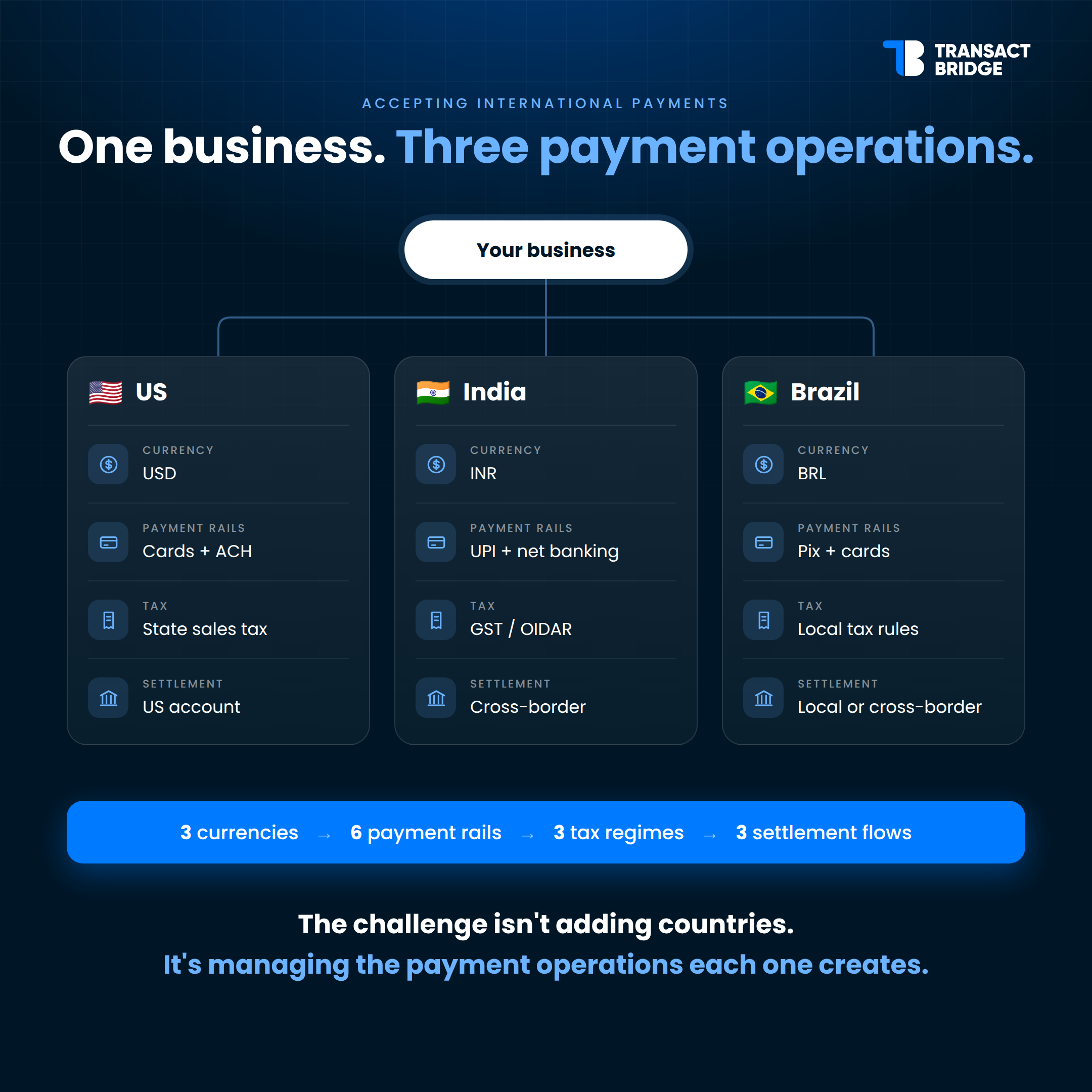
The company has added two markets, but it may also have created additional payment integrations, currencies, tax processes, reconciliation workflows and dispute operations.
That's the hidden operational cost of international expansion.
You're not just choosing a payment provider. You're building a payment operation.
The more countries you add, the more important it becomes to decide which parts of that operation you want to build yourself and which you want a payment partner to handle.
For businesses scaling across multiple markets, reducing payment friction also means understanding why otherwise valid transactions fail.
See our guide: How Payment Failures Are Quietly Killing Your Net Revenue Retention
How Transact Bridge Helps Businesses Accept International Payments
Transact Bridge provides payment infrastructure for businesses selling across India, the US and global markets, including Brazil and Europe.
Businesses can access 45+ payment methods, including UPI, net banking and cards for India, cards and ACH for the US, Pix for Brazil, and local payment methods across Europe.
The platform supports:
-
Local payment methods and cross-border payment acceptance
-
Multi-currency payments and settlement
-
Recurring billing
-
Merchant of Record services
-
Tax, invoicing and compliance support
-
Chargeback and dispute handling
-
Reconciliation and payment reporting
Transact Bridge reports 99.5% transaction clearance and 99.8% recurring billing stability. It also holds PA-CB authorisation for cross-border payment aggregation, while its hosted checkout is PCI DSS compliant.
Under its Merchant of Record model, Transact Bridge fully absorbs chargeback liability, reducing one of the operational responsibilities businesses otherwise need to manage themselves.
Enter new markets without rebuilding your payment stack
45+ payment methods, multi-currency settlement and chargeback liability absorbed, all through one integration.
Final Takeaway
Accepting payments across countries is not simply a matter of adding more currencies to checkout.
The payment method customers expect, the currency they want to see, the way funds settle and the regulatory responsibilities attached to the sale can all change from one market to another.
The scalable approach is to build a payment operation that can adapt to those differences without forcing your finance, engineering and compliance teams to rebuild the stack every time you enter a new country.
FAQs
Which payment methods should I offer in each country?
Start with the methods customers already use in that market. This can include UPI in India, cards and ACH in the US, Pix in Brazil, and SEPA or other local bank methods across Europe. The right mix also depends on your business model, customer segment and whether you support one-time or recurring payments.
Transact Bridge covers payment acceptance across all four regions through a consolidated payment infrastructure.
Can a US business accept UPI?
Yes. A US business selling to customers in India can accept UPI through a payment provider that supports the required cross-border payment structure. The business also needs to consider currency, settlement, tax and regulatory requirements.
Transact Bridge supports UPI acceptance and holds PA-CB authorisation for cross-border payment aggregation.
What's the difference between multi-currency payments and settlement?
Multi-currency payments determine how customers are charged and what currency they see at checkout. Settlement determines where the collected funds go and which currency the business ultimately receives.
A business can therefore charge a customer in INR while settling proceeds in USD, subject to the payment provider's capabilities and applicable rules.
Do I need a local entity to sell in India?
Not necessarily. The answer depends on the business model, payment flow, regulatory structure and how the transaction is processed. Businesses should assess local payment, tax and cross-border requirements before entering the market.
What should businesses look for in an international payment provider?
Look beyond the number of countries supported. Evaluate local payment methods, currencies, settlement, recurring billing, tax and compliance support, chargebacks, reconciliation, reporting and the responsibilities your business retains.


