Integrated Payment Solutions: What They Are, How They Work, and What Global Businesses Need
Published on: Wed 26-Aug-2026 04:11 PM
A practical guide for founders, CEOs, and finance leaders scaling across India, the US, and global markets.
A SaaS company starts in Bengaluru, wins its first enterprise logos in the US, then sees demand build in the UK, the UAE, and Singapore. On paper, a growth story. Under the hood, a mess: one provider for domestic UPI and cards, a separate US processor, currencies that don't reconcile, tax obligations no one has mapped, and a finance team rebuilding settlement files by hand every month. The product works. The payments don't.
That gap is what integrated payment solutions are built to close and it points to a distinction most guides miss. Integrated payments solve one problem: connecting payments to your business. Global payment infrastructure solves the next one: connecting that payment operation to each market you sell into.
Once you sell internationally, you need both. This guide covers what integrated payments are, how they work, when you need them, and how to evaluate them when your customers, currencies, and compliance obligations span multiple markets.
What are integrated payment solutions?
Integrated payment solutions connect payment processing directly to the software a business already runs – its website, checkout, POS, billing system, ERP, or CRM – so transactions, reconciliation, and reporting happen automatically instead of through manual, disconnected steps. Payments stop living in a separate silo and become a native part of how the business operates.
At their simplest, integrated payments remove the swivel-chair problem: no re-keying transactions, no reconciling two systems that disagree, no customer bounced to a third-party page to pay. A sale updates revenue, inventory, and the customer record at the moment the payment clears. That's the domestic definition and it's where most content stops. For a business selling into multiple countries, an integrated payment system has to do more, which we'll build up to.
How do integrated payments work?
Integrated payments work by embedding payment capabilities into business software through APIs and SDKs, so that when a customer pays, the transaction is authorized, captured, and automatically reflected across the business's other systems – accounting, inventory, CRM – in real time, without manual reconciliation.
The flow of a single transaction:
- Checkout : the customer pays inside your site, app, or POS, without being redirected.
- Capture and encryption : payment data is secured and passed for authorization.
- Authorization : the processor checks with the customer's bank or card network to approve or decline.
- Settlement : approved funds are routed toward the merchant's account.
- Sync : the transaction updates revenue, inventory, receipts, and customer records.
Payment integration that stops at step four moves money but doesn't feed it back into your systems – the disconnected model most businesses start with. For businesses that need operational integration, the flow should close the loop at step five, passing transaction and settlement data into the systems that depend on it, for every payment method and market you operate in.
When does a business need integrated payment solutions?
Businesses typically benefit from integrated payment solutions when payment volume, payment methods, markets, or operational complexity make manual reconciliation and disconnected systems hard to manage. Below a certain scale, a simple checkout is fine. Past it, the gaps start costing real money and time.
You're likely at that point if several of these apply:
- You're entering new countries, and each one means another provider to bolt on.
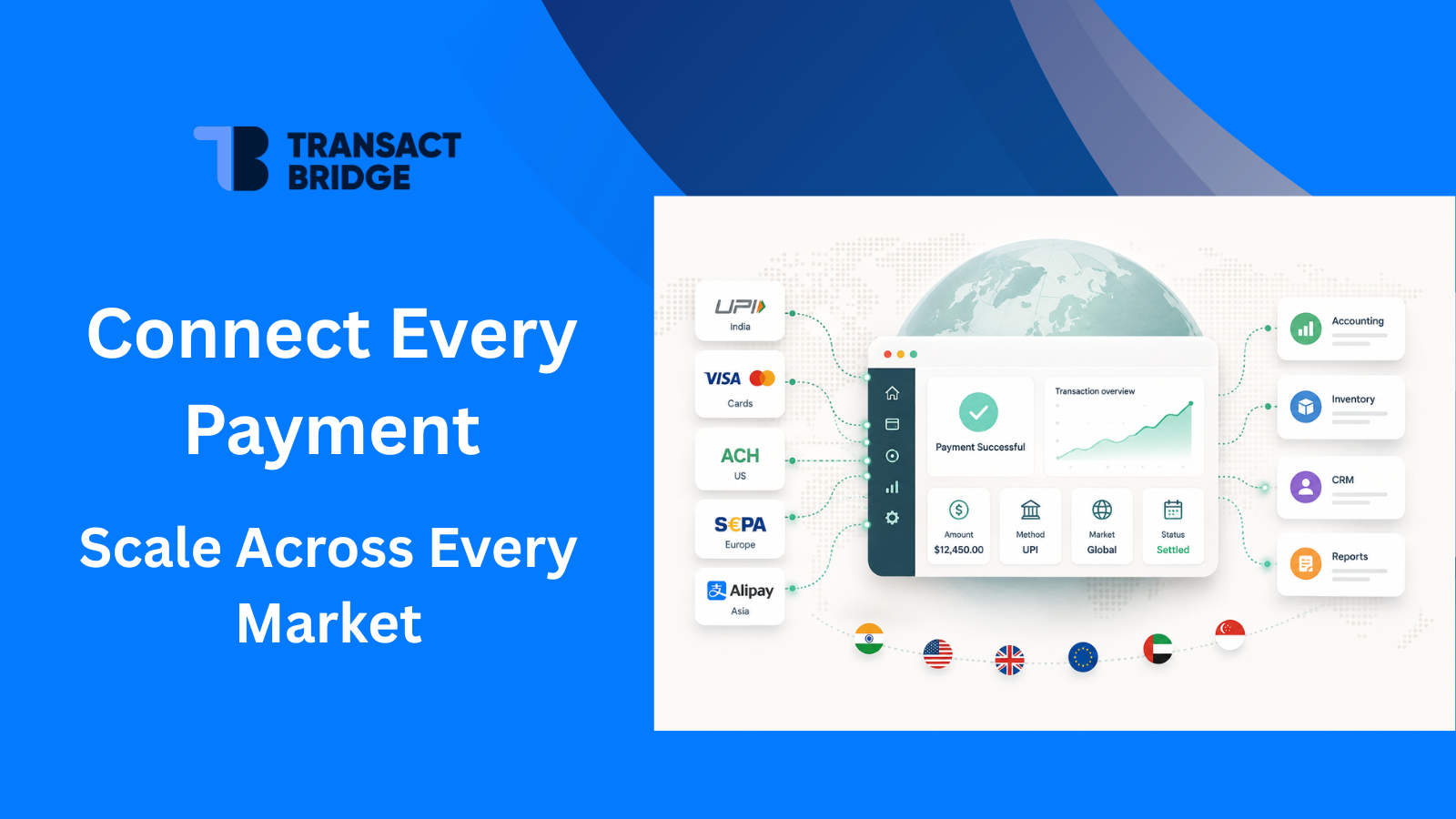
- You're adding local payment methods – UPI, ACH, SEPA, wallets – and want them in one flow, not one integration each.
- Finance spends significant time reconciling payments across systems that don't agree.
- You're running subscriptions and need reliable recurring payment processing, retries, and renewals.
- You have multiple PSPs or gateways and no single view of performance.
- Payment failure rates vary sharply by market, and you can't see why or fix it centrally.
The more that apply, the more a fragmented setup is quietly capping growth.
See If You've Outgrown Your Payment Setup
Get a quick read on where fragmentation is costing you time and revenue.
What are the core components of an integrated payment solution?
It's tempting to reduce integration to "a gateway plus a processor." In practice, an integrated payment solution spans three layers and for global businesses, the third decides whether expansion works.
Layer | What it includes | What it determines |
Payment infrastructure | Gateway, processor/acquirer, APIs & SDKs, tokenization/security | Whether payments are captured, authorized, and protected |
Business integration | ERP, CRM, billing/subscription system, accounting/reconciliation | Whether payment data flows into the systems that run the business |
Local payment methods, multi-currency processing, local acquiring, FX, settlement, tax/compliance, fraud/risk | Whether the business can operate – and stay compliant – in each market |
A domestic tool can skip the third layer; a solution built for international growth cannot. And integrated does not mean all-in-one: a business can run several specialized providers and still have an integrated payment architecture, as long as those systems communicate reliably through APIs, orchestration, and unified reporting. Integration is defined by how well the pieces talk to each other – not by whether one company supplies them all.
The executive test. Any payment system has to answer three questions: Can the customer pay? (acceptance – local methods, currencies), Can the business get paid efficiently? (processing, FX, settlement), and Can the business operate legally at scale? (reconciliation, tax, compliance).
Those three questions map directly onto the three layers above. A provider that answers only the first two works fine at home and breaks the moment you cross a border.
Why do businesses need integrated payments?
Businesses need integrated payments because disconnected systems create manual work, reconciliation errors, security gaps, and lost sales – while integrated systems improve efficiency, data accuracy, security, and checkout conversion, benefits that compound as volume grows.
- Operational efficiency : automating the flow between acceptance and back-office removes manual data entry and reconciliation.
- Cleaner books : transaction data syncs automatically, keeping records accurate and audit-ready.
- Stronger security : data stays inside controlled, tokenized, PCI DSS-compliant environments rather than shuttling between third parties.
- Real-time visibility : leaders see cash flow and performance as they happen.
- Higher conversion : a native checkout with the customer's preferred method reduces friction, which matters most at the point where a lost transaction is a lost customer.
Individually, these gains may look modest. At scale, across several markets, they determine whether the payment operation scales with the business or becomes another source of manual work.
Integrated payments vs. gateway vs. embedded vs. orchestration vs. Merchant of Record
These terms get used interchangeably, and they shouldn't be.
Term | What it means |
Payment gateway | Captures and transmits payment data for authorization – one component of a stack |
Integrated payments | Payment processing connected natively to your business software – an architecture |
Embedded payments | Payment functionality built into a platform so users never leave it – a UX pattern |
Payment orchestration | A technology layer connecting multiple providers, acquirers, and methods that routes each transaction by defined rules |
Merchant of Record (MoR) | A provider that becomes the seller of record and assumes specified legal, tax, and compliance responsibilities for eligible sales |
Two distinctions matter most for cross-border growth. Payment orchestration is about optimization – sending each transaction to the provider most likely to approve it. A Merchant of Record is about liability – becoming the seller of record and taking on defined tax and compliance responsibilities, with scope depending on the market, product, and arrangement. A gateway moves data; orchestration improves outcomes; an MoR changes who is responsible.
Why integration changes when you go cross-border
You've seen the distinction stated; here's what it looks like inside the transaction itself. Domestically, a sale runs a short path. Internationally, the same sale runs a much longer one:
Domestic flow: Customer → Checkout → Gateway → ERP
Cross-border flow: Customer → Local method → Acquirer → Processing → FX → Settlement → Reconciliation → Tax & compliance
One integration, multiple markets.
Each added stage – local acceptance, FX, settlement, market-specific tax and compliance – is one a single-country gateway was never built to handle. And the stakes are concrete: digital wallets accounted for 56% of global e-commerce value in 2025, per Worldpay's Global Payments Report, so a checkout built around international cards alone risks missing the largest payment-method category by global e-commerce value. That is the layer a market-aware integration has to cover.
India, the US, and global markets
Every market brings its own methods, regulations, and compliance obligations. These aren't the story – they're proof points for why market-aware infrastructure matters.
Dimension | India | United States | EU / other markets |
Common local methods | UPI, cards, net banking, wallets | Cards, ACH, wallets, BNPL | SEPA, iDEAL, cards, wallets; Pix in Brazil; APAC wallets |
Key framework | RBI, NPCI | State sales-tax regimes | PSD2 (moving to PSD3/PSR) |
Signature issue | RBI authorization, GST | Economic nexus sales tax | SCA; VAT / OSS |
India is defined by the scale of UPI, which accounts for roughly 85% of the country's digital payment transactions by volume (NPCI). Volume share isn't the same as any given merchant's revenue mix – B2B differs sharply from consumer retail – but the implication holds: support UPI alongside cards and other local methods, or design in friction.
The United States exposes a trap: accepting a payment and being sales-tax compliant are different problems. Since South Dakota v. Wayfair (2018), a business can owe tax in a state on sales volume alone – economic nexus – with no physical presence there (Congressional Research Service). A Merchant of Record can assume responsibility for collection and remittance as the seller of record, where the arrangement covers it.
The EU requires Strong Customer Authentication under PSD2, and the framework is evolving beyond it: the PSD3/PSR package introduces further changes to authentication, fraud prevention, and payment-services regulation. VAT and One-Stop-Shop reporting sit on top. The pattern everywhere is identical: acceptance, authentication, settlement, and tax differ by country, and none are optional.
Merchant of Record: what it does and what it doesn't
A Merchant of Record becomes the seller of record for eligible transactions and assumes specified responsibilities associated with the sale – which can include payment processing, applicable tax collection and remittance, and certain compliance obligations, depending on the market and arrangement.
What it does not do is erase every obligation automatically. The split between what the MoR handles and what stays with the merchant depends on the market, product, transaction structure, and contract.
Manage directly | Use an MoR | |
Tax registration & remittance | Managed by the business | Managed by the MoR where covered by the arrangement |
Seller-of-record responsibilities | Retained by the business | Assumed by the MoR |
Local payment infrastructure | Built and managed by the business | Provided through the MoR's network |
Compliance workload | Primarily internal | Reduced through the MoR model |
Market expansion | Requires market-by-market setup | Can simplify expansion where supported |
Treated as a model that shifts specific, agreed responsibilities rather than a blanket transfer of all liability, an MoR becomes one of the most useful tools for entering markets without first standing up a compliance operation in each one.
Not Sure What an MoR Should Cover For You?
Talk through your markets and products to see what shifts off your plate.
How to evaluate an integrated payment provider
Compare a basic setup against a genuine global solution and note why each line matters rather than assuming "more" is automatically better.
| Requirement | Basic gateway | Integrated payment solution | Why it matters globally |
Limited | Broad, per market | Improves local checkout experience | |
Multi-currency | Limited | Yes | Lets customers pay in their currency |
Local acquiring | Limited | Available | Can improve acceptance rates |
Settlement & FX | Varies | Consolidated | Reduces leakage and complexity |
Reconciliation | Separate | Unified | Cuts finance workload |
Tax / compliance | Merchant responsibility | Provider / MoR-dependent | Reduces market-entry complexity |
Recurring billing | Varies | Yes | Supports subscription models |
To turn that into a decision, weight the areas by impact on cross-border growth:
Evaluation area | Priority |
Local payment methods | Critical |
Global acceptance | Critical |
Tax & compliance support | Critical |
Settlement & FX | High |
Reconciliation | High |
APIs & integrations | High |
Fraud & risk | High |
Recurring billing | Medium |
Pricing / total cost of ownership | Medium |
If a provider integrates only the checkout while leaving local acceptance, settlement, tax, and compliance fragmented, it may solve an operational problem without solving the underlying complexity. For businesses seeking to reduce that complexity, the provider should take on as much of the market-specific infrastructure and compliance workload as its model allows.
Evaluating providers? Talk to Transact Bridge about your target markets, payment methods, settlement requirements, and compliance model.
What does an integrated payment solution cost?
The cheapest payment provider is not always the lowest-cost payment stack. The headline transaction fee is rarely the real number; for a CFO, the useful question is total cost of ownership – the visible line items plus the costs a fragmented stack hides.
Visible costs | Hidden costs |
Transaction fees | Staff time reconciling multiple settlement reports |
FX / currency conversion fees | Failed payments and retries lost to poor local acceptance |
Platform or integration fees | Multiple provider contracts to manage |
Chargeback / dispute fees | Engineering time building per-country integrations |
Refund fees (the transaction fee is often not returned) | Tax registration, filing, and compliance overhead |
Payout & settlement fees | FX leakage and capital trapped in local settlement accounts |
PCI-DSS / compliance certification fees | Fraud losses, net of prevention tooling |
A cheaper gateway that leaves your team carrying the right-hand column is often far more expensive than an integrated solution priced slightly higher on the left. Moving from "what's your rate?" to "what does it cost to operate this stack?" is where the real economics surface.
Get a True Cost-of-Ownership Estimate
See the hidden costs your current stack may be absorbing quietly.
Implementation: what a rollout looks like
Phase | What happens | Typical effort |
1. Scope | Map markets, currencies, methods, and billing model | Days |
2. Integrate | Connect via API/SDK or plugin into checkout, app, back-office | Days to weeks |
3. Configure | Enable local methods and currencies per market; set up reconciliation | Days |
4. Test | Run sandbox transactions per method and market before going live | Days |
5. Launch & monitor | Go live, then watch approval rates, settlement, reconciliation | Ongoing |
The heaviest lifting – local acquiring relationships, tax registration, market-specific compliance – is exactly what an MoR model is designed to reduce, which can significantly reduce market-entry setup. Real timelines still vary by country and product.
Where Transact Bridge fits
This is where the distinction between an integrated payment tool and integrated payment infrastructure becomes practical. Transact Bridge is built around the latter, providing acceptance, settlement, and defined compliance capabilities across markets, so the business doesn't rebuild that stack country by country. In practice, that's three capabilities:
- Local acceptance : payment methods across India, the US, and global markets in a single integration, so customers pay the way they expect.
- Payment performance : authorization infrastructure built to approve more of the transactions that should succeed; Transact Bridge reports a 99.5% authorization rate (the share of submitted transactions approved) across its own processing.
- Recurring revenue : subscription and renewal infrastructure, where Transact Bridge reports 99.8% recurring billing stability (the continuity of successful recurring charges).
Across those capabilities it supports 100+ payment methods. The aim isn't to add another gateway. It's to replace a fragmented, high-maintenance stack with infrastructure designed to scale as the business enters new markets.
The Bottom Line
For a business selling in one country, integrated payments are a convenience that cleans up operations. For a business selling across India, the US, and global markets, they're the infrastructure that decides whether international revenue actually materializes – whether the payment succeeds, the sale is compliant, and the books close without heroics. The right integrated payment infrastructure turns international payments from a collection of market-by-market processes into a scalable operating layer, letting businesses expand without rebuilding their payment stack every time they enter a new market.
FAQs
What are integrated payment solutions?
Integrated payment solutions connect payment processing with a business's existing software – checkout, billing, ERP, or CRM – so payment data moves automatically between systems. For businesses operating across markets, they can also bring together local payment methods, multi-currency processing, settlement, and reconciliation in one place.
How do integrated payments work?
They embed payment capabilities into business software via APIs and SDKs. When a customer pays, the transaction is authorized and captured, then automatically synced across the business's other systems in real time – eliminating manual reconciliation.
What's the difference between integrated payments and a payment gateway?
A payment gateway is a single component that captures and transmits payment data for authorization. Integrated payments describe the broader architecture connecting that processing to your business systems. A gateway is a part; integrated payments are the whole connected system.
What is the difference between integrated payments and payment orchestration?
Integrated payments connect payment processing with a business's operational systems. Payment orchestration connects multiple payment providers, acquirers, and methods and can route transactions between them by defined rules. A business can use both: orchestration optimizes routing, while integration connects payment activity to the systems that run the business.
Is an integrated payment solution the same as an all-in-one payment provider?
No. Integration describes how payment systems connect with business software and each other; it does not necessarily mean one provider supplies every component. A business can use multiple specialized providers while maintaining an integrated architecture through APIs, orchestration, and unified reporting.
Are integrated payment systems secure?
Yes. Reputable systems use tokenization, encryption, and PCI DSS-compliant handling to keep sensitive data inside controlled environments rather than passing it between multiple third parties – reducing both breach risk and fraud exposure.
Can integrated payment solutions support UPI and international cards?
Yes, this is a core reason cross-border businesses adopt them. A capable integrated solution can accept UPI and other local methods alongside international cards in one flow, letting a business serve Indian and international customers without separate, disconnected setups.
Can integrated payment solutions handle multiple currencies?
Strong solutions accept local methods, process in multiple currencies, and settle across markets. Multi-currency processing lets customers pay in their own currency, reducing friction and abandonment and it's where basic domestic gateways typically fall short.
How do integrated payment solutions help businesses expand internationally?
By consolidating local acceptance, multi-currency processing, settlement, reconciliation, and market-specific compliance into one integration, they let a business enter new markets without rebuilding its payment stack each time. Paired with a Merchant of Record model, much of the tax and compliance workload can shift to the provider, depending on the arrangement.
When does a business need integrated payment solutions?
When payment volume, methods, markets, or operational complexity make manual reconciliation and disconnected systems hard to manage. Common triggers: entering new countries, adding local methods, running subscriptions, operating multiple gateways, or seeing performance vary sharply by market.
Do I need a Merchant of Record for cross-border payments?
An MoR helps when you want to enter new markets without building tax registration, remittance, and compliance for each one yourself. It becomes the seller of record and assumes specified responsibilities, with exact scope depending on the market and arrangement.
Is accepting payments in a country the same as being tax-compliant there?
No, and conflating the two is a common, costly mistake. A processor can approve transactions in a market while the merchant remains responsible for sales tax, GST, or VAT. An MoR model can shift specific tax responsibilities to the provider, depending on the arrangement.