
How to Launch Your SaaS Globally Without Building Billing, Tax, Compliance, and Payment Infrastructure
Published on: Thu 30-Jul-2026 11:17 AM
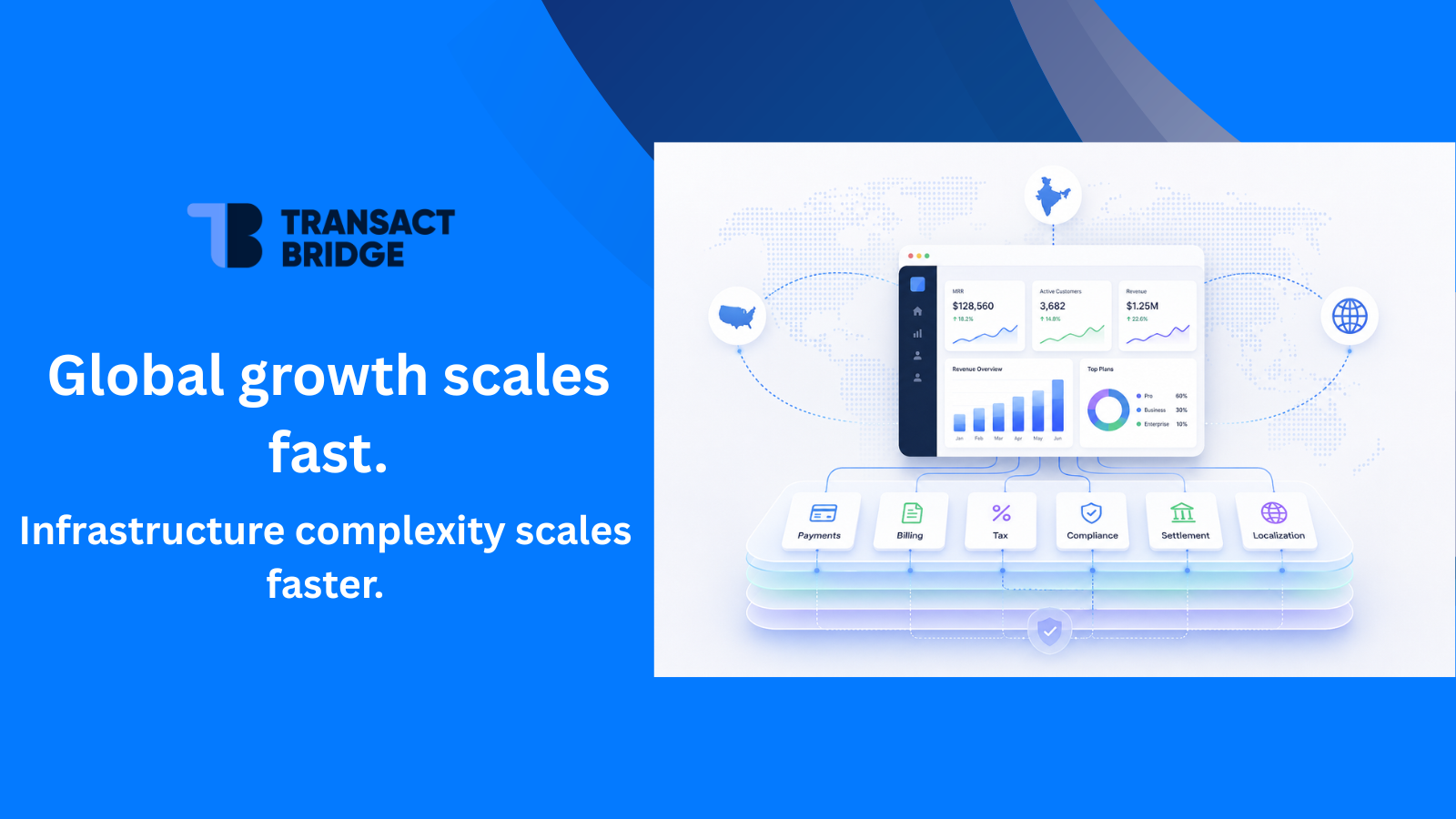
You can launch your SaaS globally without building payment infrastructure by acquiring six capabilities – payments, billing, tax, compliance, settlement, and localization – as configured infrastructure rather than in-house systems. The fastest route is to connect a platform that already operates these across your target markets, so entering a new country becomes a configuration step instead of a multi-quarter build.
The first global customer is the easiest one to celebrate and the hardest one to support.
One sale, closed in a market you weren't set up for, silently creates a stack of requirements that were invisible the day before: recurring billing, tax registration, regulatory compliance, local payment methods, compliant invoices, currency handling, fraud cover. None of it showed up in the demo. All of it now stands between you and getting paid.
This is where most international expansion quietly stalls. Not on the product – on the infrastructure behind the sale. And the reflex to "just add a payment method and figure out the rest later" is exactly what turns a first international win into a back-tax bill and a stalled second market.
This guide is about the alternative: launching across India, the US, and other global markets without building that infrastructure yourself.
What infrastructure do you need to launch SaaS globally?
You need six core capabilities: payments, billing, tax, compliance, settlement, and localization. Miss any one and the system degrades – a great checkout with the wrong tax logic still ends in penalties; perfect compliance with card-only acceptance still loses the sale.
Here is what each capability does and what breaks without it:
- Payments : accepting the methods and currencies each market actually uses. Without it: customers who want to pay but can't.
- Billing : recurring charges, upgrades, proration, dunning, invoicing. Without it: silent revenue leakage from failed renewals.
- Tax : calculating, collecting, and remitting VAT / GST / US sales tax per jurisdiction. Without it: penalties and blocked enterprise deals.
- Compliance : the rules governing how money is collected and moved across borders. Without it: frozen funds and failed audits.
- Settlement : getting funds home, compliantly, in the currency you hold. Without it: money stuck in the wrong place.
- Localization : currency, language, and payment options that feel native at checkout. Without it: trust and conversion collapse.
Key insight: "Global payments" is a category error. You are not buying a way to accept money. You are buying the ability to stay a compliant seller in dozens of jurisdictions at once without building a legal, tax, and treasury function in each one.
The global SaaS infrastructure stack
Every cross-border sale travels through the same chain. Seeing it as a stack – rather than a single "payments" box – is what makes the build-vs-buy decision obvious.
Customer
↓
Local Checkout (language, currency, local methods)
↓
Payment Infrastructure (cards, UPI, ACH, SEPA, wallets)
↓
Billing Engine (recurring, proration, dunning)
↓
Tax Engine (VAT / GST / US sales tax)
↓
Compliance Layer (RBI, state nexus, VAT rules)
↓
Settlement (multi-currency payout home)
↓
Finance (reconciliation, reporting)
Your engineering team can ship the top box – a checkout – in a sprint. It cannot ship the bottom five in the same sprint. Those aren't features. They're departments.
Can you launch globally right now? A readiness check
You're launch-ready when you have payments, billing, tax, compliance, settlement, and localization in place. If any row shows a warning, that's the gap to close – not a reason to wait.
Requirement | Status |
Local payment methods (not just cards)? | Launch-ready / Needs work – lose conversions in card-light markets |
Recurring billing with dunning? | Launch-ready / Needs work – revenue leaks from failed renewals |
Tax determination + remittance? | Launch-ready / Needs work – compliance risk from the first sale |
Cross-border compliance coverage? | Launch-ready / Needs work – frozen funds, failed audits |
Multi-currency pricing + settlement? | Launch-ready / Needs work – customers pay in the wrong currency |
Localized checkout? | Launch-ready / Needs work – trust drops at the last step |
Why India, the US, and the rest of the world need different infrastructure
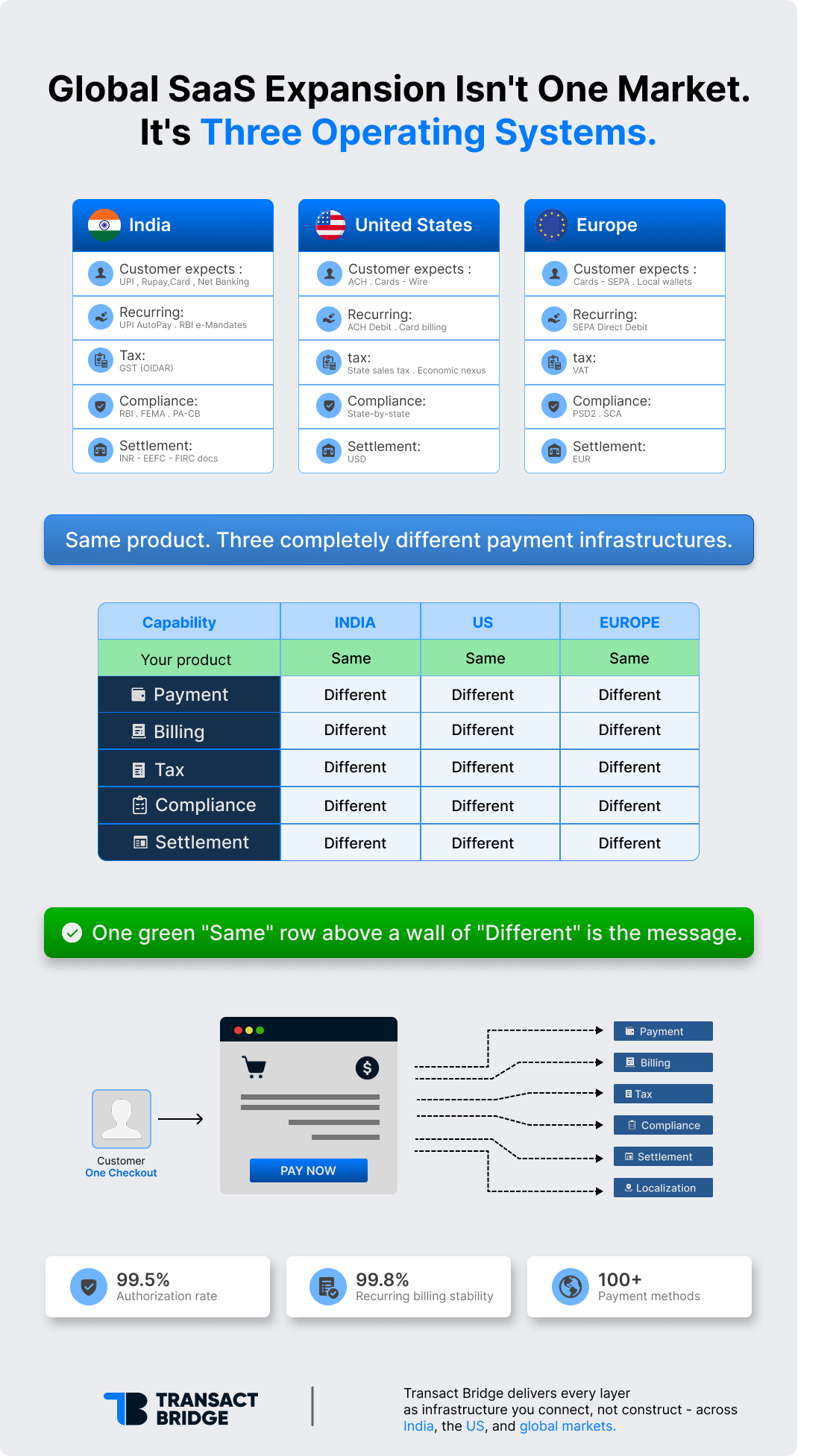
This is the part generic "sell globally" advice skips and it's where expansion actually breaks. There is no single "international" payment setup. Whether you're entering India, expanding into the US, or launching across other global markets, each corridor runs on different rails, different taxes, and different regulators.
India | United States | Europe | |
Dominant payment method | UPI | ACH + cards | Cards, SEPA |
Preferred recurring payment | UPI AutoPay | ACH debit | SEPA direct debit |
Consumption tax | GST (OIDAR) | State sales tax | VAT |
Regulator | RBI | 50 state tax authorities | Many, per country |
Tax threshold quirk | Effectively zero for digital services | Economic nexus, varies by state | Often zero for digital services |
A few realities behind that table:
India is not a card-first market. According to NPCI data reported by the government-backed India Brand Equity Foundation (IBEF), UPI processed a record 23.2 billion transactions worth roughly ₹29.9 lakh crore (about US$312 billion) in May 2026 and industry figures attributed to the IMF and ACI Worldwide place India at close to half of all real-time payments globally. A card-only checkout ignores how the market pays. Recurring billing also runs under RBI e-mandate and tokenization rules that catch foreign systems off guard.
The United States has no federal sales tax. Since the Supreme Court's 2018 South Dakota v. Wayfair decision, states can require even foreign sellers to collect sales tax once they cross an economic nexus threshold – commonly $100,000 in sales or 200 transactions and SaaS is taxable in some states but not others, so you track nexus and taxability, state by state.
Selling out of India adds a layer the Western playbook ignores entirely: collecting foreign currency into India is regulated. Cross Border (PA-CB) framework, FIRC documentation, LRS rules, and EEFC settlement all apply – so an Indian founder billing a US customer needs export-compliance infrastructure, not just a checkout.
This is why the same SaaS company can sell flawlessly in one market and stall in the next. The product travels. The infrastructure doesn't.
Taxes are only one layer of this. Once you begin selling globally, tax becomes one part of the infrastructure you need – see the SaaS Tax Compliance Guide for the full breakdown by jurisdiction.
One product. Three sets of rails, taxes, and regulators.
UPI AutoPay, ACH debit, SEPA — handled across all three.
What happens after your first international customer?
A single international sale sets off a chain reaction – each requirement triggers the next, from local payment methods through to finance operations and support. The requirements are invisible before the sale and non-negotiable after it.
Here is the chain that one customer starts:
First international customer
↓
Need local payment methods (they couldn't have paid otherwise)
↓
Need recurring billing (a subscription, not a one-off)
↓
Need tax registration (VAT / GST / sales tax now applies)
↓
Need compliant invoicing (their finance team requires it)
↓
Need settlement (funds have to reach you, in your currency)
↓
Need compliance (both collecting and repatriating money)
↓
Need finance operations (reconciliation across currencies and rails)
↓
Need support (billing questions route somewhere)
Notice what this isn't: a payments problem you solve once. It's a sequence, and each link assumes the one before it. Skip tax registration and the compliant invoice is impossible. Skip settlement planning and revenue sits in the wrong country. This is why "we'll add a payment method" is never where it ends – it's where it starts.
The strategic question isn't how do I handle each of these? It's do I build this chain myself, market by market, or connect it already assembled?
Example: a SaaS company expands from India to the US
To make the chain concrete, follow one company – a Bengaluru-based SaaS product that lands its first US customer.
Month 1 → One US customer signs up
↓
USD subscription (needs recurring billing in USD)
↓
Sales-tax obligation (is SaaS taxable in that state? nexus?)
↓
ACH payment request (the customer's finance team prefers ACH over card)
↓
Annual invoice (procurement won't pay without a compliant invoice)
↓
FIRC + PA-CB settlement (funds must reach India, with export documentation)
↓
Finance reconciliation (USD revenue, INR books, FX to track)
↓
Month 6 → Second country (the entire chain repeats – new tax, new methods, new rules)
Nothing here is exotic. Each step is the ordinary consequence of the step before it and none of it was visible when the deal closed. A team building in-house treats this as seven separate projects across two countries.
A team on connected infrastructure treats it as configuration: the billing, tax logic, ACH acceptance, PA-CB settlement, and FIRC documentation already exist, and the second country is a setting, not a rebuild.
That gap – seven projects versus one configuration – is what separates companies that expand steadily from companies that stall after their first international win.
Build it yourself, incorporate, or connect it: the three real choices
There are three ways to acquire international infrastructure – build it in-house, incorporate local entities in each market, or connect existing infrastructure. They differ most on time-to-launch and on who carries tax and compliance liability.
Build in-house | Local entities | Connected infrastructure | |
Time to first compliant market | 12–18 months | Months per country | Days |
Adding a new country | Repeat the full build | Incorporate again | Configuration |
Who owns tax/compliance liability | You, everywhere | You, via each entity | The infrastructure partner |
Ongoing overhead | Dedicated eng, tax, legal | Entity maintenance, filings | Absorbed by the partner |
Best for | Firms with full in-house tax + treasury teams | Committed physical presence in a market | SaaS that wants to launch now, compliantly |
Building it yourself:
Week 1 → Checkout
Week 2 → Payments
Week 4 → Billing engine
Month 3 → Tax engine + registrations
Month 6 → Compliance layer
Year 1 → Country #2
→ ...then repeat the whole cycle, per country
Connecting existing infrastructure:
Connect → Configure → Launch
For the deeper cost breakdown, see International Expansion Challenges.
Days, not quarters
Skip the 12–18 month build. Connect infrastructure that already runs across your markets.
Build vs. buy, capability by capability
Some of these you can reasonably build. Others are where "build" quietly becomes a year-long compliance project. This is the matrix that decides it:
Capability | Build | Buy |
Payments | Feasible | Included |
Billing | Feasible | Included |
Tax | Hard | Included |
Compliance | Very hard | Included |
Settlement | Hard | Included |
Localization | Hard | Included |
Payments and billing are genuinely buildable if you have the engineers. Tax, compliance, settlement, and localization are where in-house teams lose quarters because the work isn't code. It's registrations, remittance, and regulatory tracking that never stops changing. That asymmetry is the entire case for connecting infrastructure instead of constructing it.
7 infrastructure mistakes SaaS founders make before global launch
Most failed launches trace back to the same avoidable errors. Each of these can also be its own trap worth understanding in depth.
1. Using Stripe as the strategy. A processor is a tool, not a go-to-market plan. It moves money and hands the tax and compliance burden straight back to you – in every jurisdiction where you sell. Treating "we have Stripe" as "we're ready to sell globally" is the most common and most expensive assumption in cross-border SaaS.
2. Assuming cards are enough. Cards dominate in some markets and are a minority method in others. In India, a card-only checkout ignores UPI – the rail that carries the overwhelming majority of the country's real-time payments. Every card-only market you enter leaves conversion on the table.
3. Ignoring local payment methods. Beyond cards, each market has methods customers trust and expect – UPI in India, ACH for US B2B, SEPA in Europe. Offering them isn't a nicety; it's the difference between a customer who completes checkout and one who abandons it.
4. Launching without tax planning. Founders trained on the US $100,000 nexus number assume every market gives them room before tax applies. Across the EU and India, digital-services thresholds are often zero. The obligation starts on the first sale. "We'll deal with tax at volume" is the advice that generates back-tax bills.
5. Building billing before validating the market. Engineering a bespoke billing and compliance stack for a country before you know it will convert is effort spent backwards. Validate demand first; commit infrastructure second.
6. Registering local entities too early. Incorporating in every target country is slow, costly, and – for the merchant-of-record model – usually unnecessary. Many founders create legal entities to solve a problem that compliant infrastructure already solves.
7. Localizing pricing but not checkout. Showing local currency while the payment methods, tax handling, and language stay foreign is half a localization. Customers notice the seam, and trust drops exactly at the moment they are about to pay.
One operating model worth understanding: merchant of record
Everything above is about acquiring infrastructure instead of building it. There are a few ways to do that and for SaaS selling across many tax regimes at once, one model stands out: the merchant of record (MoR).
A merchant of record is the legal entity that sells your product to the end customer. The customer buys from the MoR; the MoR pays you. That single legal shift moves the heaviest obligations off your balance sheet – because the MoR, not you, becomes responsible for tax collection, remittance, nexus, and chargeback liability across the markets it covers.
This is fundamentally different from a payment gateway. A gateway processes the transaction and leaves you as the merchant of record by default. You still owe tax everywhere you have nexus. An MoR takes that role on. It's the difference between renting a card terminal and outsourcing your entire international tax and compliance function.
For a full treatment of the model, see Merchant of Record Explained.
Key insight: Choosing an operating model like MoR isn't a payments decision made by engineering. It's a liability decision made by the CEO and CFO because it determines whether you or your infrastructure partner files tax in 50 US states and 27 EU members.
Move tax and compliance liability off your balance sheet
Transact Bridge becomes the compliant seller across the markets it covers.
What is the fastest way to launch SaaS globally?
The fastest way to launch SaaS globally is to connect infrastructure that already supports payments, billing, tax, compliance, settlement, and localization across multiple markets – instead of building each capability individually. This turns market entry from a multi-quarter engineering and legal project into a configuration step measured in days.
Build your SaaS. Not global infrastructure.
Your competitive advantage isn't filing VAT returns in 27 countries. It isn't maintaining payment integrations across dozens of markets. It isn't tracking every sales-tax rule or recurring-payment regulation.
Your advantage is building a product customers love.
Everything else is infrastructure – necessary, unavoidable, and almost never the thing that wins or loses your market. The fastest-growing SaaS companies understand this. They don't build payment infrastructure country by country. They build products, and they connect infrastructure that lets them launch everywhere else.
Where Transact Bridge fits
That's the role Transact Bridge is built for: payments across India, the US, and global markets, delivered as infrastructure you connect rather than construct. Local payment methods where they matter (UPI in India, ACH and cards in the US, and 100+ payment methods across markets), multi-currency acceptance and settlement, recurring billing engineered for real-world renewal rules, and the cross-border compliance work – from US sales-tax logic to India's PA-CB and FIRC requirements – handled inside the platform.
Transact Bridge sustains a 99.5% payment authorization rate and 99.8% recurring billing stability, because in cross-border SaaS, success rate translates directly into recovered revenue.
The point isn't to add a tool to your stack. It's to remove the layers below the checkout – and the departments you'd otherwise build to run them.
FAQs
How do you launch a SaaS globally?
Launching a SaaS globally means putting six capabilities in place for every market you enter: payments, billing, tax, compliance, settlement, and localization. You can build them in-house, incorporate local entities in each country, or connect existing infrastructure that already operates across your target markets.
The connected route is fastest because entering a new country becomes a configuration step rather than a multi-quarter build. Platforms such as Transact Bridge provide these capabilities across India, the US, and other markets through a single integration.
What is the biggest challenge when launching SaaS globally?
The biggest challenge isn't building the product. It's supporting international sales with payments, billing, tax, compliance, localization, and settlement across multiple jurisdictions. Each new market adds its own payment methods, tax rules, and regulators, so the operational load grows faster than the engineering does. This is why most stalls happen after the first international sale, not before it.
What infrastructure do you need to sell SaaS internationally?
Selling SaaS internationally requires six capabilities: payments, billing, tax, compliance, settlement, and localization. These work together to let customers pay in local methods, keep subscriptions running, calculate and remit the right taxes, meet local regulations, and settle funds across borders. Many SaaS companies acquire them through a merchant of record or global payments platform instead of building each one individually.
Can you sell SaaS globally without registering companies in every country?
Yes. Using a merchant of record, you can sell into new markets without incorporating a local entity, opening a local bank account, or registering for tax in each country, because the merchant of record acts as the compliant seller on those transactions. This is how founders – including those in India – sell into the US and worldwide from their existing entity.
Can I launch SaaS globally without a merchant of record?
Yes. Many SaaS companies build their own billing, payments, tax, and compliance infrastructure, or establish local entities in each market instead. A merchant of record simply offers an alternative that reduces operational overhead and speeds up expansion. The trade-off is control and cost versus the time and staff an in-house build or multiple entities demand.
Can I use Stripe to sell SaaS globally?
Partly. Stripe is a payment processor, so it moves money, but selling globally also requires tax registration and remittance, cross-border compliance, localization, and settlement, which remain your responsibility as a processor. That is the gap a merchant of record or connected infrastructure layer fills, by taking on the tax and compliance burden a gateway leaves with you.
What's the difference between a payment gateway and a merchant of record?
A payment gateway processes payments, while a merchant of record becomes the legal seller and assumes tax, compliance, and chargeback responsibilities. That means a gateway leaves tax registration, remittance, and liability with you in every market, whereas a merchant of record takes them on as part of the global payment infrastructure it provides. The difference is renting a card terminal versus outsourcing an international tax and compliance function.
What taxes apply when selling SaaS internationally?
Consumption taxes apply based on where your customer is located: EU and UK VAT, US state sales tax, India GST under the OIDAR framework, and equivalents in 80-plus countries. Many regimes – including the EU and India – have effectively zero registration thresholds for digital services, so the obligation can begin on your first sale. In the US, taxability also varies by state, so you track economic nexus and product taxability together.
Do I need to register for VAT before selling SaaS globally?
Often, yes. If you sell to customers in VAT jurisdictions such as the EU or UK, registration may be required from your first sale, because digital-services thresholds there are frequently zero. Other markets – including India, which uses GST rather than VAT – have their own indirect-tax regimes with similar early-registration obligations. A merchant of record removes this step by registering and remitting on your behalf.
How do SaaS companies accept payments worldwide?
SaaS companies accept payments worldwide by offering the methods customers actually use in each market – UPI and cards in India, ACH and cards in the US, SEPA in Europe, and local rails elsewhere – alongside multi-currency pricing and settlement. Customers convert better when they can pay using familiar methods and currencies, so card-only checkouts leave significant conversion unrealized in markets like India. A global payments platform provides these methods through one integration.
Do you need local payment methods to sell SaaS globally?
Usually, yes. Customers are more likely to complete purchases when you offer methods they already use, such as UPI in India, ACH in the US, or SEPA in Europe. Card-only checkouts often reduce conversion in markets where local payment methods dominate, so matching each market's preferred rails is one of the highest-impact steps in global expansion.
How does an Indian SaaS company collect USD from US and global customers?
An Indian SaaS company collects foreign currency compliantly under the Reserve Bank of India's Payment Aggregator – Cross Border (PA-CB) framework, which covers foreign-exchange handling, FIRC documentation, and settlement to Indian or EEFC accounts. With a PA-CB-compliant provider, a founder in India can bill overseas customers while the export-compliance paperwork flows automatically – no US entity or US bank account required.
Can you launch SaaS globally from India?
Yes. Indian SaaS companies can sell to the US and worldwide from their existing Indian entity, without incorporating abroad. Foreign earnings are collected compliantly under the RBI's PA-CB framework, with FIRC documentation and settlement to Indian or EEFC accounts. Using a merchant of record, the US sales tax, EU VAT, and other market-side obligations are handled on the platform, so a founder in India sells globally without building infrastructure in each country.
When should a SaaS company build its own payment infrastructure?
Building in-house makes sense when you have dedicated tax, legal, and treasury teams, you sell in only a few jurisdictions where you'll incorporate anyway, or you need total control over billing and checkout. Below that point, building international tax and compliance yourself usually costs more than it looks – not in engineering hours, but in registrations, filings, and penalties. Most SaaS companies connect infrastructure instead until scale justifies owning it.
What is the fastest way to launch SaaS in multiple countries?
The fastest way is to connect infrastructure that already supports payments, billing, tax, compliance, settlement, and localization across those markets, instead of building each capability per country. This turns market entry from a multi-quarter engineering and legal project into a configuration step measured in days and it doesn't repeat from scratch for every new market the way an in-house build does.


