
Merchant of Record vs Payment Aggregator vs PSP: Which Model Fits Your Digital Business?
Published on: Fri 25-Sep-2026 04:40 AM
When a business expands into a new market, accepting payments is only one part of the problem.
The bigger question is who owns everything that happens around the payment – from the merchant relationship and funds flow to taxes, refunds, chargebacks, compliance and settlement.
That is why choosing between a Merchant of Record (MoR), Payment Aggregator (PA) and Payment Service Provider (PSP) is not simply a payment-processing decision.
It is an operating-model decision.
For CEOs expanding across India, the US and other global markets, understanding that distinction helps determine how much payment infrastructure the business should own and how much it should outsource.
MoR vs Payment Aggregator vs PSP: The quick comparison
|
Merchant of Record |
Payment Aggregator |
Payment Service Provider |
|
|
Primary role |
Takes the legal seller role and manages broader transaction responsibilities |
Aggregates payment acceptance for merchants |
Provides payment infrastructure and connectivity |
|
Merchant relationship |
MoR is the seller to the customer |
Business remains the merchant |
Business remains the merchant |
|
Merchant account / funds structure |
MoR collects as the seller |
Aggregator operates the aggregation structure and settles to merchants |
Business connects through the PSP's payment infrastructure |
|
Tax responsibility |
Handled within the MoR model |
Remains with the merchant |
Remains with the merchant |
|
Refunds & disputes |
Managed within the MoR arrangement |
Managed according to the aggregation arrangement |
Merchant manages them through the payment infrastructure |
|
Operational burden |
More outsourced |
Reduced payment-acceptance complexity |
More responsibility remains with the business |
|
Best suited to |
Businesses prioritising speed, simplicity and international expansion |
Businesses seeking aggregated payment acceptance |
Businesses wanting greater control over their payment stack |
The distinction between a PA and PSP becomes particularly important in India. Under the RBI's PA-CB framework, Payment Aggregators-Cross Border facilitate cross-border payment transactions and operate specific collection/settlement structures, including escrow or collection accounts.
Why this matters when you go global
Payment infrastructure is not identical from one market to another.
India is a clear example.
UPI accounted for 81% of retail digital payment transactions in FY2024–25, according to the Government of India. For a business entering India, therefore, local payment infrastructure is not simply about adding another payment button. It is about supporting the way customers actually pay.
The US presents a different payment mix. The Federal Reserve's 2025 Payments Study found that consumers and businesses made 236.6 billion noncash payments in 2024. Cards represented more than three-quarters of payments by number, while ACH accounted for almost three-quarters of noncash payment value.
The infrastructure decision therefore goes beyond:
“Which payment methods can we accept?”
A global business also needs to decide:
-
Who is the legal seller?
-
Who holds or receives customer funds?
-
Who settles money on the business?
-
Who handles applicable taxes?
-
Who manages refunds and disputes?
-
Who owns payment compliance?
-
How much operational responsibility stays with the internal team?
That is where the three models diverge.
Accept payments the way your customers pay
45+ payment methods, with MoR and PSP models built for international businesses.
What is a Merchant of Record?
A Merchant of Record is the entity that becomes the legal seller in the transaction.
Instead of simply providing payment infrastructure, the MoR sits between the customer and the underlying business as the seller and takes responsibility for a broader set of transaction obligations.
A simplified flow looks like this:
Customer → Merchant of Record → Business
The MoR manages:
-
Payment collection
-
Local payment methods
-
Applicable indirect taxes
-
Refunds
-
Fraud and payment risk
-
Payment-related compliance
-
Settlement to the underlying business
This makes the MoR model particularly relevant for businesses entering multiple markets without wanting to build a separate payment and tax operating structure for every market.
When does an MoR make sense?
An MoR is useful when a business:
-
Wants to enter markets without building the entire local payment infrastructure
-
Has a lean finance, tax or compliance team
-
Sells digital products, SaaS, subscriptions or other online services
-
Wants local payment methods without managing every local payment relationship
-
Wants to centralise payment and tax operations
-
Prioritises faster market entry and lower operational complexity
The trade-off is straightforward: more responsibility moves to the MoR, while the business gives up some direct control over the transaction structure.
For a closer look at how an MOR differs from a payment gateway, read Merchant of Record vs Payment Gateway: Which Do You Need
What is a Payment Aggregator?
A Payment Aggregator enables businesses to accept payments through an aggregated payment structure rather than requiring every merchant to build its own direct acquiring relationships.
The clearest way to understand the model is through funds flow.
The aggregator onboards merchants, aggregates payment transactions and operates the relevant collection and settlement structure before settling funds to the merchants.
In India's regulatory framework, the RBI defines a PA-CB as an entity that facilitates cross-border payment transactions for permissible goods and services. Its framework also describes an escrow account as an account where PAs pool or aggregate amounts collected on behalf of onboarded merchants.
What does a Payment Aggregator provide?
Depending on the structure, an aggregator provides:
-
Merchant onboarding
-
Payment acceptance
-
Access to multiple payment methods
-
Collection and settlement
-
Transaction reporting
-
Risk and fraud controls
-
Payment operations
The important distinction is that aggregation simplifies the payment layer; it does not automatically make the aggregator the legal seller of the underlying product or service.
For a business using an aggregation model, its own tax, legal, commercial and compliance responsibilities remain significant.
What is a Payment Service Provider?
A Payment Service Provider (PSP) primarily provides the infrastructure through which businesses accept and manage payments.
Think of a PSP as the connectivity and payment infrastructure layer.
A PSP connects a business to:
-
Card networks
-
Bank payment methods
-
Digital wallets
-
Local payment methods
-
Payment gateways
-
Payment processing
-
Fraud and risk tools
-
Recurring payments
-
Reporting and reconciliation
-
Settlement infrastructure
The business remains with the merchant.
That means the company retains greater control over its payment architecture and customer relationship, while also retaining more responsibility for the surrounding commercial and regulatory operations.
The simplest distinction
Payment Aggregator:
The provider operates an aggregation structure for merchants and handles collection and settlement within that structure.
PSP:
The provider primarily gives the business the infrastructure and connectivity required to accept payments.
That distinction is especially useful when evaluating payment infrastructure in India, where RBI's PA framework explicitly addresses the collection and settlement role of PAs.
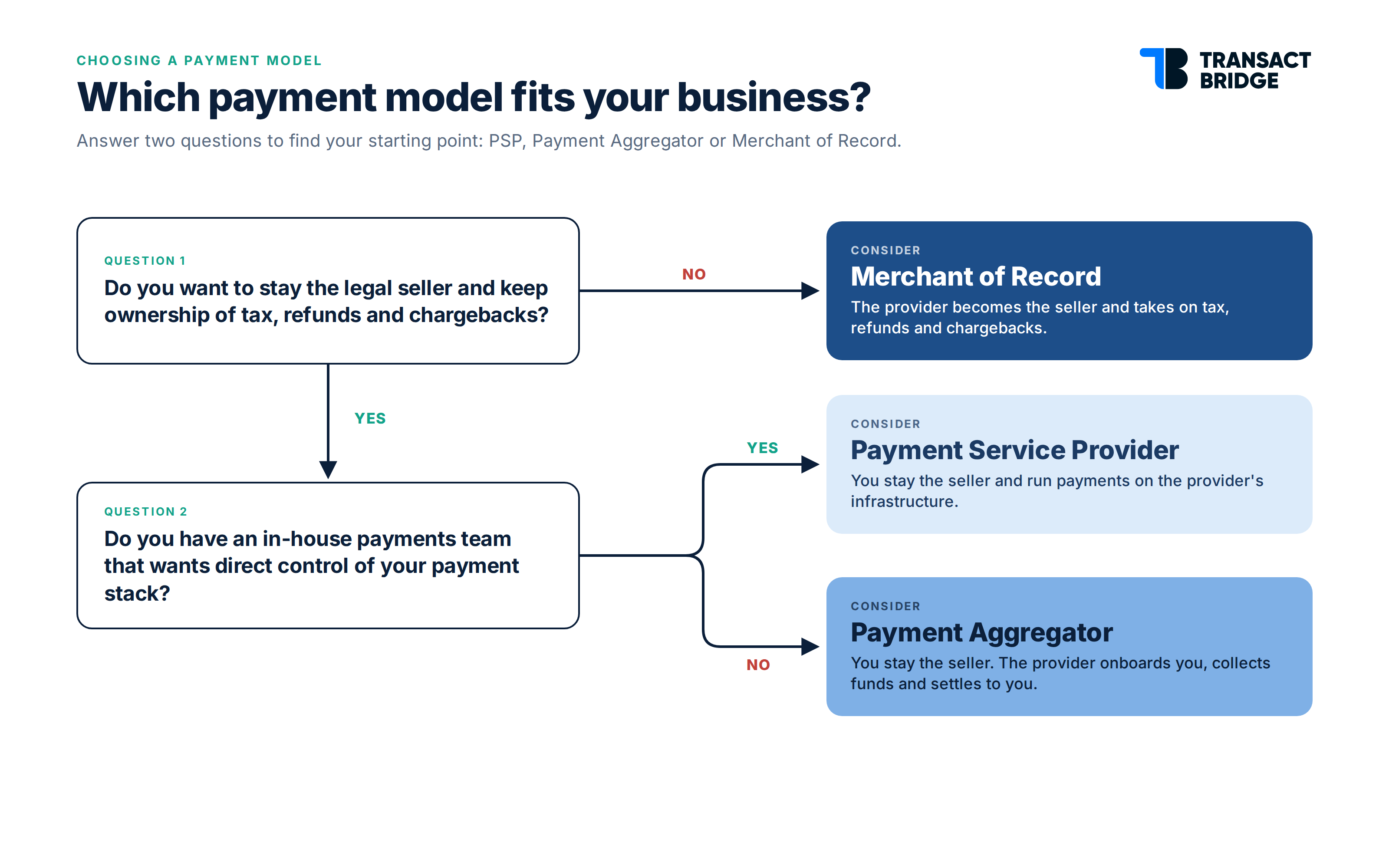
MoR vs PA vs PSP: Which model fits your business?
Instead of starting with the provider, start with what your business actually needs.
|
Business priority |
Model to consider |
Why |
|
Maximum control over payment infrastructure |
PSP |
Keeps the business closer to its payment architecture and merchant relationship |
|
Access to aggregated payment acceptance |
Payment Aggregator |
Simplifies merchant onboarding, collection and settlement |
|
Lean finance and compliance team |
MoR |
Moves a broader set of transaction responsibilities to the MoR |
|
Entering several international markets quickly |
MoR |
Consolidates payment, tax and transaction operations |
|
Established internal payments team |
PSP |
Gives the business more direct control while using external payment infrastructure |
|
Need for cross-border collection under an aggregation structure |
PA-CB |
Provides a regulated structure for applicable cross-border payment aggregation in India |
|
Want payment infrastructure without becoming the legal seller |
PSP / PA |
The business remains with the merchant |
|
Want to outsource more of the transaction operation |
MoR |
The MoR assumes a broader role in the customer transaction |
The decision is therefore less about finding the “best” payment model and more about deciding where your business wants responsibility to sit.
What changes when you choose an MoR, PA or PSP?
The difference becomes clearer when you look at the operating model rather than the product features.
With a PSP
Your business remains the merchant.
You use the PSP to connect to payment infrastructure, but your internal teams continue to manage much of the commercial, tax and regulatory operation.
You get more control. You retain more responsibility.
With a Payment Aggregator
The payment provider sits between your business and the underlying payment infrastructure through an aggregation model.
The provider handles merchant onboarding, payment collection and settlement within that structure.
You simplify payment acceptance without necessarily transferring the broader responsibilities of being the seller.
With an MoR
The provider becomes the seller to the customer and takes on a broader set of responsibilities around the transaction.
You outsource more operational complexity and focus more of your internal resources on the product, customer and growth.
That difference matters when a business moves from one market to five, or from thousands of transactions to millions.
The payment architecture that works at one stage may create unnecessary finance, tax and compliance overhead at another.
Where does TransactBridge fit?
This is where the distinction becomes commercially important.
TransactBridge operates as both a Merchant of Record and a Payment Service Provider, and also holds PA-CB capability for applicable cross-border payment aggregation in India.
That means a business does not have to choose its payment operating model based solely on the provider it selects.
It chooses the level of responsibility that fits its stage, market and operating structure.
Need more control?
Use the PSP model to retain greater control over your payment infrastructure and merchant relationship.
Need an aggregation structure?
Use the PA-CB model where the applicable cross-border payment structure calls for payment aggregation and settlement.
Want to outsource more responsibility?
Use the MoR model to move a broader set of payment, tax and transaction responsibilities to TransactBridge.
The underlying idea is simple:
One provider. Different levels of responsibility.
That can be particularly valuable for businesses expanding across India, the US and global markets, where the payment architecture may need to evolve as the business enters new markets.
TransactBridge's platform is positioned around payments across India, the US and global markets, with local payment infrastructure and Merchant of Record capabilities designed for international businesses.
The 7 questions to ask before choosing a payment model
Before signing with a provider, ask:
1. Who is the legal seller?
This determines where important commercial responsibilities sit.
2. Who holds or receives the customer funds?
Understand the collection, settlement and merchant-account structure.
3. Who handles applicable taxes?
Do not assume that payment processing and tax compliance are the same thing.
4. Who manages refunds and chargebacks?
Understand both operational ownership and financial exposure.
5. Which local payment methods can customers use?
A global checkout should reflect local payment behaviour.
6. What remains with our finance, tax and compliance teams?
Map the work that does not disappear when you outsource payments.
7. Will this model still work at our next stage of growth?
The right payment architecture should support the markets and transaction volumes you expect to reach – not just the ones you have today.
Final takeaway
Choosing between an MoR, Payment Aggregator and PSP is ultimately a decision about how your business wants to operate payments as it scales.
A PSP gives you payment infrastructure and greater control.
A Payment Aggregator gives you an aggregation and settlement structure for payment acceptance.
An MoR takes on the legal seller role and a broader share of the transaction responsibility.
TransactBridge brings these capabilities together – operating as a PSP and Merchant of Record, with PA-CB capability – so businesses can choose the level of payment responsibility that fits their growth.
For companies expanding across India, the US and global markets, that flexibility matters as much as the payment methods themselves.
TransactBridge – Payments across India, the US, and global markets.
Not sure which payment model fits your business?
Talk to our team about where MoR, PSP or PA-CB makes sense for the markets you're entering.
FAQs
Is a Merchant of Record the same as a PSP?
No. A PSP primarily provides payment infrastructure and connectivity. An MoR becomes the legal seller and takes on a broader set of responsibilities associated with the transaction.
A company can provide both services, but the roles themselves are different.
Is a Payment Aggregator the same as a PSP?
No. There can be overlap in the services they provide, but the operating model is different. A Payment Aggregator operates an aggregation structure for merchants, including collection and settlement. A PSP primarily provides payment infrastructure and connectivity.
In India, the RBI's PA framework makes the collection and settlement role particularly explicit.
Does a Merchant of Record handle taxes?
An MoR takes responsibility for applicable indirect-tax processes within the scope of its arrangement. The exact responsibilities should be established contractually for each market and transaction type.
Is a PA-CB relevant to every international business?
No. PA-CB is relevant to entities facilitating applicable cross-border payment transactions under India's regulatory framework. RBI brought entities facilitating cross-border payment transactions for imports and exports of goods and services under direct regulation through its PA-CB framework.
Which model should an international business choose?
Start with the operating responsibility you want to retain.
Businesses seeking greater payment control may prefer a PSP model. Businesses seeking an aggregation structure may consider a PA model where applicable. Businesses that want to outsource a broader set of transaction responsibilities may consider an MoR.
Should CEOs compare providers only on payment processing fees?
No. The total cost of a payment model also includes:
-
Tax and compliance operations
-
Chargebacks
-
Refund administration
-
FX and settlement costs
-
Reconciliation
-
Engineering resources
-
Finance-team workload
-
Market-entry costs
-
Local payment-method coverage
A lower transaction fee does not automatically mean a lower total cost of operating payments.


