
Payment Methods Buyers Expect in the US, EU, Brazil and India
Published on: Tue 20-Oct-2026 09:59 AM
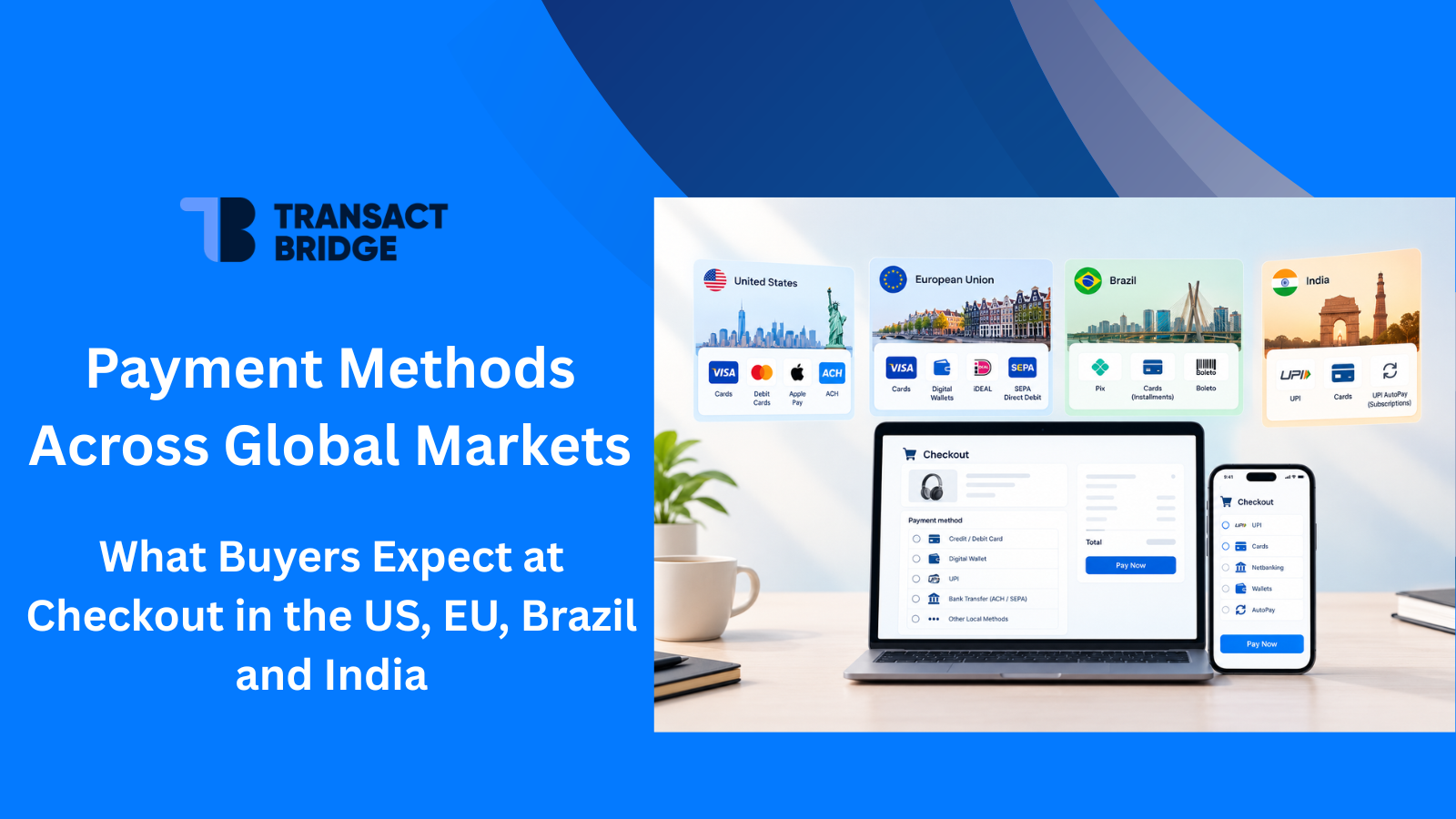
A SaaS company wins its first hundred US customers on a card-only checkout. Six months later it launches in São Paulo with the same checkout. Traffic arrives and trials convert, but Brazilian buyers stall at the payment step. Some of their cards aren’t enabled for international purchases. Others are declined as cross-border. Nothing is broken. The checkout simply asks Brazilians to pay the way Americans do.
Each market has a short list of payment methods its buyers trust.
Quick answer: payment methods to offer in each market
- US: cards and mobile wallets; ACH for invoices and annual plans.
- EU: cards and wallets everywhere, plus each country’s local method (iDEAL | Wero in the Netherlands, Bancontact in Belgium); SEPA Direct Debit for subscriptions.
- Brazil: Pix and credit cards with installments; boleto for buyers without cards and for B2B.
- India: UPI and cards; UPI AutoPay or card e-mandates for subscriptions.
NPCI has also changed when UPI AutoPay debits can run. Read what the UPI AutoPay peak-hour rule means for recurring collections.
How to read these rankings. These are launch priorities for online businesses selling digital products and services, not a league table. Each ranking combines three inputs:
- Official data on how consumers pay
- What buyers expect to see at checkout in that market
- Fit for the use case: a one-off purchase, a subscription or a B2B invoice
The statistics below measure different things, such as share of all payments, share of online payments or share of value. Each one is labelled so you can compare like with like.
Why the most-used method isn’t always the one that carries the money
The method that wins the most transactions is often not the one that carries the most money. Official data shows the same pattern across markets:
-
US: cards lead consumer payments by number, but ACH carried almost three quarters of noncash payment value in 2024
-
Brazil: Pix handled 54.7% of payment transactions in H2 2025 but only 28.6% of value, while TED interbank transfers carried the largest share of value.
-
Germany: e-wallets handle most online payments by number, while direct debit and credit transfer carry the most turnover.
-
India: recurring payments follow separate RBI rules from one-time UPI payments.
So the table below gives an overall launch order for each market, and the use-case table further down splits it by job: consumer checkout, subscriptions and B2B invoices.
Launch order by market
|
Priority |
United States |
European Union |
Brazil |
India |
|
1 |
Credit cards |
Cards |
Pix |
UPI |
|
2 |
Debit cards |
Digital wallets |
Credit cards with installments |
Cards |
|
3 |
Mobile wallets |
Country bank methods |
Boleto |
Netbanking |
|
4 |
ACH bank debit |
SEPA Direct Debit / instant transfers |
Pix Automático |
Wallets and prepaid instruments |
Selling into more than one of these markets?
One integration covers local methods such as UPI, Pix, ACH, cards and wallets, with no local entity required.
United States: cards first, ACH for recurring and B2B revenue
Cards dominate US consumer payments. In 2024, credit cards accounted for 35% of consumer payments by number and debit cards for 30%, according to the Federal Reserve’s 2025 Diary of Consumer Payment Choice.
-
Remote payments are growing. 23% of purchases and person-to-person payments were made remotely in 2024. That share has risen every year since 2021.
-
Mobile wallets matter online. 85% of remote purchases were completed on a mobile device in October 2023. Phone wallets remove card entry on mobile.
-
ACH decides B2B. Offer it for invoices and annual plans, where card fees and card expiry cost the most.
Compliance to plan for: since South Dakota v. Wayfair (2018), states can require remote sellers to collect sales tax once they pass an economic threshold. Selling nationwide can therefore create registration and filing obligations in many states, unless a merchant of record collects and files that tax as the seller.
European Union: one market, many checkouts
Across the euro area, cards are the most used online payment method at 48% of online transactions, ahead of wallets and mobile apps at 29%, according to the ECB’s SPACE 2024 study. These are euro-area averages, and country checkouts differ sharply. EU countries outside the euro area, such as Poland, Sweden and Denmark, also have their own currencies and their own leading local methods, so assess each one before launch.
|
Country |
Assess before launch |
Why |
|
Netherlands |
iDEAL | Wero, cards |
iDEAL handles about 72% of Dutch e-commerce transactions. |
|
Belgium |
Bancontact, cards, Wero |
Bancontact is the domestic default, and Wero is already live in Belgium. |
|
Germany |
Wallets, SEPA Direct Debit, bank transfer, cards |
Wallets lead by number of online payments; bank debits and transfers lead by value. |
|
France |
Cards on the CB network, wallets |
Cards were 53% of online payments in 2024 and online payment solutions 27%. |
The iDEAL-to-Wero transition: iDEAL is moving to the pan-European Wero wallet. All iDEAL merchants are expected to transition by the end of 2027 at the latest. The iDEAL brand will then be phased out gradually.
Compliance to plan for:
-
Strong Customer Authentication (PSD2) adds a verification step to card payments across the EU.
-
Instant payments: since 9 October 2025, euro-area payment providers must offer instant euro transfers and a free Verification of Payee service under the Instant Payments Regulation.
-
VAT: non-EU sellers of digital services generally charge VAT at the buyer’s local rate, typically through the One-Stop Shop. A merchant of record registers, charges and files this VAT as the seller, so you don’t have to.
Brazil: Pix for instant payments, card installments for larger purchases
Pix is Brazil’s most used payment instrument. It accounted for 54.7% of all payment transactions by number in the second half of 2025, a total of 42.9 billion transactions, according to Banco Central do Brasil’s Retail Payment Statistics (BCB open data). By value it held 28.6%, behind TED interbank transfers.
| Method | Best for | Note |
| Pix | One-off online purchases | Instant and familiar to buyers |
| Credit cards with installments (parcelado) | Higher-value purchases | 253.8 million active credit cards at the end of H2 2025 (BCB); buyers expect installments |
| Boleto | Buyers without cards; B2B | Slower to confirm |
| Pix Automático | Subscriptions | Recurring Pix, launched in 2025 |
Compliance to plan for: pricing in reais and offering Pix removes the main card problems foreign merchants face in Brazil:
- Brazilian cards not enabled for international purchases
- Cross-border declines
- IOF tax on foreign-currency card purchases, which the buyer sees
Pricing in reais fixes the checkout problem, not the tax one. Brazil also taxes imported digital services, so decide before launch who calculates and pays that tax: your business, or a merchant of record selling on your behalf.
India: UPI for checkout, mandates for subscriptions
UPI dominates Indian payments. It accounted for 83.4% of India’s payment transaction volume in FY25, according to RBI data. It processed more than 228 billion transactions in calendar 2025, per NPCI data.
Plan one-time and recurring payments separately:
-
One-time payments: UPI (QR code or collect request), cards, netbanking and wallets.
-
Recurring payments: UPI AutoPay or card e-mandates, which follow their own RBI rules.
Compliance to plan for: recurring payments fall under the RBI’s Digital Payments – E-mandate Framework, 2026 (RBI/DPSS/2026-27/396, dated 21 April 2026). It replaced earlier e-mandate circulars and covers recurring payments made with cards, prepaid instruments and UPI.
-
Registering a mandate and the first debit both require additional factor authentication (AFA).
-
Later debits up to ₹15,000 per transaction can run without AFA.
-
The limit rises to ₹1,00,000 for insurance premiums, mutual fund subscriptions and credit card bills.
-
Debits above these limits need AFA each time.
-
Issuers must notify customers before and after each debit. NPCI has also changed when UPI AutoPay debits can run. Read what the UPI AutoPay peak-hour rule means for recurring collections.
Indirect tax: foreign suppliers of online information and database access or retrieval (OIDAR) services to non-business consumers in India are generally required to register for and pay GST in India. Supplies to GST-registered businesses are usually taxed under the reverse charge mechanism instead. Whether your product counts as OIDAR depends on how it is delivered. When a merchant of record sells on your behalf, it registers for and pays this GST as the seller.
Payment methods for checkout, subscriptions and B2B invoices
|
Market |
Consumer checkout |
Subscriptions |
B2B invoices |
|
US |
Cards + mobile wallets |
Cards; ACH for annual plans |
ACH, cards |
|
EU |
Cards + the country’s local method |
Cards, SEPA Direct Debit |
SEPA credit transfer, SEPA Direct Debit |
|
Brazil |
Pix + cards with installments |
Cards, Pix Automático |
Boleto, Pix |
|
India |
UPI + cards |
UPI AutoPay, card e-mandates |
Netbanking, UPI |
For a deeper look at invoice-led sales, see 10 B2B payment methods businesses use to accept payments globally.
How to measure each payment method after launch
Choose payment methods on performance, not assumptions. Track these by country and by method from the first week:
|
Metric |
What it tells you |
|
Checkout conversion |
Whether buyers trust and complete the method |
|
Payment success rate |
How many attempted payments go through, and where banks decline cross-border ones |
|
Settlement time |
How quickly cash reaches your account |
|
FX cost per corridor |
The real margin on each market |
|
Refund and dispute rates |
The operating cost of each method |
|
Recurring-payment recovery |
How many failed renewals you win back |
|
Reconciliation effort |
Hours finance spends matching payouts to orders |
A method with lower fees can still cost more if it settles slowly or creates manual reconciliation work.
Know which methods are costing you conversions
We’ll benchmark your checkout by country and payment method, and show where buyers drop off.
Adding payment methods is the easy part
Each new market also brings tax registration, local processing, a settlement currency and regulatory obligations. A merchant of record becomes the legal seller of your product in each market, so most of that work moves off your plate. The exact split is set out in each merchant agreement.
| TransactBridge takes on, as the legal seller | Stays with your business |
|---|---|
| Local payment methods and currencies | Corporate income tax in your home country |
| VAT, GST and sales tax on the sales it makes: calculated, collected and filed | Your product, consumer-law and data-protection obligations |
| Chargebacks and disputes on its transactions | Sales you make outside TransactBridge |
| FX conversion and settlement | Accounting for the payouts you receive |
| Card data on its PCI DSS-compliant hosted checkout | PCI DSS obligations for your own systems |
How TransactBridge covers the US, EU, Brazil and India
TransactBridge covers these four markets as a global merchant of record. It processes payments through its own local entities, so customers see the methods they already use, and more of their payments go through, including Brazilian cards that would otherwise be declined as cross-border.
| Market | At checkout | For renewals |
|---|---|---|
| United States | Cards, ACH | Cards, ACH |
| European Union | Cards and wallets | Cards |
| Brazil | Pix, cards | Cards |
| India | UPI, RuPay, cards, netbanking | UPI AutoPay, card e-mandates, e-NACH |
That’s 45+ methods in all, across 80+ countries. You need no local entity, and TransactBridge files the tax as the seller.
Learn more about selling in 80+ markets, recurring billing, how the merchant of record model works and cross-border payments.
Map your payment coverage before you launch
Tell us your target markets. We’ll show the payment methods, recurring rails and tax obligations you need in each.
FAQs
What is the most popular payment method in the US?
The most popular payment method in the US is the card. Credit cards accounted for 35% of consumer payments by number in 2024 and debit cards for 30%, according to the Federal Reserve’s 2025 Diary of Consumer Payment Choice. For online and B2B sales, businesses should also offer mobile wallets and ACH bank debit.
What is the most used online payment method in Europe?
Cards are the most used online payment method in the euro area, at 48% of online transactions, followed by wallets and mobile apps at 29%, according to the ECB’s SPACE 2024 study. Local methods still lead in specific countries, such as iDEAL | Wero in the Netherlands and Bancontact in Belgium.
Is Pix more popular than credit cards in Brazil?
Yes. Pix is Brazil’s most used payment method by number of transactions, with 54.7% of all payment transactions in the second half of 2025, according to Banco Central do Brasil. Credit cards with installments remain essential for higher-value purchases, so most businesses selling into Brazil need both.
What are the RBI rules for recurring payments in India?
Under the RBI’s Digital Payments – E-mandate Framework, 2026, registering a recurring payment mandate and the first debit both require additional factor authentication. Later debits up to ₹15,000 can run without it, rising to ₹1,00,000 for insurance premiums, mutual funds and credit card bills. Debits above these limits need authentication every time.
How can one business accept local payment methods in the US, EU, Brazil and India?
TransactBridge, a global merchant of record, lets businesses accept local payment methods in the US, EU, Brazil and India through one integration, including UPI, Pix, ACH, cards and wallets, with no local entity required. As the legal seller, it also handles tax and compliance on the sales it processes, under the terms of each merchant’s agreement.


