
Breaking Down Subscription Billing Challenges Across Multiple Countries
Published on: Tue 28-Jul-2026 08:42 AM
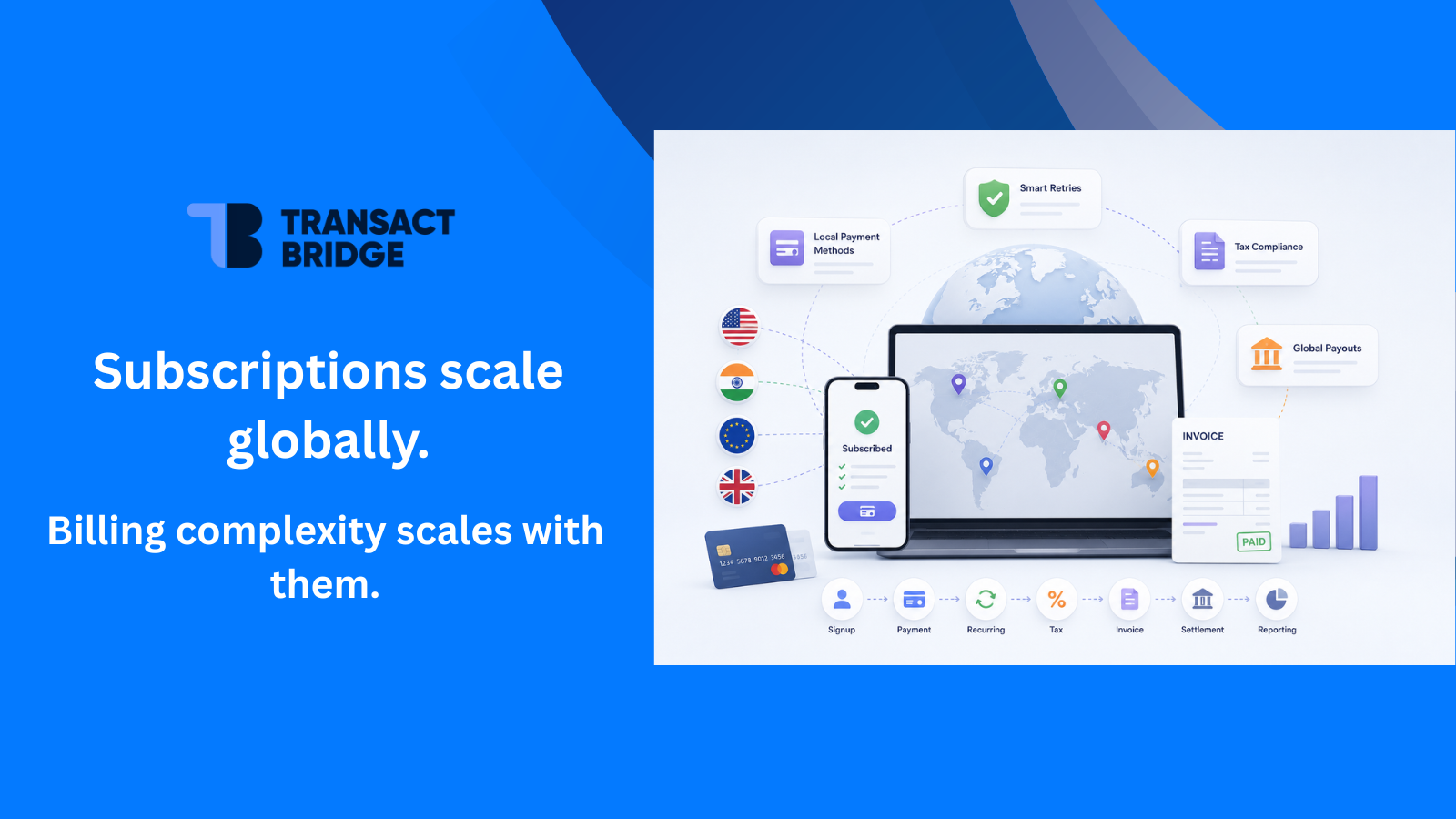
Subscription billing challenges rarely come from the price on your pricing page. They come from everything that happens after a customer clicks "subscribe" in a country you don't operate in.
A card that authorizes in New York gets declined in Delhi. A renewal that runs cleanly in London silently fails in Mumbai because a regulator changed the mandate rules. A €99 plan generates a VAT liability on its very first sale before you've registered anywhere. A mid-cycle seat upgrade prorates perfectly in dollars and wrongly in reais. None of this shows up in your billing software's happy path. All of it shows up in your revenue.
This guide breaks down subscription billing across multiple countries the way it actually fails: stage by stage, from signup to reporting, covering the billing operations (proration, plan changes, revenue recognition), the payment rails, and the tax and compliance rules that differ across India, the US, and other global markets. If you're a founder, CFO, or operator planning international expansion, this is the map of where the money leaks and where to plug it.
Key insight: Most guides organize cross-border billing around currencies, payment methods, and taxes – three buckets. That's why they all read the same. The businesses that actually scale internationally treat it as one continuous billing lifecycle, from checkout to accounting, and manage the points where each stage breaks in each market. Fix the pipeline, not the buckets.
The global subscription billing journey
International subscription billing is a pipeline of ten stages – customer, checkout, payment method, authorization, recurring renewal, tax, invoice, settlement, accounting, and reporting. Revenue leaks wherever a stage behaves differently in a new market than it did at home, and the failures compound because each stage feeds the next.
Customer
│
▼
Checkout
(Customer Experience)
│
▼
Payment Method
(Technical)
│
▼
Authorization
(Technical)
│
▼
Recurring Renewal
(Technical + Compliance)
│
▼
Tax Engine
(Tax)
│
▼
Invoice
(Compliance)
│
▼
Settlement
(Financial)
│
▼
Accounting
(Financial)
│
▼
Reporting
(Financial)
The global subscription billing journey. Each stage carries a different failure mode in each market and the same event (a renewal, a refund, an upgrade) re-triggers payment, tax, and accounting logic every time it happens.
Each stage belongs to one of five challenge categories and strong billing operations account for all five, not just the obvious payment one:
- Customer experience : does checkout feel local enough that the customer completes and stays? (stages 1–2)
- Technical : can the payment be taken and renewed at all: rails, authorization, mandates, retries? (stages 3–5)
- Tax : is the right tax charged, collected, and remitted in each market? (stage 6)
- Compliance : are registrations, invoices, and authentication rules satisfied per country? (stages 5, 7)
- Financial : does the money reconcile: FX, settlement, revenue recognition, reporting? (stages 8–10)
The mistake most teams make is treating this as a checkout problem – get the customer to pay once and move on. But a subscription isn't one transaction; it's a relationship that re-runs this entire pipeline every billing period, in every currency, under every local rule, indefinitely. That's why "we already accept international cards" is not the same as "we can bill internationally."
The rest of this guide works through these in the order they bite – how you charge, how the first payment works, how you price, how renewals survive regulation, what happens between renewals, tax, and failed payments – then closes with the build-versus-outsource decision.
Cross-border subscription billing, by the numbers
- 130+ countries now tax non-resident digital services
- 27 EU VAT jurisdictions, with rates from 17% to 27%
- 45 US states levy sales tax – no two rule sets identical
- 10–15% of recurring payments fail on the first attempt
- 20–40% of subscription churn is involuntary – payment failure, not cancellation
- ~$129 billion lost to failed subscription payments in 2025
How you charge: billing models and the cross-border twist
Your billing model determines which cross-border problems you inherit. Monthly, annual, usage-based, seat-based, and hybrid models each break differently once tax, currency, and proration cross borders – so the model is a strategic billing decision, not just a pricing one.
Billing model | Core operational challenge | The cross-border twist |
Monthly | More renewal events, higher churn exposure | Every renewal re-runs mandate and tax logic in each market – 12× the failure surface of annual |
Annual | Large single charge, deferred revenue | Revenue recognition and VAT point-of-supply rules differ by country; one invoice spans a full year of local rule changes |
Usage-based | Metering accuracy, unpredictable invoice size | Tax must be computed per usage event, per jurisdiction – not once at signup |
Seat-based | Mid-cycle proration on add/remove | Proration must respect local tax and currency on every seat change |
Hybrid (base + usage) | Invoice complexity | Multiple tax treatments on a single invoice; harder to localize and reconcile |
Operator takeaway: Annual billing isn't just a cash-flow lever – internationally, it also collapses your renewal-failure surface and your number of taxable events per customer. That's a real risk reduction when you're managing mandates and tax across many markets at once. It trades that against heavier revenue-recognition work.
Getting the first payment to work: localization and authorization
The fastest way to lose international subscription revenue is to show the wrong payment methods at checkout and then watch the few charges that do go through get declined by issuers that don't recognize a foreign merchant. Card-first checkout works in the US; in India, Europe, and most of the world, buyers expect local rails, and they abandon when they don't see them.
Payments are not universal. The method that converts in one market barely exists in another:
Market | Dominant recurring rails | What breaks if you're card-only |
India | UPI Autopay, cards, net banking, e-mandate debits | UPI is the default; card-only checkout loses the majority of consumers |
United States | Cards (credit/debit), ACH direct debit | Works for cards, but ACH is far cheaper for high-ticket B2B recurring |
European Union | SEPA Direct Debit, cards, iDEAL, wallets | SEPA is expected for recurring; cross-border card decline rates rise |
UK | Cards, Bacs Direct Debit, Open Banking | Direct Debit trusted for subscriptions; card-only feels foreign |
Global (APAC, LatAm) | Wallets, local bank transfer, cards | Wallet-first regions punish card-only flows heavily |
Why this is a billing problem, not a checkout problem: localization doesn't stop at the first payment. Each rail renews differently. UPI Autopay, SEPA Direct Debit, ACH, and card networks each carry their own mandate mechanics, failure reasons, and retry economics – so the differences that felt cosmetic at checkout compound at every renewal.
Operator takeaway: Localize the rail, not just the currency symbol. Presenting UPI Autopay in India and SEPA Direct Debit in the EU typically lifts both conversion and long-term recurring stability, because local rails carry lower ongoing failure rates than cross-border card transactions. Local acquiring – processing on rails inside the customer's own market – is one of the highest-leverage, least-visible levers in international billing.
Pricing, currency, and FX localization
Multi-currency billing is about pricing and settlement, not just display. Showing a straight FX conversion of your home price is a mistake – customers expect locally sensible prices, and how you convert and settle determines your margin.
There are three distinct decisions here, and teams routinely collapse them into one:
- Presentment currency. Show prices in the customer's local currency. Charging in an unfamiliar currency raises abandonment and cross-border decline rates.
- Localized pricing, not raw conversion. A flat FX conversion of a US price lands at odd, untrusted numbers abroad and ignores local price sensitivity. Purchasing-power-adjusted, charm-priced local numbers convert better:
Market | Straight FX of $29.99 | Price customers actually expect | Why |
United States | $29.99 | $29.99 | Baseline |
India | ≈ ₹2,500 | ₹1,499 | Price sensitivity + local charm pricing |
Japan | ≈ ¥4,600 | ¥4,200 | Clean local round number |
Germany | ≈ €27 | €29 (VAT-inclusive) | EU consumers expect tax-inclusive display |
Brazil | ≈ R$155 | R$99 | Purchasing-power adjustment |
- Settlement and FX spread. Every conversion has a cost, and where money is acquired locally versus converted cross-border materially changes what actually lands in your account.
The VAT-inclusive trap: In the EU and UK, consumer prices are displayed including VAT. A US business that lists "€29 + tax" at checkout looks wrong to a European buyer and can breach local display rules. The €29 must already contain the VAT. It means your net revenue per European customer is lower than the sticker suggests, and it varies by country because VAT rates range from 17% to 27%.
Recurring mandates: the regulation layer nobody plans for
This is where cross-border subscription billing quietly turns into a compliance problem. Recurring payments are governed by different rules in each market, and those rules change.
India: the RBI e-mandate framework (and why your old integration may be stale)
In India, recurring card and UPI payments run on the Reserve Bank of India's e-mandate framework. As of 2026, the RBI consolidated years of separate circulars into a single Digital Payments – E-Mandate Framework, 2026, replacing eight prior circulars issued between 2019 and 2024. If your India billing logic was built against the older rules, it is out of date.
The mechanics that matter for a subscription business:
- One-time registration with Additional Factor of Authentication (AFA). A recurring mandate can only be set up after the customer clears AFA (two-factor authentication). This "sets the lock."
- AFA-free auto-debits up to ₹15,000 per transaction. Below this threshold, subsequent recurring debits run without re-authentication.
- A higher ₹1,00,000 AFA-free ceiling for specific categories – insurance premiums, mutual fund subscriptions, and credit card bill payments.
- Mandatory pre-transaction notification to the customer at least 24 hours before each debit, with an opt-out for that charge.
This sits alongside the RBI's Authentication mechanisms for digital payment transactions Directions, 2025 (issued 25 September 2025), which formalize minimum two-factor authentication for digital payments, with regulated-entity compliance required by 1 April 2026.
Why founders get burned here: A subscription above ₹15,000 that skips proper AFA handling will simply fail to renew – silently. Teams often discover this only when Indian churn spikes and no one can explain it. The renewal didn't get cancelled; it was never compliant.
Renewals that survive every market's rules
RBI e-mandate, PSD2/SCA, and ACH handled correctly, so renewals don't fail silently.
The EU and UK: PSD2 and Strong Customer Authentication
In Europe, recurring payments fall under PSD2 and its Strong Customer Authentication (SCA) requirement. Initial subscriptions typically require authentication; correctly flagged "merchant-initiated transactions" can then recur without it, but only if set up correctly at the first charge.
Get the initial SCA exemption flagging wrong and every subsequent renewal is exposed to additional authentication challenges the customer isn't present to complete. The result is the same as India's AFA problem under a different acronym: renewals that fail for regulatory reasons, not because the customer left.
The pattern across markets
Market | Recurring rule | Setup requirement | Renewal risk if misconfigured |
India | RBI E-Mandate Framework, 2026 | AFA at registration; notify 24h before debit | Silent renewal failure above thresholds |
EU / UK | PSD2 + SCA | Authenticate first charge; flag as merchant-initiated | Renewals hit SCA challenges, decline |
US | No federal mandate regime | Card network + NACHA (ACH) rules | Fewer regulatory blockers, more card-decline risk |
The lesson: there is no single "recurring payment" setup that works everywhere. Cross-border subscription billing means maintaining compliant mandate flows per market and keeping them current as regulators revise the rules.
The billing-operations layer: what happens between renewals
Most billing complexity lives between the first charge and the renewal – proration, plan changes, coupons, refunds, credit notes, and revenue recognition. Each of these interacts with tax and currency, so a routine mid-cycle change in one country can produce a wrong invoice, a wrong tax amount, or an un-closable ledger in another.
This is the layer generic "we accept cards globally" content skips entirely and it's where finance teams actually lose their evenings.
- Proration on upgrades and downgrades. When a customer changes plan or adds seats mid-cycle, you charge or credit the difference for the remaining days. Cross-border, that proration must apply the local tax rate and currency to the partial amount and if the tax rate or FX moved since the original charge, a naive proration is wrong.
- Coupons and discounts. A discount can be applied before or after tax, and the correct treatment differs by jurisdiction. A 20% coupon on a VAT-inclusive EU price is not the same calculation as 20% on a US pre-tax price. Get it wrong and you either undercharge tax or overcharge the customer.
- Refunds and credit notes. A refund isn't just money back. It reverses a taxable event. Several markets require a formal, sequentially numbered credit note to document the tax adjustment; a simple reversal in your processor doesn't satisfy the tax authority.
- Free trials to first charge. The trial-to-paid conversion is the first real authorization and, in India and the EU, the moment the mandate and SCA flow must be correct or the first charge fails and the trial converts to nothing.
- Invoice timing. When the invoice is dated determines which tax period and, for annual plans, which revenue-recognition schedule it lands in. Timing that's cosmetic domestically becomes a compliance detail across borders.
- Revenue recognition. Under ASC 606 and IFRS 15, subscription revenue is recognized over the service period, not when cash arrives. Multiply that across multiple currencies, entities, and annual-vs-monthly schedules, and month-end close becomes the hidden tax of international expansion.
Key insight: Payment failure is the visible billing problem; the operations layer is the invisible one. A business can have a 99% authorization rate and still misstate revenue, mis-invoice tax, and stall its own audit because proration, credit notes, and revenue recognition weren't built for multiple markets. Both layers have to work.
Tax and compliance: the biggest cross-border trap
This is where subscription tax compliance stops being an accounting detail and becomes an existential one. The rules differ so sharply across India, the US, and global markets that a single flat approach is guaranteed to be wrong somewhere.
The three regimes, side by side
India (GST / OIDAR) | United States (sales tax) | European Union (VAT) | |
Trigger | OIDAR: non-resident digital sellers register regardless of revenue | Economic nexus after crossing a state threshold (South Dakota v. Wayfair, 2018) | Zero threshold – VAT due from the first B2C digital sale |
Typical threshold | No threshold for non-resident OIDAR services | Commonly $100,000 in sales or 200 transactions, but ranges from ~$10k to $500k and varies by state | None for non-EU sellers of digital services |
Where it applies | Nationwide GST | Only states where you have nexus and only ~2 dozen states tax SaaS at all | All 27 member states; register once via OSS non-Union scheme |
Rate | 18% GST (typical for digital services) | Varies by state and locality | 17%–27% depending on country |
B2B handling | GST applies; reverse charge in cases | Resale/exemption certificates | Reverse charge with valid VAT ID |
Three facts on that table catch founders off guard:
- The EU has no small-seller safety net. There is no minimum threshold for non-EU sellers of digital services. A single €99 subscription to an EU consumer creates a VAT registration obligation. The European Commission has estimated the EU VAT compliance gap at roughly €128 billion (2023), and enforcement is tightening, not loosening.
- US SaaS taxability is a patchwork, not a rule. Following Wayfair, states can tax remote sellers once they cross an economic-nexus threshold but whether SaaS itself is taxable varies state by state. As of late 2025, roughly two dozen states tax SaaS in some form; others don't tax it at all; and five (Alaska, Delaware, Montana, New Hampshire, Oregon) have no statewide sales tax. Newer moves – Maryland's technology-services tax, Texas's data-processing treatment – keep shifting the map.
- India's OIDAR regime ignores your size. Non-resident providers of online information and database access or retrieval services must register for GST and file regardless of revenue, with monthly filing obligations.
Add the UK (separate VAT rules post-Brexit, due from the first taxable sale), Singapore (Overseas Vendor Registration above SGD 100,000), Australia, Japan, and Canada, and the reality is stark: more than 130 countries now require non-resident businesses to register and remit indirect tax on digital services. Each has its own threshold, rate, invoice format, and filing cadence.
The compliance trap in one sentence: By the time most founders understand what cross-border tax compliance across their customer geography actually requires, they've either hired a team to run it or crossed liabilities they didn't know existed.
Invoicing is part of compliance, not an afterthought
Several countries mandate specific tax-invoice formats, sequential numbering, or even government-cleared e-invoices (Italy, India, Mexico, Chile). A generic PDF receipt is not a compliant tax invoice in these markets – so a compliance obligation you take on at registration resurfaces later as a rejected invoice if the format is wrong.
Failed payments and involuntary churn: the leak you're already funding
Involuntary churn – subscribers lost to failed payments rather than cancellation – is the largest recoverable revenue leak in the subscription economy, and it's worse across borders because cross-border transactions decline more often.
The economics, per widely cited industry research:
- 10–15% of recurring payments fail on the first attempt, and 20–40% of total subscription churn is involuntary – driven by mechanical payment failure, not customer intent.
- Failed subscription payments are estimated to cost businesses roughly $129 billion in 2025.
- Expired cards alone account for an estimated 25–30% of failures; overall payment failure rates average around 7.9% and reach into the mid-teens in some sectors.
Now layer cross-border on top. A card issued in one country, charged by a merchant in another, on rails that don't recognize the local context, declines more often and generic retry logic makes it worse. Retrying a hard decline (a closed account) repeatedly doesn't just fail; it can damage your standing with card networks. Retrying a soft decline (temporary insufficient funds) at the wrong local time misses the recovery window.
Key insight: Dunning that ignores why and where a payment failed is guessing. Recovery rates rise sharply when retry timing and messaging respond to the actual decline reason and the customer's market – soft declines retried intelligently, hard declines routed to customer action, expired cards refreshed via account-updater services.
Involuntary churn is where in-house billing quietly bleeds the most, because it's invisible on the P&L until someone measures it separately from voluntary churn. If you can't see your involuntary churn rate on its own, you can't recover it.
Recover the revenue you're already losing
99.5% authorization and 99.8% recurring stability, with dunning tuned to decline reason and market.
When one market becomes five: a story
Picture a US SaaS company – product-led, $49 per seat per month, comfortably past $2M ARR. Growth is good, inbound is global, and the board wants international revenue. So over six months the team "turns on" five markets: Germany, the UK, India, Brazil, and Singapore. The product already works everywhere. How hard can billing be?
Here is what actually happens.
German customers see "$49 + tax" and bounce – they expected a VAT-inclusive euro price and SEPA Direct Debit, not a dollar card charge. UK VAT is due from the very first sale, which no one registered for, so three months of British revenue is now a liability. In India, the higher-tier annual plan sits above ₹15,000 and the e-mandate was never configured for it, so renewals fail silently and Indian "churn" looks catastrophic for reasons unrelated to the product.
A Brazilian customer upgrades mid-cycle; the proration is calculated in dollars and the local tax is wrong. And at quarter-end, finance can't close the books, because revenue now spans five currencies and two recognition schedules with no single source of truth.
None of these were product failures. Every one was a billing failure. The company didn't need a better app. It needed billing to stop being the thing that broke every time it entered a market. That realization is what turns "how do we handle all this?" into a different question entirely.
The core decision: build it yourself, or move liability to a Merchant of Record
Everything above – local rails, mandate compliance, proration, tax, invoicing, revenue recognition, dunning – is real work that grows with every market you enter. At some point the question stops being "how do we handle this?" and becomes "should we be handling this at all?"
That's the Merchant of Record decision.
First, a distinction that trips teams up: subscription billing software and the compliance question are not the same thing. A billing platform manages the mechanics: plans, proration, invoicing, dunning, and revenue schedules. It does not, by itself, decide who is legally on the hook for tax and chargebacks in each market. That is a question about your billing infrastructure as a whole — specifically, whether you remain the seller of record or hand that role to someone else. Strong billing software is necessary; across borders, it is not sufficient.
Processor vs. Merchant of Record: what actually differs
A payment processor moves money and leaves you as the legal seller – responsible for tax, compliance, and chargebacks in every market. A Merchant of Record becomes the legal seller of record, absorbing tax registration, filing, chargeback liability, and fraud loss on your behalf.
Payment processor | Merchant of Record (MoR) | |
Role | The technical pipe – authorizes and moves money | The legal seller of record for the transaction |
Whose name is on the invoice | Yours | The MoR's |
Tax registration & filing | You, in every jurisdiction you hit thresholds | The MoR, across all covered markets |
Chargeback & fraud liability | You | The MoR |
Multi-currency settlement | You reconcile it | Handled and paid out to you |
Control over checkout & data | Full | Reduced – a real trade-off |
Typical cost | Lower per-transaction | Higher per-transaction fee for offloaded liability |
The one-line test: a processor answers "did the card work?" A Merchant of Record answers "who is legally responsible for this sale?"
A quicker way to see it is by expansion stage – the point at which running billing yourself stops scaling:
Expansion stage | Payment processor | Merchant of Record |
1 country | ✓ Fine | — |
2–3 countries | ✓ Workable | Maybe |
5+ countries | Difficult | ✓ Built for this |
Multiple tax registrations | You manage | MoR manages |
Multiple recurring rails | You build and maintain | Included |
A decision tree for international billing readiness
START
│ YES
▼
Planning international expansion?
│ YES
▼
Selling in more than one country?
│ YES
▼
Need local payment methods?
│ YES
▼
Need recurring subscriptions?
│ YES
▼
Need to manage VAT, GST,
or US sales tax?
│ YES
▼
Want your team focused on growth
instead of compliance?
│ YES
▼
┌───────────────────────┐
│ MERCHANT OF RECORD │
│ One integration handles│
│ payments, tax & compliance│
└───────────────────────┘
Work down the spine. Selling into one or two simple markets rarely justifies a Merchant of Record; running multiple rails and tax regimes and not wanting to own the liability – is exactly what it's for.
The honest trade-off: An MoR reduces your control over checkout and customer data, and costs more per transaction. In exchange, it removes the compliance surface that scales fastest and hurts most. For most companies expanding across India, the US, and global markets, that trade becomes worth it somewhere between the third and the tenth country.
Move the compliance liability off your finance team
Transact Bridge becomes the seller of record, so tax registration, filing, and chargebacks don't sit with you.
Where Transact Bridge fits
The challenges in this guide share one root cause: cross-border subscription billing is not one system but many, stitched together per market and the seams are where revenue leaks. Local rails renew differently. Mandates change. Proration and tax interact. Cross-border cards decline more. Handling each in isolation is where scaling teams lose time and money.
Transact Bridge is the infrastructure built to close those seams, enabling payments across India, the US, and global markets from a single integration rather than a patchwork of processors, tax vendors, and compliance workarounds. That means one global checkout with local rails where they matter (UPI Autopay in India, SEPA Direct Debit in Europe, ACH and cards in the US, and 100+ payment methods overall), recurring mandate handling aligned to each market's rules, multi-currency settlement, and Merchant-of-Record-model compliance so tax registration, filing, and chargeback liability don't sit on your finance team.
The operational proof points that matter for recurring revenue are authorization and stability: Transact Bridge maintains a 99.5% payment authorization rate and 99.8% recurring billing stability – the two numbers that decide whether a renewal succeeds or quietly becomes involuntary churn.
The point isn't to add another tool. It's to stop running these problems in parallel and route cross-border growth through global payments infrastructure built for it – so the answer to "should we be handling all of this ourselves?" can be no.
Cross-border subscription billing readiness checklist
- Local payment methods presented per market (UPI Autopay, SEPA, ACH, wallets – not card-only)
- Localized, charm-priced amounts per market – not raw FX conversion – with VAT-inclusive display where required
- Recurring mandates configured to current rules (RBI E-Mandate Framework 2026; PSD2/SCA in EU/UK)
- Local acquiring where volume justifies it, to cut FX drag and cross-border declines
- Proration, coupons, and refunds that apply the correct local tax and currency mid-cycle
- Compliant tax invoices and credit notes in required formats per country
- Tax mapped by market – US nexus by state, EU/UK VAT from first sale, India OIDAR/GST, other thresholds
- Involuntary churn tracked separately from voluntary churn, with smart dunning by decline reason and market
- Revenue recognition that holds up across currencies, entities, and annual-vs-monthly schedules
- MoR-vs-in-house decision revisited at every new market
Common mistakes founders make
- Assuming cards work everywhere
- Converting prices with live FX instead of localizing them
- Ignoring recurring-mandate rules (RBI e-mandate, PSD2/SCA)
- Treating invoices as receipts and skipping credit notes
- Tracking churn without separating payment failures from cancellations
How the companies that scale actually win
The companies that scale globally don't win because they built a better billing engine. They win because they removed billing as a barrier to expansion so that entering a new market is a go-to-market decision, not a six-month re-engineering project.
That's the real reframing. Subscription billing challenges across multiple countries are not a series of one-off integrations to grind through; they're a structural question about whether your billing infrastructure was designed to cross borders at all. The businesses that treat every new market as a fresh payments, tax, and compliance project stall. The ones that route recurring revenue through infrastructure designed for payments across India, the US, and global markets – with local rails, mandate compliance, and Merchant-of-Record tax handling built in – expand at the speed of their sales pipeline, not their finance backlog.
International growth should never be limited by billing infrastructure. The fastest-growing companies expand into new markets because billing is already solved – not because they solve it again each time. Build it, or partner for it, so it stays that way.
Stop rebuilding billing for every new market
One integration for local rails, mandate compliance, and MoR tax handling across India, the US, and global markets.
FAQs
What is the biggest challenge in global subscription billing?
The biggest challenge is that billing breaks in a different place in every market – payment method availability in one country, recurring-mandate rules in another, tax registration in a third, proration and revenue recognition everywhere. There is no single configuration that works everywhere, so the real challenge is maintaining a compliant, localized billing pipeline per market as rules change. This is precisely the fragmentation that Merchant-of-Record infrastructure like Transact Bridge is built to consolidate.
Why do recurring payments fail internationally?
Recurring payments fail internationally for three main reasons: cross-border cards decline more often than local ones; recurring-mandate rules (India's RBI e-mandate, Europe's PSD2/SCA) are misconfigured or out of date, causing silent renewal failures; and generic retry logic ignores local decline reasons and timing. Industry research attributes 20–40% of total subscription churn to these mechanical payment failures rather than customer cancellation.
How do you collect recurring payments in India?
Recurring payments in India run on the RBI e-mandate framework, using UPI Autopay, cards, or bank debits. A mandate is registered once with two-factor authentication (AFA), after which auto-debits up to ₹15,000 run without re-authentication (₹1,00,000 for insurance, mutual funds, and credit card bills), with a mandatory notification to the customer at least 24 hours before each debit. As of 2026 these rules sit under the consolidated Digital Payments – E-Mandate Framework, 2026, so integrations built against older circulars should be reviewed.
How does proration work for subscription upgrades across countries?
Proration charges or credits the difference when a customer changes plan mid-cycle, based on the days remaining in the period. Across borders, the proration must apply the customer's local tax rate and currency to that partial amount and if the tax rate or exchange rate has shifted since the original charge, a naive calculation produces the wrong invoice. This is why mid-cycle changes are a common source of tax errors for international subscription businesses.
Should you bill annually or monthly when selling internationally?
Annual billing reduces your international risk in two specific ways: it cuts the number of renewal events that can fail under local mandate rules, and it reduces the number of taxable events per customer. The trade-off is heavier revenue-recognition work, since annual revenue must be deferred and recognized over the year under ASC 606 / IFRS 15. Many cross-border businesses push annual plans in markets with fragile recurring rails for exactly the first reason.
How do subscription businesses handle US sales tax?
US subscription businesses must determine, state by state, whether they have economic nexus (commonly $100,000 in sales or 200 transactions, but it varies) and whether SaaS is taxable in that state – roughly two dozen states tax it, others don't. Once both are true, they register, collect, and remit in that state. Because the rules differ across every state, most scaling companies automate this or move it to a Merchant of Record rather than track it manually.
Do SaaS companies need to register for tax in every country?
Not every country, but far more than most founders expect. The EU requires VAT from the first B2C digital sale with no threshold; India's OIDAR regime requires GST registration regardless of revenue; the US triggers on per-state economic nexus; and over 130 countries now tax non-resident digital services with their own thresholds. Registration depends on where your customers are, not where you're incorporated.
How does a Merchant of Record simplify subscription billing?
A Merchant of Record becomes the legal seller of record for your transactions, so it – not you – handles tax registration and filing, chargeback and fraud liability, and multi-currency settlement across markets. This removes the fastest-scaling, highest-risk part of cross-border billing in exchange for a higher per-transaction fee and reduced control over checkout and data. Transact Bridge applies this model to enable compliant recurring payments across India, the US, and global markets from one integration.
What's the difference between a payment processor and a Merchant of Record?
A payment processor is the technical pipe that authorizes and moves money while leaving you as the legal seller – responsible for tax, compliance, and chargebacks. A Merchant of Record sits one layer up and becomes the legal seller itself, absorbing those obligations. The simplest test is whose name appears on the customer's receipt: yours (processor) or the provider's (MoR).


