
What Is Global Payment Infrastructure and How Does It Work?
Published on: Wed 07-Oct-2026 07:55 AM
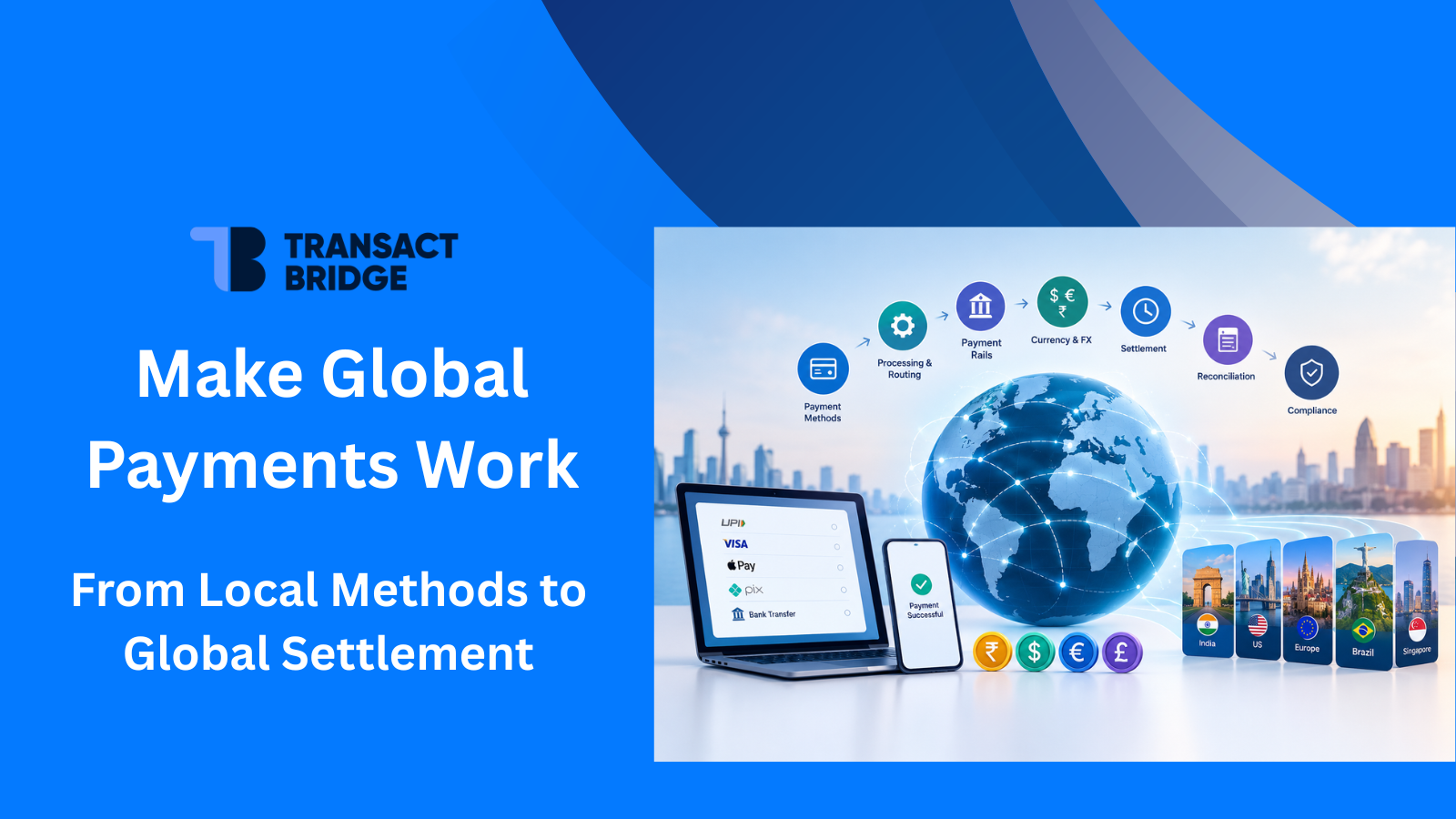
Global payment infrastructure is the combination of payment methods, processing systems, payment rails, currencies, settlement, reconciliation and compliance capabilities that enables a business to accept and manage payments across multiple markets.
A business entering a new country needs more than a checkout that accepts international cards. Customers expect local payment methods, businesses need reliable settlement in the right currency, and finance teams need accurate reconciliation. At the same time, tax, compliance and payment rules vary by market.
That combination is what global payment infrastructure has to manage.
What does global payment infrastructure include?
Global payment infrastructure connects the customer-facing payment experience with the processing, financial and regulatory operations behind each transaction.
|
Layer |
What it handles |
Examples |
|
Payment methods |
How customers pay |
Cards, UPI, ACH, Pix, wallets, bank transfers |
|
Processing & routing |
How transactions are authorised and routed |
Processors, acquirers, smart routing |
|
Payment rails |
How funds move |
Card networks, ACH, SEPA, real-time payment systems |
|
Currency & FX |
Local charging and currency conversion |
INR, USD, EUR, FX conversion |
|
Settlement |
When and where funds arrive |
|
|
Reconciliation |
Matching transactions to financial records |
Payments, fees, refunds, disputes, settlements |
|
Compliance |
Market-specific payment and regulatory requirements |
KYC/KYB, tax, payment regulations |
These layers are connected. A payment-method decision can affect processing, settlement, reconciliation and the customer experience at the same time.
Why does global payment infrastructure matter?
A payment setup can work well in one market and create friction when a business expands.
Customers in different countries don’t pay the same way. Indian buyers expect UPI. US buyers pay mostly by card, with ACH for larger and recurring payments. Brazilian buyers use Pix. European buyers use cards alongside each country’s own method, such as iDEAL in the Netherlands.
The infrastructure underneath those methods also differs.
The G20's cross-border payments roadmap sets specific targets for the end of 2027: an average global cost of no more than 1% for retail cross-border payments, no corridor above 3%, and 75% of cross-border retail payments providing funds to the recipient within one hour, with the remainder within one business day. The FSB's 2025 progress report said it was unlikely that satisfactory improvements at the global level would be achieved in line with the 2027 timetable.
In other words, businesses can’t wait for global rails to fix the cost and speed of cross-border payments. Reaching customers through local payment methods and local processing is the practical route today.
How each layer works
Local payment methods
Payment preferences are highly market-specific.
A global payment strategy may need to support cards alongside domestic systems such as UPI in India, ACH in the US and Pix in Brazil.
In Europe, cards sit alongside country methods such as iDEAL and Bancontact, with SEPA Direct Debit for subscriptions.
What matters is offering the methods customers in each market actually use, for the way you sell.
For a market-by-market breakdown of which methods to offer first, read Payment Methods Buyers Expect in the US, EU, Brazil and India.
Payment processing and routing
Once a customer selects a payment method, the transaction needs to be securely processed and routed through the appropriate payment infrastructure.
For a multi-market business, this can involve different providers, acquiring relationships, currencies and transaction rules. The infrastructure needs to make those differences manageable without creating a fragmented customer experience.
Where a payment is processed matters too. A card payment processed in the customer’s own country is less likely to be declined than one processed from abroad.
Payment rails
Payment rails are the networks and systems through which money moves.
Cards, bank transfers and real-time payment systems operate differently. Pix, for example, is Brazil's instant-payment infrastructure operated by the Central Bank of Brazil. In Europe, SEPA Instant enables funds to become available in the payee's account within ten seconds of a payment order.
Links between countries’ instant-payment systems are also developing. The ECB and India are building a link between Europe’s TIPS and UPI, and in September 2026 the ECB began assessing a similar link with Brazil’s Pix. These are early-stage projects, mainly for person-to-person transfers, not networks merchants can use today.
Currency and FX
Accepting a payment in a customer's preferred currency does not necessarily mean the business settles in that currency.
Global payment infrastructure therefore has to account for currency conversion, FX costs, settlement currencies and the timing of funds movement.
For businesses entering several markets, these factors can materially affect transaction economics.
Settlement and reconciliation
Processing a successful payment is only one part of the financial workflow.
Businesses also need to know when funds will settle, in which currency, what fees were deducted and how settlements map back to individual transactions.
Without strong reconciliation, payment data can become disconnected from the finance system, increasing manual work and making it harder to understand actual revenue and payment costs.
Compliance
Every market introduces its own regulatory and operational requirements.
Depending on the business model and market, these can involve customer and merchant verification, payment regulations, tax obligations, data requirements and transaction monitoring.
Global infrastructure therefore has to account for compliance as part of the payment operation rather than treating it as a separate layer added after checkout.
How a global payment moves, step by step
From the customer's perspective, the process may look simple: select a payment method, pay and receive confirmation.
Behind that experience, a global payment transaction can move through several connected stages:
-
Customer selects a payment method
The customer chooses a locally relevant card, wallet, bank transfer or other payment option. -
Payment is initiated
Transaction details are securely submitted for processing. -
Transaction is routed
The payment is directed through the relevant processor, acquirer or payment rail. -
Payment is authorised
The relevant financial institution or network approves or declines the transaction. -
Currency is managed
Where currencies differ, FX conversion may take place according to the payment and settlement structure. -
Funds are settled
The transaction amount, less applicable fees and adjustments, moves through the settlement process. -
Post-payment events are processed
Approved refunds, disputes and chargebacks need to be reflected across payment and financial systems. -
Transaction is reconciled
Payment data, settlement records, fees and adjustments are matched with the business's financial records.
The complexity sits behind the checkout. A customer may see one payment confirmation while the business coordinates multiple systems to complete the transaction lifecycle.
Let one partner run what happens behind checkout
TransactBridge takes on tax and compliance obligations and carries chargeback liability, so you don't rebuild that operation for every market.
Why a domestic payment setup doesn’t scale globally
A payment stack designed for one market often reflects that market's payment methods, currencies, settlement infrastructure and regulatory requirements.
Expanding into another country can therefore introduce new integrations and operational processes rather than simply adding another currency.
Before entering a new market, leadership teams should ask:
-
Customer experience: Are the preferred local payment methods available?
-
Payment success: Can payments be processed locally, so fewer are declined as cross-border?
-
Cost: What will payment processing, FX and cross-border costs do to unit economics?
-
Settlement: Where and when will funds become available?
-
Compliance: Who owns the relevant regulatory and tax obligations?
-
Operations: How will disputes, chargebacks and reconciliation be handled?
-
Scalability: Can the same infrastructure support the next market without rebuilding the stack?
Is your payment stack ready for the next market?
See which local payment methods TransactBridge supports in the markets you're entering.
How it differs from a payment gateway
A payment gateway securely passes payment details from checkout to processing. Global payment infrastructure covers everything around that: payment methods, routing, settlement, FX, reconciliation and compliance.
TransactBridge goes a step further. As a global merchant of record, it also becomes the seller. For the full comparison, read global payment infrastructure vs payment gateway.
Where does a merchant of record fit?
A merchant of record becomes the legal seller of your product in each market. It takes on:
- Collecting payments in local methods and currencies
- Calculating, collecting and filing tax such as VAT, GST and sales tax
- Payment compliance in each market
- Processing refunds
- Handling disputes and carrying chargeback liability
- Settlement and reconciliation
Your refund and cancellation policy, your own income tax and your product obligations stay with you.
For a fuller explanation, read what a merchant of record is and how it works.
How TransactBridge runs global payments for you
TransactBridge brings these layers together as a global merchant of record. Customers pay with the methods they already use, such as UPI, ACH, Pix and more than 40 others, and payments run through TransactBridge’s own local entities.
It converts the currency and pays you out in the currency you choose, files the tax as the seller and carries the chargebacks. Your team works with one integration, one PCI DSS Level 1 compliant hosted checkout and one set of reports across 80+ countries, instead of a separate stack for each market. Most businesses are live in 3 to 5 days.
Sell in 80+ markets with one partner
Local payment methods, tax, compliance and chargebacks, handled by TransactBridge as the seller.
The bottom line
Global payment infrastructure connects the customer payment experience with the processing, rails, currencies, settlement, reconciliation and compliance required to operate across markets.
The right infrastructure lets a business add markets without rebuilding its operation each time. A merchant of record goes further and also takes on the selling, tax and chargebacks in each market.
Frequently Asked Questions
What is global payment infrastructure?
Global payment infrastructure is the combination of payment methods, processors, payment rails, FX, settlement, reconciliation and compliance capabilities that allows a business to accept and manage payments across multiple markets.
How is global payment infrastructure different from a payment gateway?
A payment gateway primarily enables the secure transmission of payment information. Global payment infrastructure covers a broader set of payment and financial operations, including local payment methods, routing, settlement, currencies, reconciliation and compliance.
Why do businesses need local payment methods?
Payment preferences vary by market. Supporting locally preferred methods can make checkout more relevant to customers and give businesses access to payment infrastructure suited to each market.
What role does a merchant of record play?
A merchant of record, such as TransactBridge, becomes the legal seller of your product in each market. It handles tax and compliance, processes refunds, and takes on disputes and chargebacks. You keep control of your refund and cancellation policy.
What payment methods does TransactBridge support?
TransactBridge supports 45+ payment methods, including UPI, netbanking and cards in India; ACH and cards in the US; and Pix in Brazil. Availability can vary by market and business requirements.
Does TransactBridge handle refunds?
Yes. TransactBridge processes refunds as the seller. You set your refund and cancellation policy and decide which refund requests to approve.
Can global payment infrastructure support recurring payments?
TransactBridge supports recurring billing in the markets it covers, including UPI AutoPay, card e-mandates and e-NACH in India, with smart retries for failed renewals.
Why does reconciliation matter in global payments?
Reconciliation connects payment transactions with settlements and financial records. For businesses operating across multiple currencies, providers and markets, effective reconciliation helps finance teams understand what was collected, what was deducted and what was ultimately settled.


