
Local Payment Methods: How Global Businesses Actually Get Paid Across India, the US, and Global Markets
Published on: Sat 08-Aug-2026 01:08 PM
Key takeaways
- Local payment methods are the region-specific rails people actually use – UPI in India, ACH and wallets in the US, Pix in Brazil, iDEAL in the Netherlands. Digital wallets alone now carry 56% of global e-commerce transaction value (Worldpay/Global Payments, Global Payments Report 2026).
- Missing them costs you twice: shoppers abandon when their preferred method isn't offered, and the cross-border card attempts that remain are declined 5–15 percentage points more often than domestic ones.
- Payment localization is rarely blocked by engineering. It's blocked by who is legally permitted to collect money in each market and that liability is assessed retroactively, from your first sale.
- India is the sharpest case: UPI processed 23.66 billion transactions worth ₹29.88 lakh crore in July 2026 alone , yet no foreign company can settle UPI into India without an Indian entity or a Merchant of Record acting as legal seller.
- Four routes exist to accept local payment methods: direct integration, local PSP, orchestration, or Merchant of Record. They differ less on transaction cost than on engineering months, finance headcount, and who carries the liability.
Two companies, same problem, opposite directions.
The first is a US analytics SaaS with 40,000 signups from India and a conversion rate under 1% on them. Their checkout takes Visa and Mastercard. Most of their Indian users hold RuPay cards or simply pay by UPI, and never see an option that works. The founders read it as a pricing problem and cut prices twice. It didn't move.
The second is a Bengaluru AI tooling company with real demand from US buyers. They can take the money but invoices arrive in INR, there's no ACH option for the finance teams asking, and nobody mentioned that crossing $100,000 into a handful of states had created a filing obligation accruing for four quarters. They found out during diligence.
Neither has a product problem. Both are discovering that accepting a payment method and being legally permitted to collect it are two entirely different challenges and that the second one is the wall.
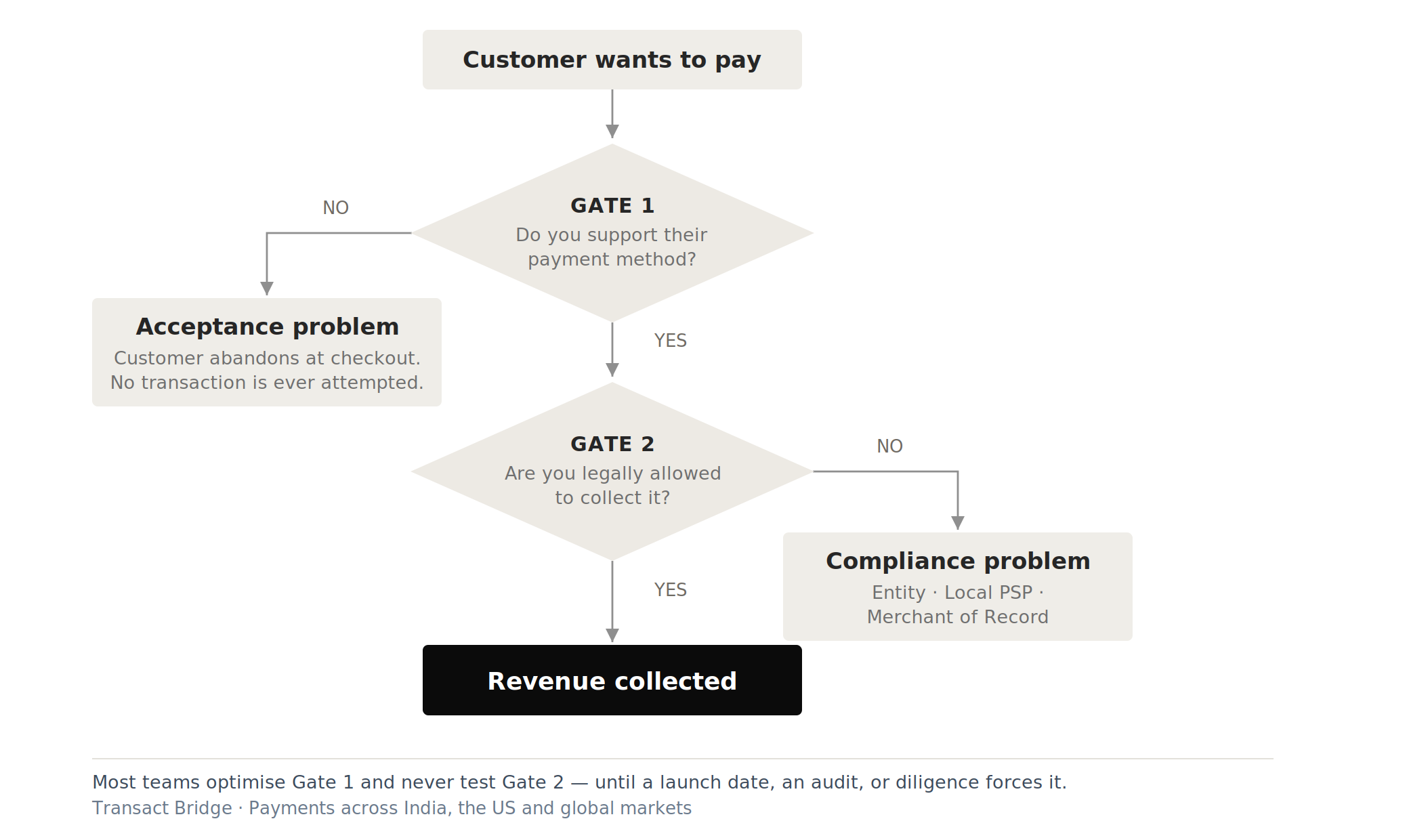
Companies rarely lose international customers to pricing. They lose them by asking foreign buyers to behave like domestic ones – to hold a card they don't have, on a network their bank won't authorise, in a currency they don't think in.
What are local payment methods?
Local payment methods are region-specific payment options that customers prefer in their domestic market – UPI in India, Pix in Brazil, iDEAL in the Netherlands, ACH and Apple Pay in the US, SEPA Direct Debit across the eurozone. They run alongside global card networks, and in most large markets they now carry more volume than cards.
"Local" describes geography, not scale. UPI is India-specific and also one of the largest payment systems on earth.
Local, alternative, or global payment methods?
Local : defined by geography. iDEAL is local to the Netherlands.
Alternative (APM) : defined against cards. Aging badly: when wallets alone are 56% of global e-commerce value, "alternative" describes the industry's history, not customer behaviour.
Global : Visa, Mastercard, PayPal, Apple Pay. Widely accepted, which is not the same as preferred anywhere.
The useful question isn't taxonomy: what share of this market's volume runs on a rail I currently cannot accept?
The six types of local payment methods
Local payment methods fall into six categories: account-to-account rails, digital wallets, bank transfers and direct debit, buy now pay later, domestic card schemes, and cash or voucher payments.
Type | Examples | Where it dominates | Recurring support |
A2A / real-time rails | UPI (IN), Pix (BR), iDEAL (NL), PayNow (SG), FedNow & RTP (US) | Asia, LATAM, N. Europe | Varies – UPI Autopay yes; many one-off only |
Digital wallets | Alipay, WeChat Pay, PayPal, Apple/Google Pay, GCash, Paytm, Cash App | Global; dominant in China, SE Asia | Usually, via tokenised mandates |
Bank transfer & direct debit | SEPA DD (EU), ACH (US), NetBanking & e-NACH (IN), Bancontact (BE) | Europe, US, India | Strong – built for recurring |
Buy now, pay later | Klarna, Affirm, Afterpay, Tabby, Tamara | US, Europe, Gulf | Instalments only, not subscriptions |
Domestic card schemes | RuPay (IN), Cartes Bancaires (FR), Mada (SA), Elo (BR), Interac (CA) | Single-country | Yes, subject to local mandate rules |
Cash & voucher | Boleto (BR), OXXO (MX), Konbini (JP), Fawry (EG) | LATAM, Japan, MEA | No |
The last column is the one most guides omit – and the one that decides your pricing model. A local payment method you can't renew on isn't a payment method for a subscription business. It's an acquisition channel with a twelve-month expiry. Verify recurring support before you localise pricing, not after renewals start failing.
More detail on rail-by-rail coverage: payment methods we support.
Why local payment methods decide whether you get paid at all
Local payment methods improve conversion by matching customer preferences at checkout and by avoiding the cross-border authorization failures that kill the attempts you do get. Two separate mechanisms, each invisible to a different dashboard.
Customers who never attempt payment
Documented cart abandonment averages around 70% (Baymard Institute). A meaningful share of shoppers with genuine intent abandon specifically because their preferred method isn't offered – Baymard's research waves have placed this between 13% and 19% as wallet and A2A usage has grown.
This never appears in your payments dashboard. There's no declined transaction, because no transaction was attempted. It surfaces only as a conversion rate that looks unremarkable until you segment by country.
Attempts that get declined
Customers who do try an international card hit a second wall. Benchmarks show cross-border card authorization running 5–15 percentage points below domestic, with some providers reporting 95–99% via local acquiring against 80–90% cross-border.
A domestic issuer sees a foreign acquirer, an unfamiliar descriptor and a cross-border flag, and applies a stricter risk model. Your customer sees "declined" and concludes your site is broken or fraudulent. More in why international payments fail and authorization rate optimization.
And for subscription businesses, it compounds
Involuntary churn – subscriptions lost to payment failure rather than a cancellation decision – runs 20–40% of total churn. Recurly's July 2026 SaaS benchmark puts it at 1.06% against 3.22% total: roughly a third of all churn, arriving without a single customer choosing to leave.
Every market you can't collect in shows up in your analytics as a low-converting traffic source. It isn't. It's demand you are declining. The distinction matters because one gets deprioritised in a growth review and the other gets fixed.
Payment methods by country: the 2026 map
Payment preferences vary sharply by market: UPI dominates India, wallets lead in the US and China, Pix in Brazil, iDEAL in the Netherlands, and cards remain primary in only a minority of large economies.
Global payments snapshot, 2026
Metric | Value | Source |
Digital wallet share of global e-commerce value | 56% | Worldpay/Global Payments, GPR 2026 |
UPI transactions, July 2026 | 23.66 billion (₹29.88 lakh crore) | NPCI |
US wallet share of online value | 40% | Worldpay/Global Payments, GPR 2026 |
China – Alipay + WeChat Pay share of e-commerce | 89% | Worldpay/Global Payments, GPR 2026 |
Cross-border vs domestic authorization gap | 5–15 pp | GR4VY / Solidgate 2026 benchmarks |
Average documented cart abandonment | ~70% | Baymard Institute |
Involuntary share of total subscription churn | 20–40% | ProfitWell / Recurly |
Projected payment-app share of global POS by 2030 | 46% (~$15.6tn) | Worldpay/Global Payments, GPR 2026 |
Shares below are of e-commerce transaction value, from Worldpay/Global Payments' Global Payments Report 2026 (31 March 2026, 42 markets) unless noted.
Market | Dominant local payment methods | Notable share | What trips up foreign sellers |
India | UPI, RuPay, NetBanking, wallets | UPI ecosystem ≈ 68% of online value | Cannot settle UPI without an Indian entity or MoR; tax registration from first sale |
United States | Cards, Apple/Google Pay, PayPal, Cash App, Venmo, ACH, BNPL | Wallets ≈ 40% of online value | Economic nexus at $100k in most states; SaaS taxability varies |
China | Alipay, WeChat Pay | ≈ 89% of e-commerce value | Cards effectively irrelevant |
Brazil | Pix, Boleto, Elo | Pix ≈ 42% of e-commerce (2025) | Instalment culture; Pix now settles beyond Brazil |
Germany | PayPal, SEPA DD, Giropay | Majority non-card | Low credit card penetration |
Netherlands | iDEAL | Large majority of online transactions | Card-only checkout is near-unusable |
Poland | BLIK, Przelewy24 | BLIK dominant for one-off | One-time codes; weak recurring |
Mexico | SPEI, OXXO, Mercado Pago | Majority non-card | Cash vouchers still material |
Japan | Cards, Konbini, PayPay | Cards lead | Konbini has no recurring path |
Indonesia / Philippines / Thailand | QRIS, DANA, OVO, GCash, GrabPay, PromptPay | Wallet-first, mobile-first | QR is the default UX |
South Korea | 20+ domestic card networks, Kakao Pay, Naver Pay | Domestic schemes dominate | Each network is a separate integration |
Saudi Arabia / UAE | Mada, STC Pay, Tabby, Tamara | Mada is the KSA default | Sharia-compliant BNPL is commercially significant |
Kenya / Nigeria / Egypt | M-PESA, Fawry, bank transfer | Mobile money leads | Banking-penetration assumptions fail |
Two shifts worth planning around. Domestic rails are internationalising – Pix now settles in Argentina, Chile, Portugal, Spain and the US; UPI acceptance extends to Singapore, the UAE, Malaysia and Thailand. And Worldpay projects payment apps will reach 46% of global point-of-sale value by 2030, roughly $15.6 trillion. The direction of travel is away from the card networks most Western checkouts still treat as default.
How real companies localize payments
The largest subscription businesses in the world run different payment stacks in every major market – and they treat local payment rails as launch infrastructure, not a later optimisation.
Netflix, India. Netflix supports UPI AutoPay for Indian subscriptions, publicly announced by the company. That matters more than it sounds: UPI AutoPay is a recurring mandate, not a one-off transfer, which means Netflix solved the harder half of the problem. A one-off UPI integration gets you the first payment. AutoPay gets you month thirteen.
Spotify, Brazil. Spotify added Pix – Brazil's dominant instant rail – alongside cards, gift cards and boleto bancário. Three quite different payment cultures served in one market: instant transfer, card, and a printed voucher paid at a lottery agent.
The pattern worth extracting. Neither company treated payment localization as a checkout feature. Both added rails already dominant in the market, and both prioritised the recurring-capable ones. Neither waited for card penetration to catch up because in these markets it isn't going to.
You are not competing with local companies on products. You are competing with them on how normal your checkout feels. A subscriber in Mumbai comparing two services doesn't evaluate your payment stack. They just notice that one of them takes UPI.
India: Why Card-Only Checkouts Fail and UPI Dominates
India runs on UPI, most Indian cards can't be charged from abroad, recurring payments follow rules that exist nowhere else, and tax obligations begin at your first sale. Each breaks a different part of a standard global checkout.
The scale
NPCI recorded 23.66 billion UPI transactions worth ₹29.88 lakh crore in July 2026 – an all-time high, up 22% year on year, averaging 763 million transactions a day. UPI is not an emerging local payment option in India. It is the default, and cards are the alternative.
Why card-only checkouts underperform here
- Most Indian cards are domestic-only. A large share of RuPay and locally-issued Visa/Mastercard cards aren't enabled for international transactions. A cross-border charge simply fails.
- Cross-border decline friction stacks on top, at full force.
- Recurring is regulated separately, so a subscription flow that works everywhere else breaks silently here.
Practical detail in our guide to accepting UPI payments.
Recurring billing: the rule that shapes your pricing
The RBI's Digital Payments – E-mandate Framework, 2026 consolidated eight earlier circulars into one rulebook covering cards, prepaid instruments and UPI. The parameter that matters commercially:
- Mandates register once with Additional Factor of Authentication; subsequent debits process without OTP up to ₹15,000 per transaction. Above that, AFA every time.
- A higher ₹1 lakh threshold applies to specified categories including insurance, SIPs and credit card bills.
- Pre-debit notification 24 hours ahead is mandatory.
An annual plan priced just above ₹15,000 is a self-inflicted wound. Every renewal demands active authentication, and a predictable share of customers won't complete it. This is a pricing decision wearing a compliance costume. Due to which India pricing should be set after you understand the mandate rules.
Workable paths: UPI Autopay, e-NACH for bank-to-bank collection, the Standing Instructions Hub for cards, or pricing under the threshold. See subscription payments for India.
The tax obligation that starts at sale one
Foreign companies selling digital services into India fall under OIDAR rules: 18% IGST, registration mandatory from the first transaction with no turnover threshold, monthly filing, and an authorised signatory resident in India holding a valid PAN. It covers SaaS, cloud, software downloads, e-books, online education, digital advertising and AI platform subscriptions.
That last requirement – a resident signatory – is where "we'll just use a global processor" plans quietly fail.
What ignoring it actually costs
The liability is retroactive to your first sale, not to the date you register. There is no discovery grace period.
- Penalties run to 10% of tax due (minimum ₹10,000) for non-fraudulent shortfalls, up to 100% where evasion is established, plus 18% annual interest.
- The commercial hit exceeds the tax. You can't retroactively bill customers 18% on invoices settled two years ago, so assessed IGST comes straight out of margin on revenue already recognised and spent.
- It surfaces at the worst moment. Undisclosed indirect tax exposure is a standard diligence finding. It rarely kills a deal. It gets priced in, escrowed, or delays close while counsel quantifies it.
Can a foreign company accept UPI without an Indian entity?
Not directly. UPI settlement runs through the domestic banking system and requires a licensed Indian entity in the flow. Three legitimate routes:
Route | Time to live | What you own | Best for |
Incorporate in India | 3–9 months | Everything – entity, banking, GST, FEMA, TDS, audits, resident directors | Committing to India with local headcount |
Local reseller | 4–10 weeks | Limited control over pricing, customer relationship, data; shared margin | Enterprise or hardware with a channel motion |
Merchant of Record | Days to weeks | Product and pricing; the MoR is legal seller and carries the liability | Digital products, SaaS, subscriptions, in-app purchases, market validation |
An Indian entity buys maximum control at maximum permanent overhead. An MoR buys access without the overhead, at the cost of the MoR appearing as seller on the invoice.
Decision point – model the compliance cost before the integration cost.
Integration is weeks of engineering, once. The entity, resident signatory, monthly filing cycle, FEMA reporting and audit obligation are permanent operating expenses. Most teams discover that ratio backwards.
Transact Bridge exists for the third row of that table. As Merchant of Record in India it is the legal seller, holds the licences, and carries GST, FEMA, RBI and TDS obligations. This makes UPI, UPI Autopay, RuPay, NetBanking and e-NACH available without incorporating.
Accept UPI without an Indian entity
Go live with UPI, UPI Autopay, RuPay, NetBanking and e-NACH in weeks — GST, and FEMA compliance handled.
US Payment Methods: Why Wallets and ACH Matter Beyond Cards
Cards still lead, but wallets are roughly 40% of US online value, ACH matters for B2B, and the complexity is tax – which fragments across jurisdictions rather than concentrating in one.
What Americans actually pay with
Wallets account for around 40% of US online transaction value and 17% of in-store POS. Apple Pay, Google Pay, PayPal, Cash App and Venmo aren't a rounding error, and Gen Z is moving away from raw card entry faster than any other cohort.
The local payment options beyond cards
- ACH : low cost, ideal for B2B invoicing and higher-value subscriptions. Slow to settle, reversible longer than cards.
- RTP and FedNow : real-time, increasingly viable for B2B where instant confirmation has commercial value.
- BNPL : Affirm, Klarna, Afterpay, for higher-ticket consumer digital purchases.
- Cards : still the volume leader, and where chargeback exposure lives.
Economic nexus: the threshold that finds you
- Most states: $100,000 in sales or 200 transactions. California is the outlier at $500,000.
- 16 states have dropped the transaction test for a pure revenue standard; Kentucky joined effective 1 August 2026 – good news for low-ticket, high-volume sellers who previously tripped nexus on count alone.
- SaaS taxability varies by state, and more states tax it each year. National selling means tracking 30+ states.
- Nexus is triggered by sales, not presence. No entity, office or staff required.
What crossing it unregistered costs
In most states the lookback is unlimited if you never filed a return. The statute of limitations protecting a registered filer who under-reported doesn't protect a business that never registered. Exposure accrues indefinitely.
The mitigation is a Voluntary Disclosure Agreement. Most states cap look back at three to four years and waive penalties for businesses that come forward first. That option vanishes the moment a state opens an inquiry, which is the entire argument for handling nexus proactively.
India taxes you from the first rupee but concentrates the obligation in one registration. The US lets you sell freely until a threshold, then fragments it across dozens of jurisdictions with different rules and different definitions of what's taxable. Neither is simpler. They fail differently – and a team that has solved one will systematically underestimate the other.
Going the other direction: US market entry strategy.
Four routes to accepting local payment methods
Integrate each method directly, use a local PSP per market, use an orchestration layer, or use a Merchant of Record. They differ mainly in who carries the legal and tax liability.
Route | Setup effort | Owns tax & compliance | Legal seller | Timeline |
Direct integration per method | Very high – separate API, contract, certification each | You | You | 6–18 months for meaningful coverage |
Local PSP per market | High – one relationship per country, often needs local entity | You | You | 3–9 months per market |
Payment orchestration | Medium – one API, many providers behind | You | You | 2–4 months |
Merchant of Record | Low – single integration | The MoR | The MoR | Days to weeks |
Orchestration solves the engineering problem elegantly. It does not solve the legal one. One API, smart routing, provider redundancy – genuinely valuable. But you remain a seller of record: still registering in India, still tracking nexus across 30 states, still filing OSS, still the entity a regulator writes to. Teams comparing orchestration against an MoR are usually comparing two things that solve different problems.
A Merchant of Record changes who the seller is. It contracts with your customer, issues the invoice, holds the payment licences and carries the tax liability. The cost of that is real: you give up direct ownership of the billing relationship, and the invoice carries someone else's name.
For enterprise deals with negotiated MSAs, that alone can kill it. For self-serve digital products, SaaS, subscriptions and in-app purchases, it's invisible to the customer and removes months of legal work. A closely related model, Seller of Record, concerns who legally sells the product rather than who processes and carries liability for the payment – the terms overlap heavily, and most providers offering one offer both.
What each route actually costs your team
The transaction fee is the smallest number in this decision. The real cost is engineering months, finance headcount, and which of your teams owns the problem permanently.
Engineering effort | Finance & ops load | Legal exposure | Permanent owner | |
Direct integration | 2– 4 engineer-months per method, plus maintenance as APIs change | Separate reconciliation, refund and dispute flow per method | Contract and certification per provider | Dedicated payments engineering |
Local PSP per market | 3–6 engineer-weeks, plus entity formation in parallel | Local bookkeeping, local audit, local banking relationship | Entity formation, local counsel on retainer | Country finance lead |
Orchestration | 4–8 engineer-weeks total | Unified reconciliation – but filings remain multi-jurisdiction | Still entirely yours | Payments engineering + tax |
Merchant of Record | 1–2 engineer-weeks | Single settlement, single reconciliation | Carried by the MoR | Finance, part-time |
Payment localization has no natural owner, which is why it slips. Engineering treats it as a finance problem, finance treats it as a legal problem, legal treats it as a vendor selection. It sits unassigned until a launch date makes it urgent. Teams that get this right name one accountable owner early – usually finance or ops with engineering support, not the reverse – because the binding constraints are registration timelines and mandate rules, not API work.
The timeline consequence is what most roadmaps get wrong. Engineering effort is measured in weeks and is largely predictable. Entity formation and tax registration are measured in months and depend on third parties you cannot accelerate. If those two run sequentially rather than in parallel, your launch date is set by the slower one – and it is never the code.
Which local payment methods should you actually support?
Support the two or three methods carrying roughly 80% of volume in each priority market – not every method available. Enabling everything is a worse mistake than enabling nothing: choice overload measurably suppresses conversion, and each method you add is a reconciliation, refund, dispute and reporting workflow forever.
- Rank markets by revenue potential, not traffic. Signups from a market you can't collect in aren't an opportunity ranking.
- For your top five, find the local payment methods carrying ~80% of volume. Usually two or three. Stop there.
- Filter by recurring support if you sell subscriptions.
- Price the compliance obligation, not the transaction fee. Registration, filings, resident signatories, audit exposure – routinely 5–10x integration cost over three years.
- Decide the entity question once per market. Revisit annually, not per launch.
The cost of a local payment method is almost never the transaction fee. It's the permanent operational workflow it creates. Providers compete on the number you can see; the number that decides your margin is the one on your finance team's calendar.
Payment localization pre-launch checklist:
- Top 3 local payment methods identified with volume share
- Recurring path confirmed for each – or subscription model adjusted
- Local currency pricing displayed, not converted at checkout
- Tax registration requirement checked and threshold monitoring live
- Refund and chargeback flow tested per method
- Checkout localised: language, currency format, method ordering
- Dominant local method shown first and pre-selected
- Failed-payment retry logic tuned to local rail behaviour
Local payment methods by business model
Subscription businesses are constrained by which rails support recurring billing; one-off sellers are constrained by wallet and A2A coverage. The constraint determines which methods are worth the workflow.
SaaS and AI tools. Recurring is the whole game, so mandate rules dominate. India's ₹15,000 threshold and SEPA Direct Debit mechanics shape your pricing tiers whether you plan for it or not.
Digital products and downloads. Lower ticket, higher volume, one-off. Wallets and A2A rails convert best. Tax registration triggers earlier than founders expect.
E-commerce and D2C. Customs, duties and Importer of Record obligations enter scope alongside payments. LATAM instalment expectations materially affect average order value.
EdTech. Long enrolment cycles, high ticket, heavy instalment demand. India is often the largest and hardest market – e-NACH outperforms cards for multi-month fee plans.
OTT and subscription media. Involuntary churn is the dominant economic problem. Localised recurring rails and per-market retry logic beat any acquisition channel on ROI.
Creator economy. Many small transactions across many countries, payouts flowing back. FX and settlement matter as much as acceptance.
In-app purchases. Moving purchases to web checkout to escape app store commission only works if the web checkout accepts what the app store accepted. In wallet-first markets, a card-only web flow converts worse than the 30% you were avoiding.
Which model fits your business?
If you're... | Likely best route | Why |
Selling SaaS or digital products into India with no local entity | Merchant of Record | UPI settlement requires a licensed Indian entity. MoR is the only route measured in weeks. |
An Indian company selling into the US and EU | Merchant of Record | Nexus tracking across 30+ states and EU VAT from the first euro, without foreign entities. |
Entering 3+ new markets in a year | MoR, then orchestration later | Optimise for speed of legal access first; optimise routing once volume justifies it. |
An enterprise with existing local subsidiaries | Local PSP + orchestration | You already carry the compliance. The problem is routing performance, not permission. |
Enterprise sales with negotiated MSAs | Local entity or PSP | Procurement usually requires you – not a third party – as counterparty on the invoice. |
A marketplace paying out to third-party sellers | Specialist model | Payment facilitation, split settlement and seller KYC are a different problem set; most MoRs don't cover payouts. |
Testing demand before committing capital | Merchant of Record | Reversible. Entity formation isn't. |
Not sure which model fits?
Tell us your target markets and we'll map entity, PSP and Merchant of Record options against your timeline.
A 90-day payment localization timeline
Payment localization takes roughly 90 days when compliance and integration run in parallel, and considerably longer when they run sequentially.
Phase | Weeks | What happens |
Diagnose | 1–2 | Authorization rate by issuing country; checkout drop-off by market; revenue-per-signup by country |
Prioritise | 3–4 | Pick two markets. Identify local payment methods carrying 80% of each. Decide entity vs MoR. |
Resolve compliance | 4–8 | Registration path, mandate rules, settlement currency, invoicing requirements |
Integrate & localise | 6–10 | Methods live; local currency pricing; method ordering; retry logic |
Measure | 10–13 | Authorization rate, checkout completion, involuntary churn – segmented by market |
Most teams compress phases 1–2 and blow through phase 3. Budget for the inversion.
Related: subscription billing across multiple countries.
How Transact Bridge enables local payment methods across India, the US and global markets
Everything above reduces to two questions: can you accept the rail, and are you permitted to.
Transact Bridge is built for companies where the second is what's actually blocking revenue – global businesses selling into India without an Indian entity, and Indian businesses selling into the US and beyond without foreign ones. As Merchant of Record, Transact Bridge is the legal seller: it holds the licences, carries GST, FEMA and TDS obligations on the India side, and settles in USD, EUR, GBP or your currency of choice.
In practice: UPI, UPI Autopay, RuPay, NetBanking, e-NACH, wallets and cards through one integration with smart routing across local acquirers, plus 100+ local payment methods globally – without incorporating anywhere.
It isn't right for everyone. With local entities, local finance teams and enterprise contracts requiring you on the invoice, orchestration over your own acquiring relationships will serve you better. The MoR model earns its place when the legal barrier, not the technical one, stands between you and the revenue.
Payments across India, the US and global markets
One integration, 100+ local payment methods, no local entity required.
The real lesson
Global expansion rarely fails because the demand wasn't there.
It fails because local payment methods get treated as the last integration before launch instead of the first question of market entry. By the time a team discovers UPI needs an Indian entity, or that four quarters of US nexus have quietly accrued, the launch date is fixed, the pipeline is built, and every remaining option is expensive.
Companies don't expand internationally by translating their website. They expand by localizing how money moves and the sequence that works inverts most roadmaps: decide how you'll legally collect money in a market before deciding how you'll sell into it.
The businesses that win internationally aren't the ones with the best product. They're the ones that removed friction from how customers pay – and from how finance collects, reconciles and stays compliant across every market they sell into.
FAQs
What are local payment methods?
Region-specific payment options customers prefer in their domestic market – UPI, Pix, iDEAL, ACH, SEPA, Alipay. They operate alongside global card networks and are often the dominant rail at home.
What is the difference between local payment methods and alternative payment methods?
"Local" is defined by geography; "alternative" is defined against cards. They overlap heavily, and the industry is retiring "alternative" – when digital wallets alone carry 56% of global e-commerce value, nothing about them is alternative.
Why are local payment methods important?
You lose revenue twice without them: shoppers abandon when their preferred method is missing, and the cross-border card attempts that remain are declined 5–15 percentage points more often than domestic ones.
What are the most popular payment methods by country?
UPI in India, cards and wallets in the US, Alipay and WeChat Pay in China, Pix in Brazil, iDEAL in the Netherlands, PayPal and SEPA in Germany, BLIK in Poland, GCash in the Philippines, M-PESA in Kenya, Mada in Saudi Arabia.
Which countries rely least on credit cards?
China, India, Indonesia, the Philippines and Kenya rely least on credit cards. Alipay and WeChat Pay carry roughly 89% of Chinese e-commerce value, UPI dominates India, and wallets and mobile money leapfrogged card infrastructure across Southeast Asia and East Africa. In the Philippines, wallets reach nearly all adults while cards reach around a fifth.
How do local payment methods improve conversion?
Two mechanisms: fewer shoppers abandon at the payment step, and a higher share of attempts are authorised, because domestic rails avoid cross-border issuer risk rules.
How can international businesses accept local payments?
Four routes – direct integration, a local PSP per market, payment orchestration, or a Merchant of Record. They differ mainly in who carries tax and licensing liability, and in how much engineering and finance capacity they consume.
Do I need a local entity to accept local payment methods?
Depends on the rail. Some are accessible cross-border through a global PSP. Others, including UPI settlement into India, require a licensed local entity – yours, or a Merchant of Record's.
How does a foreign company accept UPI payments in India?
Incorporate in India, sell through a local reseller, or use a Merchant of Record already licensed there. The MoR route is fastest because the MoR becomes a legal seller and holds the registrations.
What happens if I don't register for GST/OIDAR in India?
You become liable for the unpaid tax retroactively, from your first sale, plus penalties and interest. Penalties run to 10% of tax due for non-fraudulent shortfalls and up to 100% where evasion is established, with 18% annual interest. The cost lands on your margin, since you cannot retroactively bill customers for invoices already settled.
What happens if I cross the US economic nexus without registering?
You become liable for the sales tax you should have collected, plus penalties and interest, and in most states the lookback period is unlimited because you never filed a return. A Voluntary Disclosure Agreement typically caps that lookback at three to four years and waives penalties – but only if you approach the state before it contacts you.
What is payment localization?
Matching the whole purchase experience to the market: local payment methods, local currency in local format, local language, local tax treatment, and recurring billing compliant with local mandate rules.
What payment methods are used in the US?
Cards lead, but wallets are roughly 40% of online value. ACH, RTP, FedNow, Cash App, Venmo, PayPal, Apple Pay, Google Pay and BNPL all carry meaningful volumes.
What is the best payment method for international SaaS businesses?
The best payment methods for international SaaS are the recurring-capable local rails in each priority market: UPI AutoPay in India, SEPA Direct Debit across Europe, ACH and cards in the US, and tokenised wallets where available. Choose for renewal capability first and acceptance second – a rail you cannot renew on turns every customer into a one-time sale.
Are local payment methods cheaper than cards?
Often on interchange – UPI, Pix and iDEAL carry little or none. But total cost includes FX, settlement, reconciliation and per-method maintenance, which is where the real expense sits.
How many local payment methods should a checkout offer?
Typically four to six, routed dynamically by geography, with the market's dominant method shown first and pre-selected. More than that reduces conversion.
How do local payment methods work for subscriptions?
Unevenly. UPI Autopay, e-NACH, SEPA Direct Debit and ACH support recurring; cash vouchers and several one-time-code wallets don't. Verify per rail before committing to a pricing model.
Who should own payment localization internally?
Payment localization should be owned by a single accountable lead in finance or operations, with engineering in a supporting role. The binding constraints are tax registration timelines and local mandate rules rather than API work, which is why engineering-led projects tend to slip and why unassigned ones stall until a launch date makes them urgent.


