
Best Lemon Squeezy Alternatives in 2026: 6 Merchant of Record Platforms Compared
Published on: Mon 19-Oct-2026 06:47 AM
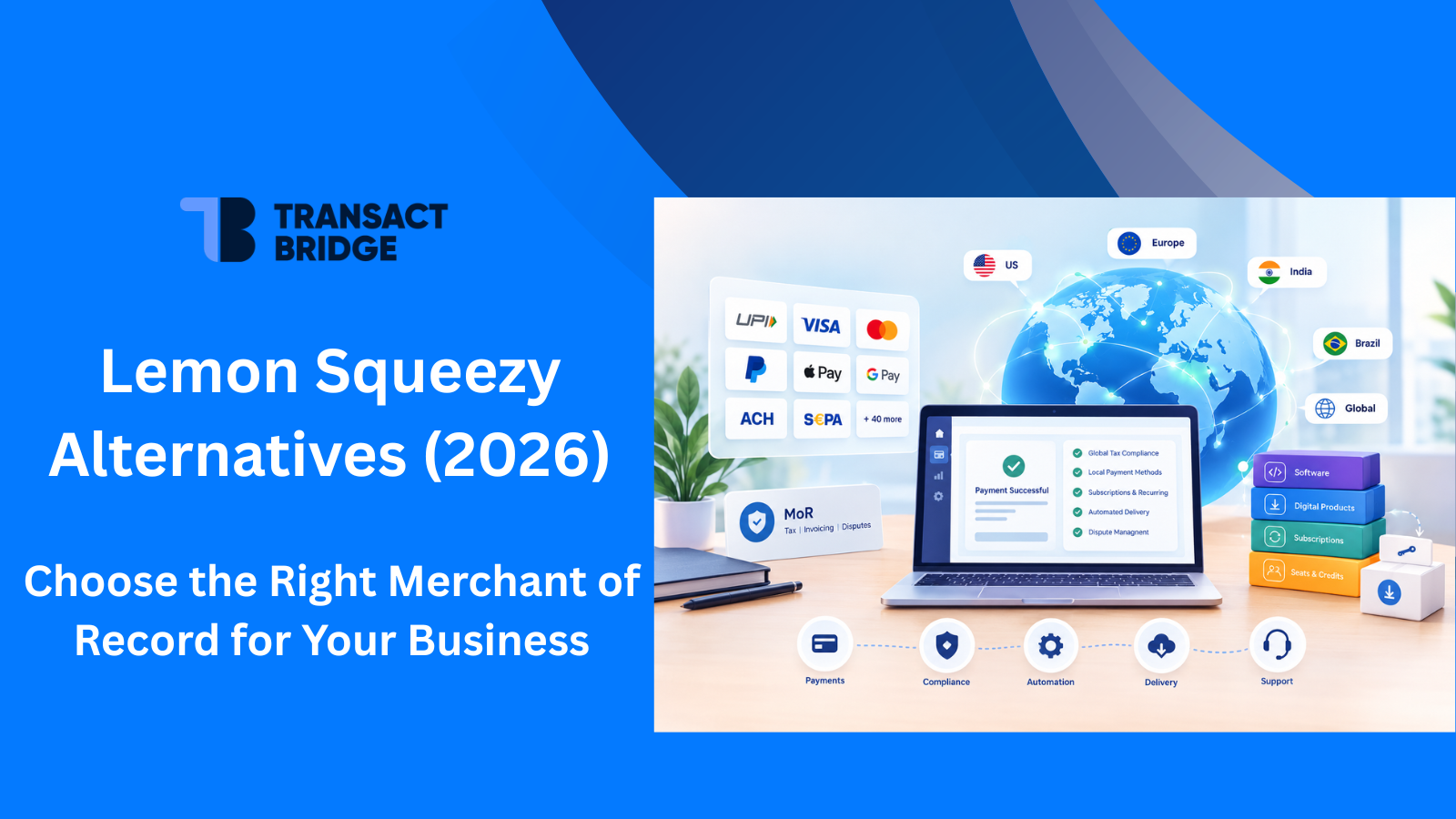
If your revenue runs through Lemon Squeezy, 2026 is a good year to review your setup. Since Stripe acquired it, Lemon Squeezy’s focus has moved to Stripe’s own merchant of record product, and the company has said support and product updates have slowed in the meantime.
There’s no shutdown and no reason to rush. But your checkout, renewals and tax filings all depend on this one platform. The question isn’t only who replaces it. It’s whether the replacement still works as you grow into new markets, where customers pay with different methods and every country has its own tax rules.
This guide compares six merchant of record platforms on pricing, payment methods, tax handling and fit. It also covers how to compare real costs and how to move your subscribers without losing revenue.
Quick answer: The strongest Lemon Squeezy alternatives in 2026 are TransactBridge, Paddle, FastSpring, Polar, PayPro Global and Gumroad. Each acts as a merchant of record (MoR): the company that legally sells to your customers and handles tax for you. They differ in where they truly sell like a local, which payment methods they offer, how recurring billing works, pricing and fit.
Compare more than fees. Check who becomes the legal seller, which taxes the provider handles, whether customers can pay the way they already pay, and whether existing subscriptions can move without customers re-entering their details.
Quick comparison
|
Platform |
Model and pricing |
Best for |
|
TransactBridge |
Global merchant of record with its own local entities; quote-based, no setup cost |
Digital businesses selling into India, the US, the UK, Brazil and other markets |
|
Paddle |
MoR; 5% + 50¢ all-inclusive, custom for high volume |
Established B2B SaaS and apps |
|
FastSpring |
MoR; quote-based revenue share |
Software, SaaS and game publishers wanting a managed partner |
|
Polar |
MoR; 5% + 50¢ Starter, paid plans from $20/month |
Developer-first, self-serve products |
|
PayPro Global |
MoR; quote-based |
Software vendors wanting assisted onboarding |
|
Gumroad |
MoR; 10% + $0.50 direct, plus processing |
Solo creators and simple digital catalogs |
Why are teams looking at Lemon Squeezy alternatives?
Lemon Squeezy still operates, but its future is tied to Stripe’s own merchant of record product. In its January 2026 update, Lemon Squeezy said it is focusing on Stripe Managed Payments and a migration path for users, with slower support and fewer product updates in the meantime. If your pricing, renewals and tax all run through one provider, that is worth planning for.
Stripe acquired Lemon Squeezy in July 2024. No shutdown has been announced, so this calls for a planned review, not a rushed switch.
Four questions matter for the next 12 to 24 months:
-
Roadmap: Will the features you rely on, such as affiliates, license keys and storefronts, keep developing?
-
Support: How quickly will payout holds, disputes and billing issues be resolved?
-
Subscriptions: Can saved payment details and renewal dates move, or will customers need to approve payments again?
-
Growth: Will your setup still work as you add markets, local payment methods or recurring billing outside the US?
What does a merchant of record handle, and what stays with you?
A merchant of record becomes the legal seller for the sales it handles. It usually works out, collects and pays sales taxes such as VAT and GST, takes the payments and handles disputes. The exact scope is set by each provider’s agreement. Income tax, data protection and product obligations usually stay with you.
Tax and payment rules differ by market. This table shows why. It isn’t legal or tax advice, so confirm your own obligations with an adviser.
|
India |
United States |
EU |
|
|
Sales tax |
Overseas sellers of digital services to Indian consumers generally must register for GST and charge 18% (CBIC) |
Depends on each state’s rules and whether it taxes software (Wayfair, 2018) |
Non-EU sellers of digital services to consumers generally owe VAT in the customer’s country from the first sale; the €10,000 threshold applies only to EU-based sellers (EU One Stop Shop) |
|
How people pay |
UPI, RuPay and domestic cards, net banking, wallets |
Cards, ACH bank transfers, wallets |
SEPA Direct Debit, iDEAL, local cards |
|
Recurring payments |
Local mandates such as UPI AutoPay and e-NACH, under RBI rules |
Saved cards that update automatically |
Extra customer authentication on many payments |
In Brazil, Pix is the everyday local method.
Local methods run at scale: UPI processed 24.07 billion transactions worth ₹29.37 lakh crore in September 2026, per NPCI. Scale doesn’t guarantee your own conversion will rise, so test local methods against your own checkout data.
How we evaluated these alternatives
This is an evaluation framework, not a weighted score. We assessed each platform on the same points, using vendor pricing pages and documentation checked in October 2026:
-
MoR scope: tax, invoicing, disputes
-
Market coverage: payment methods in India, the US and other regions
-
Billing fit: subscriptions, usage, seats, one-time
-
Pricing: published rates and surcharges
-
Integration effort: API, SDKs, hosted or no-code options
-
Limitations a buyer should know before signing
6 Lemon Squeezy alternatives to consider in 2026
1. TransactBridge
Adding a local payment method isn’t selling locally. A UPI button fixes the button. It doesn’t change who the legal seller is, who files the tax, who carries the chargeback, or why payments still fail when they are processed from abroad.
TransactBridge takes a different route. We become the legal seller in the market. We run payments through our own local entities and local acquiring (processing through local banks), so more of your customers’ payments go through. We handle tax, compliance and currency conversion. You need no entity of your own. One integration covers 80+ markets, led by India, the US, the UK and Brazil.
What’s included
-
Sell like a local. Local payment methods such as UPI, Pix, ACH, net banking, cards and wallets, so customers pay the way they already do.
-
Local recurring billing. UPI AutoPay, e-NACH and card mandates, so subscriptions renew under each market’s rules.
-
Tax, compliance and FX, handled. As the legal seller, we take on tax, invoicing (including GST-compliant invoices in India) and compliance. The liability sits with us.
-
Everything from checkout to settlement. Invoicing, reconciliation, refunds, chargebacks, currency conversion and end-customer support, with settlement through one account.
-
Integration options. Hosted checkout, payment links, a localized webshop, a no-code option, and an API with Android and iOS SDKs.
-
Go live in 3 to 5 days. Including paperwork and integration, with no setup cost.
Pricing: Custom quote, based on your markets, volume and payment mix. No setup cost.
Best for
-
SaaS, AI, app, EdTech and digital-product businesses selling into several markets at once
-
Subscription businesses that need local recurring mandates
Limitations
-
Focused on digital businesses such as SaaS, AI tools, apps, EdTech and digital products
-
No public rate card, so comparing costs requires a quote
-
Businesses that want to stay the legal seller and file tax themselves may prefer a payment provider model
See how merchants have grown in our customer stories, or check the markets we cover on our market coverage page.
Selling in more than one market?
See how TransactBridge brings local payment methods, recurring billing and tax into one integration.
2. Paddle
Paddle offers a model close to Lemon Squeezy’s: an all-inclusive merchant of record for software, with a public rate that’s easy to compare. It has operated since 2012 and serves SaaS and app businesses of many sizes.
Before choosing Paddle, check what the fee costs at your prices and whether it supports the methods your customers use.
Key features
-
Merchant of record covering tax filing and payment, fraud protection, chargebacks and buyer billing support
-
Subscription management, B2B invoicing and churn-recovery tools
-
Hosted customer portal with built-in cancellation flows
-
Payment methods including cards, PayPal, Apple Pay, Google Pay, iDEAL, Bancontact, Alipay, Pix and UPI
Pricing
-
5% + 50¢ per checkout transaction, all-inclusive
-
Custom pricing for high volume and for products under $10
Best for
-
Established SaaS and app businesses selling mainly to US and European buyers
-
Teams combining self-serve checkout with sales-assisted B2B deals
Limitations
-
Same headline rate as Lemon Squeezy, so it won’t change margins on low-priced plans
-
Paddle’s developer docs list UPI for one-time purchases, and its help centre also lists UPI AutoPay and Pix Automático. Confirm recurring availability for your account and markets.
-
Usage-based billing is in early access
3. FastSpring
FastSpring is a long-standing merchant of record for software, SaaS and games. It suits companies with B2B deals, invoicing or procurement needs that want a managed partner rather than a self-serve tool.
Key features
-
Full MoR covering payments, subscriptions, tax collection and payment, and tax audit response
-
Branded, localized checkout and store builder
-
License key, file download and signed-PDF delivery
-
B2B digital invoicing and interactive quotes
-
Built-in affiliate marketing
-
Lower rates for ACH and wire payments
Pricing
-
Flat revenue share set with sales, based on transaction type and volume (pricing)
-
No minimum volume
Best for
-
Mid-market and enterprise software teams
-
Businesses with sales-assisted deals and contract needs
Limitations
-
Costs can’t be compared before a sales conversation
-
Its managed approach suits larger teams more than small self-serve businesses
For a side-by-side look at payments, subscriptions, tax and payouts, read FastSpring vs TransactBridge.
4. Polar
Polar is an open-source merchant of record built for developers selling software and digital products. Its strengths are developer tools and automatic delivery of license keys and files after purchase.
Polar changed its pricing in May 2026, so check which plan applies to you.
Key features
-
MoR covering international tax and payment disputes
-
Subscriptions, usage-based billing, seats, credits and trials
-
Automatic delivery of license keys, file downloads, GitHub repository access and Discord roles
-
Hosted customer portal, plus an API to build your own
-
Open-source code and developer-first SDKs
Pricing
-
New organisations from 27 May 2026: Starter at 5% + $0.50, no monthly fee
-
Paid plans: Pro at $20/month (3.8% + 40¢), Growth at $100/month (3.6% + 35¢), Scale at $400/month (3.4% + 30¢)
-
Extra fees: +1.5% for non-US cards and $15 per dispute
Best for
-
Developer tools and self-serve SaaS with usage or seat pricing
-
Early-stage teams selling mainly to US buyers
Limitations
-
Launched in 2024, so a shorter track record
-
Non-US card fees add up for international-heavy businesses
-
Paid plans pay off only above certain monthly volumes
-
Check local payment methods for markets beyond the US and Europe
5. PayPro Global
PayPro Global is a merchant of record for SaaS, downloadable software and video games. It is known for hands-on onboarding, with setup help included.
Key features
-
MoR covering sales tax and VAT, invoicing and refunds
-
Local payment methods, 140+ currencies and 30+ checkout languages
-
Subscriptions, usage-based billing, failed-payment recovery and automatic card updates
-
Customer portal, license management, affiliates, coupons and bundles
-
Assisted and custom integration
Pricing
-
Quote-based, with all features included
Best for
-
Software vendors that want hands-on setup and ongoing support
Limitations
-
Costs can’t be compared before a quote
-
Suits teams that want support more than teams that want to self-serve quickly
6. Gumroad
Gumroad is a simple way for creators to sell digital products: fast setup, a ready-made storefront and no monthly fee. Since January 2025 it has acted as a full merchant of record, collecting and paying sales tax, VAT and GST.
As a business grows into subscriptions, its creator-first tools and fee level fit less well.
Key features
-
Full MoR covering sales tax, VAT and GST
-
Hosted storefront and checkout for downloads, courses and memberships
-
License keys for software
-
Affiliates and email tools
-
Discover marketplace for buyer discovery
Pricing
-
10% + $0.50 per direct sale, plus card processing and PayPal fees
-
Flat 30% on Discover marketplace sales
Best for
-
Solo creators selling templates, guides and courses
-
Testing demand before investing in a full billing setup
Limitations
-
Higher published rate than others in this list, before card processing
-
Fees aren’t returned on refunded sales, per Gumroad’s help centre
-
Few tools for SaaS subscriptions and business invoicing
Not a like-for-like swap: A billing tool such as Chargebee or Recurly paired with a payment provider leaves you as the seller. Tax registration and filing in each market stay with your team.
How to compare costs
Look beyond the headline rate. A fixed 50¢ fee is 5% of a $10 sale but only about 1% of a $49 sale, so it hits low-priced plans hardest. Extra charges for international cards, subscriptions or currency conversion add up too.
Work out what you’d pay in three cases: low-priced monthly plans, annual or one-time purchases, and a growing share of international customers.
Then check how many payments actually go through. A failed payment costs the whole sale, not just the fee. Ask each provider whether payments are processed locally or from abroad, and which local methods your customers will see.
Some providers publish rates. Others, including TransactBridge, FastSpring and PayPro Global, price by quote.
Get a cost estimate for your markets
Share your markets, prices and payment mix, and we’ll show you what you’d pay.
Which alternative fits your business?
|
Your situation |
Shortlist |
|
Selling into India, the US, the UK or Brazil together, with recurring revenue |
TransactBridge |
|
SaaS selling mainly to US and EU buyers, with sales-assisted deals |
Paddle, FastSpring |
|
Developer tool, self-serve, usage or seat pricing, wants public rates |
Polar |
|
Downloadable software needing assisted onboarding |
PayPro Global, FastSpring |
|
Solo creator with a small catalog |
Gumroad |
|
Wants to stay the seller and file tax in-house |
Billing tool plus payment provider |
Unsure which model you need? Compare a merchant of record, a payment aggregator and a payment provider.
How to move off Lemon Squeezy safely
Plan for six to nine weeks. Send new customers to the new platform first, then move existing subscribers in batches, timed to their renewal dates.
-
Week 1: review revenue by market, payment method, plan and renewal date
-
Weeks 2 to 3: shortlist two platforms; test checkout, refunds and renewals in a test environment
-
Week 4: set up products, tax settings, invoices and system connections
-
Weeks 5 to 6: send new customers to the new platform
-
Weeks 7 to 8: move subscribers in batches, monthly plans first, then annual and enterprise contracts
-
Week 9 on: check that all payments match, then close the old account
Before you move anyone:
-
Payment details. Exporting customer records doesn’t move saved cards. Ask both providers whether cards can be transferred securely. If not, plan to ask customers to re-enter them.
-
Local recurring payments. Mandates such as UPI AutoPay and e-NACH in India usually need to be set up again.
-
Subscription details. Keep each customer’s renewal date, trial, discounts and plan access the same.
-
Lemon Squeezy extras. List the extras you rely on, such as affiliates, license keys, storefronts and email, and decide how to replace each.
For 30 days after each batch, watch payment success rates, subscribers lost to failed payments, refund requests and support tickets.
Read 10 Ways to Reduce Churn From Failed Payments for practical ways to recover failed payments.
When one partner across markets makes sense
Selling in one market is a payment decision. Selling in three is an operating decision. Each new market adds a tax registration, local payment methods, recurring-billing rules and a settlement currency. Many platforms can take payments from abroad. Few become the local seller.
That is what TransactBridge is built for. We become the legal seller in each market, through our own local entities, so you sell like a local with no entity, no setup and no headache. If you’re weighing a move, bring four things to the conversation:
-
Your target markets
-
Average transaction value
-
Share of recurring revenue
-
Current payment-method mix
Planning your move from Lemon Squeezy?
Our team will map your markets, payment methods and subscriptions to a migration plan that fits.
FAQs
Is Lemon Squeezy shutting down?
No shutdown has been announced. In January 2026, Lemon Squeezy said it was prioritising Stripe Managed Payments and a migration path for users, with slower support and fewer updates.
What is the best Lemon Squeezy alternative for selling in India, the US and other markets?
TransactBridge is built for that. We become the legal seller in each market, run payments through our own local entities and local acquiring, and handle tax, compliance and FX. Local methods such as UPI, Pix and ACH, and mandates such as UPI AutoPay and e-NACH, come through one integration. Paddle and FastSpring suit businesses selling mainly to US and EU buyers.
Which Lemon Squeezy alternatives support UPI?
TransactBridge supports UPI for one-time payments and UPI AutoPay for subscriptions, along with e-NACH and card mandates. Paddle offers UPI, with recurring availability depending on your account, so confirm with Paddle. For other providers, check current documentation.
Is Paddle better than Lemon Squeezy?
It depends on your buyers. Both publish 5% + 50¢, but Paddle’s rate is all-inclusive, while Lemon Squeezy adds surcharges for non-US, PayPal and subscription payments. Paddle also offers broader B2B invoicing.
Can I move subscriptions without customers re-entering payment details?
Sometimes. It depends on whether both providers support a secure, compliant transfer. Indian recurring mandates often need to be set up again.
What is the difference between a merchant of record and a payment gateway?
A payment gateway passes payments through but doesn’t become the legal seller. A merchant of record takes on the seller role and the tax, invoicing and dispute responsibilities set out in its agreement.


