
10 Ways to Reduce Churn From Failed Payments: A Payment Recovery Guide
Published on: Wed 19-Aug-2026 04:39 AM
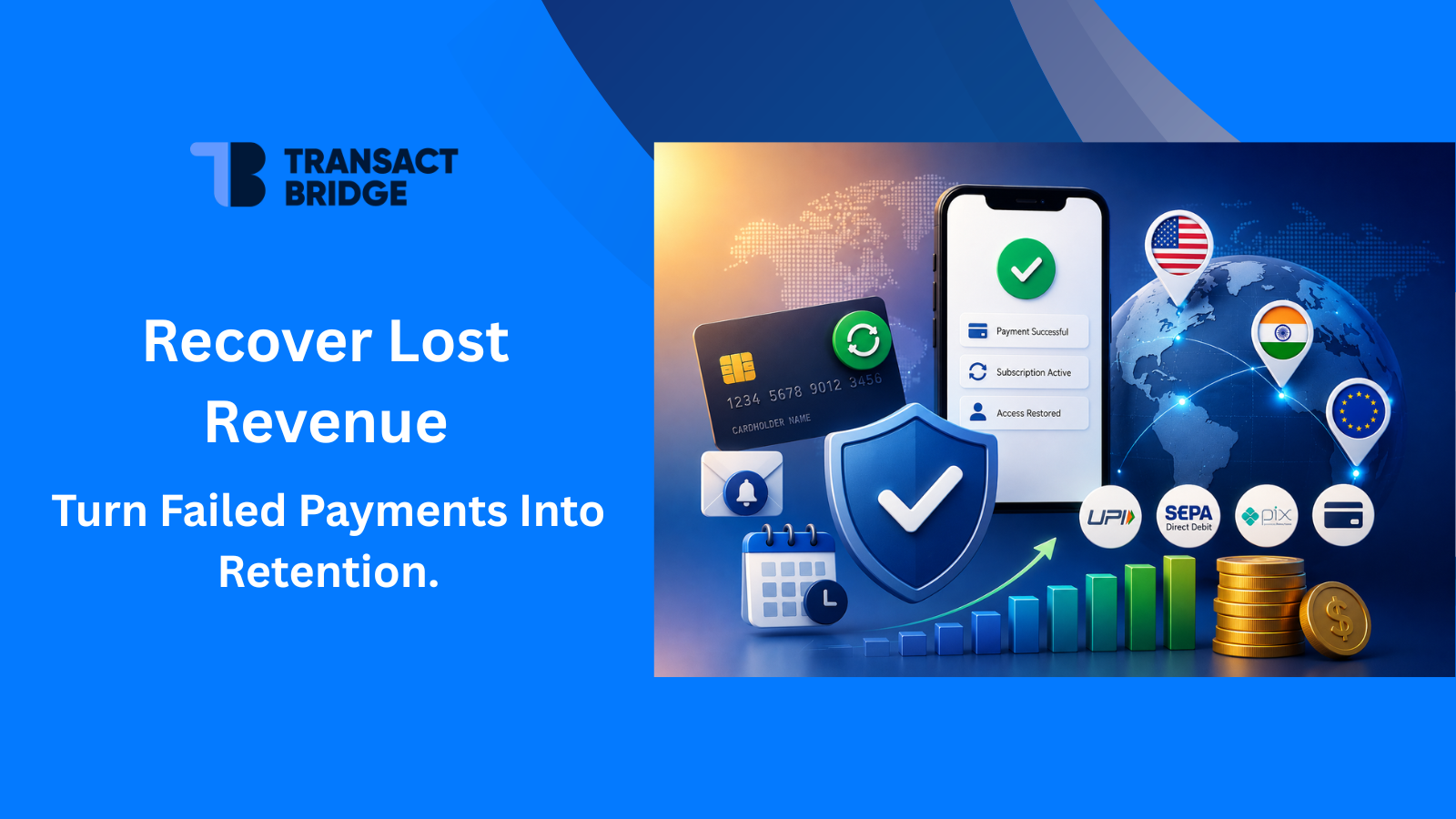
Churn from failed payments – known as involuntary churn – happens when a paying customer loses access because a recurring charge failed, not because they chose to cancel. A meaningful share is recoverable when you separate payment-driven churn from voluntary churn and apply the right fix by market. You reduce it by isolating it as its own metric, preventing failures before they happen (current card credentials and the right local payment rail), recovering the ones that still fail (decline-aware retries and empathetic dunning), and for – businesses selling across borders – routing payments locally so fewer fail in the first place.
This guide covers ten practical ways to recover failed payments and cut the churn they cause, with the specifics that matter when you sell across India, the US, and global markets.
Key takeaways
- Failed payments create involuntary churn without a customer ever choosing to leave.
- Recovery starts before the payment fails, not only after – especially across borders.
- Retry and dunning strategy should follow the decline reason, not a fixed schedule.
- International businesses need market-specific payment methods and authentication.
- Local acquiring can ease cross-border authorization friction in applicable markets.
- Measure recovery by market, payment method, and decline reason – not one global rate.
What is involuntary churn from failed payments?
Involuntary churn is when a customer loses access to your product because a recurring payment failed – an expired card, insufficient funds, a bank decline, or a cross-border rejection – rather than because they chose to cancel. It is also called passive, delinquent, or silent churn, and unlike voluntary churn, much of it can be recovered when it is identified and handled correctly.
The distinction drives everything that follows. Voluntary churn is a value problem you fix with product, pricing, and customer success. Involuntary churn is an infrastructure problem you fix with credential management, retry logic, the right payment rails, and smart routing. Blend the two into one "churn rate" and you will pour resources into the product while a declined-card problem quietly drains revenue in the background.
How much does it matter? Industry research, including analyses published by recurring-billing platform Recurly, has put failed payments at roughly 20–40% of subscription churn – a meaningful share of "lost" customers who never intended to leave. The exact figure varies by business model, market, and price point, but the direction is consistent across the industry: a large, recoverable slice of churn is caused by payments that failed, not customers who quit.
The business case (for CEOs and CFOs): If, say, 30% of your churn is payment-driven, improving recovery requires acquiring no new customers at all – it retains revenue from customers you've already won. That shows up directly as recovered MRR and ARR, reduced revenue leakage, and more predictable cash flow, with market-level authorization rate as the underlying lever.
Why failed payments require a different recovery strategy
Most churn guides treat failed payments as a single, card-shaped problem with a single, card-shaped fix: retry the card, email the customer, update the card. That works until you cross a border.
A payment can fail for structurally different reasons depending on the rail, the market, the currency, the authentication rules, and the regulatory environment. An "insufficient funds" decline in the United States is a retry-timing problem. A failed recurring charge in India may be a mandate or authentication rule under the Reserve Bank of India's e-mandate framework. A decline in the European Union may be a missing Strong Customer Authentication step under PSD2 that no amount of retrying will ever clear.
That single insight reorganizes the entire recovery strategy. Recovery does not start when a payment fails – for international businesses, it starts before the payment is ever attempted, with the right local rail, the right authentication, and the right acquiring setup.
It helps to picture recovery as a funnel with four stages, not a single "retry" step:
The Payment Recovery Funnel
1. Prevent – stop the failure before it happens (current credentials, the right local rail, proactive reminders)
2. Authorize – maximize the odds the attempt succeeds (local acquiring, smart routing, proper authentication)
3. Recover – capture the ones that still fail (decline-aware retries, empathetic dunning, one-click fixes)
4. Retain – stop the same failure from recurring (root-cause fixes, switching the customer to a more reliable method)
The ten tactics below map onto this funnel. The first cluster is about measuring and recovering; the most differentiated tactics – local payment methods and local acquiring – live in Prevent and Authorize, which is exactly where cross-border businesses win or lose.
Scenario: one subscription, three markets. Picture a SaaS company charging $100/month for the identical product in the US, India, and Germany.
- US: a customer's payment fails because their card expired. The fix is an account updater or a quick customer-side update and if they pay by ACH rather than card, the failure and recovery workflow is different again.
- India: the recurring charge depends on the applicable e-mandate and authentication rules under the RBI framework; a "failure" may really be a mandate or limit condition, not a declined card.
- Germany: the customer may prefer SEPA Direct Debit, and a card attempt may stumble on Strong Customer Authentication under PSD2.
Treat all three as "failed card payments" and you'll diagnose three different root causes with one wrong playbook. Same product, same price, three different failure mechanisms and three different fixes.
Market | Typical rails | Core failure driver |
India | UPI / UPI AutoPay, card e-mandates | Mandate, authentication, and local-rail rules |
US | Cards, ACH | Credential updates, issuer declines, bank-payment failures |
Europe | SEPA, cards | Authentication (SCA/PSD2) plus local bank rails |
10 ways to reduce involuntary churn from failed payments
1. Separate and measure involuntary churn first
You cannot fix what you have averaged into a single number. If your dashboard shows one blended churn rate, you are treating a product problem and a payments problem with the same medicine.
Isolate involuntary churn as its own metric: the share of churned revenue that came from failed payments rather than deliberate cancellations. Track it per market. A business with 5% monthly churn where 40% of it is involuntary has a 2% monthly problem hiding in plain sight and halving it can rival the revenue impact of a meaningful lift in trial conversion.
Start here:
- Tag every churn event as voluntary (cancellation) or involuntary (payment failure)
- Break involuntary churn down by decline reason code
- Segment by market – India, the US, and each expansion geography
- Set a baseline recovery rate before you optimize anything
2. Keep card credentials current with an account updater
What is a card account updater? It is a card-network service that automatically syncs updated card details – a new expiry date or a reissued number – from the issuing bank to your billing system, without asking the customer to act. Visa operates it as the Visa Account Updater (VAU) and Mastercard as the Automatic Billing Updater (ABU), with equivalents from Amex and Discover.
Outdated or reissued card credentials are a common source of recurring payment failures, which makes this a high-value, low-effort prevention step: the customer whose card was quietly reissued never sees a failed charge at all.
One caveat for global sellers: account updaters are primarily relevant to card-based recurring payments (and in the EU the service must meet GDPR requirements), so they have limited applicability when customers pay through bank-based or alternative local rails. That gap is exactly why India needs a different approach – see tactic 9.
3. Retry intelligently, based on why the payment failed
What causes recurring payments to fail? Broadly, two categories that demand opposite responses. Soft declines – insufficient funds, timeouts, temporary holds – are recoverable and often clear with a well-timed retry. Hard declines – closed accounts, stolen cards, and other issuer-indicated permanent rejections – should not be repeatedly retried and usually require a new payment method. Some issuer responses are ambiguous (a generic "do not honor," for instance, can occasionally clear later), so handle those according to your processor's and the card network's retry guidance rather than a blanket rule.
Fixed retry schedules ("try every three days") treat these identically, wasting attempts on payments that will never clear. Payment retry logic that works:
- Retries soft declines on a cadence aligned to customer pay cycles, not fixed intervals
- Does not blindly retry issuer-indicated permanent declines – flags them for customer action instead
- Respects card-network retry limits to avoid penalties
- Retries through an alternative route where available, rather than re-hitting the same failed one
Retry timing is often where businesses recover the first several points of revenue – before a single email goes out. Note that on non-card rails (like UPI AutoPay in India), "retry" behaves differently and is governed by mandate rules, which is another reason a one-size retry engine underperforms across markets.
4. Prevent failures with pre-dunning outreach
Failed payment prevention beats recovery every time. The cheapest failed payment is the one that never happens. Pre-dunning is proactive outreach before a charge fails – a heads-up that a card is about to expire, a prompt to update details ahead of a large renewal.
In some markets this is an obligation, not just good practice. India's e-mandate framework requires a pre-debit notification at least 24 hours before a recurring charge, per the RBI (detailed in tactic 9). Build that notification into the flow and you satisfy the regulator and cut surprise-driven disputes at the same time.
5. Sequence dunning with empathy, not accusation
How does dunning reduce churn? Dunning is the series of automated messages that tell a customer a payment failed and make it trivial to fix. It works because many failures are invisible to the customer. They genuinely don't know anything broke. Effective dunning reads like a customer-success nudge, not a debt notice. (The word itself comes from persistently demanding payment of a debt; modern dunning should look nothing like that.)
Stage | Timing | Channel | Message |
Pre-dunning | Before failure | Email / in-app | "Your card ends soon – update in one tap" |
First notice | Day 0 | Email + SMS | Friendly, no blame, direct fix link |
Reminder | Day 3–5 | Email / push | Reiterate value, one-click update |
Urgency | Day 7–10 | Multi-channel | Access at risk, clear deadline |
Final | Pre-cancellation | Email + human (high-value) | Personal outreach for top accounts |
Channel mix should follow the market: SMS and WhatsApp carry weight in India, while email dominates in much of the US and EU. For B2B and high-LTV accounts, consider routing the final stage to a human rather than relying entirely on automated messages, especially where the product is mission-critical to the customer.
6. Split hard and soft declines into separate workflows
Building on tactic 3: the decline code is data, and reading it is a discipline that separates businesses that improve from those that plateau. Route soft declines into retry-and-recover flows; route hard declines straight to "we need a new payment method" outreach. Analyzing declines by card type, issuer, geography, and reason code tells you exactly where to tune next and which market is quietly costing you the most.
Callout – the Failure → Fix matrix. Different failures need different responses. This is the map:
Failure signal | Likely cause | Best response |
Expired / reissued card | Outdated credential | Account updater |
Insufficient funds | Timing | Smart retry aligned to pay cycle |
Authentication failure (EU/UK) | Missing SCA / 3DS2 step | Authentication flow + exemption management |
Payment on the wrong rail | Localization gap | Offer the local payment method |
Cross-border decline | Foreign-acquirer risk scoring | Local acquiring |
Mandate / limit failure (India) | Local recurring-payment rules | Market-compliant e-mandate setup |
Closed account / stolen card | Permanent (hard decline) | Request a new method – do not retry |
7. Make recovery frictionless with one-click updates
How do you recover failed payments once they have failed? You remove every step between the customer realizing there's a problem and fixing it. A dunning email that dumps a customer onto a login wall, then a settings menu, then a re-entry form loses people at each stage.
A strong recovery experience uses a secure link that takes the customer directly to the payment-update flow – no login, no navigation – with the failed method pre-identified and local payment options offered. Reinforce it with SMS, push, and in-app prompts so the message actually lands. Every extra click is a recovery you forfeit.
8. Offer local payment methods, not just international cards
This is where the global recovery strategy really begins and where it should have begun in your thinking, not ended. In many of the world's fastest-growing markets, cards are not the default, and card-only checkout manufactures failures you could have avoided entirely.
Local payment methods convert where foreign cards decline:
- India – UPI and UPI AutoPay are important local rails, especially for recurring and subscription payments
- United States – cards remain central for many subscription businesses, while ACH matters for recurring B2B payments; each rail has different failure and recovery mechanics
- EU – SEPA Direct Debit, iDEAL, Bancontact and other local schemes
- Brazil – Pix, plus installment payments (parcelamento) available only on local rails
- China – Alipay and WeChat Pay handle the bulk of mobile payments
Supporting a wide range of local methods isn't a vanity metric; it's the difference between a payment that succeeds on a customer's trusted rail and one that fails on a rail they distrust. A recovery strategy that assumes everyone pays by card is a recovery strategy built for one country.
9. Route cross-border payments locally to stop failures at the source
Why do cross-border payments fail more often? When a card issued in one country is charged by a merchant whose acquirer sits in another, the issuing bank sees an unfamiliar, foreign transaction and may apply additional risk controls.
The result is that cross-border transactions can face lower authorization rates than comparable domestic ones. The size of that gap is not a universal constant. It depends heavily on the market, issuer, card type, currency, transaction value, authentication, and routing – but the pattern is well documented.
Payment providers including Adyen and Worldpay report that local acquiring – using an acquiring setup with local acquiring capabilities in the target market – can lift approval rates by several percentage points, with research on some European corridors citing larger gains.
Local acquiring works by presenting the transaction through an acquiring setup closer to the customer's market and payment ecosystem, so the issuer evaluates it with less of the friction it applies to unfamiliar foreign traffic. It is not a magic switch – the issuer still weighs many signals – but in the right corridors, local acquiring can improve authorization rates and reduce cross-border payment friction.
India makes the strategic point vividly. Recurring payments there run mainly on UPI AutoPay and card e-mandates, both governed by the RBI's Digital Payments – E-Mandate Framework, 2026 (Circular RBI/DPSS/2026-27/396, issued 21 April 2026 under Sections 10(2) and 18 of the Payment and Settlement Systems Act, 2007), which consolidated and repealed eight earlier circulars and expressly applies to recurring transactions, domestic or cross-border, made via cards, PPIs, or UPI.
Under the framework, subsequent recurring transactions may be authorised without an additional factor of authentication (AFA) up to ₹15,000 per transaction (with a higher ₹1,00,000 limit for insurance premiums, mutual-fund subscriptions, and credit-card bill payments), while the first transaction still requires AFA and the issuer must send a pre-transaction notification at least 24 hours before each debit.
A business that implements compliant e-mandates on appropriate local rails can reduce authentication-related friction, while appropriate acquiring and routing can address the separate problem of cross-border authorization friction – prevention, not just recovery.
This is the strategic core of the whole guide: you cannot run one identical recovery playbook across every market. The rails, the regulations, and the failure reasons differ across India, the US, and global markets – so the fixes must differ too.
Recover the payments that fail at the border
Transact Bridge routes recurring payments locally and handles market-specific compliance, so fewer charges fail across India, the US, and global markets.
10. Track the recovery metrics that actually predict revenue
A single "recovery rate" number hides more than it reveals. Recovery outcomes vary widely by market, model, and method mix, so track the metrics that tell you where and how fast you're recovering:
Metric | What it measures | Why it matters |
Involuntary churn rate | Failed-payment churn, isolated | The size of the recoverable problem |
Recovery rate | % of failed payments eventually collected | Headline effectiveness |
Recovery speed (DSO) | How fast recoveries land | Faster = less revenue uncertainty, better cash flow |
Recovery curve | % recovered at day 0 / 3 / 7 / 14 / 30 | Where to tune the sequence |
Authorization rate by market | Approvals ÷ attempts, per geography | Where cross-border routing is leaking |
A system that recovers a given share within three days beats one that recovers slightly more over thirty – because speed reduces uncertainty and protects cash flow. Track per market, and your worst-performing corridor usually reveals your single biggest opportunity.
A decision framework: which fix, in which order?
Not every business needs all ten tactics at once. Sequence by leverage, using the recovery funnel as your spine:
- Measure (Tactic 1). Isolate involuntary churn per market. No baseline, no progress.
- Prevent (Tactics 2, 4, 8). Account updaters, pre-dunning, and local payment methods remove failures before they happen – the cheapest wins.
- Authorize (Tactic 9). If you sell across borders, local acquiring and market-appropriate authentication lift the whole funnel at the source.
- Recover (Tactics 3, 5, 6, 7). Decline-aware retries and frictionless, empathetic dunning capture the recoverable middle.
- Retain and iterate (Tactic 10). Instrument everything and tune continuously; recovery is a system, not a project.
Rule of thumb: If you sell in multiple countries but route every transaction through a single home-market acquiring setup, review your authorization rates by market before assuming your recovery strategy is optimized.
When payment recovery becomes a payment infrastructure problem
At one market and low volume, businesses can manage retries, dunning, and card updates with standalone billing tools. As they expand, the problem changes shape: local payment methods, market-specific authentication, acquiring and routing, recurring-payment compliance, settlement, tax, and recovery workflows all have to work together.
There's a second dimension that a pure billing view misses: as businesses expand, payment recovery also intersects with tax and transaction responsibilities.
The payment method, entity structure, Merchant of Record arrangement, invoicing model, and settlement flow can all affect how a transaction is treated in each market – from GST and OIDAR rules in India to potential US state sales-tax obligations (including economic-nexus rules) and VAT obligations across EU markets.
That's why recovery is best evaluated alongside a company's broader cross-border tax and compliance architecture, not as an isolated billing problem – and it's a large part of what makes market entry operationally heavy.
This is where a payments infrastructure partner or Merchant of Record becomes useful. Instead of assembling these capabilities market by market, businesses can rely on an infrastructure layer designed to support payments across multiple markets at once.
Transact Bridge provides this infrastructure across India, the US, and global markets – helping businesses manage local payment acceptance, cross-border payments, recurring-payment compliance, and the tax and operational complexity that comes with international expansion.
Stop losing customers you already won
See how Transact Bridge cuts involuntary churn with local payment methods, compliant recurring billing, and local acquiring across India, the US, and global markets.
FAQs
What is involuntary churn?
Involuntary churn is when a customer loses access because a recurring payment failed – an expired card, insufficient funds, a bank decline, or a cross-border rejection – rather than because they chose to cancel. It's also called passive, delinquent, or silent churn, and much of it can be recovered when handled correctly.
What causes involuntary churn?
It's caused by failed recurring payments. Common triggers include expired or reissued cards, insufficient funds, hard bank declines, missing authentication (such as SCA in Europe), payments made on the wrong local rail, and cross-border transactions declined by issuers applying extra risk controls to foreign acquirers.
What percentage of churn is caused by failed payments?
Industry research, including analyses from recurring-billing platforms such as Recurly, puts failed payments at roughly 20–40% of subscription churn, though the exact figure varies by business model, price point, and market. Because these customers didn't choose to leave, much of that churn can be recovered.
How do you recover failed payments?
Isolate involuntary churn as its own metric, keep card credentials current with account updaters, retry soft declines on smart schedules while flagging hard declines for customer action, send empathetic dunning across email, SMS, and in-app channels, and offer a one-click fix. For cross-border volume, route locally so fewer payments fail to begin with.
What is the difference between a soft decline and a hard decline?
A soft decline is temporary – insufficient funds, a timeout, a hold – and often clears with a well-timed retry. A hard decline signals a permanent problem – a closed account or stolen card – and usually requires a new payment method. Some issuer declines are ambiguous and may clear on a later attempt, so follow your processor's and the card network's retry guidance rather than retrying everything indefinitely.
Why do cross-border payments fail more than domestic ones?
Because issuing banks may apply additional risk controls when they see an unfamiliar foreign acquirer, cross-border transactions can be declined more often than comparable domestic ones. The gap depends on market, issuer, method, and routing. Local acquiring – using an acquiring setup with local capabilities in the target market – can meaningfully narrow it.
How do local payment methods reduce failed payments?
They let customers pay on rails they use and trust – UPI in India, SEPA or iDEAL in Europe, Pix in Brazil – instead of forcing a card transaction that a foreign issuer may decline. Matching the payment method to the market reduces both failures and checkout friction.


