Top 10 Fraud Prevention Tools for SaaS Companies
Published on: Thu 10-Sep-2026 07:55 AM
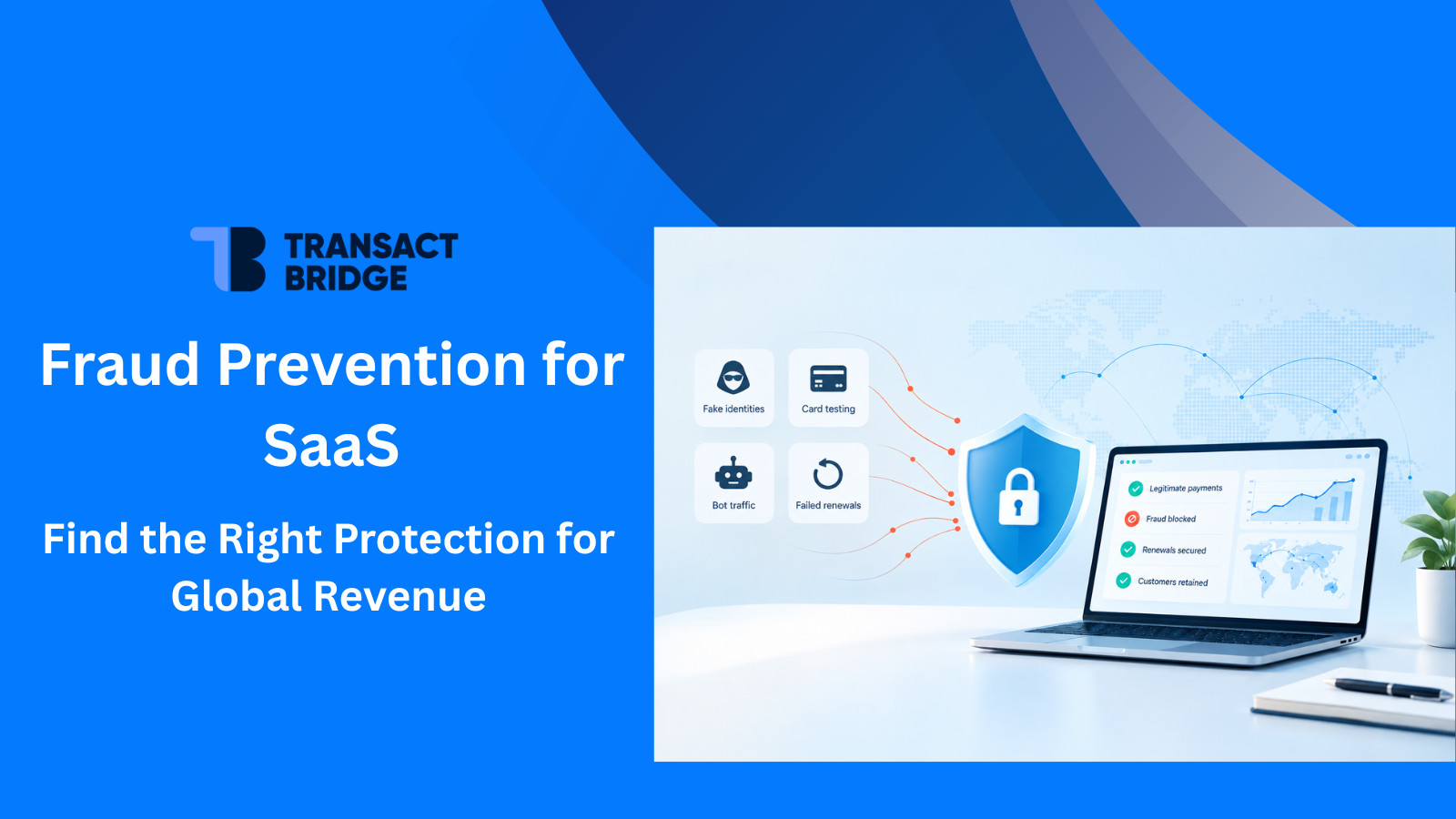
A SaaS business does not only lose money when a stolen card gets approved. It loses money when a legitimate customer is wrongly declined, when a free trial is farmed by bots, when a renewal fails silently in a market whose authentication rules changed, and when a dispute lands on month four of a subscription booked as revenue in month one.
Fraud prevention tools for SaaS companies address the first of those problems well and the others unevenly – which makes choosing one less a software decision than an operating decision about where revenue actually leaks.
Quick answer: The best fraud prevention tools for SaaS companies in 2026 are Stripe Radar, Sift, SEON, Signifyd, Riskified, Forter, Kount, Sardine, DataDome, and Arkose Labs. They divide into three operating models – risk scoring, chargeback guarantee, and bot or abuse mitigation – and most global SaaS businesses need one tool from at least two of those models rather than the highest-rated tool from one.
Key takeaways
-
Fraud tools produce decisions. They do not authorise payments. Approval rate, renewal success and dispute ratio are determined in the payment layer underneath.
-
Blocking harder appears counterproductive. Merchant Risk Council 2026 data shows more mature fraud programmes rejecting 2.8% of orders at a 0.6% fraud rate, against 5.2% rejection and 3.9% fraud for less mature programmes.
-
Visa's merchant threshold tightened from 2.2% to 1.5% on 1 April 2026, with an $8 fee per fraudulent or disputed transaction once enrolled.
-
India's cross-border authentication requirement takes effect 1 October 2026, changing decline behaviour for foreign entities billing Indian cards.
-
SaaS fraud spans four stages – signup, trial, checkout, renewal – and most tools cover only one or two well.
SaaS payment fraud prevention: why SaaS differs from e-commerce
Most "best fraud prevention tools" content is written for retailers, and the framing breaks for software companies in a specific way. A retailer has a fulfilment window: time between order and shipment in which to review. SaaS has no such window. Provisioning is instant, the marginal cost of a fraudulent account approaches zero, and damages compounds across the subscription lifecycle rather than landing in one transaction.
That produces four distinct attack surfaces. No single tool covers all four well.
|
Stage |
What goes wrong |
Detection signal that works |
Business cost |
|
Signup |
Bot-driven account farming, disposable identities, multi-accounting |
Bot mitigation, email and phone intelligence, device fingerprinting |
Polluted analytics, inflated CAC, distorted conversion data |
|
Free trial |
Trial farming across fresh identities, prepaid card cycling |
Device fingerprinting, velocity checking, digital footprint enrichment |
Infrastructure spend on non-buyers, false product-market-fit signals |
|
Checkout |
Card testing, stolen credentials, synthetic identity |
Transaction monitoring, fraud risk scoring, 3DS routing |
Direct loss, plus the dispute-ratio consequences below |
|
Renewal |
Friendly fraud on later cycles, mandate failure, involuntary churn |
Dispute intelligence, retry logic, pre-dispute alerts |
Revenue reported as churn when the cause was a payments failure |
Key insight: SaaS payment fraud prevention is a lifecycle discipline, not a checkout control. A tool that only sees the transaction is blind to three of your four attack surfaces.
Card testing prevention: the SaaS-specific hazard
Card testing deserves separate treatment because SaaS companies are structurally attractive targets. A fraudster holding thousands of stolen card numbers needs a cheap, instant, low-friction way to identify which remain live. A $9 monthly plan with an API-driven signup is close to ideal.
The direct loss is trivial. The consequence is not. Every declined authorisation attempt is logged, and high attempt volumes paired with low approval rates draw acquirer attention. Businesses that absorb a card testing wave frequently report degraded approval rates on entirely legitimate traffic for weeks afterwards.
Effective card testing prevention is layered: bot detection before the request reaches your application, velocity checking on payment attempts per IP and device, and challenge escalation on anomalous signup patterns. Transaction-level scoring alone catches it late.
Subscription fraud prevention and the renewal blind spot
The renewal stage is the one finance leaders consistently under-price, and where subscription fraud prevention diverges most sharply from e-commerce fraud prevention.
A chargeback filed against the fourth month of a subscription can arrive long after acquisition cost was spent and revenue was initially recognised. It does not present as fraud. It presents as a dip in net revenue retention, and it gets attributed to product dissatisfaction. Three distinct failures hide in that same number:
Friendly fraud on later cycles. The customer used the service, then disputed the charge. Fighting this requires an evidence trail – login records, usage logs, authorisation history – that most SaaS billing systems capture but few surface into dispute responses.
Mandate and authentication failure. In markets with recurring-payment rules, a renewal can fail for purely regulatory reasons.
Silent involuntary churn. A card expires, an issuer declines, a retry never fires. No fraud occurred, but the revenue is equally gone.
Only the first is a fraud problem. The other two are payment problems wearing a fraud costume, and a better fraud tool will not touch them. Separating the three in your own data is the highest-value diagnostic available to a SaaS finance team, and it usually takes an afternoon.
Fraud detection software vs fraud prevention: how the stack actually works
Fraud detection identifies suspicious activity, typically by scoring a transaction or session and returning a decision. Fraud prevention is the wider system that acts on that decision – authentication routing, payment method selection, velocity controls and dispute management. Detection platforms leave financial liability with the merchant; guarantee providers assume it on approved orders.
The distinction matters because fraud detection software never operates alone. It sits in a chain:
Signal collection → risk scoring → decision → authentication → payment routing → post-transaction monitoring → dispute management
Fraud detection software owns the first three links. Everything after "decision" belongs to your payment infrastructure. A tool can conclude a transaction is legitimate; whether that conclusion becomes money depends on links four through seven.
How real-time fraud detection works
Real-time fraud detection evaluates a transaction or session before authorisation, typically within milliseconds, assembling signals across several categories:
-
Device and network : device fingerprint, IP reputation, geolocation consistency, browser and hardware attributes
-
Identity : email and phone age, digital footprint depth, address verification results
-
Behavioural : typing cadence, session navigation, hesitation patterns, time-to-checkout
-
Velocity : attempts per card, per device, per IP within defined windows
-
Historical and network : prior activity for this identity, plus cross-merchant patterns where the vendor operates a consortium
Those signals resolve into a risk score mapping to one of three outcomes: approve, decline, or manual review. Decision latency matters commercially – a review queue taking six hours is effectively a decline for a self-serve SaaS signup.
How AI fraud detection improves decisioning
Rules engines encode what you already know about fraud. AI fraud detection generates the ruleset by analysing historical transactions, learning which signal combinations separated genuine from fraudulent, and adapting as patterns shift.
The practical advantage is precision on edge cases a static rule would misclassify. The practical risks are three. Model drift: fraud patterns change, and a model trained on last year's attacks degrades quietly. Explainability: when a model declines a customer, you may not be able to say why, which is a problem in regulated markets and an operational problem everywhere. Training-data geography: a model trained predominantly on one region's traffic may generalise less well to another, which is why you should ask vendors for performance by market rather than a single global average.
Why over-blocking now costs more than fraud
Before comparing tools, be clear about what you are optimising for. Most buyers open this evaluation asking which tool blocks the most fraud. The 2026 evidence suggests that is the wrong question.
The Merchant Risk Council's 2026 Global Payments and Fraud Report, surveying 1,278 professionals across 37 countries, produced the comparison worth taking into a board meeting:
|
Programme maturity |
Order rejection rate |
Fraud rate (by revenue) |
|
More mature programmes (MRC members) |
2.8% |
0.6% |
|
Less mature programmes |
5.2% |
3.9% |
The same report found merchants' self-reported false decline rates running high: 38% estimating 2–5% of orders wrongly declined, and roughly two-thirds landing between 2% and 10%. Datos Insights puts the global average false decline rate at 1.51% of e-commerce sales.
Adyen's 2026 Fraud Report, drawn from approximately $1.6 trillion in platform transactions, found static controls blocking up to 10% of legitimate customers, with half of surveyed businesses reporting false declines rising.
Vendor estimates put global false-decline losses in the hundreds of billions; Signifyd projects over $231 billion in 2026, a figure from a vendor in this comparison and best read as directional rather than as an independent measurement. The more useful observation is simpler: most SaaS teams can state their fraud rate and cannot state their false decline rate.
Do you know your false decline rate?
Most SaaS teams can state their fraud rate and not their false decline rate. The second one usually costs more.
The MRC figures suggest more mature fraud programmes achieve lower fraud rates without relying on higher rejection rates. They do not establish that rejecting fewer orders causes lower fraud. The more defensible reading is that precision, not threshold aggression, separates the two rows and precision comes from signal quality plus a payment layer capable of acting on good decisions.
The VAMP arithmetic
Visa's Acquirer Monitoring Program has made blunt blocking commercially awkward. Since 1 April 2026 the merchant "Excessive" threshold is 1.5%, reduced from 2.2%; acquirer thresholds sit at 0.5% (Above Standard) and 0.7% (Excessive), and enrolled merchants are assessed $8 per fraudulent or disputed transaction. The ratio combines fraud reports and disputes into one figure, counted by transaction count rather than value, and applies across the US, Canada, EU, APAC and LATAM, with CEMEA remaining at 2.2%.
Note the structure of the calculation. Because the VAMP ratio measures fraud-and-dispute events relative to transaction volume, simply reducing legitimate approvals does not solve the underlying ratio problem. Cutting legitimate approvals can reduce revenue without addressing the fraud and dispute events driving the ratio.
Corgi Labs illustrates the tightening with a worked example: a merchant at 60,000 monthly transactions could previously absorb up to 1,320 events before reaching "Excessive"; at 1.5% that ceiling falls to 900 (Corgi Labs, 2026). A business running around 1,050 events was compliant in March 2026 and in breach in April without changing anything.
The response that works is dual optimisation – increasing approvals of genuine transactions while reducing genuine fraud and disputes. That requires both a capable fraud tool and a payment stack able to act on its decisions.
Cross-border payment fraud prevention for global SaaS
Cross-border payment fraud prevention is a different discipline from domestic fraud prevention, and conflating the two is the most common expensive mistake in international SaaS expansion. Domestically, a decline usually means your fraud model or your issuer scored a customer as risky. Internationally, the same visible outcome can have four or five causes, most of which have nothing to do with fraud.
False declines in international payments
Several mechanisms produce an identical-looking decline:
-
Issuer behaviour varies by market. Local issuers apply their own risk logic to foreign-acquired transactions, often more conservatively than to domestic ones.
-
Authentication requirements differ. A transaction clearing without a challenge in one market requires one in another, and a broken authentication path presents as a decline.
-
Payment method mismatch. Offering only card rails where local methods dominate suppresses conversion before any fraud decision occurs.
-
Cross-border routing itself reduces approval odds. The same transaction presented through local acquiring rather than as a cross-border charge frequently performs differently.
-
Model geography. A fraud model trained mostly on North American traffic may score Indian or Southeast Asian transactions less accurately.
The practical consequence: a fraud decline and a payment decline are not the same event, and they require opposite responses. Tightening fraud rules in response to a payment-layer decline makes the problem worse. Before you change any rules, segment declines by market and by decline code. The split usually reveals that international "fraud" declines were mostly infrastructure.
3DS2 authentication routing
3DS2 authentication routing determines when a transaction is challenged, when it is authenticated silently in the background, and when a challenge is skipped entirely under an exemption. It sits between the fraud decision and the authorisation, and it is where a great deal of avoidable friction is created or removed.
Three things worth knowing. First, 3DS2 supports frictionless flow: risk data is passed to the issuer, which may authenticate without ever prompting the customer. Second, successful authentication generally shifts fraud chargeback liability from merchant to issuer, which changes the economics of your fraud tooling.
Third, routing decisions are made by your payment provider, not your fraud tool – which of your transactions get challenged, and under which exemption logic is a function of infrastructure configuration.
For SaaS specifically, the frictionless path matters disproportionately. A challenge inserted into a self-serve upgrade flow is an abandonment risk in a way it is not for a considered retail purchase.
Recurring payment fraud prevention
Recurring payment fraud prevention has to solve two problems at once: stopping genuine fraud on renewals, and not breaking legitimate renewals through over-control.
On the fraud side, the signals differ from first-purchase fraud. A subscription that has billed successfully for six months has an authorisation history, a usage record and a device pattern. Weighting those correctly means a returning customer is scored on evidence rather than treated as a fresh transaction – which is where many fraud stacks quietly lose money by re-scoring known-good customers from scratch each cycle.
On the failure side, renewals break for reasons no fraud tool controls: expired credentials, issuer declines with no retry, authentication requirements the mandate cannot satisfy, and market-specific mandate rules. India's e-mandate framework is the clearest current example, covered below – and one where the recurring billing rail you choose determines whether renewals clear at all.
What global SaaS companies should look for: different markets, different regimes
Any SaaS company selling internationally now operates under several overlapping authentication and monitoring regimes. They are not converging, and sequencing matters for planning.
India
Authentication. The Reserve Bank of India's (Authentication Mechanisms for Digital Payment Transactions) Directions, 2025 (RBI/2025-26/79, issued 25 September 2025) require a minimum of two authentication factors with at least one dynamic factor for non-card-present transactions, in force from 1 April 2026.
Cross-border acceptance. The same directions require card issuers to validate an Additional Factor of Authentication when requested by an overseas merchant or acquirer on cross-border card-not-present transactions, and to apply risk-based mechanisms, from 1 October 2026. For a SaaS company billing Indian customers from a US or EU entity on card rails, this changes the authentication path and therefore the decline profile.
Recurring payments. The Digital Payments – E-mandate Framework, 2026 (RBI/DPSS/2026-27/396, dated 21 April 2026) permits recurring debits up to ₹15,000 without per-cycle authentication following a one-time AFA at mandate registration. A higher ₹1 lakh threshold applies only to insurance premiums, mutual fund subscriptions and credit card bills – categories that do not include software subscriptions.
The framework also mandates 24-hour pre-debit notification and post-debit confirmation, and applies across cards, prepaid instruments and UPI. An annual SaaS plan above ₹15,000 therefore needs per-cycle authentication or an alternative rail such as UPI Autopay, which operates under the same framework and obligations.
Local payment methods. Card penetration does not describe Indian digital payments well. UPI and its recurring variant are central to conversion, making local method coverage a revenue decision before it is a fraud decision.
United States
Network monitoring. VAMP thresholds and fees as above – a network rule rather than legislation, enforced through your acquirer.
Combined ratio effects. Fraud reports and disputes feed a single metric, meaning a fraud problem and a customer-service problem land in the same enforcement number.
Authorisation optimisation. At a 1.5% threshold, approval-rate work is no longer separable from compliance work. Raising legitimate approvals improves the ratio directly.
Europe and other global markets
Strong Customer Authentication. PSD2 SCA remains the operative regime, with EMV 3DS as the primary mechanism for card payments. PSD3 and the accompanying Payment Services Regulation have progressed through the EU legislative process, with political agreement reported in late 2025 and phased application widely expected in the 2027–2028 window. Verify current status at publication.
Authentication exemptions. Transaction Risk Analysis exemptions allow low-risk transactions to skip a challenge where the provider's fraud rates justify it. Whether you can use them depends on your payment provider's fraud performance, not your fraud tool's opinion of the customer.
Local methods elsewhere. The principle recurs across markets – iDEAL, Bancontact, PIX, regional wallets. A fraud tool has no view on whether you offer the method your customer expects.
Callout: No fraud prevention tool holds a licence, registers a BIN, or applies an SCA exemption. Those are functions of payment infrastructure. A fraud tool concludes a transaction looks legitimate; something else has to be able to get it approved.
Selling into India from a US or EU entity?
Authentication and e-mandate rules decide whether your Indian renewals are clear. Find out where yours are failing.
The 10 best fraud prevention tools for SaaS companies in 2026
There is no single best fraud detection platform for SaaS. Tools divide into three operating models, and the right choice depends on which model matches your exposure.
|
Operating model |
What it does |
Who carries fraud liability |
Best suited to |
|
Risk scoring |
Scores transactions and sessions, returns a decision |
Merchant |
Teams wanting control and lower unit cost |
|
Chargeback guarantee |
Approves or declines, covers eligible fraud chargebacks on approved orders |
Vendor, subject to contract terms |
Businesses prioritising approval rate and predictable loss |
|
Bot / abuse mitigation |
Blocks automated abuse before it reaches the application |
Merchant |
Signup- and trial-heavy SaaS |
Comparison table
|
Tool |
Model |
Primary fraud signals |
Lifecycle coverage |
Pricing |
Best for |
|
Stripe Radar |
Risk scoring |
Transaction monitoring, network signals, fraud risk scoring |
Checkout, renewal |
Per-transaction add-on |
Stripe-native SaaS wanting fast coverage |
|
Sift |
Risk scoring |
Behavioural analytics, device fingerprinting, velocity checking |
Signup, checkout, renewal |
Quote-based |
Teams that want to own decisioning rules |
|
SEON |
Risk scoring |
Digital footprint enrichment, device fingerprinting, velocity checking |
Signup, trial, checkout |
Public starting price |
Early-stage SaaS with trial abuse problems |
|
Signifyd |
Guarantee |
Transaction monitoring, identity signals, network data |
Checkout, dispute |
Quote-based, % of volume |
Consistent volume wanting liability shift |
|
Riskified |
Guarantee |
Behavioural analytics, identity graph, transaction monitoring |
Checkout, dispute, refund abuse |
Quote-based, % of volume |
Approval rate as the binding constraint |
|
Forter |
Guarantee + decisioning |
Identity network, behavioural analytics, real-time decisioning |
Signup, checkout, dispute |
Quote-based, enterprise |
High-velocity decisioning across regions |
|
Kount |
Risk scoring |
Device fingerprinting, identity data, configurable rules |
Signup, checkout, renewal |
Quote-based |
Deep rule configuration plus identity history |
|
Sardine |
Risk scoring + compliance |
Behavioural biometrics, device intelligence, transaction monitoring |
Signup, checkout, compliance |
Quote-based |
SaaS with embedded payments or regulated flows |
|
DataDome |
Bot mitigation |
Bot detection, card testing prevention, account takeover prevention |
Signup, trial |
Quote-based |
Open signup funnels, free tiers, public APIs |
|
Arkose Labs |
Bot mitigation |
Progressive challenge, bot detection, account takeover prevention |
Signup, trial |
Quote-based, enterprise |
Organised, persistent account farming at scale |
Pricing models reflect publicly available vendor positioning as of September 2026. Most vendors in this category quote by volume and risk profile rather than publishing rates. Confirm current terms directly.
1. Stripe Radar
Machine-learning transaction scoring built into Stripe and trained on network-wide signal, covering the subscription journey from trial through first charge to renewal.
Consider before buying: Radar scores what Stripe processes. If you add a second processor for a specific market – common when entering India or where local rails matter – its view of your traffic becomes partial.
2. Sift
A PSP-agnostic machine-learning platform with configurable review workflows, handling high event volumes across diverse industries. Frequently the general-purpose scoring layer for companies that have outgrown processor-native tooling.
Consider before buying: No chargeback guarantee. You are buying better decisions rather than risk transfer, and liability remains with you.
3. SEON
Digital-footprint enrichment as the core signal – email, phone, IP and device data assembled into a profile before a decision is committed. Distinctively for this category, Footprint enrichment performs well against disposable-identity signup farming, which makes it a strong fit where free trial abuse is the dominant problem.
Consider before buying: SEON positions itself around modular, self-directed configuration rather than managed decisioning services. Confirm what operational support is included at your tier.
4. Signifyd
Signifyd approves or declines orders and assumes financial liability for eligible chargebacks on approved orders, converting a variable loss into a predictable fee.
Consider before buying: Coverage scope, excluded reason codes and merchant override rights vary by contract. Review the exclusions rather than the summary.
5. Riskified
Also a guarantee provider, positioned around approving good orders rather than blocking bad ones – the right emphasis given the false-decline economics above. A Forrester Total Economic Impact study commissioned by Riskified reported 594% ROI over three years; vendor-commissioned research warrants the usual scepticism, though the strategic framing holds.
Consider before buying: Policy abuse and friendly fraud sit in a product separate from the core guarantee.
6. Forter
Identity-based decisioning at high velocity with contractually guaranteed performance rates at enterprise scale.
Consider before buying: Its enterprise orientation may make the economics harder to justify at lower transaction volumes. Model the fee against your current volume before shortlisting.
7. Kount
Machine-learning scoring combined with a large device-fingerprint network and identity data. Kount was acquired by Equifax in 2021 and the current platform is marketed as Kount 360, covering payment fraud, chargeback management and account takeover protection. It has an established presence in subscription and recurring billing.
Consider before buying: Fraud decisioning routes through a credit-bureau-owned platform, which some teams weigh differently for data-governance reasons.
8. Sardine
Fraud, compliance and AML in one platform, with behavioural biometrics – how a user types, moves and hesitates – as a core signal. Built for fintech, making it a natural fit for SaaS that moves money on behalf of customers.
Consider before buying: The compliance capability is a significant part of the value. Businesses without a regulatory obligation should weigh that in the pricing comparison.
9. DataDome
Real-time bot detection at the edge, blocking credential stuffing, scripted account creation and automated card testing before requests reach your application. A different layer from everything above.
Consider before buying: It does not score transactions or make payment decisions. It complements a scoring or guarantee tool rather than replacing one.
10. Arkose Labs
Bot mitigation at scale, using progressive challenges that make automated abuse economically unattractive rather than simply blocking it – sound logic against determined attackers.
Consider before buying: Enterprise pricing and a more involved integration than edge-based bot tools.
Also worth evaluating: Fingerprint (device identification as a standalone signal), ClearSale and NoFraud (guarantee models with more accessible pricing), Ravelin, DataVisor, and nSure.ai – the last building a dedicated model per merchant and offering a chargeback guarantee, with a focus on digital goods, gaming and crypto rather than general B2B SaaS.
How to choose fraud prevention software
Work through this in order. Most evaluations fail because they begin at step four.
Step 1 : Identify your dominant fraud surface. Pull ninety days of data and establish where losses originate. Signup and trial abuse, checkout fraud, and renewal disputes require different tools. If trial farming is the bulk of your problem, a chargeback guarantee addresses none of it.
Step 2 : Decide whether you are buying decisions or liability transfer. Scoring platforms give control, lower unit economics, and continued ownership of loss. Guarantee providers absorb eligible fraud chargebacks for a percentage fee.
Rule of thumb, not a benchmark: Calculate the vendor fee against your actual historical fraud losses over the last twelve months. If losses are low relative to the quoted fee, the guarantee is insurance you may not need. If they are high, it is usually cheaper than the losses. Your own numbers decide this – industry averages do not.
Step 3 : Measure your false decline rate before tuning anything. Most SaaS teams cannot state this figure. Approximate it: count customers who fail a payment then succeed on retry with the same card, add support contacts about declined payments, and track post-decline churn. A rate materially above the ~1.51% figure Datos Insights reports as a global e-commerce average is a useful signal to investigate before you consider tightening rules.
Step 4 : Check performance across your actual markets. Ask for approval and fraud rates broken out by market rather than a global average, specifically for the markets you sell into.
Step 5 : Confirm your payment stack can act on the decision. The step most often skipped, and the one determining whether the tool pays for itself.
Decision shortcut
|
If your situation is… |
Start with |
|
Early stage, single processor, Stripe-native |
Stripe Radar, plus SEON if trial abuse dominates |
|
Multi-processor, low fraud rate, want control |
Sift or SEON for scoring, with liability retained |
|
Fraud losses exceed likely guarantee fees |
Signifyd or Riskified for the liability shift |
|
Bot-driven signup abuse dominating |
DataDome or Arkose, plus a scoring layer |
|
Embedded payments or regulated money movement |
Sardine |
|
Approval rate is the constraint, not fraud |
Riskified or Forter, plus a payments review |
You've picked the tool. Now check the layer underneath.
A fraud tool approves the transaction. Your payment stack decides whether it clears.
Chargeback prevention for SaaS
Chargeback prevention for SaaS operates on a different timeline from fraud prevention. Fraud prevention acts before authorisation; chargeback prevention acts in the window between a customer's dissatisfaction and a formal dispute – a window that can run weeks.
Four controls work, roughly in order of cost-effectiveness:
Clear billing descriptors. A meaningful share of SaaS disputes come from customers who did not recognise a charge. The descriptor is a one-line configuration change with a measurable dispute impact.
Pre-dispute alerts. Networks and third-party services notify merchants when a cardholder initiates a dispute, allowing a refund before the chargeback posts. A refund costs the transaction value; a chargeback costs the transaction value plus fees plus a mark against your ratio.
Dunning and retry logic. Failed renewals that are never recovered become churn; failed renewals recovered clumsily become disputes. Sequencing retries around issuer behaviour, and notifying customers before retrying, reduces both.
Evidence-backed representment. For disputes worth contesting, SaaS has unusually strong evidence available: authentication records, login timestamps, feature usage, and prior successful billing cycles. Most teams do not surface it.
Note the connection to VAMP. Because fraud reports and disputes now feed one combined ratio, non-fraud disputes contribute to an enforcement metric that used to be fraud-only. Chargeback prevention is now partly a compliance activity.
Global SaaS payment processing: the three optimisation layers
Global SaaS payment processing is best understood as three separate layers, each with its own owner, each capable of failing independently.
|
Layer |
Question it answers |
Owned by |
|
1. Fraud decisioning |
Is this customer legitimate? |
Your fraud tool |
|
2. Authentication |
Can this transaction satisfy the market's authentication requirements? |
Payment infrastructure and issuer |
|
3. Payment routing |
Can this approved transaction reach the customer through the right acquirer, rail and payment method? |
Payment infrastructure |
The full path runs: fraud decision → authentication → routing → authorisation → settlement.
Most SaaS companies invest heavily in layer one and assume layers two and three take care of themselves. Three cases show why they do not.
An Indian customer billed from a US entity. Your tool approves. The transaction is presented cross-border on card rails. The Indian issuer applies its own logic and from 1 October 2026 must be able to validate an additional authentication factor when an overseas merchant or acquirer requests one. If your acquiring path cannot carry that request cleanly, the transaction declines. Your fraud tool records a clean approval; your finance team records lost revenue.
A European renewal under SCA. Your tool scores the customer as low risk. Whether that score can purchase an exemption from a challenge depends on your provider's fraud rates and its ability to apply Transaction Risk Analysis. The score is only as useful as the infrastructure permitted to act on it.
An Indian annual subscription above ₹15,000. No fraud tool can authenticate this. The e-mandate framework requires per-cycle authentication or an alternative rail such as UPI Autopay, with associated notification obligations. This is an architecture decision made months before any fraud tool sees a transaction.
This is where Transact Bridge sits. Operating as a merchant of record, Transact Bridge provides the payment infrastructure that turns approved transactions into successful, compliant payments across India, the US, and global markets – local acquiring and local payment methods rather than cross-border card presentment, recurring billing built for markets where mandate rules differ, and the tax, compliance and seller-of-record responsibilities that come with selling across those markets.
The relationship to your fraud stack is complementary. Your fraud tool decides which transactions deserve approval. Your payment infrastructure determines how many of those approvals actually clear, in which market, on which rail, under which regulatory regime. Buying a better fraud tool while presenting Indian transactions cross-border optimises the wrong layer.
Sell in India and the US without a local entity
Transact Bridge operates as your merchant of record — local acquiring, local payment methods, tax and compliance handled.
A 90-day implementation plan
Days 1–30: measure. Establish baselines before touching a rule. Fraud rate by revenue and by count. Chargeback rate split by fraud and non-fraud reason codes. Approval rate by market. Manual review volume and handling time. False decline estimate. Current VAMP ratio. You cannot demonstrate improvement against a baseline you never took.
Days 31–60: run in shadow mode. Ask vendors to support a shadow-mode or observation phase, running against live traffic without acting on decisions, and compare their calls to your actual outcomes. Reluctance to provide one should trigger closer scrutiny. Shadow mode is also where regional blind spots surface before they cost anything.
Days 61–90: cut over on a segment. Go live on one market or one plan tier. Watch approval rate as closely as fraud rate. A tool that halves fraud while cutting approvals by three points has probably destroyed value. Expand only when both hold.
Success metrics to track throughout
|
Metric |
Why it matters |
|
Incremental approved revenue |
The CFO-facing number: additional revenue cleared versus baseline |
|
Approval rate (by market) |
The revenue side of every fraud decision |
|
Fraud rate (by revenue and count) |
The loss side; track both, they diverge |
|
Chargeback rate (fraud vs non-fraud) |
Separates fraud from service problems |
|
False decline rate |
The largest hidden cost for most SaaS businesses |
|
Renewal success rate |
Where subscription fraud and payments failure overlap |
|
Manual review rate and handling time |
Operational cost, and a proxy for model precision |
Evaluation checklist
-
Approval and fraud rates broken out by market, not global averages
-
Explicit false-positive rate, and the vendor's method for measuring it
-
For guarantee providers: covered reason codes, full exclusion list, override rights
-
Coverage across signup, trial, checkout and renewal
-
Integration effort in engineering-weeks, confirmed by a reference customer
-
Shadow-mode or observation phase before enforcement
-
Contract exit terms and data portability
-
Whether the vendor can influence your VAMP ratio or only report on it
-
Separately: whether your payment provider offers local acquiring in your top three markets
FAQs
What is the best fraud prevention tool for SaaS companies?
There is no single best tool, because SaaS fraud spans four stages and tools specialise. Stripe Radar suits Stripe-native businesses, SEON and Sift suit teams wanting control, and Signifyd, Riskified and Forter suit companies transferring chargeback liability. Most global SaaS companies run two layers: bot mitigation at signup and risk scoring or a guarantee at checkout.
How do SaaS companies prevent payment fraud?
Effective SaaS payment fraud prevention layers four controls: bot mitigation at signup, device fingerprinting and velocity checking during trials, transaction risk scoring at checkout, and dispute intelligence at renewal. Beneath all four sits the payment infrastructure that determines whether approved transactions actually clear in each market you sell into.
What is card testing and how do you stop it?
Card testing is fraudsters running small transactions to identify which stolen card numbers remain active, and SaaS free tiers are prime targets. Prevent it with bot detection at signup, velocity limits on payment attempts per IP and device, and challenge escalation. The lasting damage is the degraded approval rate that can follow, not the loss itself.
What is the difference between fraud detection and fraud prevention?
Fraud detection identifies suspicious activity, usually by scoring a transaction and returning a decision. Fraud prevention is the broader system acting on those decisions: authentication routing, payment method selection, velocity controls and dispute management. Detection platforms leave financial liability with you; guarantee providers assume it on approved orders, subject to contract terms.
How much does payment fraud cost SaaS companies?
Direct fraud losses are typically a small percentage of revenue, but total cost is larger. Merchant Risk Council data shows many merchants wrongly declining between 2% and 10% of orders, and Adyen found static controls blocking up to 10% of legitimate customers. For most SaaS businesses, false declines and involuntary churn together cost more than fraud.
Do you still need a fraud tool if you use a Merchant of Record?
Usually yes, though the burden shifts. A Merchant of Record such as Transact Bridge becomes the seller of record, assuming the merchant relationship, tax obligations and much of the dispute liability. It does not protect your signup funnel from bot abuse or your free trial from farming – those remain application-layer problems requiring bot mitigation.
Does Stripe Radar work for cross-border SaaS payments?
Yes, but only for transactions Stripe processes. Its cross-border limitation is coverage rather than accuracy: it cannot see traffic on other processors, and cannot resolve market-specific failures such as Indian e-mandate limits above ₹15,000 or an authentication path a local issuer will not honour. Those need local acquiring, not a different score.