
How Do Global Businesses Access Local Payment Rails?
Published on: Thu 08-Oct-2026 11:33 AM
Quick answer
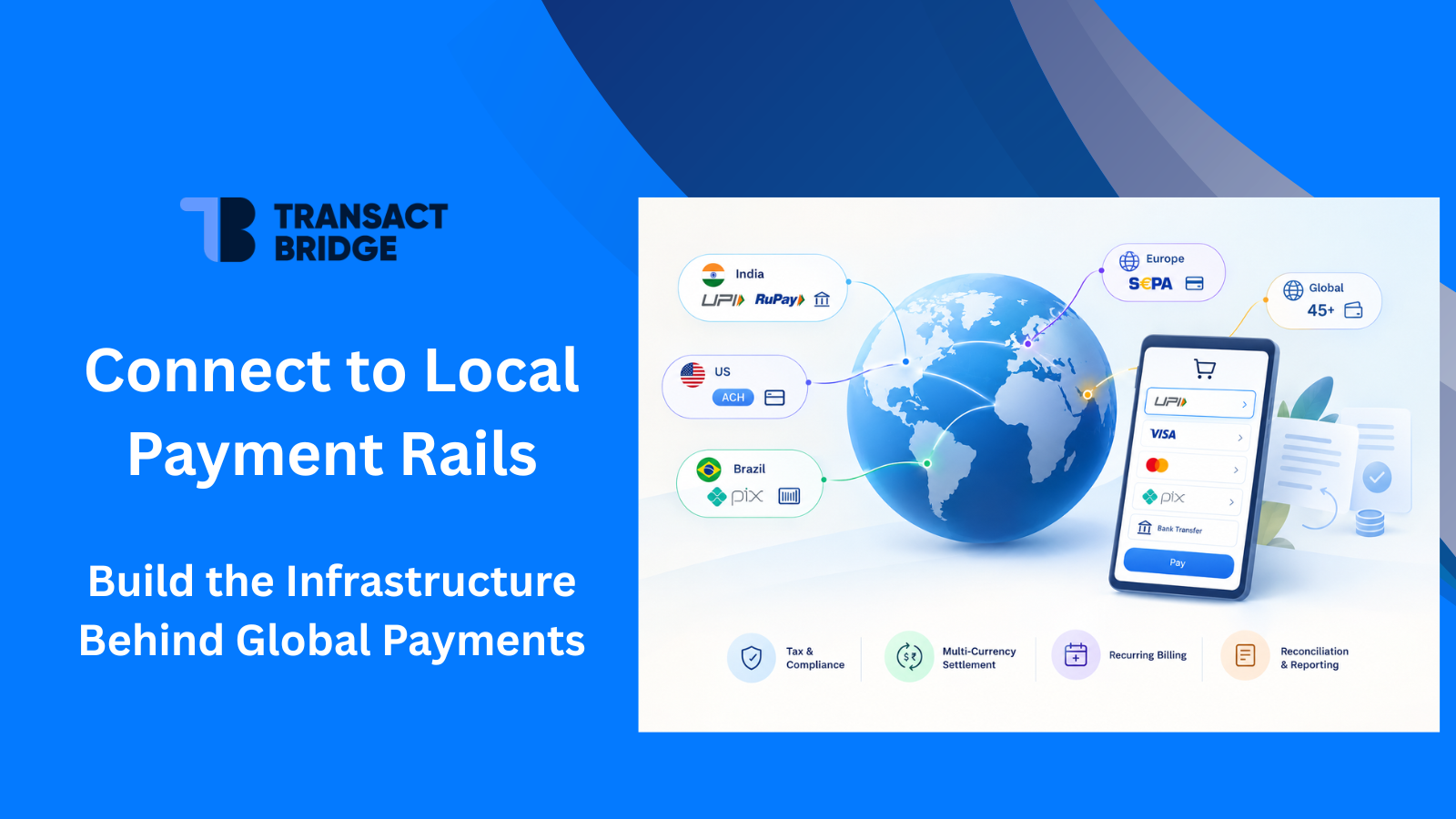
Global businesses access local payment rails through four main routes: direct local acquiring, PSPs or payment aggregators, payment orchestration, or a Merchant of Record (MoR). The right model depends on the markets you enter, the payment methods customers expect, regulatory requirements, settlement needs, tax obligations, and how much payment infrastructure your business wants to own.
Key takeaways
-
UPI processed 24.51 billion transactions in India in August 2026; Pix represented 54.7% of payment transactions in Brazil in H2 2025.
-
In India, non-bank entities facilitating cross-border payment aggregation require RBI PA-CB authorization, and PA-CB processes transactions are capped at 25 Lakh each.
-
Local payment access is only one part of the operating model. Settlement, tax, recurring billing, reconciliation and regulatory responsibilities also need to be assigned.
-
Businesses can build those capabilities directly, connect through providers, orchestrate multiple providers, or use an MoR to take on specified seller-side responsibilities.
What are local payment rails?
A local payment rail is the domestic infrastructure through which payments move within a particular market. Examples include UPI in India, ACH in the US and Pix in Brazil.
The scale of these systems explains why global businesses cannot treat local payment methods as optional checkout additions:
-
India: UPI processed 24.51 billion transactions worth ₹29.82 trillion in August 2026, according to NPCI.
-
US: The ACH Network processed 35.2 billion payments worth $93 trillion in 2025, including nearly 8.1 billion B2B payments, according to Nacha.
-
Brazil: Pix represented 54.7% of payment transactions in H2 2025, according to Banco Central do Brasil.
-
Brazil ecommerce: Pix accounted for 42% of ecommerce transaction value in 2025, according to Worldpay's Global Payments Report 2026.
These are not simply alternative buttons on a checkout page. They are established domestic payment infrastructures with their own participants, rules, settlement processes and customer behavior.
Four ways global businesses access local payment rails
1. Direct local acquiring
The business establishes the required acquiring and banking relationships in each market and connects directly to the relevant payment infrastructure.
This provides significant control over payment processing, settlement and economics. It also means managing local contracts, technical integrations, regulatory requirements, reconciliation and banking relationships market by market.
Best suited to: large businesses with substantial payment volume, established local operations and the resources to manage payment infrastructure internally.
2. PSPs or payment aggregators
A PSP or payment aggregator connects the business to multiple payment methods through an existing payment relationship.
Instead of building every acquiring relationship from scratch, the business integrates with the provider and accesses supported local methods through that connection.
The trade-off is control. The provider's market coverage, supported rails, settlement model, pricing and regulatory structure become important parts of the decision.
Best suited to: businesses entering selected markets without wanting to build every acquiring relationship themselves.
3. Payment orchestration
Orchestration sits above multiple payment providers or processors and coordinates how transactions are routed.
A typical orchestration layer can handle:
-
Routing transactions to the appropriate processor or rail
-
Applying market-specific payment-method logic
-
Managing retries and fallback routes
-
Consolidating payment data and reporting
This can give larger businesses more control over their payment stack, but the underlying provider relationships and compliance responsibilities still need to be managed.
Best suited to: businesses with significant transaction volume, multiple processors or complex payment-routing requirements.
4. Merchant of Record
An MoR takes a broader role. It can act as the seller for the transaction while managing payment acceptance, applicable tax obligations, compliance processes and other operational responsibilities within its scope.
That distinction matters for businesses selling digital products, SaaS, subscriptions and other cross-border services.
An MoR is therefore less about adding another payment method and more about deciding who owns the infrastructure and obligations behind the transaction.
Best suited to: SaaS, digital products and subscription businesses selling across multiple markets without local entities.
For a deeper look at how to choose the right provider, read our guide: How to Choose a Cross-Border Payment Provider.
Local payment access is more than checkout
Adding UPI, ACH or Pix to a checkout does not automatically make a business ready for that market.
Finance teams also need to consider:
-
Settlement: Where does the money settle, in which currency and on what schedule?
-
FX: Who converts the funds and at what cost?
-
Tax: Who calculates, collects and remits GST, VAT or sales tax?
-
Recurring billing: Does the local rail support recurring payments in the required way?
-
Disputes and returns: Who manages refunds, chargebacks and payment returns?
-
Reconciliation: Can finance reconcile transactions, fees, taxes and settlements across markets?
The customer sees a checkout. Finance sees an operating model.
What do global businesses need to know about local regulations?
India: UPI and the PA-CB framework
For businesses selling into India, UPI is central to payment acceptance. But accessing Indian payment rails also means understanding India's regulatory framework.
The RBI's 2025 Payment Aggregator Directions divide PA-CB activity into inward and outward categories. Inward activity covers payments received from overseas for Indian merchants, while outward activity covers Indian customers paying overseas merchants. For PA-CB-processed inward or outward transactions, the framework sets a ₹25 lakh maximum per transaction.
The framework also requires separate collection accounts for inward and outward flows.
There is an important technical distinction for card payments: where a card network facilitates the foreign-exchange settlement and the aggregator receives payment in local currency, that transaction is not treated as PA-CB activity under the relevant framework.
For a global business, the practical question is therefore not simply whether a provider supports UPI. It is under what regulatory structure the payment is being collected, settled and remitted.
India: recurring payments
Recurring revenue adds another layer. UPI AutoPay allows recurring payments through UPI, making local recurring-payment infrastructure particularly relevant for SaaS, subscriptions and digital services.
A global subscription business therefore needs to evaluate both one-time acceptance and the local mechanism for collecting recurring payments.
United States: ACH and sales-tax nexus
ACH is a core US payment rail for bank-based payments. Its scale makes it an important acceptance option for businesses selling to US customers, particularly for higher-value or recurring transactions.
There is also a separate tax consideration. US sales-tax obligations can arise when a remote seller crosses a state's economic-nexus threshold. Thresholds and rules vary by state.
For businesses selling at scale, the question becomes: who monitors those obligations, calculates the tax, collects it and handles the required filings?
Nacha's 2026 fraud-monitoring rules now require applicable ACH participants and third-party providers to monitor potentially fraudulent transactions. Under a direct or PSP model, more responsibility may remain with the merchant; under an MoR structure, specified responsibilities can shift to the MoR where the contractual and regulatory structure allows it.
Europe: instant payments and verification
Europe is also moving toward more connected instant-payment infrastructure. Under the EU Instant Payments Regulation, Verification of Payee requirements began applying in euro-area member states from October 9, 2025, with implementation for non-euro member states from July 9, 2027.
For businesses operating across Europe, local payment access therefore needs to account for both payment-method availability and evolving regulatory requirements.
Brazil: Pix
Brazil illustrates why a global checkout cannot simply be designed around international cards.
Pix is a major domestic payment rail, and its importance extends into recurring commerce through Pix Automatico, launched in June 2025.
For SaaS and subscription businesses, supporting the local recurring-payment mechanism can be as important as supporting the local one-time payment rail.
Does local payment access affect conversion?
Payment-method availability can affect checkout completion.
Baymard's latest research found that 9% of US shoppers who abandoned a checkout cited insufficient payment methods, while 10% cited a declined credit card. Its benchmark also puts average documented cart abandonment at 70.22% and estimates that large ecommerce sites could potentially gain 35.26% in conversion rate through better checkout design.
These figures do not prove that adding a specific local rail will produce a fixed conversion uplift. They show the broader commercial problem: payment availability and payment failure are part of checkout performance.
Which model should you choose?
|
Requirement |
Direct acquiring |
PSP / Aggregator |
Orchestration |
MoR |
|
Local entity |
Often required |
Depends on market/provider |
Depends on underlying providers |
Often not required for supported markets |
|
Control |
Highest |
Moderate |
High |
Lower |
|
Operational effort |
High |
Moderate |
High |
Lower |
|
Tax & compliance |
Merchant |
Usually merchant |
Usually merchant |
MoR, within contractual scope |
|
Recurring support |
Depends on acquirer |
Depends on provider |
Depends on underlying rails |
Typically supported |
|
Best suited for |
Large established businesses |
Businesses entering selected markets |
High-volume complex stacks |
Global SaaS and digital businesses |
A practical decision guide
Choose direct acquiring when payment volume and local operations justify owning the relationships.
Choose a PSP or aggregator when you want access to local methods without building every connection yourself.
Choose orchestration when you already have multiple processors and need greater control over routing and redundancy.
Choose an MoR when the priority is selling across markets without building payment, tax and compliance infrastructure country by country.
Global payment-rail readiness check
Before entering another market, ask:
-
Do we support the payment methods customers actually use there?
-
Can we settle in the currencies our finance team needs?
-
Do we know who owns local tax calculation and remittance?
-
Do we know who handles payment disputes, refunds and returns?
-
Does the local rail support our recurring-payment model?
-
Can finance reconcile transactions across providers and currencies?
-
Do we understand the regulatory requirements for our payment flow?
0–3 “yes” answers: Talk to us before entering another market.
4–5: Your payment stack may support expansion, but important gaps remain.
6–7: Your infrastructure is better positioned for multi-market expansion.
Scored 0–5 on the readiness check?
Our payments team can map the gaps for your target markets.
Why Transact Bridge for India, the US and global markets?
Most growing businesses do not want to build a separate payment operation for every country they enter. They want customers in each market to pay using the methods they already trust, while finance and engineering avoid rebuilding the payment stack every time the business expands.
Transact Bridge is built around that model. As a Merchant of Record, it combines access to local payment methods with the operational infrastructure behind the transaction. Businesses can sell across India, the US and global markets through one integration, without setting up a local entity in every market.
What Transact Bridge brings together:
-
India: UPI, including UPI AutoPay for subscriptions, RuPay, net banking and cards
-
US: ACH and cards
-
Global: 45+ local payment methods, including Pix and SEPA
-
Behind the checkout: multi-currency settlement, recurring billing, tax calculation and remittance across GST, VAT and US sales tax, refunds and dispute management, invoicing and tax reporting
That means local payment access does not have to become a separate finance, compliance and engineering project in every new market. The payment rail is only one part of the infrastructure; Transact Bridge brings the operational layer around it into the same model.
For businesses evaluating local payment methods across India, the US and global markets, the goal is not simply to add more payment buttons. It is to build a payment operation that can support how customers pay, how money settles and how the business manages its obligations as it expands.
For a closer look at local payment methods, read our guide: Local Payment Methods Across India, the US and Global Markets.
Sell in India, the US and global markets through one integration
Accept UPI, ACH, Pix and 45+ local payment methods, with tax, settlement and compliance handled by Transact Bridge as your Merchant of Record.
FAQs
Can a foreign business accept UPI?
Yes. A foreign business can accept UPI when the payment structure, provider and applicable regulatory requirements support transactions with Indian customers. For cross-border payment aggregation, the relevant PA-CB authorisation must cover the applicable flow. An alternative is an MoR structure, such as Transact Bridge, in which the provider becomes the seller to the Indian customer.
Merchant of Record vs PSP: which is better?
A PSP primarily provides payment connectivity and processing infrastructure, while an MoR can also become the seller for the transaction and take on specified tax, compliance and operational obligations. A PSP generally offers more direct control; an MoR can reduce the internal burden of multi-market expansion.
What is the difference between a payment rail and a payment method?
A payment method is what the customer chooses at checkout, such as UPI, a card or a bank transfer. A payment rail is the infrastructure underneath that clears and settles the funds between banks, such as the UPI network, ACHin the US or Pix in Brazil
Can one integration provide access to local payment rails?
Yes. A PSP, aggregator, orchestration layer or MoR can provide access to multiple local payment methods through a single technical integration. The important questions are which rails are supported, where the provider is authorized, and which obligations remain with the merchant.
Do global businesses need a local entity?
Not always. Some payment models require a local entity or acquiring relationship, while an MoR can allow a business to sell into supported markets without establishing a local entity itself.
Who owns tax and compliance?
It depends on the model and contractual scope. With direct acquiring and most PSP structures, the merchant generally retains its tax and regulatory obligations. An MoR can take on specified seller-side tax and compliance responsibilities where it operates.
Why do SaaS businesses need local recurring-payment methods?
Because a local one-time payment method does not automatically solve recurring billing. SaaS companies need to evaluate whether the local rail supports mandates, recurring collection, retries and subscription management in the way their billing model requires.


