
Cross-Border Payments: 10 Factors to Consider When Choosing a Provider
Published on: Wed 26-Aug-2026 05:01 AM
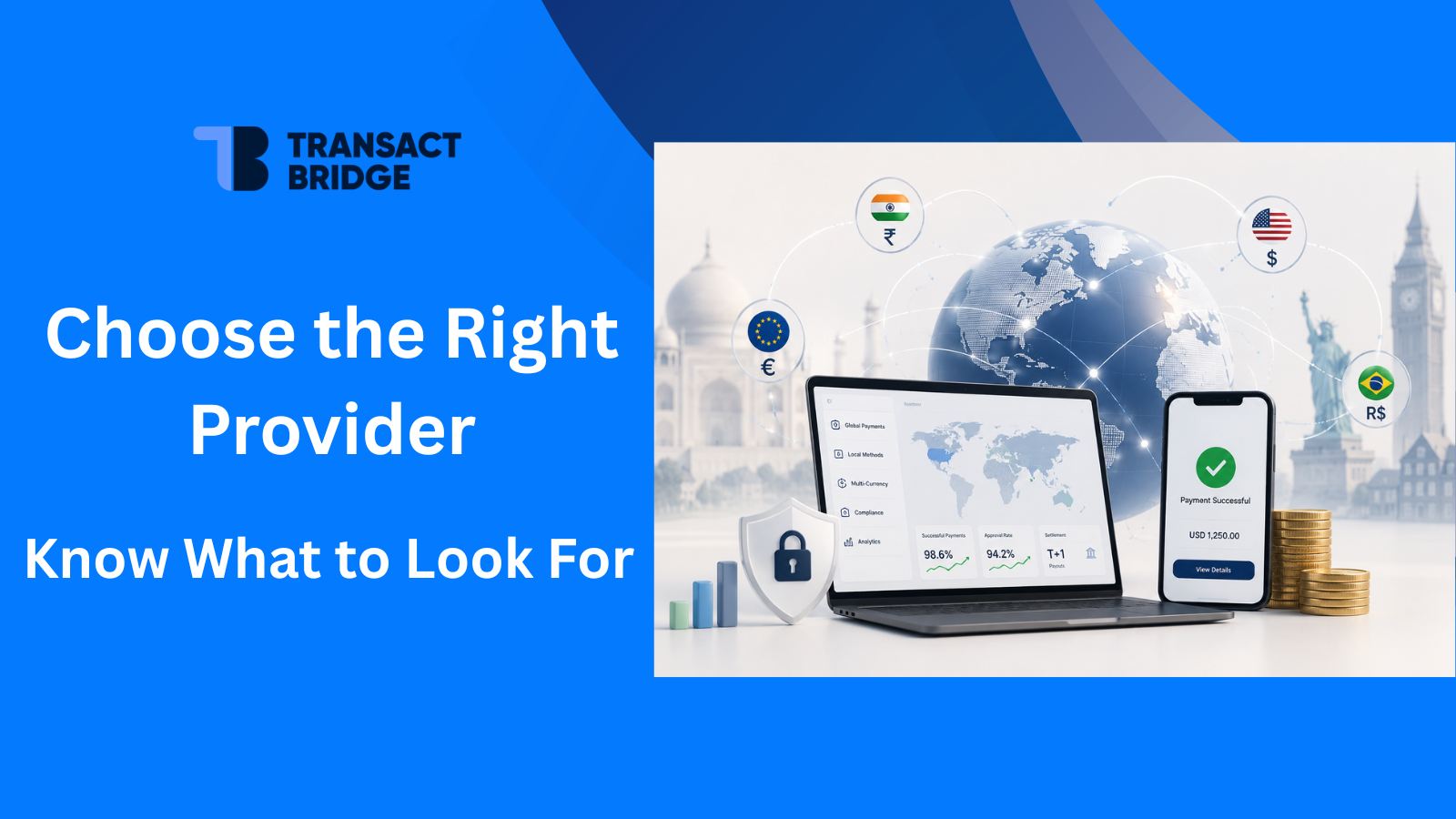
Expanding into a new country doesn't always fail because of the product. More often, the hidden friction appears somewhere less visible – at checkout, in the reconciliation file, or in a compliance obligation nobody anticipated.
Picture this: a Bengaluru SaaS company signs its first wave of customers across the US and Europe. The demand is real, but one-fifth of its international card payments are quietly declining, its "3% FX" turns out to be closer to 5% once the exchange-rate spread is factored in, and a finance lead has just realised the company may owe sales tax in several US states and VAT across the EU – with no system tracking any of it. None of this appeared in the sales forecast. All of it is a cross-border payments problem.
Choosing the right cross-border payment provider is one of the highest-leverage decisions a company makes when going global. Get it right, and international revenue compounds quietly in the background. Get it wrong, and money leaks at three points simultaneously: lost sales from declined transactions, margin eroded by fees and FX, and unplanned compliance exposure.
This guide gives founders, CEOs, and finance leaders a framework they can actually use to shortlist, score, and choose a provider – across India, the US, and other global markets.
Key takeaways
- Choose the model first: merchant of record, gateway, PSP/aggregator, orchestrator, or bank. It determines who carries tax and compliance liability.
- Compare total payment economics, not transaction fees alone. FX spreads and failed payments usually cost more than the headline rate.
- Check local acquiring. It can materially influence authorization in your key markets.
- Verify who owns tax and compliance. Don't assume a provider covers obligations that may still remain with your business.
- Score providers against your expansion plan: coverage, payment methods, FX, settlement, recurring billing, fraud, integration, and support.
What are cross-border payments?
Cross-border payments are transactions in which the payer and recipient are located in different countries. They typically involve more than one currency, payment network, financial institution, and regulatory framework – which makes them structurally more complex than domestic payments.
They cover everything from a US customer subscribing to an Indian software product, to a marketplace paying sellers across a dozen countries, to a business settling an overseas supplier invoice.
The Financial Stability Board (FSB), which coordinates the G20's global reform effort, frames the problem around four persistent frictions: high cost, low speed, limited access, and poor transparency.
In its October 2025 consolidated progress report, the FSB noted that despite five years of coordinated work, these efforts have not yet produced tangible improvements for end users, and the global targets set for 2027 are unlikely to be met on schedule. In other words, these frictions remain the operating reality for any business moving money internationally today.
For a company, that reality appears as declined payments, unpredictable settlement, opaque fees, and compliance obligations that multiply with every new market. A good provider absorbs that complexity. A weak one passes it directly to your customers and finance team.
Why the provider decision matters more than it looks
The gap between a strong and weak cross-border setup isn't marginal – it can determine whether a market is profitable at all, because weak setups leak revenue, margin, and compliance at the same time.
Revenue leaks through declines
Cross-border card transactions are approved less often than domestic ones – but there isn't one simple reason. When the merchant, acquirer, cardholder country, currency, or transaction pattern differs from what an issuing bank normally sees, the issuer may apply additional risk checks, causing more legitimate transactions to be declined.
Authentication requirements (PSD2 Strong Customer Authentication in Europe), currency mismatches, and card-network rules compound the effect. Local acquiring and intelligent routing can recover a meaningful share of this friction, although the impact varies by market, payment method, and issuer mix.
Margin leaks through hidden costs
Much of the true cost of a cross-border payment is invisible at the headline level, buried in the FX spread rather than the advertised fee.
To put the cost of cross-border money movement into perspective: for remittances specifically, the World Bank's Remittance Prices Worldwide put the global average cost at 6.36% in Q3 2025 – more than twice the UN's 3% Sustainable Development Goal target – with banks being the most expensive channel at roughly 15%.
Business payment economics vary by method, corridor, provider, and transaction size, so treat this as evidence that cross-border costs can be high and opaque, not as a benchmark for your own payments.
Compliance risk transfers to you. Every market introduces tax and licensing obligations. Miss them, and the liability falls on your business – often retroactively.
Key insight: In cross-border payments, the fee you're quoted is rarely the cost you actually pay. The number that predicts profitability is the total cost of accepting and settling a transaction. Evaluate providers on that basis.
Know the players (and why the labels matter)
The market uses several terms loosely. The distinctions determine what work remains on your side:
- Payment processor : moves the transaction between the acquiring and issuing banks. Plumbing.
- Payment gateway : captures and transmits card data and authorizes the transaction. You remain the seller of record.
- PSP / payment aggregator : combines payment acceptance, processing, and often acquiring under one relationship for faster onboarding. This is especially common in India under the RBI's regulated aggregator framework; exact responsibilities vary by market and provider.
- Payment orchestrator : a routing layer that sends transactions across multiple acquirers/providers to optimize authorization and cost.
- Merchant of record (MoR) : becomes the legal seller for covered transactions and, depending on scope, assumes tax, compliance, and chargeback responsibility.
Start with the model, not the vendor
The most consequential choice isn't which provider you select. It's which model you choose, because the model determines who is legally the seller and who owns tax, compliance, and chargeback liability.
This is the article's single most important idea. Two providers can quote similar fees while leaving you with very different levels of operational and regulatory burden – because they operate on different models.
Dimension | Merchant of Record (MoR) | Payment Gateway | PSP / Aggregator | Bank / Wire |
Seller of record | Provider | You | You | You |
Tax calculation & remittance | Typically provider* | Yours | Usually yours* | Yours |
Regulatory & licensing | Provider* | Largely yours | Shared* | Yours |
Chargebacks & fraud | Typically provider-managed* | Yours | Shared* | Limited / N/A |
Local payment methods | Broad | Depends on integrations | Varies | Minimal |
Setup speed | Fast | Moderate | Moderate | Slow |
Best suited to | Digital products, SaaS, subscriptions | Businesses wanting granular control | Mixed portfolios, marketplaces | High-value B2B transfers |
*Responsibilities vary by provider, market, contract, and transaction structure.
Under a gateway or PSP model, these responsibilities generally remain with the merchant, although the exact allocation varies by provider, market, product, and contract. A bank/wire works for large, infrequent B2B transfers but offers little for consumer checkout.
A merchant-of-record model is different in kind: the provider becomes the seller of record for covered transactions and, depending on the markets and contractual scope, can assume responsibility for tax calculation and remittance, regulatory obligations, dispute management, and local payment methods.
For a company selling software, subscriptions, or digital goods internationally, that can consolidate the most difficult parts of going global – tax and compliance – into someone else's obligation.
Decision cue: If your international sales are digital, recurring, or high-frequency and you don't want to register for tax and licensing in every country you sell to, the merchant-of-record model is usually the fastest compliant route to market. When evaluating one, verify exactly which tax, licensing, reporting, refund, and chargeback responsibilities the provider assumes in each market – the model describes the proposition, but the contract defines the coverage.
Not sure which model fits your expansion?
See how a merchant-of-record setup shifts tax, compliance, and chargebacks off your team.
How to choose a cross-border payment provider
Choose the model first, define your target markets, calculate your all-in payment economics, then shortlist and score providers on coverage, authorization, compliance, settlement, recurring billing, risk, integration, and support – and validate everything with a live corridor test before you commit.
A seven-step process:
- Define your markets. List your top current corridors and your next three planned ones. This anchors every later decision.
- Choose your model. MoR, gateway, PSP/aggregator, orchestrator, or bank – based on how much tax and compliance burden you want to own (see above).
- Calculate your current payment economics. Establish your real all-in cost and authorization today, so you have a baseline to beat (see the cost section below).
- Shortlist providers that cover your markets and support the local payment methods your customers actually use.
- Score them against the ten factors, weighted according to your priorities (see the scorecard).
- Run a live or corridor test. Paper specifications and real authorization rates can differ; test in your actual markets before committing volume.
- Review the contract and compliance responsibilities. Confirm in writing exactly which tax, licensing, settlement, refund, and chargeback obligations the provider assumes in each market.
The 10 factors to consider when choosing a cross-border payment provider
They're ordered roughly according to how often they are overlooked relative to how much they matter.
1. Market and corridor coverage
Does the provider actually reach the markets you sell into and the ones you'll sell into next?
Coverage is more than a country list. It means whether the provider supports the local payment methods your customers use. Card penetration is high in the US, but much of Indian checkout runs on UPI, Brazil moves on Pix, the Netherlands defaults to iDEAL, and much of Europe relies on SEPA bank transfers. Offering only international cards in these markets effectively closes your checkout to a portion of potential buyers.
2. Local acquiring and authorization
Can the provider make your payments look "domestic" to the customer's bank?
Routing each transaction through an acquirer licensed in the customer's own country allows the issuing bank to see a familiar domestic transaction instead of an unfamiliar foreign one - which can reduce the additional scrutiny that drives cross-border declines.
Ask two direct questions: What authorization do you see in my target markets? and do you have local acquiring there, or are you routing cross-border?
The difference can materially affect authorization and revenue, although the impact varies by market, payment method, issuer mix, and configuration.
3. Total cost of ownership (not the transaction fee)
What does it actually cost to accept and settle one payment, end to end?
The headline fee is only one part of the picture. The full cost also includes the FX spread (often larger than the visible fee), intermediary and correspondent bank fees on settlement, failed-payment losses caused by weak authorization, and any compliance and tax overhead the model leaves on your side.
Don't compare payment fees. Compare payment economics. A provider advertising a low percentage fee can still be more expensive if it applies a significant FX markup. For example, a 2% processing fee combined with a 3% FX spread produces very different economics from a provider charging a higher processing fee but a narrower FX margin. Always compare the effective all-in rate on a realistic transaction.
4. Tax handling and who is the merchant of record
When a customer abroad pays you, who calculates, collects, files, and remits the tax?
This is where the model becomes concrete and the distinctions matter for a finance audience. Selling to customers in the US can create state-level sales-tax obligations once a business establishes economic nexus under a given state's rules (the standard that followed the 2018 South Dakota v. Wayfair decision), and thresholds vary by state.
Selling into the EU brings VAT, with schemes such as the One-Stop Shop (OSS) and Import One-Stop Shop (IOSS) governing collection. In India, GST and FEMA shape how inbound and outbound payments are treated.
For each market, separate four things: the tax obligation, registration, collection, and filing/remittance. Under a gateway or PSP model, these generally remain with the merchant, although the exact allocation varies by provider, market, product, and contract.
Under a merchant-of-record model, the provider is the seller of record and can assume tax calculation and remittance for covered transactions – the difference between building a global tax function and not needing one.
5. Regulatory and licensing coverage
Is the provider licensed to operate in your markets and does that licensing shield you?
The rules differ sharply by country. In India, cross-border payment facilitation is governed by the Reserve Bank of India (Regulation of Payment Aggregators) Directions, 2025, which set requirements for cross-border payment aggregators including RBI authorisation, FIU-IND registration, net-worth thresholds, transaction limits, and FEMA compliance.
In the United States, money transmission is licensed state by state, and transactions must be screened against OFAC sanctions lists.
In the European Union, providers operate under PSD2 (which mandates Strong Customer Authentication) and EMI licensing. FATF-aligned AML and KYC obligations apply almost everywhere.
(Some providers structure around this differently – for example, operating a merchant-of-record model that avoids needing a PA-CB licence.) When evaluating a provider, verify that it is authorized for the activities and corridors relevant to your business.
A provider holding the appropriate licenses absorbs much of this burden; one that doesn't may expose you to it – or be unable to operate compliantly where you need to sell.
6. Settlement, payout currencies, and reconciliation
How quickly do funds reach you, in what currency, and how cleanly can finance reconcile them?
Slow or opaque settlement ties up working capital and makes forecasting more difficult. Assess the days from capture to payout; which settlement currencies are supported (can you hold and settle locally, or must you convert every time); and the quality of reconciliation data.
The industry's migration to the ISO 20022 messaging standard provides richer, more structured payment data – which can support better reconciliation when a provider actually exposes and preserves that data through its reporting and settlement systems.
7. Recurring billing and subscription resilience
If your revenue is recurring, how effectively does the provider protect it?
Subscription businesses lose a significant share of customers not through cancellation but through involuntary churn – renewals that fail because a card expired, reached a limit, or was declined. Cross-border renewals can introduce additional failure points, including issuer risk controls, expired credentials, currency issues, and authentication requirements.
A capable provider addresses these with account-updater services, intelligent retry logic, network tokenization, and dunning management timed to when funds are likely to be available. If subscriptions are your model, treat billing resilience as a first-order requirement, not a checkbox.
8. Fraud prevention and chargeback management
Does the provider stop fraud without strangling good customers and who absorbs the chargeback?
Cross-border transactions carry greater fraud risk, so screening must be precise enough to catch genuine fraud while minimizing false declines that turn legitimate buyers away. Look for adaptive, machine-learning-based screening, rules that can be configured by market, and clear chargeback handling.
Under a merchant-of-record model, chargeback liability and dispute management typically sit with the provider but confirm the exact scope.
9. Integration, developer experience, and platform fit
How much engineering will this require – both to launch and to maintain?
A provider can look strong on paper and still be painful in practice. Assess API quality and documentation, no-code and hosted options, SDKs for your stack, sandbox testing, and pre-built support for the platforms you already use. The goal is to achieve coverage and compliance without turning payments into a permanent engineering project.
10. Reliability, scale, and support
Will it remain available under load, and is there a human when something breaks?
Payments are infrastructure; downtime means lost revenue in real time. Check the uptime track record and SLAs, the ability to scale through demand spikes, and often the deciding factor at enterprise level – whether you get genuine account management in your time zones or simply a ticket queue.
How to calculate your real cross-border payment cost
Add every cost layer across three buckets – payment-level cost, revenue leakage, and operational cost – because failed payments and FX can dwarf the headline fee.
A useful CFO framework separates three things that a single "fee" number conceals:
- Payment-level cost: processing fee + FX spread + settlement/intermediary costs + payment-method fees + dispute costs
- Revenue leakage: failed authorizations + failed renewals + fraud losses + chargebacks
- Operational cost: tax + compliance + reconciliation + engineering + support
Your true cost of cross-border payments is the combination of all three.
A worked illustration – a business processing $100,000/month in EU card payments:
Cost layer | Illustrative rate | Monthly figure |
Headline processing fee | ~2.9% + fixed | ~$2,900 |
FX spread on settlement | ~2% (often invisible) | ~$2,000 |
Authorization gap | 82% vs 92% achievable | see note |
Dispute / chargeback handling | varies | variable |
Illustrative authorization exposure – not guaranteed revenue loss: up to $10,000 of the $100,000 monthly volume could be associated with the 10-point authorization gap, before retries, alternative payment methods, and customer behavior are considered.
The actual recovered figure is lower – but even a fraction of it typically outweighs the fee line, which is why the right comparison is total payment economics × authorization, not the quoted percentage.
What's your real cost of cross-border payments?
Get a breakdown of the fees, FX spread, and failed-payment leakage hiding in your current setup.
The provider scorecard
Score each shortlisted provider from 1–5 across the areas below, multiply by the weight, add the results, and choose the highest weighted score based on your actual priorities – not the highest feature count.
Adjust the weights to your model: a subscription business places greater emphasis on billing resilience and tax; a B2B importer places more weight on settlement, corridors, and compliance.
Evaluation area | Weight |
Market & payment-method coverage | 15% |
Authorization & local acquiring | 15% |
Total cost + FX | 15% |
Tax & compliance responsibility | 15% |
Settlement & reconciliation | 10% |
Recurring payments | 10% |
Fraud & chargebacks | 7.5% |
Integration | 5% |
Reliability & support | 7.5% |
How to use it: Score every shortlisted provider from 1–5 on each area, multiply by the weight, and add the results. Example: if Provider A scores 4/5 on total cost and Provider B scores 5/5, but Provider A scores 5/5 on authorization while Provider B scores 3/5, the weighted score can favor Provider A – even with a higher headline fee. Don't choose the provider with the most features; choose the one with the highest score against your actual expansion priorities.
Red flags to watch for
- Opaque FX pricing. If a provider won't provide a clear all-in rate including the exchange-rate margin, assume the spread is where the cost is hidden.
- Cross-border-only routing. If a provider lacks local acquiring in your key markets, it may create additional authorization friction compared with an appropriately configured local-acquiring setup.
- Compliance offloaded to you. If tax registration, filing, and remittance are entirely your responsibility, factor in the real cost of running a global tax function.
- Thin local payment methods. Card-only where customers pay through UPI, Pix, iDEAL, or bank transfer limits conversion.
- No recurring-payment recovery. For subscriptions, missing retries and account-updater capabilities quietly erode revenue every renewal.
- Vague uptime and support. No published SLA and no named contact is a risk you'll experience at the worst possible moment.
The provider evaluation checklist
Take this into every provider conversation:
- Which target markets do you support, and which local payment methods do you offer there?
- Do you provide local acquiring there, or route cross-border?
- What authorization do you see in my key corridors?
- What is the all-in cost per transaction, including the FX spread?
- Under your model, who is the merchant of record for tax purposes?
- Which taxes do you calculate, file, and remit (US sales tax, EU VAT, GST) – and which remain mine?
- What licenses do you hold in my markets (e.g., RBI PA-CB, US MTLs, EU EMI)?
- How quickly is settlement, in which currencies, and how strong is the reconciliation data?
- For recurring revenue: what retry logic, account-updater, and tokenization capabilities do you offer?
- Who carries chargeback liability, and how are disputes handled?
- What's your uptime record, SLA, and support model?
Where Transact Bridge fits
Most of this decision comes down to one question: whether you carry the complexity of going global, or your provider does.
Transact Bridge is built as payment infrastructure for payments across India, the US, and global markets, operating on a merchant-of-record model so that tax calculation, regulatory licensing, compliance, and chargeback management can sit with the provider rather than your team – with the exact scope defined for each market and contract.
In practice, that means local payment methods and local acquiring to support authorization where cross-border routing falls short, broad method coverage so customers can pay the way they prefer in each market, and billing infrastructure designed to recover failed renewals that quietly erode subscription revenue.
The point isn't that a merchant-of-record model is right for every business; it's that for companies selling digital products, software, and subscriptions internationally, it addresses two of the biggest operational barriers that can turn a promising new market into a stalled one: tax and compliance.
Transact Bridge at a glance
- Payments across India, the US, and global markets
- 100+ payment methods
- 99.5% reported authorization rate*
- 99.8% reported recurring-billing stability*
Launch payments across India, the US, and global markets
One merchant-of-record platform for local acquiring, tax, compliance, and recurring billing.
The bottom line
Choosing a cross-border payments provider is ultimately a decision about how much complexity you're willing to own as you expand. The model determines who carries tax and compliance liability; the ten factors determine whether the provider actually solves the problem rather than simply relabeling it; and the scorecard turns a sales pitch into a meaningful comparison.
Evaluate providers based on the total cost of accepting and settling a payment, insist on local acquiring and strong authorization in your actual markets, and be precise about who is the merchant of record and what they cover. Do that, and international expansion becomes an engine rather than a liability – payments that work quietly across your markets, so growth is what you notice, not the friction.
FAQs
What is a cross-border payment provider?
A cross-border payment provider enables businesses to accept and settle payments between customers and companies located in different countries. It handles currency conversion, local payment methods, acquiring, settlement, and – depending on its model – the tax and regulatory compliance involved in moving money internationally.
How do I choose the right cross-border payment provider?
Start by choosing the model – merchant of record, gateway, PSP/aggregator, or bank – because it determines who carries tax and compliance liability. Then score providers on market coverage, local acquiring and authorization, total cost of ownership, tax and regulatory handling, settlement, recurring-billing resilience, fraud management, integration, and support. Compare based on the total cost of accepting and settling a payment, not the headline fee.
What should I look for in a cross-border payment provider?
Look for coverage in your target markets, local payment methods and acquiring, transparent all-in pricing, competitive FX, appropriate regulatory coverage, reliable settlement, strong authorization, recurring-payment recovery, fraud controls, clean reconciliation, and responsive support. If you sell digital products or subscriptions, also assess whether a merchant-of-record model can reduce your tax and compliance burden.
What is a merchant of record, and why does it matter?
A merchant of record becomes the legal seller for covered transactions and, depending on scope, assumes tax calculation and remittance, regulatory licensing, and chargeback liability. For businesses selling digital products or subscriptions internationally, this can eliminate the need to register for tax and licensing in every country they sell into.
Why are cross-border payments declined more often than domestic ones?
When the merchant, acquirer, cardholder country, currency, or transaction pattern differs from what an issuing bank normally sees, the issuer may apply additional risk checks, resulting in more legitimate transactions being declined. Authentication requirements and card-network rules add further friction. Local acquiring – processing through an in-country acquirer – can make the transaction appear domestic and recover some of that lost authorization, although results vary by market.
How much do cross-border payments cost?
It depends on the method, corridor, provider, and transaction size – which is why businesses should calculate their own all-in cost rather than rely on a single benchmark. Beyond the visible fee, the cost includes the FX spread, intermediary bank fees, and losses from failed payments. For context on how expensive cross-border money movement can be, the World Bank put the global average remittance cost at 6.36% in Q3 2025, well above the UN's 3% target, with much of the cost typically hidden in the exchange-rate margin.
Do I have to handle tax compliance myself when selling internationally?
Under gateway or aggregator models, obligations such as US state sales tax, EU VAT, and India's GST typically remain your responsibility to calculate, register for, file, and remit in each jurisdiction. Under a merchant-of-record model, tax handling can shift to the provider for covered transactions – which is why businesses expanding into multiple markets often prefer it.


