
Is a Merchant of Record Right for Indian Businesses? 5 Common Claims, Checked
Published on: Wed 25-Nov-2026 12:57 AM
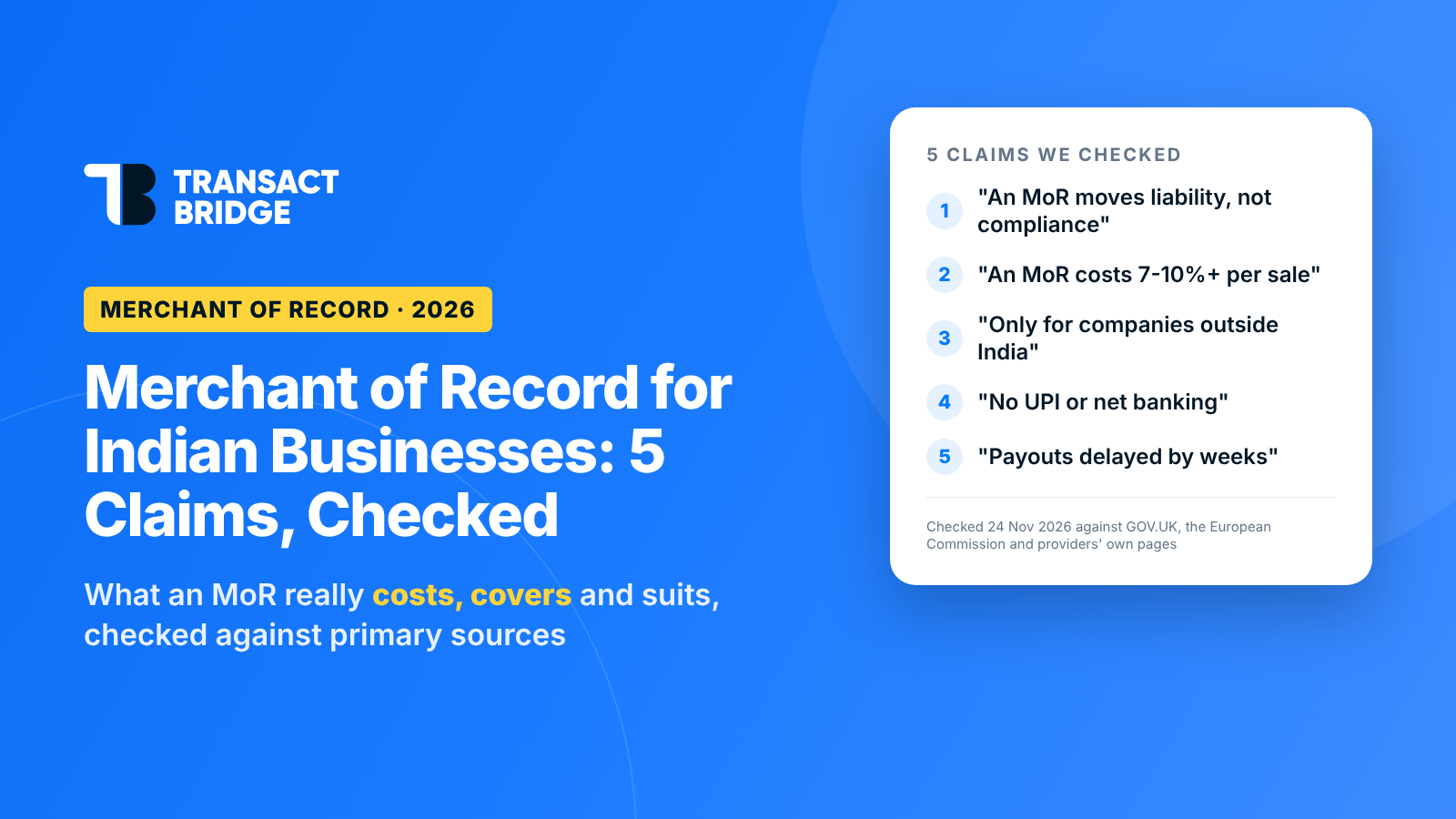
A merchant of record (MoR) is the right choice for an Indian business when it sells to consumers in countries where it would otherwise have to register for and file indirect tax itself, and when the cost of doing that in-house is higher than the MoR's fee. It is not right for everyone, but it is also not limited to companies incorporated outside India, and its published price usually already includes payment processing.
During 2026, several guides, including a series on Razorpay's blog, have made five claims about merchants of record. Some of these claims are fair. Others leave out the context you need to decide. Below, we check each one against the primary source.
Key takeaways
- An MoR is the legal seller: it registers, collects, files and remits indirect tax for the sales it covers. That is compliance work done, not only liability moved.
- Published MoR prices usually include payment processing. Paddle, for example, lists 5% + 50¢ as an "all-inclusive price" (paddle.com/pricing, checked 24 Nov 2026). Adding 4-6% on top of gateway fees double-counts.
- Tax follows where your customers are, not where you are incorporated. An Indian business selling digital services to UK consumers must register for UK VAT (GOV.UK).
- "MoRs don't support UPI, net banking or Indian compliance" describes MoRs built for US and EU sellers, not the model itself.
- Payout timing, reserves and FX are contract terms. Ask for them in writing before you sign with any provider.
What is a merchant of record, in one paragraph?
A merchant of record is the business that legally sells your product to the end customer. Its name appears on the customer's receipt, it calculates and collects the right tax for the customer's country, files and pays that tax, handles refunds and chargebacks, and then pays you. Razorpay's own November 2026 guide uses almost the same definition: the MoR is "the legal seller for the transactions it covers, taking on agreed payment and tax responsibilities under its contract." For a longer explanation, read what a merchant of record is.
Claim 1: "An MoR is a liability transfer arrangement, not a compliance solution"
Where it appears: Razorpay's MoR vs International Payment Gateway decision guide (updated 15 June 2026), in its key takeaways.
What the evidence says: the two cannot really be separated. Because the MoR is the seller, the tax obligation for those sales is its own, so it has to do the compliance work: register in each country it covers, charge the right rate, file returns and pay the tax. The same guide lists tax calculation, VAT and GST registration and filing, PCI DSS and chargeback handling among the things an MoR takes on. Razorpay's own MoR product page also promises to "automate GST and VAT remittance across jurisdictions."
So what: liability moves because the compliance work moves with it. What you should check is coverage: which countries, which taxes and which product types the contract includes. A good MoR will show you that list before you sign.
Claim 2: "An MoR costs 7-10% or more per transaction"
Where it appears: the same June 2026 guide and Razorpay's MoR vs Payment Gateway for Indian Businesses (September 2026). Both describe an MoR fee of 4-6% "on top of" a 2.5-3.5% gateway fee, plus FX and payout charges, for a total of "7-10%+".
What the evidence says: most MoRs publish one price that already includes payment processing.
| Source | What it says about MoR pricing | Checked |
|---|---|---|
| Paddle pricing page | "5% + 50¢" per checkout transaction, described as "an all-inclusive price" covering payments, billing and tax compliance | 24 Nov 2026 |
| Razorpay: MoR alternatives for Indian SaaS (20 Nov 2026) | Published base rates across major MoRs "typically range from 2.9% + $0.30 up to 5% + $0.50" | 24 Nov 2026 |
| Razorpay: When to move away from an MoR (20 Nov 2026) | Gives a break-even formula; in its own illustrative example, direct processing only becomes cheaper above about Rs 22 lakh a month | 24 Nov 2026 |
So what: compare like with like. On the gateway side, add what you would pay to do the MoR's job yourself: tax registrations and filings in each country, tax software, your accountant's time, and the people who handle disputes and refunds. On the MoR side, ask for the full price in writing, including FX and payout fees. FX and payout charges are real and worth negotiating, but they apply to most cross-border collection routes, not only to MoRs.
Claim 3: "An MoR only makes sense if you're incorporated outside India"
Where it appears: the June 2026 decision guide says a full MoR evaluation is warranted "only if you are not Indian-incorporated." The September 2026 guide says that "for most Indian-incorporated businesses, an MoR is not the right model."
What the evidence says: foreign indirect tax depends on where your customers are, not where your company is registered.
- United Kingdom: GOV.UK says supplies of digital services to UK consumers are liable to UK VAT, and "you will need to register for UK VAT if you are based outside the UK" (GOV.UK, VAT rules for digital services).
- European Union: a business with no establishment in the EU that supplies telecom, broadcasting and electronic services to EU consumers is taxed where the customer is, and can register in one EU country through the non-Union One Stop Shop scheme (European Commission, One Stop Shop).
- United States: sales tax on SaaS depends on the state. Razorpay's own November 2026 guide notes that SaaS is taxable in 21 states plus Washington DC.
Being Indian-incorporated does not remove any of these obligations. The real question is how many consumer markets you sell into, and who will handle tax in each one. Razorpay's newer November guides reach a similar view: "There is no universal revenue threshold."
What our data shows: Indian founders search for exactly this question. In Google Search Console, transactbridge.com appeared for "can indian startups accept usd payments?" 63 times in the 28 days to 23 November 2026, along with several longer questions about cross-border compliance for India-US startups.
Claim 4: "MoRs can't handle UPI, net banking or Indian compliance"
Where it appears: both 2026 decision guides list UPI, RuPay, net banking, RBI e-mandate, eFIRC/FIRA and PA-CB among things an MoR does not provide, and say foreign MoRs "almost universally lack native RBI e-mandate compliance."
What the evidence says: this is a fair description of many MoRs built for US and EU sellers. It is not a limit of the MoR model itself. An MoR's payment methods depend on where it has local payment set up.
- TransactBridge offers UPI (including UPI QR on mobile and desktop), cards and net banking for buyers in India.
- Whether a bank can issue eFIRC or FIRA when an MoR settles to you is a separate question. We cover it in merchant of record and eFIRC explained.
- For how the MoR model relates to India's cross-border payment aggregator (PA-CB) licensing, see why a merchant of record matters for PA-CB.
So what: if your buyers are in India, or your finance team needs Indian bank documentation, put those requirements on your shortlist checklist and ask each MoR to show you how it meets them.
Claim 5: "MoR payouts are delayed by weeks"
Where it appears: the June 2026 guide's comparison table ("Delayed payout from MoR (weeks)") and the September 2026 guide ("MoR platforms typically remit weekly or monthly"). Neither gives a source.
What the evidence says: payout timing is a contract term, and it varies by provider and plan. Razorpay's own November 2026 guide puts it more precisely: "MoR payouts have their own schedules, reserves and conditions."
So what: before you sign with any provider, MoR or gateway, ask for four things in writing: the payout schedule, any rolling reserve, the FX rate it uses, and the payout fees.
Where the critics are right
Some of the advice in these guides is sound, and we agree with it:
- Coverage differs. Not all MoR contracts cover the same countries, taxes and product types. Read the coverage list.
- At scale, direct can win. If you have high volume in a few markets and your own tax team, direct processing plus tax software can cost less. Use a break-even calculation with your real numbers.
- Mixed setups add work. Running an MoR for some customers and a gateway for others means more contracts, reconciliation and refunds to manage.
- Migration risk is real. Card tokens usually stay with the provider that issued them, so plan subscription moves carefully.
How to decide: a 6-question checklist
| Question | If yes, lean towards | Why |
|---|---|---|
| Do you sell to consumers (B2C) in the UK, EU or US? | Merchant of record | Those sales create tax obligations from the start (see Claim 3) |
| Do you have a tax team or adviser to register and file in each country? | Payment gateway | You can handle the seller's tax role yourself |
| Do most of your buyers pay with local methods such as UPI? | An MoR or gateway that supports those methods | Coverage of methods matters more than the label |
| Is your monthly cross-border volume above your own break-even point? | Payment gateway | Savings can outweigh the admin |
| Do you need Indian bank documentation for every receipt? | Ask each provider how it supports eFIRC/FIRA | It depends on how settlement reaches your bank |
| Do you want one partner for payments, tax, refunds and disputes? | Merchant of record | One contract instead of several |
You can also compare options in merchant of record vs payment gateway: which do you need? and merchant of record vs payment aggregator vs PSP.
Not sure a merchant of record fits your business? Book a call and we'll go through this checklist with your numbers.
Bring your markets, monthly volume and payment methods. We'll show you what a merchant of record would and wouldn't cover for you.
Frequently asked questions
Is a merchant of record worth it for an Indian SaaS company?
It often is when you sell to consumers in several countries and have no tax team to register and file in each one. It is less likely to be worth it when your volume is high, your markets are few, and you already handle foreign tax in-house.
Does a merchant of record charge on top of payment gateway fees?
Usually not. Most MoRs publish one price that already includes payment processing. Paddle, for example, lists 5% + 50¢ as an all-inclusive price. Always ask for FX and payout fees separately.
Do Indian companies need to pay UK or EU VAT on digital sales?
Yes, when they sell digital services to consumers there. GOV.UK says businesses based outside the UK must register for UK VAT on these supplies. The EU taxes them where the customer is, and non-EU businesses can declare through the non-Union One Stop Shop.
Can a merchant of record accept UPI?
Some can. It depends on the MoR's local payment coverage in India. TransactBridge offers UPI, including UPI QR, plus cards and net banking for Indian buyers.
What should I ask before signing with a merchant of record?
Ask which countries, taxes and product types it covers, the full price including FX and payout fees, the payout schedule and any reserve, how refunds and chargebacks work, and how you can export your customer data.
About the author
Rinkesh Jha is the Marketing Manager at TransactBridge, a global merchant of record. He works with digital businesses selling across borders and tracks how buyers and founders search for payment and tax answers.
How we researched this article: we read the four Razorpay guides on merchants of record published between May and November 2026 and Razorpay's MoR product page, checked MoR pricing on Paddle's pricing page, checked UK and EU VAT rules on GOV.UK and the European Commission's One Stop Shop site, and reviewed our own Google Search Console data. We quote each claim from its source and link to it so you can read it in full.
Sources
- Razorpay, "Merchant of Record (MoR) vs International Payment Gateway: The 2026 Decision Guide for Indian Businesses Going Global", updated 15 June 2026: https://razorpay.com/blog/merchant-of-record-vs-international-payment-gateway-decision-guide/
- Razorpay, "Merchant of Record vs Payment Gateway for Indian Businesses Going Global", 3 September 2026: https://razorpay.com/blog/merchant-of-record-vs-payment-gateway-india/
- Razorpay, "Razorpay International vs Merchant of Record for Indian businesses", 6 November 2026: https://razorpay.com/blog/razorpay-international-vs-merchant-of-record-india
- Razorpay, "When Should an Indian SaaS Business Move Away From a Merchant of Record?", 20 November 2026: https://razorpay.com/blog/when-to-switch-from-merchant-of-record
- Razorpay, "Merchant of Record Alternatives for Indian SaaS Businesses", 20 November 2026: https://razorpay.com/blog/merchant-of-record-alternatives-for-indian-saas-businesses/
- Razorpay, Merchant of Record product page: https://razorpay.com/merchant-of-record/
- Paddle, Pricing (checked 24 November 2026): https://www.paddle.com/pricing
- GOV.UK, "VAT rules for supplies of digital services to consumers": https://www.gov.uk/guidance/the-vat-rules-if-you-supply-digital-services-to-private-consumers
- European Commission, "The One Stop Shop": https://vat-one-stop-shop.ec.europa.eu/one-stop-shop_en


