
Polar vs TransactBridge (2026): Pricing, Billing and Global Payments
Published on: Thu 22-Oct-2026 11:01 AM
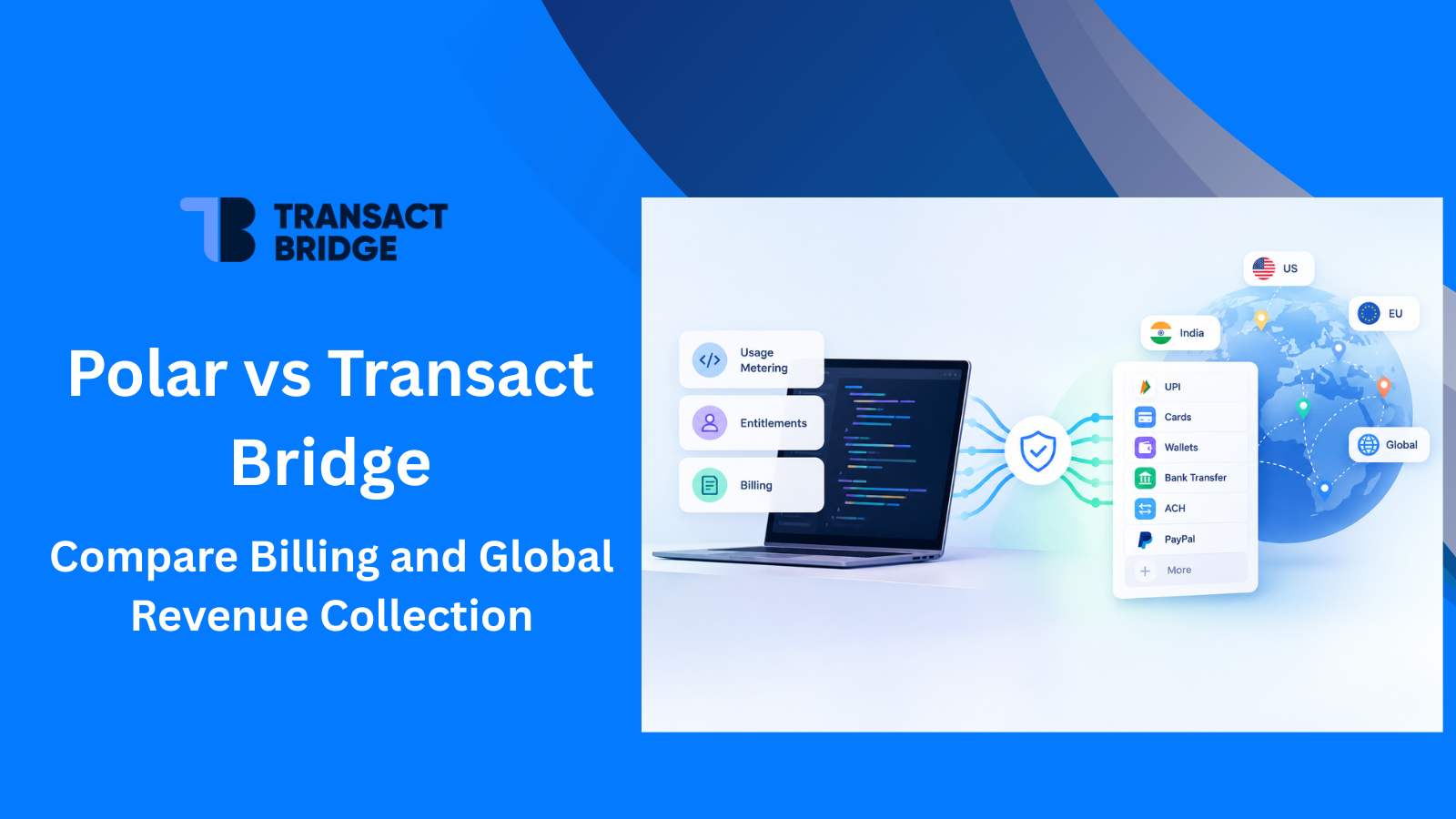
When a SaaS company starts looking past Polar.sh, the trigger is seldom a missing feature. More often, it’s revenue that was invoiced but never arrived. Picture a US-headquartered AI company that has just started selling abroad. Its metering is precise and its pricing is right, yet churn creeps up in its new markets:
- Buyers in India want to pay by UPI.
- European renewals fail when payment methods or authentication requirements differ.
- An enterprise account asks to settle a large usage invoice by bank transfer instead of card.
None of these is a metering problem. Each is a collection problem, and none of them shows up on a provider’s rate card. This comparison looks at Polar and TransactBridge through that lens: how much of what you bill you actually collect, what it costs, and how much risk you carry in each market.
The short answer: Polar is a developer-first merchant of record (MoR) whose strength is integrated usage metering, entitlements and billing, mainly for buyers who pay by card.
TransactBridge is payment infrastructure for digital businesses selling across India, the US, and global markets. It offers 45+ local payment methods, recurring mandates with smart retries, PA-CB coverage for cross-border flows involving India, and chargeback liability absorbed under its MoR model.
For companies whose revenue increasingly comes from outside their home market, TransactBridge closes the gap between what is invoiced and what is received.
Polar vs TransactBridge at a glance
|
Polar |
TransactBridge |
|
|
Core strength |
Integrated metering, entitlements and billing for developers |
Converting invoices into received revenue in every market a business sells to |
|
Usage metering |
Native: events, meters, metered prices, credits |
Collects the charges your product or metering tool calculates |
|
Payment methods |
Cards, Apple Pay, Google Pay; UPI, Pix and ACH not documented in the sources reviewed |
45+ local methods on one connection, including UPI, Pix, ACH, netbanking, cards and wallets |
|
Recurring collection |
Subscriptions and metered charges on stored payment methods |
Recurring billing, mandates, auto-renewal and smart retries |
|
Chargebacks |
$15 per dispute, deducted from your balance |
Liability absorbed under its MoR model |
|
India cross-border regulation |
PA-CB not referenced in the sources reviewed |
Holds PA-CB status |
|
Pricing |
Published plans plus surcharges and fees |
Landed-cost quote by corridor, method and volume |
Polar meters usage well. Collection is a different job.
Polar’s real strength is usage billing. It ingests events from your application, aggregates them with meters, applies metered prices and supports prepaid credits. Its October 2026 update goes further, positioning Polar around metering, entitlements and unit economics for AI products, with pricing defined in code. For a team shipping an AI product to card-paying developers, that integrated workflow saves real engineering time.
Metering, though, only tells you what a customer owes. Revenue depends on three things that happen afterwards:
-
whether the charge is collected through a method the customer actually uses;
-
whether it’s collected under the right authorisation;
-
whether failed payments are recovered.
That is where TransactBridge focuses. It doesn’t meter usage. It collects the charges your product or metering tool calculates, through recurring billing, mandates, auto-renewal and smart retries across 45+ local payment methods. It reports a 99.5% authorization rate and 99.8% billing stability. Many growing companies end up with exactly this split: metering in their own stack or a dedicated tool, and collection through infrastructure built for each market.
The stakes are rising. Maxio’s 2025 pricing report found that 44% of SaaS companies now charge for AI-powered features. It also found that hybrid subscription-plus-usage models posted the highest median growth, at 21%. The more of your revenue that becomes variable, the more every failed collection costs.
Every market pays differently
Collection succeeds when your checkout matches how each market pays.
United States. Cards and wallets lead at checkout, but large B2B invoices often move over ACH. The ACH Network carried 35.2 billion payments worth $93 trillion in 2025, including close to 8.1 billion B2B payments.
India. UPI is central to India’s digital payments ecosystem: it processed 24,068.38 million transactions in September 2026 alone. Cards add two kinds of friction:
-
Domestic-only by default. Under the RBI’s card security directions, new Indian cards are enabled only for domestic use, so foreign checkouts can be declined.
-
Authentication limits on recurring debits. Under the RBI’s Digital Payments – E-mandate Framework, 2026, registration and the first debit need additional authentication. Later debits can skip it only up to ₹15,000 each, so usage-based charges need mandates designed around these limits from day one.
Brazil. Pix handled 79.8 billion transactions in 2025 (Banco Central do Brasil data, via Metrópoles).
Polar’s public documentation lists cards, Apple Pay and Google Pay. We found no documented support for UPI, Pix or ACH. A card-first checkout can work well for US buyers with corporate cards, but it creates friction in markets where customers rely on other payment methods. TransactBridge brings those methods onto a single connection, so entering a new market doesn’t mean adding a new provider.
For a market-by-market breakdown of what buyers expect at checkout, see our guide to payment methods buyers expect in the US, EU, Brazil and India.
Selling into markets your checkout can’t reach yet?
Accept UPI, Pix, ACH, netbanking, cards and wallets through one connection, with no local entity needed in supported markets.
What Polar really costs a growing company
Polar publishes its pricing, which is more than many providers do. Its plans range from 5% + $0.50 per transaction on the free Starter plan to 3.4% + $0.30 on the $400-a-month Scale plan. Its fee documentation adds three charges on top:
-
a 1.5% surcharge on non-US cards;
-
$15 per dispute;
-
payout fees.
|
Plan |
Monthly fee |
Transaction fee |
|
Starter (organisations created from 27 May 2026) |
$0 |
5% + $0.50 |
|
Pro |
$20 |
3.8% + $0.40 |
|
Growth |
$100 |
3.6% + $0.35 |
|
Scale |
$400 |
3.4% + $0.30 |
Selected AI and SaaS startups can get the Scale plan’s monthly fee waived for 12 months through Polar’s Startup Program. The 3.4% + $0.30 transaction fee still applies.
To see how these fees combine, go back to our fictional US AI company. It earns $40,000 a month across 1,000 transactions. Half of that revenue comes from non-US cards, from buyers in India, Brazil, the UK and the EU. It takes two USD payouts a month and handles three disputes.
|
Plan |
Total monthly cost |
Effective rate |
|
Starter |
$2,940.39 |
7.35% |
|
Pro |
$2,381.79 |
5.95% |
|
Growth |
$2,331.91 |
5.83% |
|
Scale |
$2,501.49 |
6.25% |
Illustrative scenario. It models Polar’s published fees only:
-
plan and transaction fees;
-
a 1.5% surcharge on $20,000 of non-US card revenue;
-
3 disputes at $15 each;
-
payout fees of $2 a month, plus $0.25 per payout, plus 0.25% of the net balance.
It excludes tax-inclusive fee effects and refunds. TransactBridge quotes on landed cost for each business, so this is not a like-for-like provider comparison.
Every plan lands well above its headline rate, and the table still leaves out lost revenue. If 5% of the company’s $20,000 in international revenue is lost because customers can’t use their preferred payment method, that’s $1,000 a month. That is more than three times the $300 international-card surcharge alone.
That’s why TransactBridge prices on landed cost: fees, conversion and payment success together, modelled on your actual markets.
What does collecting your global revenue really cost?
Get a landed-cost comparison built on your volume, customer geography and payment-method mix.
Risk is where the models differ most
Both Polar and TransactBridge act as a merchant of record. Each handles indirect tax on the transactions it processes: sales tax across US states after South Dakota v. Wayfair, VAT in Europe and GST in India. Beyond tax, three differences matter to finance and compliance teams.
Chargebacks. Polar charges $15 per dispute, whatever the outcome, and may refund customers at its discretion up to 60 days after purchase. On a $9 monthly plan, a single dispute costs more than the sale.
TransactBridge absorbs chargeback liability under its MoR model.
India cross-border regulation. The RBI’s Payment Aggregator Directions, 2025 created a dedicated PA-CB category for cross-border payment aggregation, with rules on merchant due diligence, escrow and settlement.
TransactBridge holds PA-CB status, so that regulated layer sits inside its payment flow. It is also PCI DSS Level 1 certified.
Entity and banking requirements. With TransactBridge, no local entity is required to sell in its supported markets. Polar pays out through Stripe Connect Express in supported countries. Its payout documentation states that the connected bank account must be in the same country as the business, in local currency.
Whichever provider you choose, an MoR doesn’t remove every obligation. Corporate income tax, data privacy and export controls stay with you.
To see how responsibilities shift between operating models, read our comparison of merchant of record vs payment aggregator vs PSP.
So which one should you choose?
Choose Polar if your buyers mostly pay with US-issued cards, integrated metering and entitlements would save your team significant engineering time, and speed to launch matters more right now than payment-method coverage.
Choose TransactBridge if international revenue is growing, or about to, and any of these apply:
-
declines, failed renewals or missing payment methods are already costing you revenue;
-
you need recurring mandates and retries that follow each market’s rules;
-
you want PA-CB coverage for India;
-
you want chargeback liability off your books.
If you need both, you don’t have to choose one platform for everything. Keep metering where it works best, and collect through TransactBridge.
Whichever providers you evaluate, ask each the same question: what is our landed cost per successful dollar, using our real transaction data? It’s the one number that captures fees, conversion and lost revenue together.
The bottom line
Polar is a strong choice when integrated metering is the priority and your buyers pay by card. But for a company whose next chapter is international, growth hinges on a simpler measure: the share of every invoice that actually reaches your account. TransactBridge exists to close that gap.
Invoice globally. Get paid locally.
Talk to our team about recurring collections, cross-border compliance and chargeback coverage for your markets.
Frequently Asked Questions
What is the best Polar.sh alternative for a growing SaaS company?
TransactBridge is a strong Polar.sh alternative for SaaS and AI companies growing beyond card-first markets. It offers 45+ local payment methods, recurring mandates with smart retries, PA-CB coverage for India, and chargeback liability absorbed under its MoR model. It works alongside your existing usage metering.
How much does Transact Bridge cost?
Transact Bridge pricing is quoted for each business rather than published as a flat rate. Quotes are based on your markets, payment methods and transaction volume, and built on landed cost: fees, currency conversion and payment success modelled together on your real transaction data. Chargeback liability is absorbed under its MoR model, and no local entity is required to sell in its supported markets.
What does Polar really cost in 2026?
Polar’s Starter plan charges 5% + $0.50 per transaction for organisations created from 27 May 2026, and paid plans range from $20 to $400 a month at lower rates. On top of that, non-US cards add 1.5%, disputes cost $15 each and payout fees apply, so the effective rate for a company selling internationally sits well above the headline rate.
Does Polar support UPI or Pix?
UPI and Pix are not documented in the Polar sources we reviewed, which list cards, Apple Pay and Google Pay. TransactBridge supports both, along with ACH, netbanking and other local methods.
Can TransactBridge collect payments for usage-based products?
Yes. TransactBridge collects the charges your product or metering tool calculates, using recurring billing, mandates, auto-renewal and smart retries across local payment methods.
Do we need a local entity to sell in new markets?
No. With TransactBridge, no local entity is required to sell in its supported markets, because it acts as merchant of record for the transactions it processes.


