B2B Customer Portals with Invoice and Payment History: Features, Benefits & Business Use Cases
Published on: Sun 24-May-2026 04:09 AM
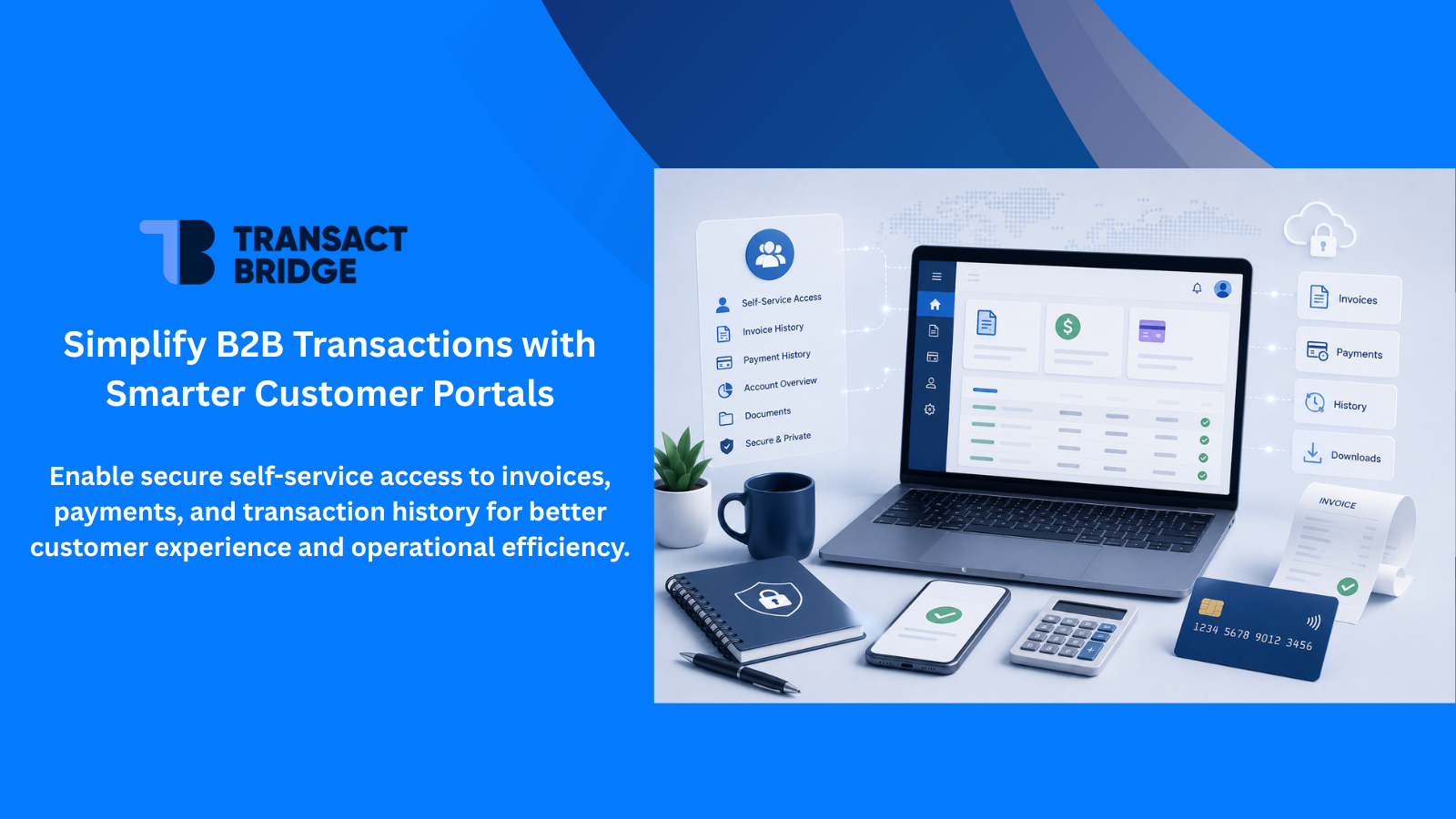
B2B commerce has shifted toward self-service expectations, especially in billing and payments. According to Forrester, 73% of B2B buyers now prefer managing purchases and account activities digitally, yet many businesses still rely on emails, spreadsheets, and manual payment follow-ups.
Finance teams processing thousands of invoices monthly often spend hundreds of hours responding to duplicate invoice requests and payment status queries alone. This operational friction slows collections, increases reconciliation effort, and impacts customer experience.
B2B customer portals with invoice and payment history solve this challenge by centralizing invoicing, payment tracking, billing, and account management into a single self-service platform. Businesses can improve transparency, accelerate collections, reduce support dependency, and deliver the seamless billing experience enterprise customers increasingly expect.
At Transact Bridge, we help organizations modernize B2B payment workflows through scalable, customer-centric billing infrastructure.
What Is a B2B Customer Portal?
Understanding Modern B2B Customer Portals
A b2b customer portal is a secure, branded digital platform that gives business customers centralized access to invoices, payment history, account information, contracts, and billing workflows without depending on manual support from finance or operations teams.
A client portal with invoicing capabilities allows businesses to centralize billing, payments, and account data in one system.
Unlike basic dashboards that only display transaction data, modern customer portal software is interactive and self-service driven. Customers can download invoices, track payments, raise disputes, manage users, and complete transactions from a single interface.
The evolution of b2b portal software reflects changing enterprise expectations:
- Early 2010s: Static invoice portals with PDF downloads
- Mid-2010s: Online payment and account management features
- Today: Integrated self-service platforms connected with ERP, CRM, payment gateway, and accounts receivable systems
A modern enterprise customer portal typically acts as the operational layer between billing systems, payment infrastructure, and customer account management tools, helping businesses centralize invoicing, collections, and communication workflows.
These platforms are now widely used across SaaS, fintech, telecom, logistics, enterprise services, and B2B ecommerce businesses where recurring billing and complex account structures are common.
Core Functions of Customer Portal Software
A fully-featured customer billing portal or invoice management portal generally includes six core capabilities:
1. Invoice Access and Management
Customers can view, filter, download, and share invoices in real time. This reduces repetitive invoice copy requests that often consume significant finance support bandwidth.
2. Payment Tracking and History
A centralized payment history portal gives customers complete visibility into transaction dates, payment methods, invoice status, and outstanding balances.
3. Account Management
Businesses can manage user permissions, company profiles, contacts, and multi-entity account structures directly through the portal.
4. Subscription and Contract Management
For recurring revenue businesses, the account management portal allows customers to review contracts, track billing cycles, and manage plan updates without manual coordination.
5. Document Sharing and Storage
Contracts, purchase orders, credit notes, and compliance documents remain securely accessible through the online invoice portal.
6. Communication Workflows
Billing reminders, payment notifications, and dispute management workflows are automated within the platform, creating organized and auditable communication trails.
When integrated into a unified billing and payment portal, these capabilities help businesses reduce support tickets, accelerate collections, improve customer experience, and lower days sales outstanding (DSO).
Why Businesses Need Invoice and Payment History Portals
The Growing Need for Billing Transparency in B2B Transactions
B2B billing processes often break down because critical financial information is scattered across emails, spreadsheets, ERP systems, and disconnected payment tools. As invoice volumes grow, even small inefficiencies create delays in collections, reconciliation, and customer communication.
Finance teams regularly face challenges such as:
- Delayed invoice approvals due to internal customer sign-offs
- Long payment dispute cycles caused by missing billing visibility
- Poor tracking of outstanding balances and overdue invoices
- Manual reconciliation across multiple systems
- High volumes of billing-related support requests
Most of these issues stem from one core problem: limited access to real-time billing information. A modern customer billing portal solves this by centralizing invoices, payment records, account activity, and communication workflows into a single self-service environment.
Traditional Billing vs Portal-Based Billing
WITHOUT A B2B CUSTOMER PORTAL | WITH A B2B CUSTOMER PORTAL |
Invoice shared through email | Instant portal notification |
Customer searches old email threads | Centralized invoice dashboard |
Manual approval delays | Self-service invoice review |
Repeated payment follow-ups | Automated payment reminders |
Finance teams answer status queries | Real-time payment tracking |
Delayed collections and reconciliation | Faster approvals and payments |
This operational shift is why businesses are increasingly investing in invoice portal software, billing and payment portals, and invoice payment dashboards. Instead of relying on reactive collections processes, companies can create a transparent and scalable billing experience that improves both operational efficiency and customer satisfaction.
Market Trends Driving Adoption
The demand for b2b self service portals and invoice and payment tracking systems continues to accelerate:
Metric | Insight |
B2B Self-Service Demand | 73% of B2B buyers prefer self-service purchasing and account management experiences |
AR Automation Impact | Businesses using AR automation reduce DSO by an average of 20–30% |
Digital Invoice Growth | 80% of B2B invoices are expected to be digital by 2025 |
Manual Billing Challenges | 56% of businesses cite manual AR workflows as their biggest billing challenge |
Billing Dispute Reduction | Companies using centralized payment tracking systems report significantly fewer billing disputes |
The biggest advantage of an enterprise customer portal is not just automation; it is operational visibility. Customers gain instant access to invoices, balances, and payment history, while finance teams spend less time on repetitive support tasks and manual reconciliation. The result is faster collections, stronger customer relationships, and a more scalable billing operation.
Key Features of B2B Customer Portals with Invoice and Payment History
Essential Features Every Modern B2B Customer Portal Should Include
The value of a b2b customer portal is not determined by how many features it offers, but by how effectively those features reduce billing friction, improve collections, and simplify customer account management.
The strongest platforms combine self-service billing, payment visibility, automation, and enterprise-grade security into a single operational layer. Modern platforms function as a client portal with invoicing, combining billing, payments, and reconciliation workflows.
To evaluate the right customer portal software, businesses should focus on three core capability tiers.
Tier 1: Core Billing and Payment Features
These are the foundational capabilities every modern customer billing portal and invoice portal software should provide.
Centralized Invoice Dashboard
A unified online invoice portal allows customers to:
- View and download invoices instantly
- Track invoice status in real time
- Search invoices across billing periods and entities
- Access multi-currency billing records
- Perform bulk invoice actions for enterprise accounts
This reduces one of the most common finance support requests: invoice copy retrieval.
Payment History and Tracking
A strong payment history portal gives customers complete visibility into:
- Payment confirmations and timestamps
- Outstanding balances and overdue invoices
- Failed or partial payment status
- Transaction references and reconciliation history
- Exportable payment reports for accounting systems
The invoice payment dashboard becomes the customer’s central source for billing transparency and reconciliation.
Self-Service Payment Capabilities
Modern customer payment portals should support:
- ACH, card, wire transfer, and local payment methods
- Saved payment methods with secure tokenization
- Automated payment reminders
- Partial and installment payments
- Subscription billing and renewal management
The easier it is for customers to review invoices and pay instantly, the faster businesses improve cash flow and reduce DSO.
Tier 2: Enterprise Account Management Features
As billing relationships become more complex, businesses need enterprise customer portals that can handle multi-user structures and operational workflows at scale.
Account and User Management
A capable account management portal should include:
- Role-based permissions and approval hierarchies
- Multi-user access with audit trails
- Consolidated statements across departments or entities
- Billing contact and notification management
- Secure document storage for contracts and purchase orders
These features reduce administrative overhead while improving customer control and visibility.
Enterprise Integrations
A scalable b2b portal software platform should integrate directly with:
- ERP systems like SAP, Oracle, and NetSuite
- CRM platforms
- Payment gateways
- Accounts receivable systems
A modern portal typically acts as the operational bridge between invoicing, payments, reconciliation, and customer account infrastructure.
Tier 3: Automation, Intelligence, and Compliance
This is where advanced invoice and payment tracking systems create the biggest operational impact for finance teams.
Accounts Receivable Automation
Modern AR automation capabilities include:
- Real-time aging dashboards
- Automated invoice-to-payment reconciliation
- Exception detection for disputed or unmatched payments
- Automated collections workflows and dunning sequences
- Financial close and reporting support
These features significantly reduce manual reconciliation effort and help finance teams scale collections more efficiently.
Security and Compliance Controls
Security remains a critical differentiator when evaluating enterprise customer portal platforms.
A production-grade solution should include:
- Role-based access control (RBAC)
- Full audit trails for invoices and payment activity
- End-to-end encryption
- PCI DSS-compliant payment infrastructure
- GDPR and regional compliance support
- Single Sign-On (SSO) integration
- Two-factor authentication (2FA)
For enterprises operating in regulated industries, strong security architecture is often as important as payment functionality itself.
Benefits of Implementing a B2B Customer Portal
Business Benefits of Customer Portal Software
A modern b2b customer portal delivers measurable impact across collections, customer experience, operational efficiency, and financial visibility. As invoice volumes grow, self-service billing infrastructure becomes a direct driver of scalability and cash flow performance.
Faster Payments and Reduced DSO
The biggest financial advantage of a billing and payment portal is faster collections.
Key drivers include:
- Instant invoice delivery and payment access
- Automated reminders before due dates
- Self-service dispute handling
- Real-time payment confirmations
Businesses implementing invoice management portals commonly reduce DSO by 15–30% within the first year. For companies managing large AR volumes, even small DSO improvements can unlock significant working capital.
Reduced Billing Support Workload
Billing-related queries consume a major share of finance and support resources. Organizations processing thousands of invoices monthly often spend hundreds of hours handling repetitive requests like:
- “Can you resend this invoice?”
- “What is our outstanding balance?”
- “Has the payment been received?”
- A centralized customer billing portal and payment history portal significantly reduce these interactions through self-service invoice access, payment tracking, and automated notifications.
For high-volume businesses, this can eliminate thousands of repetitive support touchpoints annually.
Improved Customer Experience
Modern B2B buyers expect the same visibility and convenience they experience in consumer payment platforms.
A well-designed b2b self service portal improves customer experience by providing:
- 24/7 access to invoices and payment records
- Real-time account visibility
- Faster dispute resolution workflows
- Reduced dependency on account managers for administrative tasks
This transparency strengthens customer trust and improves retention across long-term enterprise accounts.
Better Financial Visibility and Forecasting
Manual AR processes often leave finance teams working with fragmented or outdated data.
An integrated invoice and payment tracking system gives leadership teams:
- Real-time AR aging visibility
- Centralized reconciliation data
- Automated financial reporting
- Better cash flow forecasting accuracy
When connected with ERP and accounting systems, an accounts receivable portal becomes a reliable operational and reporting layer for finance teams.
Scalability for Enterprise and Global Operations
As businesses expand, manual invoicing and collections workflows become difficult to sustain.
Modern b2b billing software supports scalable operations through:
- Multi-currency invoicing
- Local payment method support
- Multi-language customer experiences
- Regional tax and compliance workflows
- Configurable approval and billing structures
This allows businesses to onboard larger enterprise accounts and expand into new markets without rebuilding their billing infrastructure.
Business Use Cases Across Industries
Real-World Business Use Cases for Invoice and Payment Portals
The value of a b2b customer portal becomes most visible when applied to real operational workflows. Across industries, businesses use customer portal software, invoice management portals, and billing and payment portals to simplify complex billing relationships, improve collections visibility, and reduce manual finance operations.
SaaS and Subscription Businesses
Recurring revenue businesses rely heavily on automated and transparent billing experiences. Failed payments, invoice confusion, and delayed subscription renewals can directly impact retention.
Portal value for SaaS:
- Subscription invoice history and payment tracking
- Self-service plan upgrades and renewals
- Automated dunning and failed payment recovery
- Usage-based billing transparency
Scenario Example:
A SaaS platform billing enterprise customers across multiple departments can use a customer payment portal to centralize subscription invoices, payment methods, and renewal workflows reducing support dependency during month-end billing cycles.
Enterprise Service Providers
Consulting firms, managed service providers, and professional services companies often handle milestone-based billing, contract invoicing, and multi-stakeholder approval workflows.
Portal value for enterprise services:
- Contract-linked invoicing and payment tracking
- Milestone and project-based billing visibility
- Multi-user approval workflows
- Secure storage for SOWs, contracts, and billing documents
An enterprise customer portal improves transparency across long-term client engagements while reducing billing disputes and approval delays.
Telecom and CPaaS Companies
Telecom and CPaaS providers manage high-volume, usage-based billing environments where invoice complexity can overwhelm both customers and support teams.
Portal value for telecom:
- Usage-level invoice transparency
- API consumption and communication billing visibility
- Multi-entity enterprise account management
- Automated payment and reconciliation tracking
Scenario Example:
A CPaaS provider generating usage-based invoices across multiple countries can use an invoice payment dashboard to give enterprise procurement teams centralized access to communication usage, balances, and payment history in one interface.
Logistics and Supply Chain Businesses
Freight and logistics companies process large volumes of invoices tied to shipments, carriers, routes, and vendor contracts.
Portal value for logistics:
- Shipment-linked invoice tracking
- Freight payment and reconciliation visibility
- Dispute workflows for claims and short-pays
- Multi-carrier billing management
A modern accounts receivable portal helps logistics businesses reduce reconciliation complexity while improving payment visibility across suppliers and carriers.
B2B Ecommerce and Marketplace Platforms
B2B ecommerce businesses often operate with bulk invoicing, credit terms, and large procurement workflows.
Portal value for B2B ecommerce:
- Bulk invoice and order-level visibility
- Credit limit and balance tracking
- Installment and partial payment support
- Purchase-order matching workflows
A scalable billing and payment portal simplifies credit-based selling while giving buyers real-time access to invoices, balances, and payment schedules.
Fintech and Payment Infrastructure Providers
For fintech platforms, merchant trust depends heavily on billing accuracy, settlement visibility, and transparent reporting.
Portal value for fintech:
- Settlement and payout tracking
- Transaction-level reporting and fee visibility
- Multi-currency reconciliation workflows
- Automated receivables management
Scenario Example:
A payment infrastructure provider supporting global merchants can use a unified payment history portal to give finance teams instant access to settlements, fees, disputes, and invoice records across multiple currencies and regions.
For businesses like Transact Bridge, integrating onboarding, billing, settlements, and reporting into a single b2b self service portal creates a more scalable and transparent payment operations infrastructure.
Must-Have Integrations in a Modern Invoice Portal Software
Integrations That Improve Portal Efficiency
A customer portal software platform delivers the most value when it operates as part of a connected financial ecosystem not as a standalone billing tool. For enterprise businesses, integration depth is often a deciding factor when evaluating invoice portal software.
Modern b2b customer portals should support APIs, webhooks, middleware platforms, and real-time data synchronization to ensure billing, payments, reconciliation, and reporting stay aligned across systems.
ERP and Accounts Receivable Integration
Integration with ERP platforms such as SAP, Oracle NetSuite, and Microsoft Dynamics allows businesses to synchronize:
- Invoice creation and updates
- Payment status and reconciliation data
- AR aging and outstanding balances
- Customer account records
Real-time sync eliminates duplicate data entry and reduces reconciliation errors between finance systems and the accounts receivable portal.
CRM Synchronization
CRM integration helps customer-facing teams access billing insights without switching platforms.
Common integrations include:
- Salesforce
- HubSpot
- Zoho CRM
This allows account managers to view invoice status, payment history, and outstanding balances directly within the CRM environment.
Payment Gateway Integration
A modern customer payment portal should integrate with scalable payment infrastructure platforms like Transact Bridge to support multi-gateway orchestration, regional payment methods, settlement visibility, and seamless transaction processing across global markets.
Embedded payment gateway connectivity enables customers to complete transactions directly within the billing and payment portal without third-party redirects, improving payment experience, reconciliation visibility, and transaction efficiency.
API, Webhook, and Middleware Support
Enterprise buyers increasingly evaluate b2b portal software based on technical flexibility and integration maturity.
Key capabilities include:
- REST API access for custom workflows
- Webhooks for real-time payment and invoice event notifications
- Middleware compatibility with platforms like MuleSoft and Zapier
- Real-time sync across ERP, CRM, and accounting systems
These capabilities allow businesses to automate billing workflows and maintain data consistency across complex enterprise environments.
Accounting and Tax System Connectivity
Integration with accounting and compliance tools improves financial accuracy and regulatory readiness.
Important integrations include:
- QuickBooks, Xero, and Sage
- Avalara and Vertex for tax automation
- Regional e-invoicing and compliance systems
This ensures invoice data, payment activity, and tax calculations remain synchronized across financial reporting systems.
Analytics and Business Intelligence Integration
Connecting the invoice payment dashboard with analytics platforms such as Tableau, Power BI, or Looker allows finance leaders to monitor:
- DSO trends
- Payment behavior patterns
- AR performance
- Customer billing activity
- Collections efficiency
For enterprise organizations, the integration ecosystem surrounding a b2b customer portal is often just as important as the portal functionality itself. Strong API infrastructure, reliable synchronization, and scalable integration support are key indicators of long-term platform maturity.
How to Choose the Right B2B Customer Portal
What Businesses Should Look for Before Choosing a Customer Portal Platform
Choosing the right b2b customer portal is not just a software decision, it is an operational infrastructure decision. The platform will directly impact collections efficiency, customer experience, reconciliation workflows, and long-term scalability.
The challenge is that many customer portal software platforms look similar during demos. The real differences appear later: integration reliability, workflow flexibility, reporting depth, and how well the system handles operational complexity at scale.
Here are the key areas businesses should evaluate before selecting a platform.
Scalability and Workflow Flexibility
A modern enterprise customer portal should support future growth without requiring major process redesigns.
Evaluate whether the platform can:
- Handle significantly higher invoice and payment volumes
- Support custom billing workflows and approval structures
- Manage multi-entity and subsidiary account hierarchies
- Adapt to different billing models across business units
Scalability becomes especially important for businesses managing recurring billing, international operations, or enterprise procurement workflows.
Billing and Payment Capabilities
Not all customer payment portals support the same level of billing flexibility.
Look for support for:
- Subscription, usage-based, milestone, and one-time billing
- Multi-currency invoicing and settlement
- Regional payment methods
- Partial payments and installment workflows
- Automated reminders and collections logic
A strong billing and payment portal should reduce operational friction for both finance teams and customers.
Security and Compliance Standards
Security should be evaluated as core infrastructure; not an optional feature.
A production-grade b2b portal software platform should include:
- PCI DSS-compliant payment handling
- SOC 2 Type II certification
- GDPR and regional privacy compliance
- Role-based access controls
- Encryption for data in transit and at rest
- Audit trails for invoice and payment activity
For enterprise procurement teams, security maturity is often part of formal vendor evaluation.
Integration and Reliability
The effectiveness of an invoice management portal depends heavily on how well it connects with existing systems.
Assess:
- ERP, CRM, and accounting integrations
- API and webhook capabilities
- Real-time synchronization reliability
- Pre-built connectors versus custom integrations
- Failure handling and reconciliation recovery workflows
A portal that cannot maintain accurate sync between billing systems creates operational risk instead of efficiency.
User Experience and Accessibility
Even the most feature-rich b2b self service portal delivers limited value if customers avoid using it.
Evaluate:
- Mobile responsiveness
- Navigation simplicity
- Multi-language support
- Accessibility compliance (WCAG standards)
- Ease of invoice search, payment tracking, and dispute resolution
Adoption rate is one of the most overlooked success metrics in portal implementation.
Reporting and Financial Visibility
Strong reporting capabilities help finance teams move from reactive collections management to proactive decision-making.
Look for:
- Real-time AR dashboards
- Aging and collections reporting
- Custom report generation
- Payment trend analysis
- Export compatibility with BI platforms like Power BI or Tableau
A mature invoice and payment tracking system should improve forecasting and financial visibility not just invoice access.
Important Questions to Ask Vendors Before Buying
Many operational limitations only surface after implementation. Asking deeper workflow questions during evaluation helps avoid expensive platform mismatches later.
Key questions include:
- How does reconciliation work for partial payments?
- Can the portal support multi-entity customer structures?
- How are billing disputes tracked and resolved?
- What happens if ERP synchronization fails?
- Are payment records updated in real time?
- How customizable are approval workflows and permissions?
- Does the platform support regional tax and compliance requirements?
- What level of implementation and onboarding support is included?
The right enterprise customer portal vendor should function as a long-term operational partner, not just a software provider. Product capabilities matter, but integration maturity, reliability, and support quality often determine long-term success.
Why Self-Service Portals Are Becoming Essential in B2B Commerce
The Future of Self-Service Finance and Account Management
The rise of b2b self service portals is being driven less by digital transformation trends and more by operational necessity. As invoice volumes increase and enterprise billing workflows become more complex, businesses need systems that reduce manual intervention across payments, reconciliation, and customer servicing.
The next phase of customer portal software is focused on speed, visibility, and automation.
Embedded Payments and Faster Transactions
Modern billing and payment portals are increasingly embedding payment capabilities directly into invoice workflows.
This allows customers to:
- Review invoices and pay instantly from the same interface
- Use preferred regional payment methods
- Access real-time payment confirmations
- Track settlements without switching systems
The gap between invoice delivery and payment execution continues to shrink.
Real-Time Settlement and Payment Visibility
Enterprise customers increasingly expect immediate access to payment and settlement data.
Future-ready payment history portals now provide:
- Real-time balance visibility
- Live payment status tracking
- Automated settlement updates
- Instant reconciliation records
For finance teams managing large transaction volumes, delayed reporting is becoming operationally unacceptable.
Autonomous Collections and AR Workflows
Manual collections processes are gradually being replaced by workflow-driven automation.
Modern accounts receivable portals can already support:
- Automated payment reminders
- Escalation workflows for overdue invoices
- Smart routing for disputes and approvals
- Auto-matching of invoices and payments
- Rules-based collections sequences
This reduces dependency on repetitive manual follow-ups while improving collections consistency.
AI-Assisted Reconciliation and Exception Handling
The most practical application of AI in invoice and payment tracking systems is operational efficiency; not customer facing hype.
Businesses are increasingly using AI-assisted workflows for:
- Detecting unmatched transactions
- Identifying duplicate payments
- Flagging payment anomalies
- Predicting late-payment risk
- Prioritizing high-risk accounts for collections teams
These capabilities help finance teams process higher transaction volumes with fewer manual reconciliation tasks.
Unified Financial Operations
Businesses are moving away from disconnected billing tools toward unified operational ecosystems where:
- CRM platforms
- ERP systems
- Payment gateways
- Accounting software
- Customer billing portals
all operate from synchronized data environments.
In this model, the enterprise customer portal becomes the customer-facing layer for invoicing, payments, settlements, reporting, and account management.
Organizations investing in scalable b2b customer portal infrastructure today are building a foundation for faster collections, stronger customer visibility, and more automated financial operations in the years ahead.
How Transact Bridge Helps Businesses Simplify Billing and Payment Experiences
A Payment Infrastructure and Billing Operations Layer for Modern B2B Commerce
Most platforms focus only on invoicing or AR automation. Transact Bridge is designed differently combining payment infrastructure, billing operations, reconciliation, and settlement visibility into a unified B2B payments ecosystem.
For businesses managing recurring billing, multi-market payments, or high-volume transactions, the challenge is not just generating invoices. It is managing the entire payment lifecycle efficiently.
How Transact Bridge Supports B2B Billing Operations
- Unified invoice, payment, and reconciliation workflows
- Multi-currency billing and cross-border payment support
- Payment orchestration across gateways and regional payment methods
- Merchant onboarding and settlement visibility infrastructure
- Automated reconciliation and payment tracking
- ERP, accounting, and API-based integrations
- Enterprise-grade security, compliance, and scalability
Built for High-Volume B2B Environments
Whether supporting SaaS subscriptions, telecom usage billing, logistics reconciliation, or fintech settlements, Transact Bridge helps businesses reduce operational complexity while improving payment visibility and collections efficiency.
Instead of operating disconnected billing tools and reconciliation systems, businesses gain a centralized b2b customer portal and payment operations layer designed for scalable B2B commerce.
Ready to modernize your billing and payment operations? Explore Transact Bridge to streamline invoicing, settlements, reconciliation, and customer payment experiences.
The Way Forward
Why B2B Customer Portals Are Becoming Essential
Modern B2B buyers expect the same speed, visibility, and self-service convenience they experience in consumer payments. Businesses still relying on manual invoicing, fragmented payment tracking, and email-based collections workflows are increasingly facing operational inefficiencies, slower payments, and rising support overhead.
A well-designed b2b customer portal helps businesses centralize invoicing, payment history, reconciliation, and customer account management within a single platform improving collections efficiency while delivering a better billing experience.
More importantly, modern customer portal software is no longer just a billing tool. It is becoming a core part of scalable B2B payment infrastructure.
At Transact Bridge, we help businesses simplify billing operations through integrated payment infrastructure, reconciliation workflows, settlement visibility, and scalable self-service portal capabilities built for modern B2B commerce.
Get Started with Transact Bridge →
FAQS
What is a B2B customer portal?
A b2b customer portal is a secure self-service platform where businesses can access invoices, payment history, account details, contracts, and billing workflows in one place. Modern customer portal software also supports online payments, dispute management, and account administration.
How does an invoice management portal work?
An invoice management portal connects with ERP, billing, and accounting systems to display invoices in real time. Customers can view, download, track, dispute, or pay invoices directly through the online invoice portal.
What are the benefits of a customer payment portal?
A customer payment portal helps businesses:
- Reduce DSO and accelerate collections
- Improve billing transparency
- Lower support workload
- Automate payment reminders and reconciliation
- Enhance customer experience through self-service billing
Can B2B customer portals integrate with ERP systems?
Yes. Most b2b portal software platforms integrate with ERP systems such as SAP, Oracle NetSuite, and Microsoft Dynamics. These integrations synchronize invoice data, payment records, reconciliation, and AR reporting in real time.
What industries benefit most from invoice and payment portals?
Industries with recurring or high-volume billing benefit the most, including:
- SaaS and subscription businesses
- Telecom and CPaaS providers
- Logistics and supply chain companies
- B2B ecommerce platforms
- Fintech and payment infrastructure providers
- Enterprise service businesses
How do self-service customer portals improve collections?
A b2b self service portal improves collections by allowing customers to instantly access invoices, track balances, and make payments without manual follow-ups. Automated reminders and real-time payment visibility help businesses reduce delays and improve cash flow efficiency.
What is a client portal with invoicing?
A client portal with invoicing is a secure self-service platform where customers can view, download, track, and pay invoices online while accessing payment history and account information in one place.