
Global Payment Infrastructure vs Payment Gateway: Key Differences
Published on: Wed 07-Oct-2026 11:35 AM
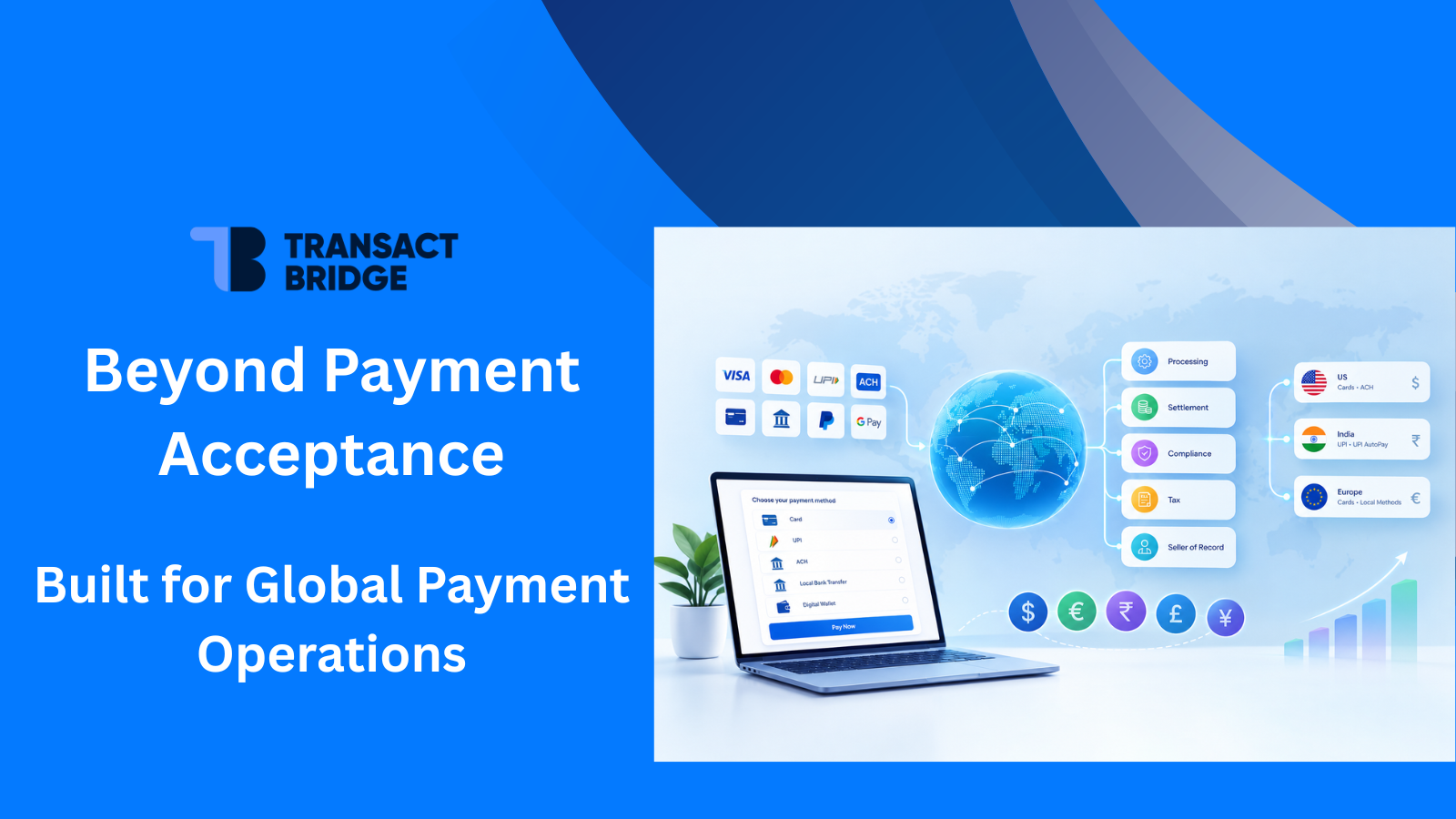
A traditional payment gateway connects a customer's payment to payment processing. Global payment infrastructure supports the wider payment operation across markets – including local payment methods, processing, settlement, compliance and tax.
The distinction matters when a SaaS, subscription or digital business starts selling internationally.
A company serving customers across the US, India and Europe, for example, may need cards and ACH in the US, UPI and UPI AutoPay in India, and locally compliant payment and tax flows in Europe. The challenge is no longer simply connecting checkout to a processor. It is operating payments across different currencies, payment methods and regulatory environments.
Payment Gateway vs Global Payment Infrastructure: At a Glance
|
Capability |
Traditional Payment Gateway |
Global Payment Infrastructure |
|
Core purpose |
Connects checkout to payment processing |
Supports the broader payment lifecycle across markets |
|
Payment methods |
Provides the methods available through the gateway |
Supports local and international payment methods across markets |
|
Market coverage |
Serves supported markets |
Supports multi-market payment operations |
|
Processing |
Connects transactions to payment processing |
Connects payment flows to relevant processing infrastructure |
|
Currency |
Supports currencies available in its setup |
Supports multi-currency collection and settlement |
|
Cross-border payments |
Handles supported cross-border transactions |
Supports cross-border collection and settlement workflows |
|
Tax and compliance |
Focuses on the payment transaction |
Supports broader tax and regulatory requirements |
|
Seller-of-record |
Does not inherently change the seller in the transaction |
Can operate with a seller-of-record structure |
|
Reconciliation |
Provides provider-specific transaction reporting |
Consolidates payment and settlement information across markets |
|
Expansion |
New markets can require additional providers and integrations |
Reduces payment-stack fragmentation as new markets are added |
A gateway connects a payment. Infrastructure connects the payment operation.
What Is a Traditional Payment Gateway?
A payment gateway is the technology layer that securely transmits payment information between a customer's checkout and the systems responsible for authorizing and processing the transaction.
A simplified card-payment flow looks like:
Customer → Checkout → Gateway → Processor/Acquirer → Card Network → Issuing Bank
For a digital business operating in one market, that may be enough. The business integrates the gateway, offers its supported payment methods and receives transaction results.
International expansion creates a wider set of requirements.
A SaaS company selling subscriptions across several markets may need to determine:
-
Which payment methods customers expect locally
-
Which currencies customers can use
-
How funds will be collected and settled
-
Which tax rules apply to the sale
-
Who is responsible for tax and compliance
-
How recurring payments and renewals are handled
-
How transactions are reconciled across currencies and providers
A gateway addresses the payment connection. Global payment infrastructure addresses the operating environment around that connection.
What Is Global Payment Infrastructure?
Global payment infrastructure is the broader technology and operational layer that enables a business to collect, process, settle and manage payments across multiple markets.
It can bring together:
-
Local payment methods
-
Payment processing
-
Multi-currency settlement
-
Recurring billing
-
Tax and regulatory workflows
-
Seller-of-record structures
-
Transaction and settlement reporting
This matters because an international payment is not simply a domestic payment with a foreign currency attached.
A customer may use a local payment method, the transaction may move through a different payment ecosystem, the business may settle in another currency, and the sale may create tax obligations in the customer's jurisdiction.
Infrastructure is designed to make those pieces work together.
Why the Difference Matters for Digital Businesses
Consider a SaaS company selling subscriptions internationally.
Customers in the US may expect cards or ACH. Customers in India may prefer UPI, cards or UPI AutoPay. European customers may expect cards and regional payment methods, while the business must also account for applicable VAT rules.
The payment stack can quickly become fragmented:
Payment provider A + payment provider B + local payment integrations + separate settlement workflows + separate tax processes + separate reconciliation
The alternative is a broader infrastructure layer that connects the payment experience with the processing, settlement and compliance requirements behind it.
The goal is not simply to add more payment buttons.
It is to let customers pay using locally relevant methods while giving the business a consistent operating layer behind those transactions.
For a deeper look at the components of a global payment stack, read our guide : what payment infrastructure a global business needs.
Payment Gateway vs PSP vs Payment Orchestration vs Global Payment Infrastructure
|
Term |
What it does |
What it does not inherently cover |
|
Payment gateway |
Securely connects checkout to payment processing |
Tax, seller-of-record responsibilities or a complete international operating model |
|
Payment processor |
Facilitates technical transaction processing through the payment ecosystem |
Full checkout localization, tax or commercial responsibility |
|
PSP |
Bundles payment capabilities such as gateway, processing and payment methods |
Automatically taking responsibility for every market's tax and compliance |
|
Payment orchestration |
Coordinates multiple payment providers and can route transactions between them |
Seller-of-record responsibilities or complete tax infrastructure |
|
Global payment infrastructure |
Connects payment methods, processing, settlement, compliance and other capabilities needed across markets |
— |
These categories can overlap in real-world products, but they solve different layers of the payment problem.
Tax Is Where Payment Infrastructure Gets More Complicated
Tax is one of the clearest reasons international digital businesses need to look beyond payment acceptance.
India: GST and OIDAR
India's GST framework contains specific rules for Online Information Database Access or Retrieval (OIDAR) services.
For an overseas supplier providing OIDAR services to a non-taxable online recipient in India, the supplier is responsible for IGST under the applicable rules. The statutory definition covers recipients who are not registered and receive OIDAR services for purposes other than commerce, industry or another business/profession. (CBIC's OIDAR guidance explains the scope and examples of OIDAR services.)
For qualifying B2B supplies to a registered Indian recipient, the applicable tax treatment can instead involve reverse charge. Businesses therefore need to distinguish between B2C and B2B digital-service transactions rather than treating every Indian payment in the same way.
United States: Economic Nexus
The US has a different structure.
In South Dakota v. Wayfair (2018), the US Supreme Court rejected the idea that physical presence was always required before a state could require an out-of-state seller to collect sales tax. States subsequently developed economic-nexus rules and thresholds, while SaaS taxability varies by state.
For a digital business, entering the US therefore requires more than enabling US card acceptance.
European Union: OSS
For qualifying cross-border B2C supplies, the European Commission's One Stop Shop (OSS) provides a simplified mechanism for declaring and paying VAT through a single system, subject to the scheme's rules.
This is distinct from IOSS, which applies to specific imported low-value goods and is not the relevant framework for a digital-only SaaS sale.
The broader lesson is simple:
Payment acceptance and tax compliance are connected parts of international selling, but they are not the same function.
Selling digital services across borders?
See how Transact Bridge handles tax and compliance on cross-border transactions, so you don't build it market by market.
What is a Merchant of Record Model?
A merchant of record (MOR), is the entity legally responsible for selling a product or service to the end customer.
For digital businesses selling across markets, the question is not only how to collect the payment, but who is responsible for the sale. In an MoR model, the provider becomes the seller for the transaction and takes on defined responsibilities around it, such as tax calculation, collection and remittance, customer invoicing and refunds and chargebacks.
That means a business can enter new markets without building separate tax and commercial infrastructure in each one.
A payment gateway processes the payment. A merchant of record takes responsibility for the sale.
For a detailed comparison, read our guide on: merchant of record vs payment gateway
What Is PA-CB?
India's Payment Aggregator – Cross Border (PA-CB) framework applies to entities facilitating cross-border payment transactions for imports and exports of permissible goods and services in online mode.
The Reserve Bank of India's October 2023 direction brought entities facilitating such cross-border payment transactions under the PA-CB framework.
For businesses collecting internationally, the regulatory structure behind cross-border payments is therefore an important part of evaluating payment infrastructure.
When Does a Business Need Global Payment Infrastructure?
A traditional gateway may be sufficient when a business:
-
Operates primarily in one market
-
Has a limited payment-method mix
-
Uses straightforward settlement arrangements
-
Has relatively simple cross-border activity
-
Manages tax and regulatory requirements independently
Global payment infrastructure becomes more relevant when a business:
-
Sells SaaS, subscriptions or digital products internationally
-
Collects in multiple currencies
-
Requires cross-border settlement
-
Manages recurring billing at scale
-
Has market-specific tax obligations
-
Needs seller-of-record support
-
Wants to add markets without creating a separate payment stack for every country
The deciding factor is payment complexity, not company size.
A small SaaS company selling in ten countries can have a more complicated payment operation than a large company selling only domestically.
Outgrowing a single-market payment setup?
Find out which payment methods, currencies and settlement options your next market needs.
What Should You Look for in Global Payment Infrastructure?
Six areas matter when evaluating a provider.
1. Local payment coverage
Can customers use the payment methods they already trust in each market?
The provider should support the payment methods relevant to your customer base rather than simply offering international cards.
2. Payment reliability
Does the infrastructure provide consistent transaction performance across payment methods and recurring payments?
For subscription businesses, the payment stack also needs to support recurring billing and payment recovery.
3. Checkout security
Is payment information handled through a secure, compliant checkout architecture?
A hosted checkout can reduce the payment-data burden placed on a business while providing customers with a consistent payment experience.
4. Cross-border regulatory capability
Does the provider operate within the regulatory framework relevant to the payment corridors it supports?
For businesses using India-related cross-border payment flows, this includes understanding the PA-CB framework.
5. Tax and seller-of-record capability
Can the infrastructure take responsibility for defined tax, invoicing and commercial obligations where the business needs it?
This is especially important for SaaS and digital businesses entering markets where establishing the required local tax and commercial infrastructure independently could add significant operational complexity.
6. Expansion without fragmentation
Can the business add markets, payment methods and currencies without creating another disconnected provider, integration and reconciliation process?
The last criterion is often the most important.
A payment stack should be evaluated not only for where the business sells today, but where it plans to sell next.
How Transact Bridge Fits
Transact Bridge is built for digital businesses that need to manage payment acceptance and related payment operations across multiple markets through a unified infrastructure layer.
The platform supports 45+ payment methods, has a 99.5% transaction clearance rate, and provides 99.8% recurring billing stability. Its hosted checkout is PCI DSS-compliant, and Transact Bridge holds PA-CB.
Its broader model combines local payment methods, cross-border payments, recurring billing, multi-currency settlement and seller-of-record capabilities.
Businesses can explore its payment solutions for more detail on the payment methods and infrastructure available.
The model is designed to move businesses from:
Multiple markets → Multiple providers → Multiple integrations → Multiple operational workflows
toward:
One integration → Local payment methods → Payment processing → Applicable tax/compliance model → Settlement
That means the customer can use a locally relevant payment method while the business manages the resulting payment operation through a broader infrastructure layer.
For a practical look at how local payment methods, currencies, settlement and compliance come together, read our guide to accepting payments across multiple countries.
Global Payment Infrastructure vs Payment Gateway: The Bottom Line
A payment gateway connects a customer's payment to payment processing. Global payment infrastructure supports the wider payment operation required to sell across markets.
If a business operates in one market with a straightforward payment mix, a gateway may be sufficient.
When a digital business expands internationally, the requirements become broader. Local payment methods, currencies, recurring billing, settlement, tax, compliance and commercial responsibility can all become part of the payment operation.
The right question is therefore no longer just:
“Which payment gateway should we use?”
It is:
“What payment infrastructure can support the markets we plan to enter?”
Get a payment readiness review for your next market with Transact Bridge.
Plan your next market with Transact Bridge
Get a payment readiness review covering local payment methods, settlement and tax requirements for the markets you're entering.
Frequently Asked Questions
Is a payment gateway the same as a payment processor?
No. A gateway securely connects checkout to payment processing, while a processor facilitates the technical processing of the transaction through the relevant financial institutions and payment networks. A provider can offer both capabilities as part of one service.
Do I need global payment infrastructure for a small SaaS company?
Not necessarily. A SaaS company operating in one market may only need a gateway or PSP. Global infrastructure becomes more relevant when the business needs local payment methods, multi-currency settlement, recurring billing, cross-border collections or market-specific tax and compliance support.
Who handles tax on cross-border digital sales?
It depends on the transaction and commercial structure. For example, an overseas supplier providing qualifying OIDAR services to a non-taxable online recipient in India can be responsible for IGST, while qualifying B2B supplies can fall under reverse charge depending on the applicable rules. Under a seller-of-record structure, Transact Bridge can take on defined tax and compliance responsibilities associated with the transaction.
What is PA-CB?
PA-CB means Payment Aggregator – Cross Border. The RBI framework covers entities facilitating online cross-border payment transactions for permissible imports and exports of goods and services. Transact Bridge holds PA-CB.
Is Transact Bridge a payment gateway?
No. Transact Bridge is a broader payment infrastructure provider for digital businesses operating across markets. Its offering combines payment acceptance with cross-border payment capabilities, recurring billing, settlement and seller-of-record infrastructure.
How does settlement work across currencies?
A customer can pay in a supported local currency while the business receives settlement in another supported currency, subject to the provider's settlement arrangement and applicable foreign-exchange terms. Transact Bridge supports multi-currency collection and settlement through its payment infrastructure.


