7 Payment Infrastructure Bottlenecks That Are Quietly Costing Your Business Revenue
Published on: Tue 09-Jun-2026 10:40 AM
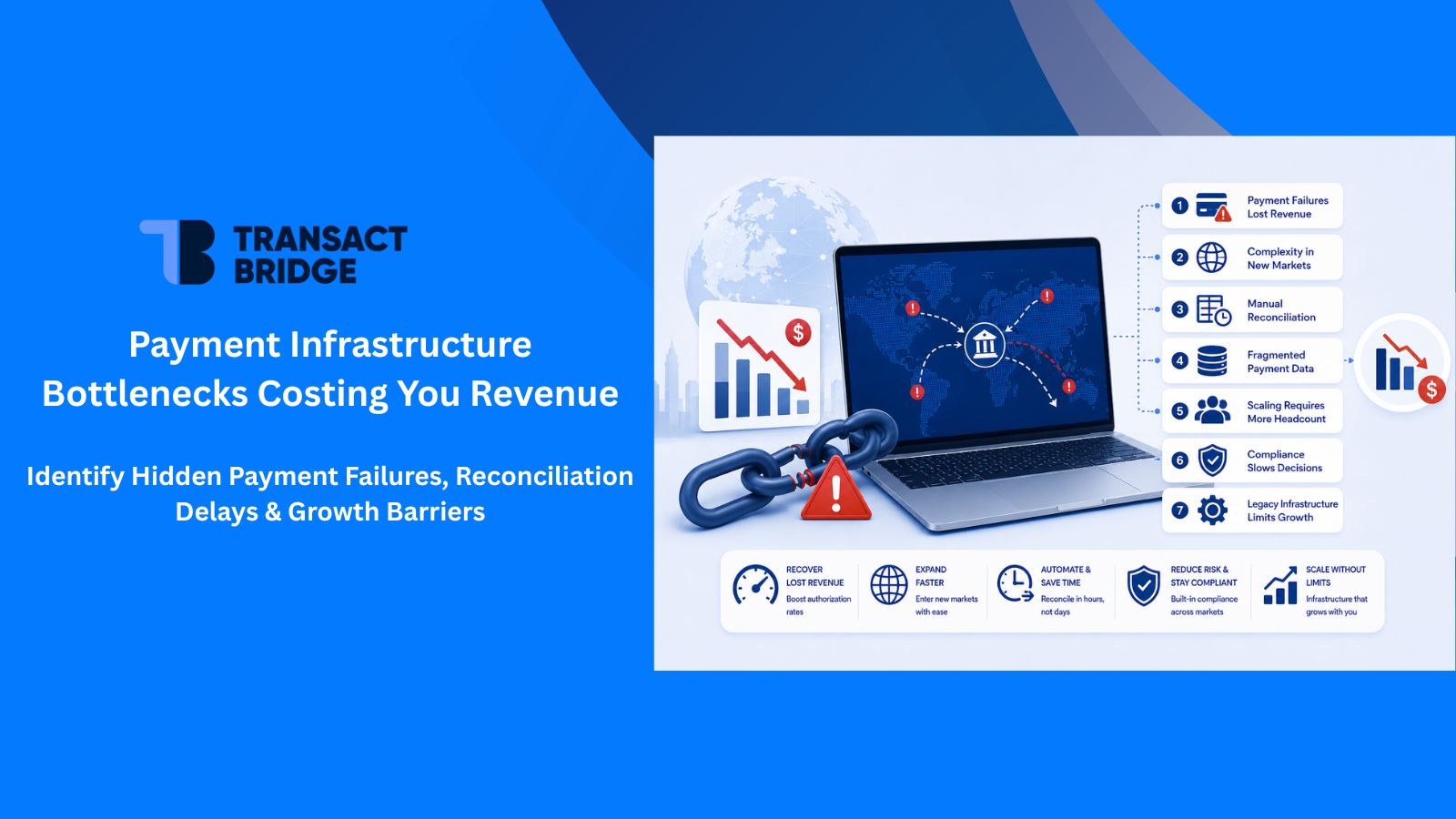
Your sales team closes a record quarter. Your product ships. Your customer is ready to pay.
And then the payment fails.
Not because the deal fell apart.
Because the infrastructure handling the money couldn't keep up with the business that earned it.
This is the payment infrastructure bottleneck; the silent gap between revenue earned and revenue collected that costs businesses more than most finance teams ever see on a dashboard.
The global payments industry processed 3.4 trillion transactions in 2023, according to McKinsey's Global Payments Report and according to Accuity's True Cost of Failed Payments report, failed payments alone cost the global economy $118.5 billion in fees, labor, and lost business in a single year.
The infrastructure carrying that growth is where revenue quietly disappears through failed transactions, manual reconciliation, fragmented data, and compliance friction that compounds across every market and every billing cycle.
For a business generating $10M ARR, even a conservative 7.9% payment failure rate puts nearly $790,000 at risk every year.
This guide breaks down the seven bottlenecks most likely to be limiting your growth right now.
1. Payment Failures Are Draining Revenue Before Customers Ever Complete a Purchase
Most finance and operations teams track revenue closely. Far fewer track payment authorization rates with the same discipline.
That's an expensive blind spot.
Industry benchmarks show failed payment rates of 5–10% are typical across subscription and B2B businesses with Recurly's State of Subscriptions research showing decline rates reaching 13–14% for debit card transactions, and higher still in certain high-risk or consumer-facing sectors. At low transaction volumes, a 5% failure rate is manageable. At scale, it becomes a significant and measurable revenue leak.
The root causes are rarely obvious:
- Single-provider dependencies with no failover routing
- Limited acquiring relationships in key geographies
- Poor or absent retry logic for soft declines
- Issuer restrictions by country or payment method
- No intelligent routing based on transaction type or success probability
Transact Bridge's smart routing engine addresses this directly by evaluating acquiring network performance, geography, payment method, and transaction history in real time to select the highest-probability path for each transaction.
Combined with AI-driven retry logic for soft declines, businesses using Transact Bridge report a 99.5% transaction clearance rate across markets, based on platform performance data across 500+ merchant accounts.
This aligns with broader industry findings- over 80% of businesses that adopt payment orchestration report improved authorization rates and customer experience.
If your payment failure rate is not being actively monitored and optimized, you are leaving revenue on the table with every transaction cycle.
Questions to ask your team:
- What is our current payment authorization rate by market and payment method?
- Do we have failover routing in place if our primary provider declines a transaction?
- What percentage of failed payments are soft declines that could be recovered with a retry strategy?
2. Every New Market Requires a New Payments Project
International expansion is a growth priority for most scaling businesses. It should not require rebuilding your payment stack every time you enter a new country.
Yet that is exactly what happens when payment infrastructure hasn't kept pace with growth ambitions.
Entering a new market raises a familiar set of questions:
- Which local payment methods does this market require?
- Which provider can settle in local currency?
- How do we handle tax and compliance requirements?
- How do we connect a new provider to our existing reconciliation and reporting workflows?
Each of these questions becomes an engineering and operational project. Weeks turn into months. Revenue opportunities are delayed or abandoned because the cost of entering a market through the payment stack is too high.
Transact Bridge separates market expansion from payment re-integration. Through a single API, businesses get access to 100+ payment methods globally, local rails, cards, wallets, and bank transfers, with multi-currency settlement and regional compliance handled automatically. Entering a new market becomes a configuration decision, not an engineering project. No local entity required, no new integration to build.
The businesses expanding fastest into international markets are the ones whose payment infrastructure enables that expansion rather than gating it.
3. Reconciliation Has Become a Full Time Operational Burden
Ask your finance team how long month-end reconciliation takes. If the answer involves spreadsheets, multiple provider portals, and days of manual effort- your payment infrastructure is creating a hidden operational cost.
Manual reconciliation across multiple payment providers, currencies, and markets is one of the most common and most underestimated signs of an infrastructure that has outgrown itself.
The complexity compounds with scale:
- Multiple providers generate inconsistent reporting formats
- Chargebacks and refunds appear in different systems at different times
- Currency conversion introduces reconciliation discrepancies
- Settlement timelines vary by provider, creating timing gaps in financial reporting
The result is a finance team spending significant capacity on transactional data-matching instead of strategic financial analysis, forecasting, and planning.
Transact Bridge's enterprise-grade reconciliation layer normalizes transaction data across all payment providers, currencies, and markets into a single audit-ready view; automatically. Finance teams using Transact Bridge close payment reconciliation in hours rather than the multi-day spreadsheet cycles that fragmented provider setups typically produce.
If your team closes the books on payment activity in days rather than hours, reconciliation complexity is a measurable drag on operational efficiency.
Still reconciling payments manually? See how Transact Bridge closes the books in hours, not days. Book a 30-minute infrastructure review →
4. Your Payment Data Is Fragmented Across Multiple Systems
Growing businesses accumulate payment providers over time. One handles domestic card payments. Another was added for international transactions. A third manages subscriptions. A fourth was integrated to support a specific market.
Each provider has its own dashboard, reporting format, and settlement process.
The result is that no one in the organization has a single, accurate view of payment performance.
Leadership cannot confidently answer:
- What is our authorization rate across all markets and providers?
- Where are customers abandoning transactions, and why?
- Which providers deliver the best performance for which transaction types?
- How much revenue was lost to payment failures last month?
Without unified payment data, optimization is guesswork. And guesswork at scale is expensive.
Transact Bridge consolidates all payment activity across every provider, method, currency, and market into a single reporting layer. Finance, operations, and commercial teams get one dashboard showing authorization rates, failure reasons, provider performance, and settlement status globally.
No more pulling exports from five different portals to answer a question leadership is asking today.
5. Scaling Transaction Volume Requires Scaling Headcount
A healthy payment infrastructure should scale with your business without requiring proportional growth in the teams managing it.
The warning sign is when headcount in finance, operations, or payments grows roughly in step with transaction volume not because the business is expanding strategically, but because more people are needed to manage the operational overhead that the infrastructure cannot automate.
Common signals include:
- Manual settlement tracking and provider reconciliation
- Dedicated resource managing dispute and chargeback processes
- Payment reporting assembled manually from multiple system exports
- Compliance documentation maintained across fragmented records
- Provider relationship management handled individually per contract
These are infrastructure problems wearing the costume of operational ones.
Scalable payment infrastructure automates the repetitive workflows that currently consume manual resources, freeing your team to focus on analysis, optimization, and growth initiatives rather than transaction-level data management.
Transact Bridge automates the workflows that typically require dedicated headcount ,settlement tracking, dispute and chargeback management, compliance documentation, and cross-provider reporting. Businesses using Transact Bridge manage significantly higher transaction volumes without proportional growth in their payments team. The infrastructure scales. The people focus on growth.
If your payment operations headcount is growing as fast as your payment volume, the infrastructure is not scaling. The people are compensating for it.
6. Compliance Is Slowing Strategic Decisions
Compliance should be an operational capability, not a recurring emergency.
For businesses operating across multiple markets with multiple payment providers, compliance management becomes genuinely complex. Regulatory requirements vary by country. Reporting obligations multiply with every provider added. Audit preparation requires gathering data from systems that don't communicate with each other.
The practical consequence is that compliance becomes reactive:
- Audit requests trigger days of manual data gathering
- Market expansion decisions are delayed pending regulatory review
- New payment provider onboarding stalls on documentation requirements
- Finance teams spend hours validating transaction records that a unified system would surface instantly
This creates a compounding problem. The more fragmented the payment infrastructure, the more compliance overhead grows and the more that overhead slows the commercial decisions that drive growth.
Transact Bridge owns the compliance lifecycle across every market it operates in - tax filings, regulatory reporting, and audit documentation are maintained automatically as a byproduct of normal transaction processing. Businesses stay expansion-focused while Transact Bridge keeps operations legally secure across jurisdictions. What was once a recurring emergency becomes a background capability.
The CFOs and heads of payments who treat compliance infrastructure as a growth enabler rather than a cost center are the ones who expand fastest into new markets.
7. You're Still Running on Infrastructure Built for a Previous Version of Your Business
This is the bottleneck that rarely gets named directly but it underlies most of the others.
The payment stack that served your business two or three years ago was designed for a different company. Smaller. Fewer markets. Simpler product lines. Lower transaction volumes.
As the business evolves, payment infrastructure typically doesn't keep pace:
- Domestic businesses become international businesses
- One-time transactions become subscription models
- Single-channel commerce becomes omnichannel
- Regional teams become global operations
The response is usually to add another provider, another integration, another workaround. Each addition makes the stack more complex and harder to manage. Operational risk increases. Visibility decreases. And the cost of changing the underlying infrastructure grows.
The businesses that scale efficiently are not the ones with the most providers or the most integrations. They're the ones that built payment infrastructure designed to scale a unified layer that supports new markets, new payment methods, new business models, and new compliance environments without requiring a rebuild every time the business changes.
Payments are not a back-office function. For growing businesses, they are a strategic capability. The infrastructure underneath them should be treated accordingly.
How to Diagnose Your Payment Infrastructure: A CFO Checklist
Use these questions to assess whether your current infrastructure is supporting growth or quietly limiting it:
Authorization & Revenue
- Do you know your authorization rate by market, provider, and payment method?
- Do you have intelligent retry logic for soft declines?
- Do you have failover routing across multiple acquirers?
Reconciliation & Reporting
- Can your finance team reconcile payment activity across all providers in under 24 hours?
- Do you have a single dashboard showing payment performance across all markets?
- Are chargebacks and refunds automatically matched to original transactions?
Scalability & Operations
- Does entering a new market require a new payment integration project?
- Is your payment operations headcount growing proportionally with transaction volume?
- Are compliance and audit tasks largely automated, or primarily manual?
If you answered "no" to three or more of these questions, your payment infrastructure is likely creating measurable drag on growth, efficiency, and revenue.
Is Your Payment Infrastructure Supporting Growth or Limiting It?
Payment bottlenecks are rarely visible in good times. They surface through rising decline rates, slower market launches, growing operational overhead, and finance teams buried in reconciliation.
By the time those signals are loud, the revenue impact has been accumulating for months.
The businesses that scale efficiently invest in payment infrastructure as a growth function not just a transaction processing necessity.
Transact Bridge helps mid-market and enterprise businesses build payment infrastructure that scales. Through payment orchestration, automated reconciliation, unified reporting, and global payment capabilities, we help finance and payments leaders eliminate operational drag and improve authorization rates without replacing everything they've built.
If you're managing multiple payment providers, entering new markets, struggling with reconciliation complexity, or preparing for a step-change in transaction volume, a 30-minute infrastructure review can identify exactly where your current setup is holding revenue back.
Schedule a Payment Infrastructure Review with Transact Bridge →
Transact Bridge helps growing businesses build scalable, efficient payment infrastructure. To identify hidden revenue leaks and operational bottlenecks in your current payment stack, schedule a free 30-minute infrastructure review.
FAQs
What is payment orchestration and how does it improve authorization rates?
Transact Bridge's routing engine evaluates acquirer performance, payment method, geography, and transaction type in real time to select the path most likely to succeed. Combined with AI-driven retry logic for soft declines and relationships across 100+ global payment methods, this is what drives the 99.5% transaction clearance rate Transact Bridge clients see versus the 5–10% failure rates typical of single-provider setups.
How much revenue do businesses typically lose to payment failures?
Industry data indicates that subscription and B2B businesses see failed payment rates of 5–10% on average, with some sectors reaching 13–14% or higher according to Recurly's research . For enterprise businesses, revenue leakage from payment failures and billing issues can represent 10–20% of total revenue annually. The actual impact depends heavily on transaction volume, business model, and whether retry and recovery strategies are in place.
What are the signs that a business needs to modernize its payment infrastructure?
Key signals include rising payment failure rates, manual reconciliation processes that take more than 24 hours, fragmented reporting across multiple provider dashboards, difficulty entering new markets without new integration projects, and payment operations headcount growing proportionally with transaction volume.
How does payment infrastructure affect international expansion?
Businesses with unified payment infrastructure can enter new markets by enabling local payment methods and currencies through configuration rather than re-integration. Without this, each new market requires a new payment project slowing expansion timelines and increasing the cost of growth.
What is the difference between a payment gateway and a payment orchestration platform?
A payment gateway connects a business to a single payment processor. A payment orchestration platform connects to multiple gateways and processors simultaneously, routing transactions intelligently, managing failover, and providing unified reporting across all payment activity. For businesses operating at scale or across multiple markets, orchestration delivers significantly better performance and operational efficiency.
When should a company consider working with Transact Bridge?
Transact Bridge works best with businesses processing $5M or more in annual payment volume that are experiencing growth-stage complexity- multiple markets, multiple providers, reconciliation challenges, or a need to improve authorization rates and reduce operational overhead. The best starting point is a payment infrastructure review to identify where your current setup is creating friction.