India Market Entry Strategy for US & Global Businesses: The Complete 2026 Guide
Published on: Sat 18-Jul-2026 05:50 AM
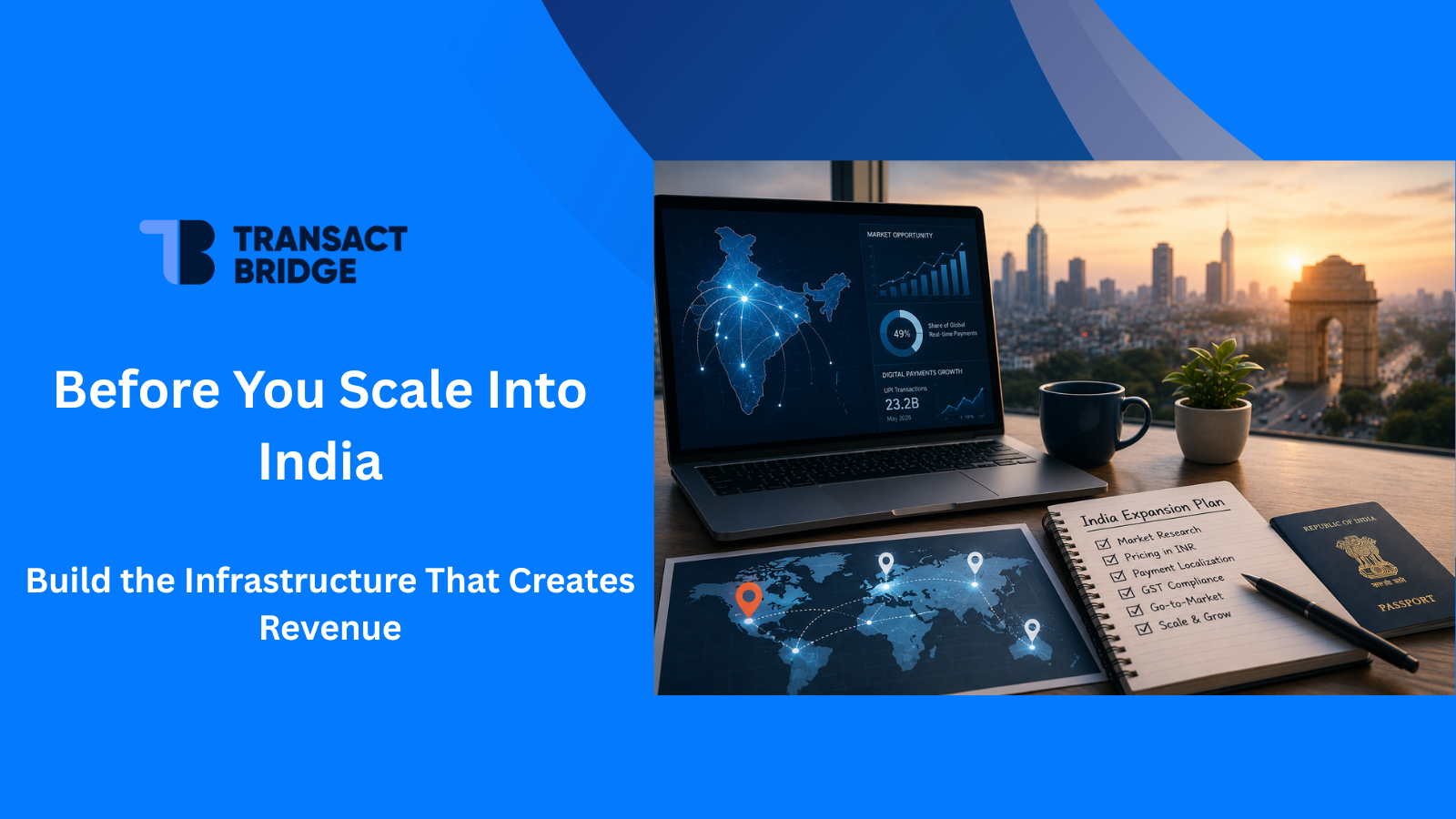
Every international expansion starts with the same assumption: if demand exists, revenue will follow. In India, that assumption breaks down more often than most executive teams expect. Products generate traffic. Marketing generates leads. Sales generates pipeline. Yet revenue stalls, not because customers don't want to buy, but because the commercial infrastructure behind the product wasn't built for how Indian businesses and consumers actually purchase.
The scale of what's at stake isn't in question. UPI alone handled roughly 23.2 billion transactions worth ₹29.9 lakh crore in May 2026, up 19% year-on-year, and India now accounts for close to half of all real-time digital payments processed globally, more than the next several countries combined (source: NPCI/IBEF).
For US and global businesses, an India market entry strategy that works isn't built on demand alone. It's built on the commercial infrastructure to accept payments in India, price in INR, stay compliant with GST and India's legal and regulatory requirements, and deliver a checkout experience that feels local from the first transaction.
This guide covers market evaluation, entry models, including the Merchant of Record model – payment localization, pricing, compliance, and the 12-step framework for taking India from pilot to scaled revenue.
Quick answer: The most effective India market entry strategy validates demand before large operational investment. Rather than establishing a local entity on day one, most SaaS, AI, ecommerce, and digital businesses first localize INR pricing, enable UPI and other local payment methods, handle GST-compliant invoicing through a Merchant of Record, and prove product-market fit. As recurring revenue grows, they decide whether to keep operating through a Merchant of Record, set up a local subsidiary, or run a hybrid model.
Where the Assumption Breaks Down
The pattern repeats across boardrooms: leadership approves India expansion, marketing turns on paid campaigns, product enables INR pricing, and trial sign-ups climb. Then customers reach the checkout and abandon it. Some can't find a payment method they trust.
Others hesitate at USD-only pricing. Finance teams ask for GST-compliant invoices the vendor can't issue. Subscription renewals fail because the billing flow doesn't match local expectations.
Each of these is revenue leakage after acquisition, not before it. Most businesses treat India as a market-entry exercise when it's really a market-localization exercise and closing that gap is what separates companies converting traffic into recurring revenue from those with strong products and stalled checkouts.
Why India Has Become a Strategic Growth Market
Beyond population, India has built one of the world's most advanced digital public infrastructure stacks, and the numbers back it:
Data Point | Figure |
UPI monthly transaction volume | |
UPI monthly transaction value | ~₹29.9 lakh crore (May 2026) |
UPI share of India's retail digital payments | |
India's share of global real-time payment volume | ~49% |
Year-on-year UPI transaction value growth | ~19% (May 2026) |
Banks live on UPI |
For most SaaS, AI, ecommerce, gaming, EdTech, and OTT businesses, India has moved from "secondary market after the US or Europe" to a core contributor to acquisition and recurring revenue but only for companies that adapt pricing, payments, and compliance to how Indian customers actually buy.
Market Opportunity vs. Market Readiness
"Is India a large enough market?" is the wrong first question. The better one: "Is our business ready to sell successfully in India?"
Market Opportunity | Market Readiness |
Customer demand | Local payment methods (UPI, RuPay, cards, Net Banking) |
Industry growth | INR pricing |
Population size | GST-compliant invoicing |
Digital adoption | Subscription billing that survives renewal |
Startup ecosystem | Localized checkout |
Internet penetration | Settlement, reconciliation, and support coverage |
The left column explains why companies expand. The right column determines whether they succeed after expanding.
Not sure where you stand?
Get a quick read on your India payment readiness.
Before You Expand: The India Readiness Framework
Rather than judging India on market size alone, assess readiness across six functions:
Pillar | Executive Question | Why It Matters |
Market Demand | Is there measurable demand from Indian customers? | Prevents expansion on assumption |
Product Readiness | Does the product fit local buyer needs? | Pricing and features may need to shift |
Commercial Infrastructure | Can customers discover, buy, and renew easily? | Revenue depends on buying experience, not just product |
Payment Infrastructure | Can customers pay with methods they trust? | Payment friction is the #1 cause of checkout abandonment |
Compliance & Finance | Can you manage GST, regulatory compliance, and settlement? | Gaps here create downstream legal and financial risk |
Scalability | Does the model work across markets, not just India? | Avoids rebuilding systems as revenue grows |
Executive Scorecard
Question | Yes | No |
Are you already seeing inbound traffic or inquiries from India? | ☐ | ☐ |
Can you support INR pricing? | ☐ | ☐ |
Can customers pay with methods they already trust (UPI, cards, Net Banking)? | ☐ | ☐ |
Does finance understand cross-border GST/tax implications? | ☐ | ☐ |
Is support prepared to serve Indian time zones? | ☐ | ☐ |
Can your billing system handle local renewal behavior? | ☐ | ☐ |
Is leadership committed to India as a multi-year market? | ☐ | ☐ |
Can your payment and compliance infrastructure scale beyond India too? | ☐ | ☐ |
7–8 Yes: ready for commercial expansion now. 5–6: close operational gaps before major GTM spend. Below 5: validate demand and build readiness first.
When not to enter India yet
Expansion should follow readiness, not fear of missing out. Delaying India may be the better call if:
- Product-market fit is still uncertain in your home market
- Unit economics or churn are already unstable elsewhere
- Your billing systems can't yet support international customers
- Leadership can't dedicate real attention to another growth market
- There's no budget for localization – pricing, payments, or support
Delaying by a quarter to fix one of these is usually cheaper than launching without it.
Four India Market Entry Models
There's no universally correct model. The right one depends on the revenue stage, risk tolerance, and how fast you need to move.
Model | Best For | Speed | Upfront Cost | Commercial Control | Best for Digital Businesses |
Local Entity | Enterprises, manufacturing, long-term physical ops | Low (months) | High (CAPEX-heavy: office, staff, registration) | High | Moderate |
Distributor / Channel Partner | Hardware, medical devices, enterprise sales | Medium | Medium | Low–Medium | Low |
Merchant of Record (MoR) | SaaS, AI, ecommerce, gaming, EdTech, OTT | High (weeks) | Low (validate demand first, invest later) | Medium | High |
Hybrid | Fast-growing digital businesses scaling into a local presence | High | Medium | Medium–High | High |
Choosing between entity, distributor, or MoR?
Transact Bridge helps digital businesses launch in India without building local infrastructure first.
A local entity gives a business direct, unmediated control over contracts, pricing, and operations. A Merchant of Record trades some of that direct control for speed. The business still sets pricing and product, but the provider's supported markets, payment methods, policies, and contract terms shape what's possible, so control is more accurately "medium" than "high."
Merchant of Record India is typically the fastest way for digital businesses to accept payments in India without standing up local infrastructure first. A Merchant of Record acts as the legal seller for covered customer transactions, depending on the agreement, this can include payment processing, GST collection and remittance, and invoicing, so a foreign business can start collecting payments from India, the US, and other markets under one framework rather than building country-by-country systems.
Terminology and scope aren't fully standardized across providers. Some describe this role as "Seller of Record" with a narrower or differently structured set of responsibilities, so businesses should verify the contractual scope rather than assume it matches a competitor's setup.
Hybrid expansion is the most common path for SaaS and AI companies: validate demand → localize pricing → enable local payments through a Merchant of Record → grow recurring revenue → build a customer base → establish a local entity only once volume justifies it.
B2B vs. B2C India Entry: Different Playbooks
"India market entry" isn't one playbook. A self-serve consumer app and an enterprise software vendor hit friction at completely different points in the journey.
Requirement | B2B Entry | B2C Entry |
Primary buying friction | Procurement and invoicing | Checkout and payment choice |
Pricing | Contract- or volume-based, often negotiated | Visible, transparent INR pricing |
Payments | Bank transfer, cards, invoice-based billing | UPI, cards, and other relevant local methods |
Tax focus | Buyer's GST registration and place of supply | Consumer-facing tax treatment on digital services |
Sales motion | Longer, multi-stakeholder, finance- and legal-reviewed | Self-serve or high-volume, conversion-driven |
Retention risk | Procurement delays and slow internal adoption | Failed renewals and involuntary churn at the payment layer |
A B2B software vendor selling to Indian enterprises should prioritize GST-compliant invoicing and finance-team-ready documentation before worrying about UPI. A B2C or PLG product should prioritize checkout conversion and payment-method coverage first, since that's where most of its revenue leakage happens.
Businesses running both motions – common for SaaS with a self-serve tier and an enterprise tier – typically need both capabilities rather than picking one.
The 12-Step India Market Entry Framework
Most failed expansions aren't caused by weak demand. They're caused by doing the right things in the wrong order (launching ads before localizing checkout, hiring sales before validating pricing, incorporating before proving demand). At its core, the sequence collapses into a single stack:
The India Revenue Stack
Demand
↓
Product
↓
Pricing
↓
Payments
↓
Compliance
↓
Billing
↓
Renewals
↓
Expansion
Skip a layer – launch payments before pricing is settled, or expand before renewals are proven and the layers above it become unstable. The 12 steps below are how each layer of the stack gets built in practice.
| Phase | Outcome | |
1 | Validate demand | Evidence-based expansion |
2 | Define your ICP | Focused GTM |
3 | Assess competitors' commercial experience | Better positioning |
4 | Localize the product experience | Higher conversion |
5 | Build India-specific pricing | Customer trust |
6 | Enable local payment infrastructure | Higher payment success |
7 | Prepare GST/compliance workflows | Lower operational risk |
8 | Build your GTM strategy | Sustainable acquisition |
9 | Launch a pilot | Validate assumptions cheaply |
10 | Measure commercial KPIs | Optimize before scaling |
11 | Scale without fragmenting systems | Efficient growth |
12 | Standardize infrastructure for the next market | Global repeatability |
1. Validate demand with your own data first
Before external market reports, check organic traffic from India, trial sign-ups, demo requests, enterprise inquiries, and support tickets. First-party signals are more reliable than macro forecasts.
2. Define your ICP – India is not one market
Buyer titles shift by vertical: a CISO for cybersecurity, an Operations Director for SaaS, a Founder or Academic Director for EdTech, a Digital Commerce Manager for ecommerce. Serving everyone at launch usually weakens positioning more than it broadens reach.
3. Study competitors' commercial experience, not just features
Look at how they price, structure trials, present checkout, accept payments, and display taxes – commercial experience often decides purchase confidence more than feature comparisons do.
4. Localize beyond translation
Real localization covers regional examples and testimonials, INR pricing, a familiar checkout, local payment methods, GST-compliant invoices, and time-zone-aware support, not just translated copy.
5. Price for India, not just in INR
A straight USD-to-INR conversion is rarely optimal. The right model depends on local purchasing power, customer lifetime value, CAC, and how the buyer expects to pay – not the exchange rate alone.
Pricing Model | Best For |
Direct INR conversion | Premium enterprise software with limited price sensitivity |
Market-based pricing (adjusted to local purchasing power) | Broad SaaS audiences competing with local vendors |
Tiered pricing | AI tools and productivity software with varied usage levels |
Usage-based pricing | Developer tools and infrastructure platforms |
Seat-based pricing | B2B SaaS sold to teams |
Freemium | Consumer software and PLG motions |
For enterprise/B2B deals, pricing is often negotiated regardless of published rates; for self-serve B2C products, the published INR price is the actual persuading, so clarity matters more than the specific number chosen.
6. Build real payment infrastructure for India
This is where most expansion strategies quietly win or lose. In digital commerce, the payment flow is part of the product experience and Indian buyers now default to a specific set of expectations:
Customer Expectation | Business Impact |
UPI and other local payment methods | Higher conversion |
Transparent INR pricing and tax display | Greater trust |
Fast, familiar checkout | Lower abandonment |
Reliable recurring billing | Better retention |
Payment methods worth evaluating: UPI, RuPay and other credit/debit cards, Net Banking, digital wallets, and EMI options where relevant. Foreign companies generally cannot add UPI directly through an international payment setup.
Access typically requires an eligible local acquiring partner or a Merchant of Record that already supports UPI and cross-border settlement. Prioritize the mix your ICP actually uses over maximizing the number of options.
7. Prepare GST and regulatory compliance workflows
Whether GST registration is required depends on your product, customer type (registered business vs. unregistered consumer), and place-of-supply rules under India's tax code.
CBIC guidance on Online Information Database Access and Retrieval (OIDAR) services – a classification that covers SaaS, cloud services, digital content, and other automated digital products delivered with minimal human intervention.
It distinguishes between supplies to registered and unregistered Indian recipients, with different potential GST treatment for each. The payment, settlement, and foreign-exchange requirements that apply will similarly depend on the transaction structure, payment partner, customer type, and flow of funds – a local CA can confirm auditing and taxation requirements specific to your setup.
There isn't one uniform rule that covers every foreign seller. Fill out our Legal and Compliance form to confirm the requirements for your specific model before launch, rather than after a procurement team flags it.
8. Build a GTM strategy your ICP actually uses
Organic search and content marketing compound over time; partner ecosystems and events work for enterprise pipeline; paid search and LinkedIn work for high-intent B2B demand. Prioritize the two or three channels aligned to your ICP rather than running all of them at once.
9. Pilot before you scale
Launch a controlled version first. A pilot answers which payment methods convert best, whether pricing resonates, whether CAC is sustainable, and where customers actually drop off – before you commit to full GTM spend.
10. Measure the metrics that predict revenue, not just revenue
Conversion rate, checkout abandonment, payment success rate, CAC, LTV, churn, subscription renewal rate, and net revenue retention – together, these show whether the commercial engine is healthy, not just whether last month's number looked fine.
10. Measure the metrics that predict revenue, not just revenue
Conversion rate, checkout abandonment, payment success rate, CAC, LTV, churn, subscription renewal rate, and net revenue retention – together, these show whether the commercial engine is healthy, not just whether last month's number looked fine.
11–12. Scale without fragmenting, then reuse the model
Growth tends to introduce a different payment provider, billing system, and tax process for every new market – which fragments reporting and duplicates reconciliation work. The alternative many digital businesses now use: standardize one commercial and payment infrastructure layer, and localize only the customer-facing experience (pricing, language, support) per market.
Built this way, the same infrastructure that gets India live can extend to the US, Southeast Asia, the Middle East, or Europe without a rebuild. India becomes proof of the model, not a one-off project.
Sector-Specific Considerations
The 12-step framework holds across verticals, but where the friction concentrates differs by business type:
Sector | Where Friction Concentrates | Priority Fix |
SaaS / B2B software | GST-compliant invoicing for enterprise procurement | Invoicing and finance-ready documentation |
AI platforms | Usage-based billing accuracy, data residency questions from enterprise buyers | Transparent usage pricing, compliance documentation |
Ecommerce | Payment method coverage and COD expectations in some segments | UPI and card coverage, transparent landed pricing |
Gaming | Wallet and card payment reliability, sector-specific tax treatment | Payment success rate, tax classification review |
EdTech | Consumer trust at checkout, refund policy clarity | Transparent pricing and visible refund terms |
OTT / subscriptions | Recurring billing and involuntary churn from failed renewals | Renewal success rate, retry logic on failed payments |
A Practical 30/60/90-Day India Launch Plan
Once the readiness scorecard clears and a pilot is approved, sequencing matters more than speed:
Days 1–30: Foundation
- Finalize ICP and pricing model
- Set up INR pricing and localized checkout
- Enable priority local payment methods (start with UPI and cards)
- Complete the Legal and Compliance form to confirm GST and regulatory treatment for your specific product and customer type
- Set up GST-compliant invoicing
Days 31–60: Controlled pilot
- Launch to a limited channel or segment, not full GTM spend
- Track conversion rate, payment success rate, and checkout abandonment weekly
- Fix the highest-friction step first, rather than optimizing everything at once
- Confirm renewal/recurring billing actually works on the first billing cycle, not just at checkout
Days 61–90: Scale decision
- Review CAC, LTV, and early churn against target thresholds
- Expand successful channels; cut underperforming ones
- Decide whether current infrastructure (MoR, local payments, invoicing) can scale as-is, or whether a local entity is now justified
- Document the setup so it's reusable for the next market, not India-specific
Executive Checklist Before Launch
- Is pricing aligned with how Indian buyers actually evaluate cost?
- Can customers pay with a method they already trust – UPI included?
- Can you issue GST-compliant invoices that clear enterprise procurement?
- Are settlement, reconciliation, and refund processes defined?
- Is support staffed for Indian time zones?
- Does today's payment and compliance infrastructure scale to your next market, or will you rebuild it?
If several of these are "no," it's usually cheaper to close the gap before launch than to fix it after customers start buying.
Planning your India launch?
Accept payments across India, the US, and supported markets – one setup.
FAQs
What is the best India market entry strategy for a US business?
Validate demand before major structural investment: a defined ICP, localized INR pricing, relevant payment methods (including UPI), GST-compliant invoicing, and a controlled pilot. Form a local entity once hiring, regulation, or proven revenue makes it necessary.
Can a US company sell in India without a local entity?
In many cases, yes – through cross-border sales, a distributor, or a Merchant of Record, without forming an Indian subsidiary immediately. The right structure depends on product type, customer type, transaction flow, and applicable tax and regulatory requirements – use our Legal and Compliance form to get a read specific to your business.
Does a foreign company need an Indian entity to accept payments in India?
Not always. Foreign companies can often accept payments in India through an approved cross-border setup or a Merchant of Record, provided the legal seller, tax handling, and settlement flow are clearly defined.
What is a Merchant of Record in India?
A Merchant of Record acts as the legal seller for covered customer transactions. Depending on the agreement, it may handle payment processing, GST collection and remittance, invoicing, refunds, chargebacks, and related compliance. Terminology and scope vary by provider – some use "Seller of Record" for a differently structured set of responsibilities – so verify the provider's exact contractual scope, supported markets, and settlement terms rather than assuming it matches another vendor's setup.
Should a business use a Merchant of Record or set up an Indian entity?
A Merchant of Record suits testing demand and launching quickly with lower operational complexity. A local entity makes more sense once you need employees, regulated operations, or direct local contracts. Many digital businesses run a hybrid: MoR first, entity later.
What payment methods should global businesses support in India?
Match the mix to your ICP – commonly UPI, RuPay and other credit/debit cards, Net Banking, select digital wallets, and invoice-based bank transfers for enterprise buyers.
Can foreign companies offer UPI payments?
Not directly through a standard international payment setup. It typically requires an eligible local acquiring partner or a Merchant of Record that already supports UPI and cross-border settlement.
Does a US company need to register for GST in India?
It depends on the product, customer type, and place of supply – some foreign providers of digital services to unregistered Indian consumers have GST obligations, while different rules apply to registered business buyers. Get tax advice specific to your model before launch.
How long does it take to enter the Indian market?
A digital business using existing payment and compliance infrastructure can often launch a controlled pilot within weeks. Standing up a local entity, banking relationships, and staff takes considerably longer. The more useful measure is time to first compliant revenue, not time to first sign-up.
What are the most common India market entry mistakes?
Treating India as one uniform market, launching with USD-only pricing, skipping UPI and other local payment methods, ignoring GST and invoicing until procurement flags it, hiring before validating demand, and spending on acquisition before fixing checkout. Most failures come from sequencing, not lack of opportunity.
Executive Takeaways
The strongest India market entry strategy isn't the fastest one – it's the one that removes commercial friction while keeping the infrastructure scalable. Five questions decide it:
- Have we validated real demand with our own data?
- Can customers pay the way they expect, including UPI?
- Can we handle GST and regulatory compliance without slowing down?
- Can our commercial infrastructure scale past India?
- Does today's setup support tomorrow's expansion into the US or other global markets?