International Expansion Challenges: Why Global Projects Fail Before Launch
Published on: Sun 26-Jul-2026 01:02 PM
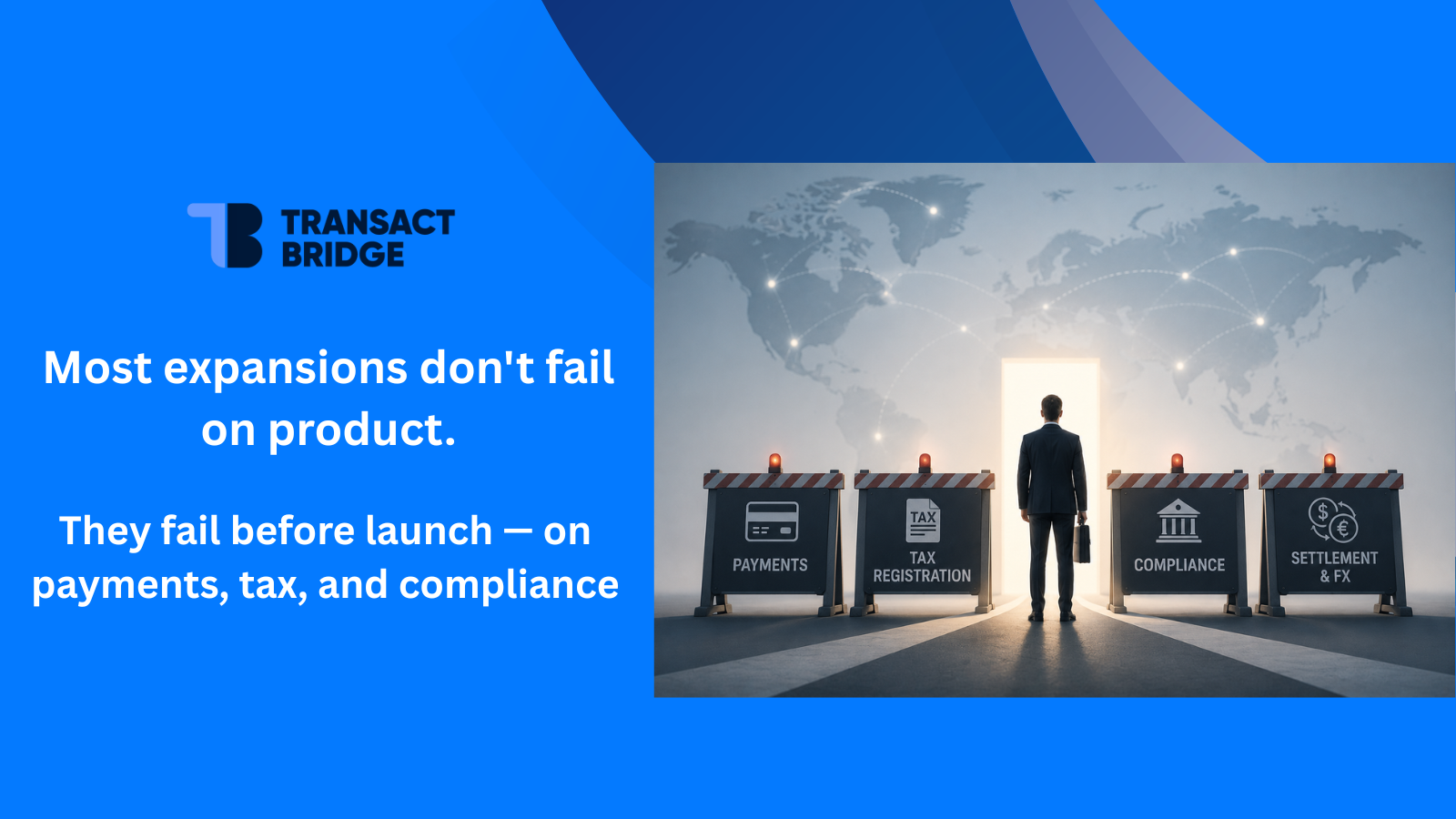
Across cross-border launches, one failure shows up more reliably than any other and it has nothing to do with the product. A company does everything the playbook says: months of market research, the product localized, a country lead hired, pricing modeled, a launch campaign that converts. Then, on launch day, almost nothing processes.
The checkout offers cards in a market that pays by bank transfer and wallet. Invoices can't be issued because the business isn't registered to collect local tax. The demand shows up but the commercial infrastructure, the ability to actually take money, isn't ready.
Whether you're expanding into India, entering the US, or launching into multiple markets at once, this is the pattern behind most international expansion challenges. And it's almost always preventable.
Cross-border payment flows are projected to reach nearly $290 trillion by 2030 yet many international market expansion projects never make it past launch, because the commercial infrastructure to collect that money wasn't ready in time.
Key insight: The four gaps that sink expansions before launch.
Most global expansion projects don't fail because the product is wrong. They fail because four pieces of commercial infrastructure weren't ready in time:
- Payment localization : customers can't pay the way they expect to
- Tax registration : you're obligated to collect before you realize it
- Regulatory compliance : entity and licensing block settlement
- Settlement & FX : getting paid isn't the same as getting the money
Everything below is about closing these four gaps before you set a launch date.
Before you expand, ask yourself five questions
Most international expansion challenges are decided before a single line of localization is written. If you can answer these clearly, you're ahead of most companies entering a new market:
- Are you selling into one market or several? One corridor is a project; three is a system, and the infrastructure decisions change accordingly.
- Does each market need different payment methods? India runs on UPI, the US on cards and ACH, Europe on local schemes – one checkout rarely fits all three.
- Will your sales trigger tax registration? US economic nexus, EU VAT, and India's GST/OIDAR can obligate you from your first sale.
- Can customers pay the way they expect to? If the answer is "we take cards," you may be invisible to how the market actually moves money.
- Who owns compliance? You, a local entity, or a partner – because someone has to, and "we'll figure it out at launch" is where timelines die.
For any company expanding internationally, those questions rarely have the same answer twice. Here's the launch blocker most likely to stall each market:
Market | Biggest launch blocker |
India | UPI acceptance + GST/OIDAR registration |
United States | Economic nexus (sales tax) + ACH coverage |
Global | Local payment methods + VAT + settlement |
Why do international expansion projects fail before launch?
International expansion projects fail before launch when the ability to collect payment is treated as a launch-day integration rather than a launch-gating dependency. Product-market fit gets months of attention; the plumbing that turns a signup into settled revenue gets a few weeks and in cross-border commerce, those few weeks are where the hard, slow, regulated work actually lives.
Read almost any analysis of why global expansion fails and you'll see the same list: cultural misreads, local competition, mispricing, hiring the wrong first team. Those are real but they're survivable, post-launch problems. You can reprice, rehire, and re-message. What you cannot do is un-fail a launch where the checkout couldn't accept money, because launch day only happens once.
The stakes scale with the opportunity. Cross-border payment flows are among the largest movements of money in the global economy and that entire prize sits behind infrastructure most expansion plans assume will "just work."
Bottom line: expansions fail before launch because the ability to collect money is scheduled last, when it should be planned first.
The risks teams plan for – and the layer they miss
The infrastructure layer gets skipped because of org design, not negligence. Visible risks have obvious owners. The invisible layer sits between functions – too operational for strategy, too regulated for engineering, too cross-border for a domestic finance team – so it falls to whoever notices it last.
Layer | Category | Usually addressed | Failure mode |
Visible | Market research | Early | Slow, recoverable |
Visible | Localization | Early–mid | Iterative, recoverable |
Visible | Talent & ops | Mid | Costly, recoverable |
Visible | Pricing & GTM | Mid–late | Adjustable post-launch |
Invisible | Payment acceptance | Launch day | Hard stop – no revenue |
Invisible | Tax registration | "At launch" | Legal precondition to invoicing |
Invisible | Entity & compliance | Assumed | Adds months; freezes settlement |
Invisible | Settlement & FX | After first sale | Margin leak, reconciliation chaos |
One way companies close all four invisible gaps at once – without building a payment, tax, and compliance stack in every market – is a Merchant of Record model. We'll return to exactly how that works later; for now, keep it in mind as the shortcut behind the challenges below.
Key insight: You can recover from a launch that was mispriced or mistimed. You cannot recover from a checkout that won't take money.
The four pre-launch failure points that actually block revenue
Strip away the strategy-deck framing and international expansion challenges resolve into four concrete places where money stops moving and each one looks different in India, the US, and the wider global market.
1. Payments: your checkout is speaking the wrong language
Customers arrive ready to pay and can't. Research from PPRO found that 99% of cross-border shoppers want their preferred payment method available, and 94% expect to pay in their local currency. A cards-only checkout in a wallet-first or bank-transfer-first market loses the sale before price ever matters.
Market | How it actually prefers to pay |
India | UPI, digital wallets, netbanking |
United States | Cards, ACH, digital wallets |
Europe | iDEAL, SEPA, local schemes |
Brazil | Pix |
Even when the right method is offered, cross-border transactions clear a lower bar. Issuing banks screen foreign merchants harder, and that caution lands on legitimate customers as false declines. The structural fix companies use is local acquiring – routing transactions through in-market banks, which pulls approval rates back toward domestic levels.
- ~70% : average global cart abandonment rate (Baymard Institute)
- 72% : of merchants see higher payment failure rates cross-border than domestically (PPRO)
- $260B : in lost orders recoverable through better checkout alone, US + EU (Baymard Institute)
Transaction path | Typical approval range |
Domestic card | 85–90%+ |
Cross-border card (global acquirer) | ~80–90% |
Routed via local acquiring | 95–99% |
Illustrative ranges; actual figures vary by corridor, card type, and provider. See international payment methods.
Bottom line: in cross-border commerce, the checkout : not the product – is usually where the first sale is won or lost.
2. Tax: you owe before you know
In the United States, the 2018 Supreme Court decision in South Dakota v. Wayfair replaced physical presence with economic nexus: cross a state's threshold – commonly $100,000 or 200 transactions a year – and you must register, collect, and remit sales tax there, with no office or employee in the state. All 45 sales-tax states plus Washington, D.C. now enforce a threshold.
The pattern repeats by market:
Market | The tax trigger you can miss |
United States | Economic nexus – sales tax obligation from a threshold |
Europe / UK | VAT registration thresholds and reverse charge |
India | GST under OIDAR for foreign digital services |
India's OIDAR framework was expanded in October 2023 to cover cloud, AI, online content, and advertising, and enforcement is scaling with it: GST collected from overseas digital services rose from ₹80 crore in 2017–18 to ₹2,675 crore in 2023–24 (Government of India). However you enter – India, the US, or several markets together – tax registration is often a legal precondition to invoicing your very first customer, not a finance-team afterthought.
Key insight: Miss a registration and you're not late on paperwork; you're non-compliant from sale one.
3. Compliance & entity: "do we even need a local company?"
This is a timeline killer disguised as a legal question. Whether you need a local entity, what licensing applies, and how you're permitted to collect and repatriate funds all determine how long "launch" actually takes.
In India, the Reserve Bank of India's rules under FEMA and its cross-border payment-aggregation framework govern how foreign earnings can be collected and settled – get the structure wrong and funds can be held in settlement even after customers have paid.
Standing up a local entity to solve this can add months and material cost. For many companies the entity was never the goal – just the assumed path to collecting money legally. It's also the gap a Merchant of Record most often removes.
4. Settlement & FX: getting paid isn't the same as getting the money
A cleared sale still has to settle, convert, and reconcile. The World Bank reports that sending just $200 across borders still costs an average of around 6.2% globally, far above the 3% international target.
Multiply thin FX spreads and reconciliation overhead across every currency you operate in, and "we're live in five markets" quietly becomes "we're leaking margin in five currencies and can't cleanly close the books." A global checkout that settles in one place is how companies avoid this.
The typical expansion timeline and why infrastructure starts too late
Here's how most expansion plans sequence the work. Notice where payments, tax, and compliance land:
Week | Activity | When it should start |
Week 1 | Market research | On time |
Week 3 | Localization | On time |
Week 5 | Pricing | On time |
Week 7 | Payments | Too late – this is a long pole |
Week 9 | Tax registration | Too late – can gate invoicing |
Week 11 | Compliance / entity | Too late – can add months |
Week 13 | Launch | Slips when the above isn't ready |
Payments, tax, and compliance are the slowest, most regulated items – yet they're scheduled last, so they become the reason launch dates slip. The fix is to sequence backward from launch and start the infrastructure first. A global expansion strategy is only as strong as the infrastructure underneath it.
Bottom line: if payments, tax, and compliance start in the same week as launch, they are your launch date.
7 mistakes founders make before global expansion
- Assuming your existing payment processor covers every market. Domestic coverage rarely equals local acquiring, local methods, and local compliance.
- Treating tax as a post-launch problem. Registration is often required before you can invoice.
- Ignoring local payment methods. A UPI-first or Pix-first market won't convert on cards alone.
- Building a card-only checkout. It quietly caps your addressable market in most countries outside the US.
- Underestimating compliance and entity requirements. The "do we need a local company?" question can add months if asked late.
- Starting payments, tax, and compliance too late. These are long poles, not launch-week tickets.
- Assuming one checkout works globally. Each market is a stack of local requirements – payments, tax, and rules.
Myth vs reality
Myth | Reality |
Our existing processor is enough | Payment methods and acquiring differ by market – local coverage is what converts |
Tax comes later | Tax often applies from sale one (economic nexus, VAT, OIDAR) |
Cards work everywhere | Many markets are wallet-first or bank-transfer-first – India runs on UPI |
One checkout is global | Every market has its own local payment behavior, currency, and rules |
Key takeaway: the assumptions that feel safe domestically are exactly the ones that break a cross-border launch.
The expansion risk matrix
Not every expansion risk is equal. Ranked by likelihood and business impact, the pattern is clear – the highest-impact risks are the commercial-infrastructure ones:
Risk | Likelihood | Business impact |
Wrong / missing local payment methods | High | High |
Missed tax registration | High | High |
Cross-border false declines | High | High |
Compliance / entity delays | Medium–High | High |
Settlement & FX leakage | Medium | Medium |
Mispricing | Medium | Medium |
The expansion decision path
Every global market entry comes down to a handful of decisions. Work down this path to see, at each fork, where a Merchant of Record removes work versus where you take it on yourself:
At this decision point… | If yes… | What it means |
Are you selling into several markets, not one? | Complexity multiplies per corridor | Plan infrastructure as a system, not a one-off |
Do customers there pay differently (UPI / ACH / Pix / SEPA)? | You need local payment methods | A card-only checkout won't convert |
Will your sales cross a tax threshold (nexus / VAT / OIDAR)? | You must register to invoice | Tax gates your very first sale |
Would you need a local entity to collect funds? | Months and material cost | Weigh entity vs. a Merchant of Record |
Do you want to skip the entity, tax and payments build? | A Merchant of Record handles it | Fastest compliant path to launch |
Bottom line: every "yes" on this path is either work you staff yourself, or work a Merchant of Record absorbs.
Skip the per-market build
Local payments, tax, and settlement as one inherited layer — first legal sale in weeks, not months.
Score your expansion readiness
Before you commit to a launch date, score yourself. Can you answer yes to each?
- Local payment methods are live for the market
- You can bill in the local currency
- Tax obligations are known and registration has a path
- Compliance and entity structure are resolved
- Settlement timing and route are understood
- Invoicing meets local requirements
- Fraud handling is in place
- Chargebacks and disputes are handled
Score your total:
Score | Verdict |
0–3 | Not ready – the infrastructure gaps will set your real launch date |
4–6 | Needs work – you have a stack, but corridors are exposed |
7–8 | Launch ready – the commercial infrastructure is in place first |
Close all four gaps as a single layer
Payment acceptance, tax, compliance, settlement — one integration, a 99.5% authorization rate and 100+ payment methods.
Where a Merchant of Record fits
Each of the four failure points – payment acceptance, tax registration, compliance, and settlement – can be built in-house, one market and one function at a time. Or it can be inherited as a single layer through a Merchant of Record (MoR): a partner that becomes the legal seller in each market and takes on local payments, tax, compliance, and settlement on your behalf, so you can launch without first standing up an entity and a tax function. For an expansion timeline, that's the difference between months and weeks to first legal sale.
That's why the MoR model keeps surfacing as the answer to each failure point above. The full picture – how it works, what it costs, the liability shift, and when it isn't the right fit – lives on our Merchant of Record page; here, it's simply the fastest way to make the commercial infrastructure ready before launch.
This is the layer Transact Bridge operates as, built for payments across India, US and global markets: a 99.5% payment authorization rate, 99.8% recurring-billing stability, and 100+ payment methods through one integration – whether you're live in India on UPI, the US on ACH and cards, or a dozen markets at once.
The real lesson of international expansion challenges
The companies that expand fastest aren't the ones with the biggest budgets. They're the ones that remove commercial friction before it becomes a launch-day problem. Culture, pricing, and competition are survivable; a checkout that can't take money is not, because launch day only happens once.
Whether you're entering India, expanding into the US, or building a global business from day one, payments, tax, and compliance shouldn't determine when you can launch. A durable international expansion strategy plans the commercial infrastructure first – build it yourself or inherit it through a Merchant of Record – so it's already working before your first customer arrives.
Key takeaways
- Most international expansion challenges are about commercial infrastructure, not product or culture.
- Four gaps cause most pre-launch failures: payment localization, tax registration, compliance, and settlement/FX.
- Each market answers differently – UPI and OIDAR in India, economic nexus and ACH in the US, local acquiring and VAT globally.
- Payments, tax, and compliance are long poles; sequence them first, not last.
- A Merchant of Record collapses months of per-market infrastructure into a single layer, compressing time to first legal sale from months to weeks.
FAQs
Why do international expansion projects fail before launch?
Most fail because commercial infrastructure – payment acceptance, tax, compliance, and settlement – is treated as a launch-day integration rather than a launch-gating dependency. Product and market work get months while the machinery of getting paid gets weeks, so the project either slips or launches into a checkout that can't collect revenue. A Merchant of Record such as Transact Bridge closes those four gaps before the launch date rather than after it.
Should I expand into one market or several at once?
Either can work, but each additional market multiplies the payments, tax, and compliance work – so the decision should hinge on whether you can staff that infrastructure per corridor or offload it to a Merchant of Record. Sequencing one market well often beats launching three half-ready.
How does a Merchant of Record speed up international expansion?
It removes the slowest pre-launch work – local payment setup, tax registration, and compliance – by becoming the legal seller in each market, so you can sell without first standing up a local entity and tax function. That typically compresses time to first legal sale from months to weeks. Transact Bridge operates this model across India, the US, and global markets; see our Merchant of Record page for how it works in detail.
Do I need a local entity to sell in India or the US?
Not necessarily – whether an entity is strictly required depends on the market, the product, and how funds are collected and repatriated. A Merchant of Record can collect and settle funds compliantly on your behalf, which removes the entity as a launch dependency. Transact Bridge lets companies sell in India, the US, and other markets on this basis.
What is economic nexus, and when does it apply?
Economic nexus is the US rule, from the 2018 South Dakota v. Wayfair decision, that requires a business to collect and remit a state's sales tax once its sales cross a threshold – commonly $100,000 or 200 transactions a year – even with no physical presence there. All 45 sales-tax states and Washington, D.C. now enforce it, so businesses need to monitor these thresholds before they trigger obligations. Transact Bridge automates that tracking as part of its Merchant of Record infrastructure.
How does OIDAR GST affect foreign companies selling in India?
OIDAR is the GST framework covering online services supplied from outside India – expanded in October 2023 to include cloud, AI, online content, and advertising – under which foreign providers owe GST on sales to Indian users. Registration and remittance are required to operate compliantly. Transact Bridge handles GST obligations, including OIDAR, as part of operating as Merchant of Record in India.