How to Manage Payments for Multiple SaaS Products Under One Merchant Account
Published on: Sun 26-Jul-2026 06:49 AM
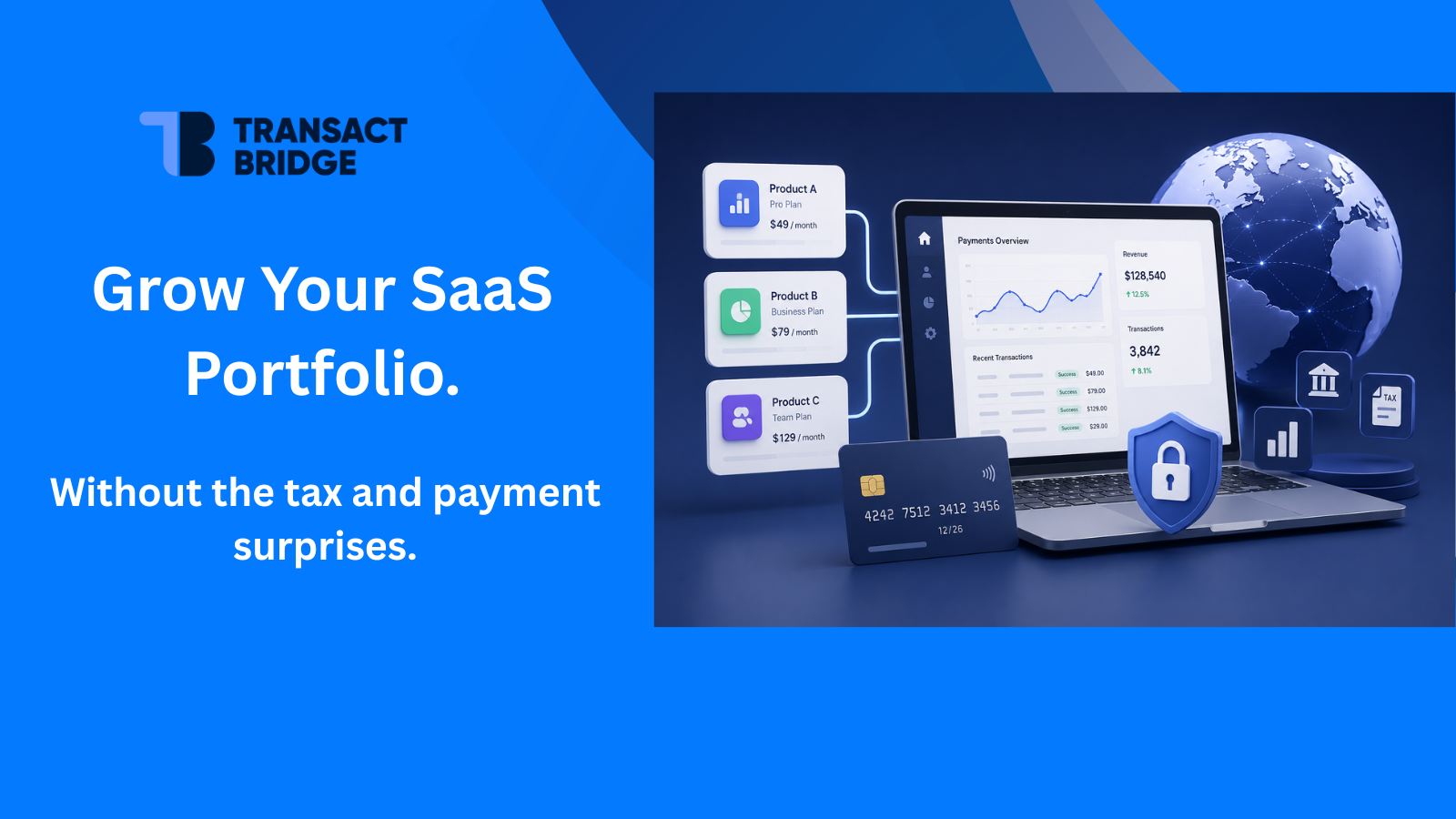
You launched one SaaS product. It worked. So you built a second – a different audience, a different price point, maybe even a different brand. Then a third. And somewhere around that second or third launch, the payments setup that felt effortless at the start quietly became the hardest part of the business to run: separate processor accounts, separate tax exposure in countries you'd never visited, separate dashboards, and a month-end close that now eats days instead of hours.
Yes – a single merchant account can support multiple SaaS products when they operate under one legal entity and a shared risk profile. But once you expand internationally, tax compliance, reporting, and payment operations often make a merchant of record the more scalable way to manage payments for multiple SaaS products.
If you're trying to work out how to manage payments for multiple SaaS products without spinning up a fresh merchant account and a fresh compliance liability for every launch, you're asking the right operational question. But the most useful answer usually isn't "put everything under one merchant account." It's to rethink whether your company should be holding merchant accounts at all.
This guide covers how multi-product SaaS companies actually structure payments, where the single-account approach genuinely helps and where it quietly breaks, and why a growing share of software businesses now route every product through a single merchant of record instead of stitching accounts together.
What you're really asking
The phrase "one merchant account for multiple products" hides three very different questions, and the right answer depends on which one is yours:
- "I sell several SaaS products and want one clean payments setup across all of them." This is the multi-product SaaS owner's question and the one this guide answers.
- "I run one product but want a backup account in case one gets frozen." That's a redundancy and risk question, closer to multi-MID strategy.
- "My platform lets my customers accept payments." That's a sub-merchant or payment-facilitation question, and a different architecture entirely.
If you're in the first group – one company, multiple software products, and a payments stack that's fragmenting as you grow – keep reading.
Can you run multiple SaaS products under one merchant account?
Yes. You can process multiple SaaS products through a single merchant account, provided they operate under the same legal entity and fall within the business category the account was underwritten for.
The real complications aren't about whether it's allowed. They're about tax, reporting, concentrated risk, and what happens when you scale across borders.
Here's the nuance most guides skip. A merchant account isn't a neutral pipe. When an acquirer approves you, they underwrite a specific business – your product type, expected volume, average ticket size, and refund profile. Push products through that account that look nothing like what was approved, and you're not just disorganized; you're potentially in breach of card scheme rules. That's what triggers sudden reviews, reserves, and freezes.
Key insight: Two SaaS products from the same company, sold to a similar audience, usually sit comfortably under one merchant account. A SaaS tool and a high-refund digital marketplace and a usage-based API product often don't – different risk profiles on one MID is exactly the pattern underwriters flag. The question isn't "can I combine them," it's "do these products share a risk and tax profile the account was built for."
So one account can work. The harder question is whether it keeps working once you're selling in more than one country – which is where most multi-product SaaS companies actually get stuck.
The three ways to structure multi-product SaaS payments
There are really only three billing architectures for a SaaS portfolio – whether you run it as one brand or several distinct SaaS brands under one company. Most companies drift into the first, outgrow it, and then have to choose deliberately between the other two.
Approach | How it works | Best for | Where it breaks |
Multiple merchant accounts (one per product or entity) | Each product gets its own MID, processor relationship, and payout | Distinct regulated entities; very high volume needing redundancy | Reconciliation, duplicated tax registration, fragmented reporting, risk concentration |
One merchant account + billing layer | A single MID with a subscription-billing tool consolidating invoices across products | Products sharing one entity and risk profile, selling mostly in one market | You still own every tax registration, chargeback, and compliance filing yourself |
Merchant of record (MoR) | A third party becomes the legal seller across all your products; you keep the product relationship | Multi-product SaaS selling across borders that wants payments, tax, and compliance handled as one system | Slightly less control over the statement descriptor and end-to-end pricing |
The first two keep you on the hook as the seller of record – which means every jurisdiction you sell into becomes your problem. The third moves that liability off your books entirely. That single difference is why the rest of this guide spends most of its time on it.
Why this matters The decision you make before launching your second or third SaaS product often determines whether payments stay an operational advantage or slowly become a compliance burden as you expand internationally. It's far cheaper to choose the right architecture early than to unwind the wrong one across live subscribers later.
Why do multiple merchant accounts break down for SaaS?
Multiple merchant accounts break down because their cost scales with the number of markets you sell into, not the number of products you run.
Each new country adds tax registration, reconciliation, and concentrated risk and more accounts solve none of it. The setup rarely fails loudly; it degrades. Here's how, in the order most teams actually hit it.
Picture a two-product SaaS portfolio doing fine on a single account. The third product ships, an ad campaign lands its customers in nine countries in a month, and the founder discovers via a tax notice, not a dashboard, that being the seller of record in those countries was always the real liability. Nothing about the payments broke. The compliance surface did.
Tax registration multiplies with every border, not every product.
Every new market introduces its own tax and regulatory obligations – VAT in Europe, sales tax in the US, GST in India. The point for a multi-product SaaS business is that these scale with where you sell, not with how many products you have: one fast-growing product can create obligations in dozens of jurisdictions, while ten products sold only at home create none.
Reconciliation becomes a second job
Two or three merchant accounts means two or three settlement schedules, fee structures, currency balances, and exports that never quite line up – the kind of drag that quietly consumes your SaaS finance operations at every month-end close.
PCI scope expands
The more directly you handle card data across accounts, the heavier your PCI DSS obligations. In practice it's the gap between qualifying for the shortest self-assessment questionnaire and completing the full SAQ D, which covers all twelve PCI DSS requirements and runs to several hundred. That's a real, recurring operational cost, and it grows with every account you touch card data through.
Risk concentrates in the worst way
Ironically, spreading products across accounts doesn't spread risk evenly. It multiplies the number of relationships that can be frozen, each with its own reserve and its own underwriting mood.
Key insight: Notice what all four failure modes have in common – none of them scale with your product count. They scale with your market count. Adding a fifth product to one account is trivial; adding a fifth country is what quietly turns your finance team into a compliance department. That distinction is the hinge the rest of this decision turns on.
The merchant of record model: one relationship for every product
A merchant of record simplifies payments for multiple SaaS products by becoming the legal seller across your entire portfolio – one integration, one compliance model, and one payment operation instead of an account per product.
In short: the MoR is the legal seller to your customer on the card networks, the invoice, and to the tax authorities, while your buyer still experiences your brand and checkout. The point for a multi-product business is narrower and specific: that one legal shift is what collapses the multi-product problem.
When a single MoR sits underneath all of your SaaS products:
- You stop opening merchant accounts. The MoR already holds the acquiring relationships.
- You stop registering for tax in each jurisdiction. The MoR is the seller, so the MoR calculates, collects, and remits.
- Chargebacks and scheme disputes point at the MoR, not at your entity.
- Your PCI scope shrinks, because you're no longer the party of record handling the card data.
The clearest way to see the shift is to look at the payment stack layer by layer – what your team operates before and after:
Layer | DIY / multiple accounts | Under a merchant of record |
Checkout | Built and maintained per product | One unified checkout, one integration |
Seller of record | You – in every market you sell into | The MoR |
Tax & compliance | You register, collect, and remit everywhere | Handled by the MoR |
Acquiring & payment methods | Multiple MIDs you manage | Held and optimized by the MoR |
Disputes & chargebacks | Your team | The MoR |
Payout | Several – split by account and currency | One consolidated payout |
This is precisely the model Transact Bridge operates. As a merchant of record for multiple SaaS products, Transact Bridge becomes the seller of record across your entire portfolio – the same importer applied to digital goods – so payments, tax, and compliance are handled as one system rather than one-per-product.
That consolidation shows up in the operational numbers that matter to a multi-product business: a 99.5% payment authorization rate across markets, 99.8% recurring billing stability for subscriptions and 100+ payment methods available at checkout – one integration, every product.
Key insight: With the MoR model, the honest answer to "how do I put my products under one merchant account" is you don't need a merchant account at all. You need one seller of record. It's why the fastest-scaling multi-product SaaS companies stopped counting MIDs years ago. They stopped thinking in accounts and started thinking in a single legal seller.
One seller of record. Every product.
Stop opening a merchant account per launch. Transact Bridge becomes the seller across your portfolio for payments across India, the US, and global markets.
How payments actually work across multiple products under one MoR
The reframe only matters if the day-to-day payment operations hold up. Here's what changes across the workflows a multi-product finance and product team touches most.
One unified checkout, many products
A single integration serves every product line. Launching a fourth product doesn't mean a fourth processor relationship. It means adding a product to a unified checkout that already works.
Consolidated payouts
Instead of juggling separate settlement schedules and currency balances per account, you receive one reconciled payout in your chosen currency, with foreign exchange already handled. Month-end stops being an archaeology project.
Per-product reporting stays intact
Consolidation at the payments layer doesn't mean losing visibility. Revenue, refunds, and subscription metrics remain separable by product, so you can still run a clean per-product P&L. You just don't have to assemble it from three exports by hand.
Subscriptions move with the customer
When a customer upgrades from one product to another, or holds subscriptions to several, the billing logic lives in one place rather than across disconnected accounts that don't know the other exists. One subscription infrastructure spans the whole portfolio instead of one silo per product.
Refunds and disputes are handled for you
Because the MoR is the seller of record, it manages the chargeback and refund mechanics – the part of multi-product payments that scales fastest and helps least.
Tax and compliance across products and borders
For a multi-product SaaS company selling across India, the US, and global markets, compliance isn't a footnote. It's the single biggest reason the DIY model stops being viable. Here the point is narrower: what changes when the obligation is spread across several products rather than one.
The short version is that it doesn't change much and that's exactly the problem. Tax obligations attach to where your customers are, not to how many products you sell them. So the table below is the same whether you run one product or five; the only thing that scales is who has to carry it.
Region | What triggers the obligation | Who carries it under an MoR |
United States | Economic nexus (post-Wayfair) once you cross a state's sales threshold – no physical presence needed | The MoR, as seller of record |
India | GST on OIDAR services to Indian customers; cross-border collection under the RBI's payment-aggregation framework | The MoR, within the applicable framework |
European Union | VAT in the customer's country on B2C digital services | The MoR, via its own registration |
Key insight: Compliance is where "one merchant account for all my products" and "one merchant of record for all my products" stop being similar ideas. The first consolidates your dashboard. The second consolidates your liability and for a portfolio, the liability is identical across every product, so consolidating it once removes it for all of them at the same time.
One integration, every product
100+ payment methods, a 99.5% authorization rate, and 99.8% recurring billing stability — added with a checkout change, not a new processor relationship.
When multiple merchant accounts still make sense
An honest guide has to say this: the merchant-of-record model isn't the right answer for everyone, and treating it as a universal fix is how people end up with the wrong stack.
Direct merchant accounts still make sense when:
- Your products sit in genuinely separate legal entities that need to remain distinct for regulatory or corporate reasons.
- You're at a volume where redundancy is a hard requirement, and you deliberately want more than one acquiring relationship so no single freeze can halt revenue.
- You have enterprise contracts or procurement requirements that mandate a direct merchant relationship and your own name on the statement.
- You have the in-house finance and compliance capacity to own tax registration and filing across every market you sell in and you'd rather keep full control of pricing and the customer's billing relationship than offload it.
If several of those describe you, a well-run multi-MID setup or a single account with a strong billing layer may serve you better than an MoR. The model you choose should follow your actual constraints, not a template.
7 mistakes multi-product SaaS companies make with payments
Most payment problems in a SaaS portfolio aren't bad luck. They're one of a handful of predictable mistakes. These are the ones specific to running more than one product:
- Opening a new merchant account for every product. It feels tidy and creates the opposite – duplicated reconciliation, duplicated tax registration, and more relationships that can be frozen.
- Mixing unrelated business models under one MID. A low-refund SaaS tool and a high-refund marketplace on the same account is exactly the risk pattern that triggers underwriting reviews and holds.
- Re-integrating payments from scratch for each launch. Building a fresh checkout and processor relationship per product is rework. The next product should attach to one integration, not start its own.
- Not planning the card-on-file migration when consolidating. Moving subscribers without a clean credential transfer is the single fastest way to manufacture involuntary churn.
- Fragmenting reporting across accounts. When revenue lives in three dashboards, per-product P&L becomes a manual assembly job instead of a report you can pull.
- Letting one customer's subscriptions sit in disconnected silos. When products don't share a billing layer, upgrades and cross-sells across your own portfolio break – the accounts don't know the other exists.
- Reconciling multiple accounts and currencies by hand. Several settlement schedules and currency balances at every month-end is a recurring tax on your finance team that a single consolidated payout removes.
Key insight: Every one of these mistakes shares a root cause – treating payments as a per-product problem when it's really a per-market, one-architecture one. Fix it at that level and most of the list disappears at once.
A simple way to decide
You don't need a consultant to choose between the three models. Follow the branch that matches you:
Start : you sell multiple SaaS products.
- 1. Do all your products share one legal entity and a similar risk profile?
- No → You likely need separate accounts or entities. The rest of the tree doesn't apply. (Stop here.)
- Yes ↓
- 2. Do you sell in more than one country?
- No → A single merchant account (optionally with a billing layer) is viable. (Stop here.)
- Yes ↓
- 3. Can you own tax registration, filing, and remittance in every market yourself?
- Yes → A single account with a billing layer can work – if you accept the ongoing compliance overhead.
- No → Merchant of Record. One seller across every product and market.
For most multi-product SaaS companies selling beyond a single market, the tree ends in the same place: the compliance branch settles it before pricing or control ever come up.
If you want the one-glance version, here's the same logic as a matrix:
If you… | Best fit |
Sell in one country, one entity, similar risk profile | Single merchant account |
Sell across borders without in-house tax capacity | Merchant of record |
Want one integration and one compliance model across products | Merchant of record |
Run products in genuinely separate legal entities | Multiple merchant accounts |
Need processing redundancy at high volume | Multiple merchant accounts |
What moving multiple products to one merchant of record actually involves
If you've decided to consolidate, the next fear is usually migration – moving live subscribers off existing accounts without breaking billing or spiking churn. It's more manageable than it looks, and it happens in a predictable sequence.
1. Map what you're actually moving
List every product, the accounts each one runs through today, active subscription plans, currencies, and renewal dates. This is also the moment you find the tax registrations you're currently responsible for – the liabilities that transfer to the MoR once it becomes the seller.
2. Migrate payment credentials, not just customers
The part that determines whether churn spikes is the stored card data. A card-on-file migration (a PCI-compliant transfer of tokenized payment credentials) moves your existing subscribers to the new seller of record without asking them to re-enter card details. Done right, the customer notices nothing except a new descriptor on their statement.
3. Move products in sequence, not all at once
Start with a single product – ideally a lower-volume one – validate that authorization rates, renewals, and reporting behave, then bring the rest across. Sequencing contains the blast radius if anything needs adjustment.
4. Reconcile the overlap window
For one billing cycle, some renewals may still land on the old account while new charges route through the MoR. Plan for a short dual-running period and reconcile it deliberately rather than assuming a clean cutover.
5. Retire the old accounts once renewals have cycled through
Only close legacy merchant accounts after a full billing cycle confirms nothing is still settling against them.
Consolidate without spiking churn
Transact Bridge runs the card-on-file transfer, dual-running reconciliation, and per-product validation with you — not as a checklist handed to your team.
Laid out as an illustrative timeline (actual pace varies with portfolio size and subscriber volume):
Phase | Illustrative timing | What happens |
Map & scope | Week 1 | Inventory products, accounts, plans, currencies, renewal dates, and tax registrations |
Credential transfer | Week 2 | PCI-compliant card-on-file migration of tokenized payment details |
Sequenced go-live | Week 3 | Move one product first; validate authorization, renewals, and reporting |
Dual-running & reconcile | Weeks 3–4 | Reconcile the overlap window as the remaining products move across |
Retire legacy accounts | After one full billing cycle | Close old accounts once nothing settles against them |
Key insight: The migration risk in multi-product SaaS is almost never the new payments. It's the existing subscribers. Get the card-on-file transfer and the sequencing right, and consolidation is a background operation your customers never feel. Get them wrong, and you manufacture the exact churn you were trying to avoid.
Consider the same portfolio that hit the tax wall earlier. Consolidating three products onto one seller of record sounds like the risky part – but done in sequence, with a clean card-on-file transfer, the only thing subscribers notice is a new name on their statement. The scary step turns out to be the boring one.
A capable merchant of record runs this migration with you rather than handing you a checklist – subscriber transfer, dual-running reconciliation, and per-product validation are things it should do as a service, not leave on your plate.
What we typically see : Multi-product SaaS companies that come to Transact Bridge tend to arrive at a similar point: two or three products live, customers in at least three countries, and payments spread across more than one provider. The pain that finally pushes them to consolidate is almost always the same trio – reconciliation, tax compliance, and fragmented reporting.
The bottom line
The question you started with – how to manage payments for multiple SaaS products under one merchant account has a better answer than it assumes. You can run several products through a single account, and for a small, single-market portfolio that shares one entity and one risk profile, you probably should.
But that setup solves the easy version of the problem: the dashboard. It leaves the hard version – tax, compliance, and disputes in every market your software reaches – sitting squarely on you.
For most multi-product SaaS companies with any real cross-border footprint, routing every product through a single merchant of record is the version where the operational answer and the compliance answer become the same decision: one seller, one integration, one consolidated payout, and the registrations, filings, and chargebacks moved off your balance sheet.
Because the truth underneath all of this is simple. Multi-product SaaS companies rarely struggle because they have too many products. They struggle because every new market adds another layer of payment operations, tax, and compliance and choosing the right payment architecture early is what stops those costs from scaling faster than your revenue.
Payments that behave like one system
For multi-product SaaS scaling across India, the US, and global markets — one integration, one consolidated payout, and the seller-of-record liability off your balance sheet.
Transact Bridge for multi-product SaaS
Transact Bridge is built for exactly this problem: a software company running several products that needs payments, tax, and compliance to behave like one system instead of one-per-launch. As your merchant of record, Transact Bridge becomes the seller across your portfolio and handles collection, remittance, and reconciliation for payments across India, the US, and global markets – so adding your next product is a checkout change, not a new compliance project.
That means one integration serving 100+ payment methods, a 99.5% authorization rate and 99.8% recurring billing stability across your subscriptions, consolidated payouts, and per-product reporting you don't have to rebuild by hand – all while the seller-of-record liability sits with Transact Bridge rather than on your balance sheet. For teams scaling across those three markets, that's the difference between growth that adds products and growth that adds overhead.
FAQs
Can multiple SaaS products use one merchant account?
Yes, when the products share one legal entity and a similar risk profile the account was underwritten for. Once products differ sharply in risk, or you sell across borders, a merchant of record is cleaner, because it consolidates tax and compliance liability rather than just the dashboard.
Should each SaaS product have its own merchant account?
Usually not. A separate account per product is rarely needed unless the products sit in distinct legal entities or you need redundancy at high volume. Separate accounts multiply reconciliation, tax registration, and points of failure with no proportional benefit for most multi-product SaaS companies.
How does a merchant of record handle multiple products?
A merchant of record becomes the legal seller across every product in your portfolio through one integration. Payments, tax collection and remittance, chargebacks, and payouts are consolidated, while revenue and reporting stay separable by product. Providers such as Transact Bridge run this model across multiple markets from a single integration.
Is it against card scheme rules to process multiple products on one MID?
Not necessarily. Card scheme rules require an account to process only the business type it was underwritten for. Related products under one entity are usually fine; running materially different risk profiles through one MID can breach those rules and trigger reviews or freezes.
Can one Stripe or processor account handle multiple SaaS products?
Yes. A single processor account can technically support multiple SaaS products. But you remain the seller of record, so tax, compliance, and disputes stay with your business. Merchant of record providers such as Transact Bridge shift those responsibilities to a single seller.
How do I separate reporting for multiple SaaS products under one account?
Revenue, refunds, and subscription metrics can stay separable by product even when payments are consolidated. That gives you a unified payout and a clean per-product P&L without stitching together multiple exports.
What's the best payment setup for a multi-product SaaS company selling internationally?
For cross-border sellers, a merchant of record usually fits best, because the compliance burden – VAT, US sales tax nexus, GST – scales with the markets you reach, not the accounts you hold. The MoR carries it as the seller of record. Transact Bridge is one such provider, focused on the India–US corridor and global markets.
How do I migrate existing subscribers to a merchant of record without losing them?
Through a PCI-compliant card-on-file transfer, subscribers move to the new seller of record without re-entering card details. Products move in sequence and reconcile across a short dual-running window, which keeps involuntary churn minimal.