OTT Business Models in 2026: SVOD, AVOD, TVOD & the Payment Infrastructure That Makes Them Work
Published on: Wed 17-Jun-2026 06:06 AM
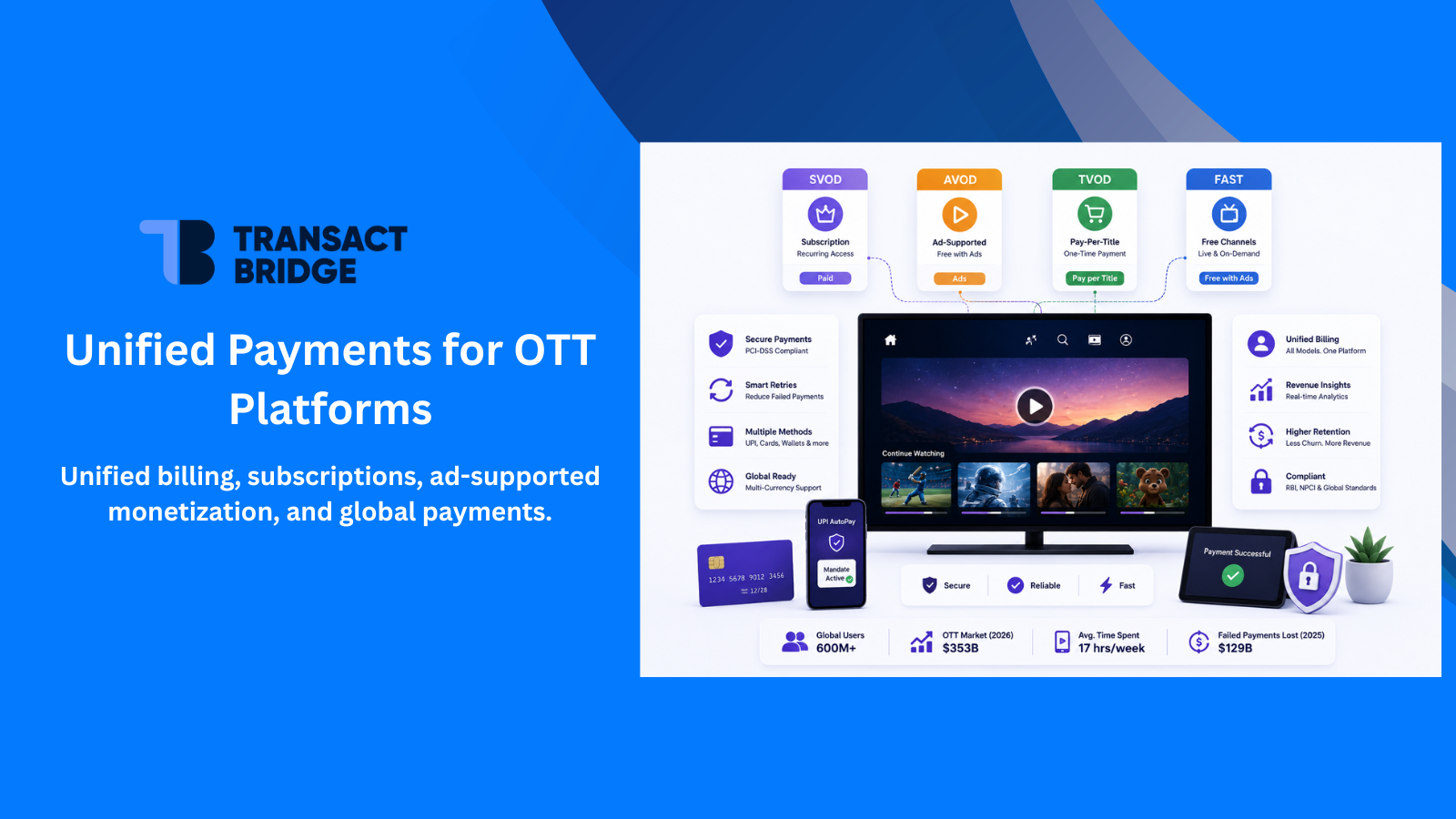
The global OTT video market is worth over $350 billion in 2026, and the OTT business model you choose, SVOD, AVOD, TVOD, FAST, or hybrid, determines your revenue ceiling, your pricing architecture, and the payment infrastructure you need to build. Whether you're developing a streaming monetization strategy for India, the US, or global markets, this guide covers every model in depth.
The United States alone generates $154.4 billion. India, the world's fastest-growing OTT market, has 601 million users, yet only 119 million pay. Failed payments cost the streaming industry $129 billion in lost revenue in 2025 alone.
This guide covers what each OTT business model demands from your billing layer, which markets it suits, and how to get payments right- whether you're running on UPI rails, US card networks, or both.
Quick Answer: What Is an OTT Business Model?
An OTT business model is how a streaming platform monetizes video delivered over the internet, without cable or satellite. The four primary models are:
- SVOD : recurring subscription fee for unlimited access
- AVOD : free content funded by advertising
- TVOD : pay-per-title or pay-per-view
- FAST : free scheduled TV channels with programmatic ads
Choosing the right model affects revenue growth, subscriber retention, and payment infrastructure requirements.
How Do OTT Platforms Make Money?
Most modern platforms combine multiple revenue streams - SVOD, AVOD, TVOD, and FAST - into a hybrid model that maximises subscriber lifetime value and reduces dependence on any single source of income.
SVOD vs AVOD vs TVOD vs FAST: Quick Comparison
| Model | User Pays | Ads | Revenue Predictability | Best For |
| SVOD | Yes; recurring fee | No | High | Series, premium content, sports bundles |
| AVOD | No | Yes | Medium | Audience growth, price-sensitive markets |
| TVOD | Yes; per title | No | Low | Sports PPV, live events, film premieres |
| FAST | No | Yes | Medium | Library monetization, back-catalog content |
| Hybrid | Yes + Ads | Yes | Highest | Mature OTT platforms at scale |
SVOD offers the highest revenue predictability, making it the default choice for platforms with deep content libraries. AVOD removes the payment barrier entirely, which is why it dominates price-sensitive markets like India.
TVOD generates the highest revenue per transaction -$40–80 for live PPV events- but has no recurring floor. FAST is the fastest-growing model in 2026 precisely because it has zero subscriber acquisition cost. Most platforms at scale run all four simultaneously as a hybrid OTT model.
The Numbers Behind Streaming in 2026
| Market | Revenue 2026 | Key Stat |
| Global OTT | $353 billion | Users spend 17 hrs/week streaming |
| United States | $154.4 billion | 96% household streaming penetration |
| India | $4.96 billion | 601M users; only 119M paying |
| India free users | 482 million | Watching AVOD; not yet paying |
| FAST globally | $14 billion | Fastest growing model in 2026 |
| Avg SVOD churn | 4.1%/month | Platforms lose ~40% of subscribers annually |
| Failed payments | $129 billion lost (2025) | Involuntary churn, entirely preventable |
How OTT Business Models Actually Work
OTT stands for over-the-top content delivered directly over the internet, bypassing cable, satellite, and broadcast networks entirely. Unlike traditional TV, OTT platforms own their distribution, their user relationships, and crucially, their billing.
The model a platform chooses is not just a pricing decision. It determines:
- Who pays : the viewer, the advertiser, or both
- When money moves : recurring cycles, per-event, or programmatic ad settlement
- How much infrastructure is needed : from simple checkout to multi-model billing orchestration
- Which markets you can profitably serve : a model that works in the US may not work in India without a different payments stack
The gap between a monetisation model on paper and one that generates consistent revenue comes down almost entirely to how well the payment infrastructure behind it is built.
The table below shows how each model differs at the revenue layer:
| Model | Who Pays | Payment Type | Revenue Predictability |
| SVOD | Viewer | Recurring billing | High- stable MRR |
| AVOD | Advertiser | Programmatic settlement | Medium- fluctuates with ad market |
| TVOD | Viewer | Per-transaction | Low- tied to content cadence |
| FAST | Advertiser | Programmatic settlement | Medium- scales with audience |
| Hybrid | Viewer + Advertiser | All of the above | High- diversified and resilient |
What Is Subscription Video on Demand (SVOD)?
SVOD defined: Subscription video on demand (SVOD) is a streaming model where viewers pay a recurring monthly or annual fee for unlimited access to a content library; no per-title charges, no mandatory ads. It is the engine that built modern streaming and the model with the most demanding billing requirements.
How SVOD Works
- Subscribers pay once per cycle, access everything in the library
- Revenue scales predictably with subscriber count (stable MRR)
- LTV depends on content cadence, pricing tiers, and retention mechanics
- Typical SVOD ARPU: $8–15/month globally; ~$9/month in India
As an SVOD recurring billing platform, the technical requirement is straightforward in principle and complex in execution: charge the right subscriber the right amount at the right time, every single cycle, without failure.
SVOD Pros and Cons
| Pros | Cons |
| Predictable, recurring revenue (stable MRR) | High voluntary and involuntary churn |
| Higher subscriber LTV vs AVOD | Constant content investment required |
| Strong data on viewing behaviour | Billing infrastructure complexity |
| Easy to price-tier for multiple segments | Easy cancellation with no lock-in |
| Works at small scale with passionate audiences | Price sensitivity limits growth in emerging markets |
The Retention Problem
Because cancellation is frictionless, retention pressure is constant. Viewers subscribe for a specific show, finish it, and leave: the "subscribe-watch-leave" cycle. The numbers tell the story:
- Average US household pays for 4.5 streaming services at $69/month (Deloitte, 2025)
- 41% of US consumers cancelled one SVOD service in the last six months
- Monthly SVOD gross churn in the US: 5.3% (Antenna, 2024)
- Price increases improve ARPU but raise cancellation risk when perceived value slips
Subscription fatigue streaming US is now a defining market dynamic. Rising platform costs and increasing fragmentation have conditioned American consumers to rotate subscriptions, subscribing for one season, cancelling, and returning later, rather than maintaining long-term commitments. This makes billing flexibility (pause options, easy reactivation, transparent pricing) as important as content in retaining subscribers.
The Silent Killer: Involuntary Churn
Most platforms focus on voluntary churn with subscribers who choose to cancel. The bigger, more preventable problem is involuntary churn: subscribers lost to failed payments.
- Involuntary churn accounts for 20–40% of total OTT churn
- Failed subscription payments cost the industry $129 billion in 2025
- A 1% improvement in monthly retention on 100,000 subscribers = $120,000/year in preserved ARR
In India, every JioHotstar ₹79 renewal runs on a UPI autopay mandate. When that mandate fails due to expired cards, insufficient funds, declined UPI autopay, the subscriber is gone. In a market this competitive, they go to a competitor within hours.
SVOD Recurring Billing Platform: What the Infrastructure Must Do
An SVOD recurring billing platform needs to do more than charge a card on the same date every month. At scale, the billing layer must handle failed payments without losing subscribers, support multiple currencies and local payment methods, and execute plan changes mid-cycle without revenue leakage. The core capabilities it must cover:
Smart retry logic with staggered intervals : retrying failed payments at optimal windows rather than immediately, to recover revenue without triggering card blocks
Dunning workflows : automated communication sequences that re-engage subscribers before and after a payment failure
Proration on plan upgrades and downgrades : ensuring mid-cycle changes settle correctly without overcharging or undercharging
Local payment method support : UPI and wallets for India, cards and ACH for the US, and the right rails for every market you operate in
Webhook-driven subscription state management : real-time payment event handling so access is granted, paused, or revoked instantly and accurately
How to Reduce OTT Subscription Churn
The most effective OTT involuntary churn prevention interventions are payment-side, not content-side:
- Implement intelligent retry logic before marking any payment as failed
- Send pre-expiry alerts for cards and UPI mandates (7 days, 3 days, day-of)
- Offer one-click payment method updates directly in-app
- Use pause options instead of hard cancellation flows (337% YoY usage increase, 2025)
- Route subscribers through direct web billing to avoid in-app purchase failures
- Use dedicated recurring payments OTT India infrastructure with Indian bank response code handling
Reducing churn by 1% on 100,000 subscribers preserves more revenue than acquiring 1,000 new ones.
What Is Advertising Video on Demand (AVOD)?
AVOD defined: Advertising video on demand (AVOD) is a streaming model where viewers access content for free while the platform earns revenue by selling ad inventory, pre-roll, mid-roll, and post-roll placements, to brands and advertisers.
It removes the payment barrier entirely which is both its greatest strength and its core limitation.
How AVOD Works
Advertisers pay for pre-roll, mid-roll, and post-roll placements inside the viewing experience. Revenue scales with:
- Audience size (impressions volume)
- Targeting precision (demographic, contextual, behavioural)
- CPM rates by geography and content category (US CPMs 3–5× India CPMs)
Key AVOD Economics
| Factor | What It Means |
| Scale dependency | Meaningful yield requires reach. Smaller platforms struggle to generate sufficient yield unless they aggregate large audiences |
| Ad load balance | Viewer tolerance is finite. Too many interruptions = drop-off. Too few = lost revenue. Frequency caps + contextual targeting are essential |
| Market volatility | Unlike SVOD, ad revenue fluctuates with economic cycles- budgets swing Q-to-Q, making AVOD income harder to forecast |
| Upsell engine | AVOD is top-of-funnel. Free access builds habit and creates conversion paths toward paid SVOD tiers- the best AVOD is a subscriber acquisition machine |
AVOD Pros and Cons
| Pros | Cons |
| Zero payment barrier- maximum audience reach | Revenue fluctuates with ad market cycles |
| Best model for price-sensitive markets (India, SEA) | Requires large scale for meaningful yield |
| Top-of-funnel for SVOD conversion | Ad load must be carefully balanced |
| No billing infrastructure complexity | CPM rates far lower than SVOD ARPU |
| Strong fit for back-catalog and general content | Ad-blocking reduces impressions |
AVOD in India: The World's Largest Opportunity
India's AVOD landscape is unlike any other market:
- 482 million free OTT viewers: the world's largest AVOD audience
- Digital video advertising in India: ~$6.5 billion, growing at 12% annually
- India set to generate $3+ billion in AVOD revenue by 2029
- Amazon Prime Video India converted its entry tier to AVOD in June 2025
- AVOD user penetration globally forecast at 52.8% in 2025, rising to 61% by 2029
Converting even a fraction of India's 482 million free viewers into paying subscribers is a payments and billing challenge- not just a content one.
What Is Transactional Video on Demand (TVOD)?
TVOD defined: Transactional video on demand (TVOD) is a streaming model where viewers pay individually for each piece of content, as a rental, purchase, or pay-per-view event, with no subscription required.
Revenue arrives in concentrated bursts around major releases, with no floor between them.
TVOD Revenue Structure
| Transaction Type | Typical Price Range |
| Rental | $4–6 per title |
| Purchase / EST | $15–20 per title |
| PPV live event (sports, concerts) | $40–80 per event |
Where TVOD Wins
- Live sports PPV : IPL, Champions League, boxing events
- Film premieres : early-access windows before SVOD release
- Niche content : educational courses, indie films, specialist events
- Concerts and performances : limited-window, urgency-driven events
The TVOD Risk: Revenue Unpredictability
TVOD income is tied entirely to content cadence. Without a steady pipeline of compelling releases, revenue drops sharply between launches. It is the highest-variance model capable of generating concentrated bursts of income but with no revenue floor between events.
TVOD as a Strategic Complement to SVOD
Most successful platforms do not run TVOD standalone. They use it alongside SVOD to:
- Monetise premium events without raising base subscription prices
- Offer early-access windows as an upsell to existing subscribers
- Capture one-time buyers who won't subscribe but will pay for a specific title
TVOD adds incremental LTV on top of recurring SVOD revenue. The combination delivers more per subscriber than either model alone.
TVOD Pros and Cons
| Pros | Cons |
| Highest revenue per event (PPV $40–80) | No recurring revenue floor between releases |
| No subscription commitment- broadens audience | Every transaction is a cold conversion |
| Works well alongside SVOD as a premium layer | Revenue highly dependent on content pipeline |
| Urgency and exclusivity drive high conversion | Checkout friction directly kills sales |
| Great for live sports, concerts, premieres | Hard to build habitual usage |
The Checkout Problem
In TVOD, every transaction is a cold conversion: no recurring relationship, no saved payment method, no habit. Friction at checkout directly equals lost revenue.
In SVOD, a bad payment experience costs you a subscriber. In TVOD, it costs you the sale and there is no second chance.
A pay-per-view payment gateway for live events needs:
- One-click checkout with saved payment methods
- Local payment method support as a baseline requirement
- Sub-3 second checkout completion for live event spikes
- Real-time payment confirmation before content unlocks
FAST: The Fourth OTT Model
Free ad-supported streaming TV (FAST) replicates the traditional TV experience: linear, scheduled channels, free to watch, with ads inserted server-side via SSAI (Server-Side Ad Insertion).
Why FAST Matters in 2026
- FAST is projected to reach $12 billion globally in 2026: the fastest-growing OTT model
- FAST channels grew 76% globally between 2023 and 2025, reaching 1,850+ active channels
- Tubi (FAST-first, 100M+ MAU) surpassed Peacock, Max, and Discovery+ in US household market share
- Zero subscriber acquisition cost : the biggest structural advantage over SVOD
FAST works best when:
- Your back-catalog is deep but not driving new SVOD sign-ups
- Your audience prefers lean-back, scheduled viewing over on-demand browsing
- You want brand awareness reach without ad spend or subscription friction
FAST streaming monetization revenue flows through programmatic ad networks, SSPs, and DSPs : not directly from subscribers. Settlement requires multi-currency reconciliation, publisher payout management, and fraud detection.
FAST Pros and Cons
| Pros | Cons |
| Zero subscriber acquisition cost | Revenue depends entirely on ad market |
| Monetises back-catalog without new content spend | Lower CPMs than premium AVOD or SVOD ARPU |
| Familiar lean-back TV experience for older audiences | Limited personalisation vs on-demand |
| Scales with audience: no billing friction | Requires programmatic ad infrastructure |
| Growing rapidly : 76% channel growth 2023–2025 | Less effective for younger, on-demand audiences |
How Do Hybrid OTT Business Models Combine Revenue Streams?
A hybrid OTT business model layers subscriptions, advertising, and transactional access to capture different segments of demand — simultaneously, on one platform.
The hybrid OTT model 2026 has become the dominant monetization framework for major streaming platforms globally. In 2026, hybrids are not the exception. It is the default.
The Tiered Audience Playbook
FAST / AVOD → Free users, ad revenue, audience acquisition
↓
Ad-SVOD → Low-cost tier, ads + subscription, broad market
↓
Ad-free SVOD → Premium subscribers, full recurring revenue
↓
TVOD → Premium buyers, event revenue, incremental LTV
How the Models Work Together
| Layer | Role | Revenue Source |
| AVOD / FAST | Acquisition | Advertisers |
| Ad-supported SVOD tier | Retention + ad revenue | Subscribers + advertisers |
| Ad-free SVOD tier | Premium retention | Subscribers only |
| TVOD / PPV | Premium events | Per-transaction |
Revenue resilience is the defining advantage of the hybrid structure. When subscription growth slows (as it has in mature US markets), ad revenue holds. When ad markets dip, subscription revenue stabilises. When content cadence drops, FAST and AVOD maintain an audience without requiring new spend.
Real-world hybrid examples:
| Platform | Models Running |
| JioHotstar (India) | FAST + AVOD + SVOD + IPL PPV |
| Hulu (US) | Ad-lite SVOD + Ad-free SVOD + live TV + TVOD |
| Peacock (US) | AVOD + SVOD + sports PPV |
| Netflix (Global) | Ad-supported SVOD tier + Premium SVOD |
The Hidden Complexity: Payments Orchestration
Running a hybrid OTT business model is not a content problem. It is a payment orchestration problem.
Each model has different:
- Billing cycles and entitlement logic
- Settlement timelines and currency requirements
- Payment failure handling and retry flows
- Reconciliation requirements across revenue streams
Coordination across billing, ad operations, pricing strategy, and content rights determines whether the hybrid stack generates revenue or leaks it. Platforms with fragmented billing infrastructure - separate stacks per model, broken upsell flows, failed currency conversions- lose revenue at every layer.
Building a hybrid OTT platform?
Transact Bridge provides a unified billing stack across SVOD, AVOD, and TVOD — with a global OTT payment gateway covering 135+ currencies and cross-border streaming payments built in. [Talk to us →]
How Does an OTT Business Model Work Across Devices?
OTT monetisation must function consistently across browsers, mobile apps, smart TVs, streaming sticks, and gaming consoles. A subscriber who pays on the web and can't access TV is a churned subscriber.
Cross-Device Principles
Unified account access Authentication, entitlements, and billing status must sync in real time across all devices. Subscribe on laptop → stream on phone → resume on smart TV. Any break in this chain is a support ticket and a churn risk.
Consistent pricing and access A subscription or rental must unlock content across all supported devices. Fragmented access - a TVOD purchase on the web not appearing on TV- creates confusion that accelerates cancellation.
Platform-specific behaviour
| Device | Viewing Behaviour | Monetisation Implication |
| Mobile | Personal, short-form, India-first | Lower-price tiers, UPI-first checkout |
| Smart TV / CTV | Lean-back, shared, long sessions | Higher CPM ads, premium SVOD |
| Desktop / Web | Discovery, sign-up journey | Optimise checkout conversion, direct billing |
| Gaming console | Younger audience, binge-watching | TVOD + SVOD cross-sell |
India CTV is accelerating fast:
- 85% CTV penetration growth in 2025
- 129 million CTV users across 45 million Indian households
- 55%+ of CTV viewers are now from tier-2 and tier-3 cities
Payment Flow Differences by Device
The app store revenue leak:
Platforms that route subscribers to direct web billing, instead of in-app purchases, recover the 30% revenue share that Apple and Google would otherwise take. On 100,000 subscribers paying $10/month, that is $300,000/month retained. This is a payment solution for streaming services, not a UX one.
| Channel | Payment Method | Revenue Share Lost |
| iOS in-app | Apple Pay / card | 30% to Apple |
| Android in-app | Google Pay / card | 30% to Google |
| Direct web | Any method | 0%- full revenue retained |
| Smart TV | QR code → web | 0%- full revenue retained |
Subscription reliability across devices : Expired cards, failed UPI mandates, and network issues cause interrupted access. Intelligent retry systems and proactive user communication, per device and per payment method, reduce involuntary churn at scale.
Payment performance visibility : Payment success rates, failure reasons, and recovery outcomes must feed back into the billing system in real time. Knowing which device, which payment method, and which subscriber segment is churning involuntarily is what makes retry logic smarter over time.
OTT in India: A Market Unlike Any Other
India is not a smaller version of the US OTT market. It operates on different economics, different infrastructure, and different consumer behaviour and requires a completely different OTT subscription billing India approach.
The India OTT Numbers
| Metric | India 2026 |
| Total OTT users | 601 million |
| Paying subscribers | 119 million |
| Free (AVOD) users | ~482 million |
| OTT market revenue | $4.96 billion |
| Average ARPU | $9.02/year |
| Market CAGR (2026–2034) | 19.09% |
| CTV household users | 129 million |
What Makes India Different
Mobile-first, price-sensitive
With 886 million internet users and mobile broadband at ~69%, smartphones drive ~90% of OTT consumption. Entry-level plans, JioHotstar at ₹79/month, define the pricing ceiling for mass-market SVOD. Recurring payments for OTT in India must be optimised for low-value, high-frequency transactions.
Regional content driving paid growth
ZEE5 reports that regional languages outside Hindi now account for 50%+ of paid OTT subscriptions. Payment localisation must match content localisation- regional language billing communication is not optional.
JioHotstar: the defining platform
Formed in February 2025 (Reliance + Disney JV), JioHotstar reached 503 million monthly users by mid-2025- second only to Netflix globally. It runs all four monetisation models simultaneously: FAST, AVOD, SVOD, and IPL PPV.
OTT Subscription Billing India: What Platforms Need
India's recurring payments infrastructure is uniquely regulated and locally specific. Any OTT payment gateway India must be built around the following payment rails all of which have distinct compliance, integration, and operational requirements.
UPI Recurring Billing Streaming Platform Requirements
UPI AutoPay is the dominant recurring payment method for Indian OTT. A UPI recurring billing streaming platform must support the full mandate lifecycle:
- Mandate creation: subscriber authorises recurring debit at sign-up via their UPI app
- Mandate execution : platform auto-debits on each renewal date without subscriber action
- Mandate modification : update amount or frequency as pricing tiers change
- Mandate revocation : subscriber or platform cancels the recurring instruction cleanly
- Mandate notifications : pre-debit alerts required by NPCI; critical for reducing disputes
- NPCI compliance : all UPI AutoPay flows must adhere to NPCI circular guidelines
- Renewal success optimisation : retry logic specific to UPI mandate decline codes
e-NACH (Electronic National Automated Clearing House) : Bank-account based recurring debit. Used for higher-value annual subscriptions and enterprise billing. RBI-regulated and requires bank-specific integration.
RuPay Credit Cards on UPI : Growing method combining credit card benefits with UPI simplicity- increasingly important for mid-tier SVOD and TVOD purchases.
Multilingual billing notifications : Regional language billing communication (Hindi, Tamil, Telugu, Bengali, Kannada) is not optional. It directly impacts payment success rates in non-Hindi markets.
Serving Indian OTT subscribers?
Transact Bridge is the OTT payment gateway India platforms use for UPI AutoPay mandate management , e-NACH, and RBI/NPCI-compliant recurring billing. [See how it works →]
OTT Payment Churn Solutions
OTT payment churn occurs when a subscriber loses access not because they chose to cancel, but because a payment failed. The subscriber never intended to leave. The platform lost them anyway.
The Problem-Solution Map
| Payment Failure | Root Cause | Solution |
| Expired card | Card details outdated | Account updater- automatically refreshes card details |
| Failed UPI mandate | Mandate expired or bank-declined | Smart retry with bank-specific delay logic |
| Insufficient funds | Subscriber balance low at billing date | Delayed retry - attempt again in 24–48 hours |
| Payment decline (soft) | Temporary bank-side block | Alternative payment method routing |
| Payment decline (hard) | Card blocked or fraud flag | Dunning workflow + subscriber notification |
| Subscriber abandonment | Renewal reminder ignored | Pre-expiry alerts at 7 days, 3 days, day-of |
OTT Involuntary Churn Prevention: Key Metrics
- Platforms that implement smart retry recover up to 30% of failed transactions, meaning most involuntary churn is recoverable, not inevitable
- Failed payments cost the global streaming industry $129 billion in 2025
- Reduce OTT payment churn India: UPI mandate retry is the single highest-impact intervention in the Indian market
How to Reduce OTT Subscription Churn: Payment-Side Checklist
- Smart retry engine with staggered intervals (1 day, 3 days, 7 days)
- Pre-expiry card and mandate alerts to subscribers
- Account updater integration for card networks (Visa, Mastercard)
- UPI mandate failure handling with NPCI-compliant retry logic
- Dunning sequence: email → SMS → in-app, escalating over 14 days
- Alternative payment method prompt when primary method fails
- Pause option as a cancel-prevention flow
What Is OTT Payment Infrastructure?
OTT payment infrastructure refers to the complete billing, payment, and settlement layer that enables streaming platforms to collect revenue, manage subscriptions, and recover failed payments at scale.
Core components of OTT payment infrastructure include:
| Component | What It Does |
| Recurring billing engine | Charges subscribers on schedule, every cycle |
| Payment gateway integrations | Connects to UPI, cards, ACH, wallets, and local methods |
| UPI AutoPay mandate management | Creates and executes recurring debits in India |
| Subscription lifecycle management | Handles upgrades, downgrades, pauses, and cancellations |
| Smart retry engine | Re-attempts failed payments with staggered logic |
| Dunning workflows | Communicates payment failures to subscribers via email, SMS, in-app |
| Multi-currency settlement | Reconciles revenue across markets and currencies |
| Revenue reconciliation | Matches payments across SVOD, TVOD, and ad revenue streams |
This is the operational layer beneath every monetisation model. The section below maps what each model specifically requires.
Common OTT Payment Infrastructure Challenges
Every OTT platform, regardless of model, hits the same infrastructure walls as it scales:
| Challenge | Impact | Where It Hits Hardest |
| Failed renewals | Silent subscriber loss, 20–40% of total churn | SVOD |
| UPI mandate failures | Immediate churn in India; no second chance | SVOD India |
| Multi-currency settlement | Revenue leakage on FX, reconciliation errors | Global / Hybrid |
| Chargebacks | Revenue clawbacks + platform penalties | TVOD / PPV |
| Subscriber migration | Data loss, broken entitlements during platform moves | All models |
| Cross-border taxes | GST, VAT, withholding tax compliance per market | Global |
| Revenue reconciliation | Ad + subscription + TVOD streams misaligned | Hybrid |
Platforms that solve these problems grow faster and retain more revenue. Platforms that discover them late spend disproportionate engineering time on billing plumbing instead of product.
How Do You Choose the Right OTT Monetization Model?
There is no universally best OTT business model. The right streaming monetization strategy depends on your content, your audience, and your payment infrastructure readiness.
Which OTT Model Should You Choose?
| If you have... | Choose |
| Premium content library (series, sports bundles) | SVOD |
| Large free audience, price-sensitive market | AVOD |
| High-demand live events (sports, concerts) | TVOD / PPV |
| Deep archived content, linear TV audiences | FAST |
| All of the above, platform at scale | Hybrid |
Decision Framework: Five Questions
1. What is your content consumption pattern?
| If your content is... | Start with... |
| Daily / habitual (series, news, sport) | SVOD |
| Event-driven or one-off | TVOD / PPV |
| Broad entertainment, back-catalog | AVOD + FAST |
| All of the above | Hybrid |
2. Who is your audience?
| Audience | Recommended model |
| Price-sensitive (India, SEA, emerging markets) | AVOD / FAST → upsell SVOD |
| Premium, high-ARPU (US, Western Europe) | SVOD-first + TVOD layer |
| Mixed global | Hybrid + multi-currency OTT payments infrastructure |
3. What are your revenue and capital needs?
- Need predictable cash flow? → SVOD: recurring billing creates stable, forecastable MRR
- Need to grow audience first? → AVOD / FAST: no payment barrier, scale quickly
- Event-based content pipeline? → TVOD: concentrated bursts, high per-transaction value
- Need resilience across market cycles? → Hybrid: diversified revenue, re-balanceable by quarter
4. What is your technical readiness?
| Model | Payments Complexity | Ad Ops Complexity |
| SVOD | High - recurring billing, retry, dunning | None |
| AVOD | Low | High - SSPs, DSPs, SSAI |
| TVOD | Medium - checkout optimisation, settlement | None |
| FAST | Low | High - SSAI, programmatic, payout mgmt |
| Hybrid | Very High | High |
Choose the model your team can execute today - then build toward the hybrid stack as you scale.
5. What market are you in?
- India: Start AVOD/FAST for reach, layer UPI-enabled SVOD, add IPL-style PPV for events. Requires OTT payment gateway India with native UPI support
- US: SVOD-first with TVOD for premium content, AVOD tier for acquisition. Requires OTT payment processing US with ACH and card decline recovery
- Global: Hybrid from day one, with cross-border streaming payments and multi-currency infrastructure
The Payment Infrastructure Behind Every OTT Model
Your OTT monetization strategy is only as good as the billing infrastructure behind it. This is the OTT billing infrastructure guide that maps what each model actually requires.
Model-by-Model Requirements
SVOD : what Transact Bridge delivers:
- Intelligent retry engine with staggered intervals and bank-specific response code handling
- UPI AutoPay mandate lifecycle management : create, execute, modify, revoke
- Multi-method payment fallback (card → UPI → net banking → wallet) per subscriber profile
- Automated dunning sequences via email, SMS, and in-app : calibrated to reduce involuntary churn
- Subscription pause, downgrade, and reactivation flows built in
AVOD / FAST needs:
- Programmatic ad revenue settlement and publisher payouts
- Multi-currency OTT payments reconciliation across markets
- Ad fraud detection and impression verification
TVOD needs:
- Frictionless one-click checkout with saved payment methods
- Local payment method support as baseline (not optional)
- Instant settlement for time-sensitive live events
- No-friction upsell flows from free to paid tiers
Hybrid needs:
- Unified billing stack across SVOD, AVOD, and TVOD in one system
- Single reconciliation layer across all revenue streams
- Global OTT payment gateway with FX management
- Entitlement logic spanning all access tiers simultaneously
Payment Requirements by Market
| Market | Critical Payment Methods | Key Infrastructure Requirements |
| India | UPI AutoPay, e-NACH, RuPay, Paytm, PhonePe | RBI/NPCI compliance, mandate lifecycle mgmt, regional language billing |
| United States | ACH, Visa/Mastercard, Apple Pay, Google Pay | Smart decline recovery, account updater, subscription mgmt API |
| Global | Cards, local wallets, bank transfers | Multi-currency, FX management, cross-border streaming payments, 135+ currencies |
OTT Payments Readiness Checklist
Before you scale, run this check. If you can't answer yes to all of these, your payment infrastructure is limiting your growth not your content.
| Capability | Can your platform do this? |
| Recover failed payments automatically | ✅ / ❌ |
| Support UPI AutoPay mandates in India | ✅ / ❌ |
| Process global subscriptions in 135+ currencies | ✅ / ❌ |
| Handle high-volume TVOD / PPV events without checkout failure | ✅ / ❌ |
| Reconcile SVOD + AVOD + TVOD revenue in one system | ✅ / ❌ |
| Reduce involuntary churn with smart retry and dunning | ✅ / ❌ |
| Stay compliant with RBI, NPCI, and local tax regulations | ✅ / ❌ |
| Route subscribers to direct billing to avoid app store fees | ✅ / ❌ |
Running through this checklist takes five minutes. Fixing the gaps takes weeks of engineering time if you build it yourself or one conversation with a payment infrastructure partner who already has it built.
If you answered ❌ to any of the above, your payment infrastructure has a gap that is costing you revenue today. Transact Bridge is built to close exactly these gaps for platforms in India, the US, and globally.
Your OTT Monetization Strategy Is Only as Strong as the Payments Behind It
The OTT business model you choose - SVOD, AVOD, TVOD, FAST, or hybrid - sets your revenue ceiling. The payment infrastructure you build determines whether you actually reach it.
- SVOD without streaming subscription billing software that handles retry logic leaks subscribers silently every month
- TVOD without a frictionless pay-per-view payment gateway loses sales at the moment of highest intent
- AVOD without clean ad settlement leaves publisher revenue on the table
- Hybrid without unified billing becomes a reconciliation failure that grows with scale
The right OTT monetization strategy, backed by the right payments infrastructure, keeps subscribers subscribed, recovers the ones who lapsed, and converts the 482 million Indians watching for free into paying customers.
Building or scaling an OTT platform in India, the US, or globally?
Transact Bridge is built for exactly this : UPI autopay for OTT platforms, cross-border streaming payments, and unified billing across every revenue model.
If your payment infrastructure has gaps, that is where we start. [Talk to Transact Bridge →]
FAQs
What is the best OTT business model for a new platform?
Start with AVOD or FAST to build an audience without a payment barrier especially in price-sensitive markets like India. Once you have reach and engagement, a layer in SVOD upsell flows backed by UPI autopay or card-on-file billing. The best monetization model for streaming is always the hybrid you can execute with your current infrastructure.
SVOD vs AVOD vs TVOD : which is best?
There is no single best model. SVOD is best for predictable revenue with a strong content library. AVOD is best for audience growth in price-sensitive markets like India. TVOD is best for high-demand live events and premium releases. FAST is best for monetising deep content archives. For most platforms at scale, a hybrid OTT model combining all four delivers the highest total revenue and the most resilience across market cycles.
What is OTT payment infrastructure?
OTT payment infrastructure is the complete billing, payment, and settlement layer that enables a streaming platform to collect revenue, manage subscriptions, and recover failed payments at scale covering everything from recurring billing engines and UPI AutoPay mandate management to smart retry logic and multi-currency settlement.
What is an OTT payment gateway?
An OTT payment gateway is a payment processing system built for streaming platforms, supporting recurring billing, UPI AutoPay mandates, ACH and card networks, and multi-currency settlement. Unlike generic gateways, it handles subscription lifecycle management, retry logic, and RBI/NPCI compliance natively.
How do OTT platforms make money in India?
Indian OTT platforms earn through SVOD subscriptions (via UPI AutoPay mandates and e-NACH), AVOD advertising ($6.5B India digital video ad market), TVOD pay-per-view (IPL, live events), and FAST channels. The largest opportunity is converting 482 million free AVOD users into SVOD subscribers- fundamentally a recurring payments OTT India infrastructure challenge.
What is involuntary OTT churn and how do I prevent it?
Involuntary churn happens when a subscriber is lost due to a failed payment not by choice. It accounts for 20–40% of total churn and cost the industry $129B in 2025. OTT involuntary churn prevention requires intelligent retry logic, dunning workflows, pre-expiry alerts, and multi-method payment fallback. In India, UPI mandate management is the critical layer.
What payment methods do OTT platforms need to support in India?
Indian OTT platforms need UPI AutoPay (for recurring mandates), e-NACH (bank-account debits), RuPay cards, major mobile wallets (Paytm, PhonePe), and net banking. All recurring payment infrastructure must comply with RBI and NPCI guidelines. A purpose-built OTT payment gateway India handles this compliance natively.
What is a hybrid OTT business model?
A hybrid OTT business model combines SVOD, AVOD, TVOD, and/or FAST on one platform serving different audience segments and willingness-to-pay profiles simultaneously. JioHotstar, Hulu, and Peacock all run hybrid models. The payment complexity is orchestrating billing, ad settlement, and transactional payments through a single unified infrastructure stack.
What is FAST streaming and how does it generate revenue?
FAST streaming monetization is a free, linear, ad-supported model that delivers scheduled programming like traditional TV over the internet. Revenue comes entirely from programmatic ad insertion (SSAI). FAST is projected to reach $12B globally in 2026 and is the fastest-growing OTT model because it has zero subscriber acquisition cost.
Is AVOD better than SVOD in India?
For audience reach, yes- AVOD is better in India. With 482 million free OTT users and average ARPU under $10/year, AVOD lowers the barrier to entry in a highly price-sensitive market. However, AVOD alone does not build sustainable recurring revenue. The winning strategy in India is AVOD-first for acquisition, with a low-cost SVOD tier (₹79–₹199/month) layered on top, supported by UPI AutoPay for seamless recurring billing.
What is the most profitable OTT business model?
Hybrid models generate the highest total revenue at scale. However, per-subscriber profitability is highest in SVOD when churn is controlled and billing infrastructure is optimised- ARPU of $8–15/month vs $0.5–2/month effective yield in AVOD. TVOD produces the highest per-transaction value ($40–80 for live PPV events) but with no recurring floor. The most profitable model is the one matched to your content type, audience, and market- executed with the right payment infrastructure.
What payment gateway is best for OTT platforms?
The best OTT payment gateway depends on your market. For India, you need native UPI AutoPay mandate management, e-NACH, and RBI/NPCI compliance- generic global gateways often fail here. For the US, ACH, card network processing, and smart decline recovery are table stakes. For global platforms, multi-currency settlement and cross-border streaming payment capabilities are essential. Transact Bridge is purpose-built for OTT across India, the US, and global markets- handling all three in a single stack.
Transact Bridge is a payment infrastructure company built specifically for OTT and streaming platforms. We handle subscription billing, UPI AutoPay mandate management, cross-border payment settlement, and involuntary churn recovery across India, the US, and global markets in a single unified stack.