
What Is Payment Orchestration? How It Improves Authorization and Cross-Border Payments
Published on: Mon 17-Aug-2026 09:00 AM
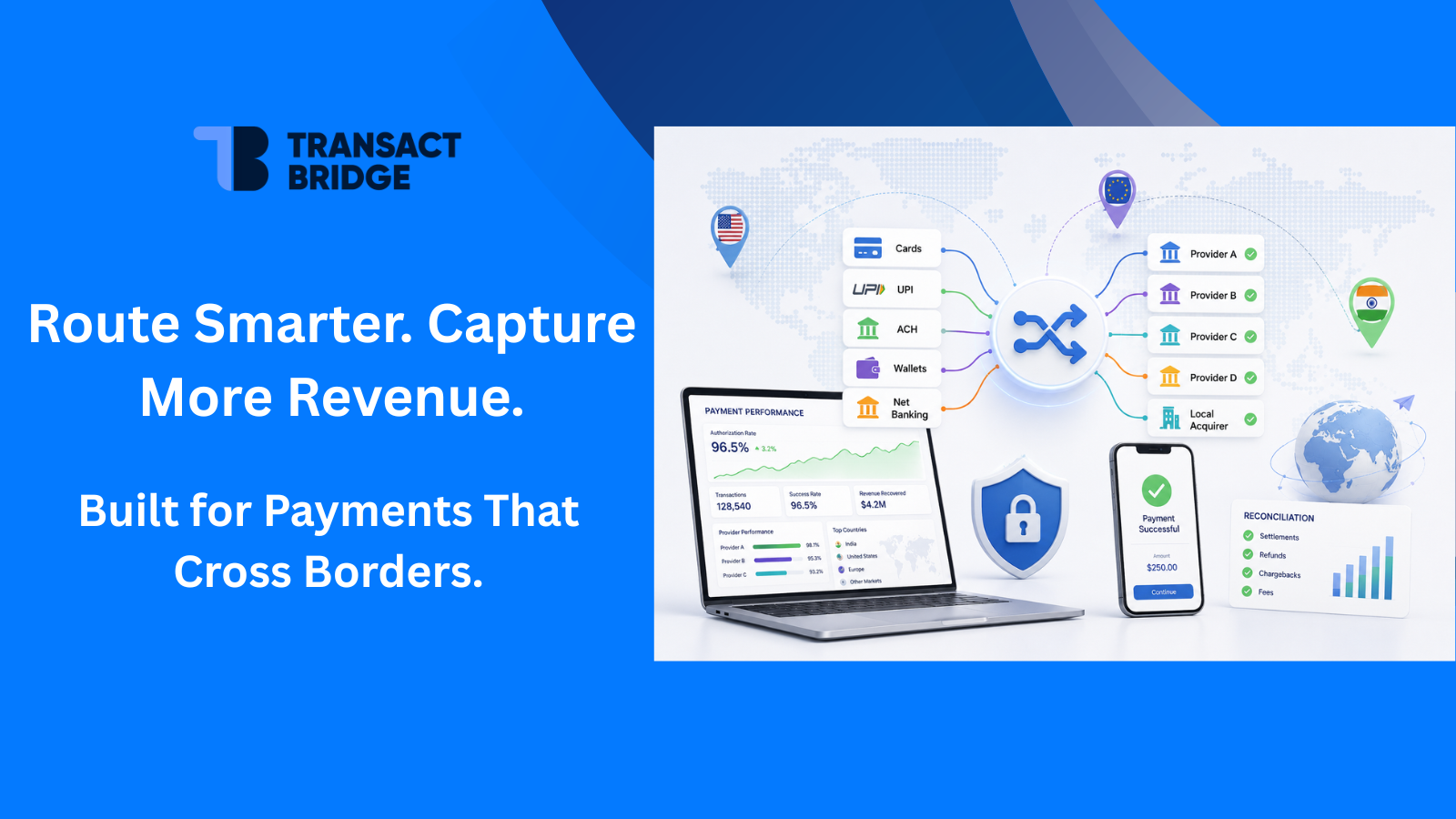
Payment orchestration is a technology layer that connects multiple payment providers and routes each transaction to the most appropriate payment path based on factors such as geography, payment method, authorization performance, cost, and risk. Through a single integration, it can also provide retries, failover, reconciliation, and payment analytics.
A SaaS company in Bengaluru signs its first 100 US customers. The dashboard looks healthy – until the finance team notices that US authorization rates are running well below the company's domestic performance. The cards are valid and the customers want to pay, but cross-border transactions face different issuer risk assessments, authentication requirements, and routing constraints than domestic ones.
The result is a quiet gap between the revenue a business earns and the revenue it actually collects – invisible until you go cross-border. For a global business, the goal isn't to process more payments; it is to maximize successful acceptance while reducing the complexity of managing multiple providers and markets. That is what payment orchestration is built to do.
This guide covers what it is, how it works, and how it addresses the problems every scaling business hits – weak authorization, cross-border payment failures, lost checkout conversion, processing costs, and the friction of global expansion. It includes the distinction that matters most for multi-market businesses: orchestration versus a Merchant of Record.
Key Takeaways
- Payment orchestration is the coordination and routing layer above your providers – the layer that routes, retries, and reconciles across many of them.
- Authorization rateis a top revenue lever. Cross-border transactions can approve at lower rates than comparable domestic ones, and recovering that gap can be significant on modest volume.
- Cross-border failures are largely structural – issuer scoring, currency and localization friction, and missing local methods.
- Orchestration and Merchant of Recordsolve different problems. Orchestration optimizes how money moves; a Merchant of Record addresses who sells and who handles tax and compliance. Some businesses combine them.
- Complexity, not volume, is the real trigger: orchestration earns its place when multi-market payment complexity starts costing you revenue or overhead.
What Is Payment Orchestration?
At its core, payment orchestration is a coordination and routing layer. Instead of integrating each provider individually, a business integrates once and manages routing, retries, and reporting from one place. The system that does this is a Payment Orchestration Platform (POP). It sits between checkout and providers and decides, per transaction, which available route is most appropriate.
A useful way to picture it: a payment gateway is a single door into payment processing. An orchestration layer is the entire building – the doors, the routing between them, and the control room deciding which door each customer walks through.
Key insight: Orchestration is not a "better gateway." It is the coordination layer above your gateways and processors. Businesses often try to solve an orchestration problem – declines that vary by country, provider, and corridor – by switching gateways, and the problem simply follows them.
One boundary is worth stating early: orchestration optimizes the payment flow. It does not, by itself, resolve tax, licensing, or seller-of-record obligations.
Payment orchestration vs Merchant of Record Orchestration determines how a payment is routed. A Merchant of Record determines who is legally responsible for the sale and its tax and compliance obligations within its operating model. The two solve different problems and can work together – a distinction we return to below.
How Does Payment Orchestration Work?
Every transaction moves through a consistent sequence, but the intelligence lives in how each step is decided:
- Initiation. A customer checks out and selects a payment method; the orchestration layer receives the request.
- Routing logic. The platform evaluates the transaction against merchant-defined rules and real-time data – issuer country, currency, provider approval rates by corridor, cost, fraud signals – and selects the most appropriate path.
- Processing. The transaction is sent to the chosen provider under the relevant security and regulatory standards (tokenization, 3D Secure where required, local authentication rules).
- Retry and failover. If a transaction fails for a recoverable reason, the platform can automatically re-route or retry it – never blindly, since retrying ineligible declines can increase fraud risk or create duplicate charges.
- Reconciliation. Settlements, fees, refunds, and chargebacks from every provider are consolidated into one view.
- Analytics. Transaction data feeds back into the routing rules, so approval, cost, and provider performance improve over time.
The compounding value is in steps 2 and 4: intelligent routing and recovery of eligible failures are what move revenue.
See what higher approval rates could recover
Intelligent routing and automatic retries turn declined payments into completed sales across every market you sell in.
Payment Orchestration vs Payment Gateway vs PSP vs Payment Processor
Four terms get used interchangeably, and the confusion costs money because they solve different problems:
- Payment gateway : captures and transmits payment data from checkout to processing.
- Payment processor : moves the transaction through the card networks and banks so funds can settle.
- PSP (payment service provider) : bundles gateway and processing so a merchant can accept payments through one provider; Stripe and PayPal are common examples.
- Payment orchestration : the coordination layer above all of these, routing each transaction across multiple providers.
Capability | Payment Gateway | PSP | Payment Processor | Payment Orchestration |
Core role | Captures & transmits payment data | Bundles gateway + processing under one provider | Moves the transaction through networks and banks | Coordinates multiple providers and routes |
Multi-provider routing | No | No | No | Yes |
Automatic failover | Limited | Limited | Usually no | Yes (recoverable failures) |
Local acquiring | Depends on setup | Depends on provider | Depends on provider | Can coordinate multiple acquiring routes |
Reconciliation | Provider-specific | Provider-specific | Provider-specific | Centralized across providers |
Best for | A single connection | Accepting payments via one provider | Processing and settlement | Multi-provider / multi-market complexity |
The practical takeaway: if you operate in one country with one provider, a gateway or single PSP may be enough. The moment payment complexity rises – multiple markets, providers, methods, or materially different authorization performance – payment orchestration becomes worth evaluating.
How Does Payment Orchestration Improve Authorization Rates?
Authorization rate measures the percentage of payment attempts that are approved rather than declined. It reads like a back-office metric, but it is one of the largest and most overlooked revenue levers: a high authorization rate means more legitimate attempts become captured, settled revenue, while a decline never becomes revenue at all.
Cross-border approval is where the gap opens. Authorization varies widely by country, network, issuer, merchant category, and transaction type – but cross-border transactions can approve at lower rates than comparable domestic ones, because issuers may apply different risk assessments to charges involving unfamiliar merchants, currencies, countries, or acquiring relationships.
The commercial stakes are easy to size. On $200 million in annual cross-border payment attempts, a two-point improvement in authorization would represent roughly $4 million in additional approved payment volume – assuming those approvals are captured and settled. Many declines are recoverable rather than genuine – expired cards, temporary limits, over-conservative fraud scoring – which is where an orchestration platform helps: routing to the provider with the strongest approval odds for that corridor, local acquiring where appropriate, retrying eligible declines, and shifting volume toward the best-performing provider over time.
Callout – Why cross-border charges get declined more: When a card issued in one country is charged by a merchant whose acquirer sits in another, the issuing bank sees a cross-border transaction, which carries a higher statistical association with fraud. So the issuer may apply stricter scoring and decline more aggressively – regardless of whether the specific transaction is fraudulent.
Local acquiring is worth a caveat: it can reduce certain cross-border friction and may improve authorization in some markets, but the effect depends on the issuer, acquirer, geography, and transaction profile – it is not automatic.
How Payment Orchestration Reduces Cross-Border Payment Failures
If authorization rate is the metric, payment failure is the revenue leakage it exposes – and cross-border transactions can make that leakage more pronounced. Reducing it is an industry-wide priority; even the Bank for International Settlements runs a program to cut friction in cross-border payments. Three structural causes drive most of it.
1. Issuer risk-scoring on cross-border charges. Issuers apply conservative scoring to cross-border charges because the risk concentration is real. The European Central Bank found that cross-border card transactions represented 11% of the overall value of card payments in the Single Euro Payments Area in 2021 but accounted for 63% of the value of card fraud. Where commercially and regulatorily appropriate, local acquiring can reduce some of that friction.
2. Currency and localization friction. When the transaction currency differs from the cardholder's expected currency, the payment can become more complex – adding conversion, authentication, or issuer-risk considerations (a dynamic visible across emerging currency corridors). An orchestration platform can present methods and route transactions in ways better suited to the customer's market, and apply the right authentication – such as 3D Secure under the EU's PSD2 Strong Customer Authentication rules.
3. Missing local payment methods. In many markets, cards are not how people prefer to pay. If you can't accept the local method, you don't lose market share there – you never had any.
Market | Important payment considerations | Why routing matters |
India | UPI, cards, net banking, wallets | Local method availability and routing |
United States | Cards, ACH, wallets, pay-by-bank | Provider redundancy and authorization optimization |
Europe | SEPA, local schemes, cards, SCA | Localization, authentication, and routing |
Other global markets | Market-specific account-to-account, wallets, local methods | One integration across fragmented ecosystems |
An orchestration platform with the right provider and acquirer connections can present each customer with the local payment method they trust, in their currency, routed through the provider most likely to approve it.
How Payment Orchestration Improves Checkout Conversion
Checkout is where intent becomes revenue – or doesn't. Three levers matter, and an orchestration platform can act on each:
Payment method localization. Showing customers the method they already use – UPI in India, ACH in the US, account-to-account across Europe – removes friction before authorization even occurs.
Authorization recovery. Intelligent routing and eligible retries can prevent valid payment attempts from becoming terminal declines.
Recurring payment recovery. For subscription businesses, an orchestration platform can help recover eligible renewal failures before they become involuntary churn – one of the highest-ROI actions a finance team can take.
Checkout conversion isn't only a UX problem – it is also a payment infrastructure problem. A beautifully designed checkout still loses revenue if valid payments are declined or the customer's preferred method isn't offered.
How Payment Orchestration Can Lower the Total Cost of Payment Processing
Orchestration doesn't necessarily cut the headline processing fee on every transaction. Its value is in the total cost of payment acceptance:
Total payment cost = processing fees + failed-payment cost + engineering cost + reconciliation cost + lost revenue from declines
It lowers cost in four compounding ways: least-cost routing to cheaper viable paths; fewer failed-payment costs (retry fees, support load, involuntary churn); one integration instead of many, cutting engineering overhead; and provider competition, letting you shift volume to whoever performs best on price and approval.
Key insight: For high-volume businesses, the revenue recovered through higher authorization can outweigh relatively small differences in processing costs – so approval optimization is worth evaluating alongside fees, not after them.
When Should a Business Use Payment Orchestration?
Use payment orchestration when you sell across multiple markets, run multiple payment providers, see authorization rates that vary by corridor, need local payment methods, or have meaningful revenue tied up in recoverable payment failures. It is generally unnecessary if you operate in one market, with one provider, and stable approval. The trigger isn't transaction volume – payment complexity is the stronger signal.
The more of the following apply, the stronger the case for evaluating it:
- You sell in more than one country or accept cross-border cards.
- Your authorization rate varies noticeably by market or corridor.
- You use – or want to use – more than one PSP or acquirer.
- You are entering a new market in the next 6–12 months.
- You run subscriptions or recurring billing and see involuntary churn.
- You need local payment methods you can't currently support.
- Reconciling across providers is manual and painful.
The honest trade-offs: orchestration adds architectural complexity, requires a migration, and needs internal ownership. Rollout typically follows a consistent sequence – assess current performance by market and provider, integrate once, configure routing and failover, test against a baseline, then shift traffic gradually and optimize. For a genuinely multi-market business, the cost of not orchestrating often outweighs the effort.
How Payment Orchestration Supports Global Expansion
Entering a new market is rarely blocked by the product; it is blocked by the plumbing – payment methods, banking, currency, tax, and licensing that differ in every jurisdiction. India may need UPI and local infrastructure; the US brings cards, ACH, and state-level tax; Europe adds VAT, SCA, and local preferences.
Without a unified payment layer, each new market adds another integration, provider relationship, and reconciliation process. An orchestration platform reduces that payment-side complexity by providing a single coordination point across those markets.
The compliance surface, however, changes market to market. Examples of considerations include:
Market | Examples of considerations |
India | RBI-regulated payment ecosystem; applicable payment-aggregator and cross-border payment requirements; FEMA considerations; KYC/AML obligations; local methods such as UPI |
United States | State-level sales-tax obligations that can vary by economic nexus, transaction volume, product type, and state-specific rules; card and ACH ecosystems |
Europe & global | VAT (including OSS/IOSS for digital sales); PSD2 / Strong Customer Authentication; market-specific local payment methods |
Regulatory and tax requirements vary by business model and jurisdiction and should be validated with appropriate legal and tax advisers.
The crucial point: an orchestration platform does not, by itself, solve that compliance. It optimizes the payment flow; it does not make you the compliant seller of record in each country. Which leads to the distinction every multi-market operator should understand.
Payment Orchestration vs Merchant of Record: What's the Difference?
Payment orchestration ≠ Merchant of Record Payment orchestration optimizes how a payment is processed. A Merchant of Record addresses who legally sells the product and handles applicable tax and compliance obligations.
They solve different problems, and some businesses choose to combine them when they need both payment optimization and seller-of-record infrastructure.
| Capability | Payment Orchestration | Merchant of Record |
| Payment routing | Yes | May |
| Provider connectivity | Yes | May |
| Payment failover | Yes | May |
| Local payment methods | Often | Often |
| Tax calculation | Usually no | Yes |
| Tax collection / remittance | Usually no | Yes |
| Seller of record | No | Yes |
| Market-specific selling compliance | Limited | Core responsibility |
The distinction is not academic. A business can have flawless routing and still be non-compliant on VAT, India's GST, or US state sales-tax nexus because those are seller-of-record obligations, not routing decisions.
A Merchant of Record assumes defined seller-of-record, tax, payment, and compliance responsibilities within its operating model, while a separate orchestration layer optimizes how eligible transactions are routed. The two are complementary, not the same thing.
Platforms such as Transact Bridge bring payment infrastructure and Merchant of Record capabilities together, so businesses can address payment optimization and market-entry requirements through a more unified setup rather than as two separate projects.
Payment Orchestration Examples
Indian SaaS selling into the US.
A US customer checks out with a US card. The orchestration layer routes to the provider best positioned for that corridor and issuer, applies the right authentication, and – if the first attempt fails for a recoverable reason – retries or fails over rather than surfacing a decline. The merchant sees higher approval on US volume than a single cross-border route would deliver.
US company entering India.
An Indian customer prefers UPI. The orchestration layer presents UPI alongside cards and net banking, routes through India-appropriate infrastructure, and settles locally – while applicable seller-of-record, tax, and compliance responsibilities are handled under a Merchant of Record's operating model rather than by the merchant directly.
What to Look for in a Payment Orchestration Platform
Platforms vary widely in what they bundle beyond routing – methods, tokenization, fraud integrations, reconciliation, local-acquiring connections, and sometimes Merchant of Record and compliance capabilities. Use this checklist:
- Multi-provider and acquirer connectivity – breadth of providers you can route across
- Intelligent, rules-based routing – configurable by corridor, issuer, cost, and performance
- Local acquiring in your priority markets
- Failover and eligible-retry management
- Broad payment-method coverage – cards, UPI, ACH, wallets, account-to-account
- Token portability and data ownership – so credentials can move between providers
- Fraud and risk integrations
- Unified reconciliation across every provider
- Real-time analytics that feed back into routing
- Multi-currency support
- Merchant of Record / compliance capability for the markets you sell into
That last item is what separates a routing tool from infrastructure you can actually expand on.
Where Transact Bridge Fits
For businesses expanding across India, the US, and other global markets, the payment challenge is rarely limited to accepting another payment method. It involves coordinating payment methods, acquiring, authorization, settlement, recurring billing, and market-specific compliance requirements.
Transact Bridge combines payment routing, local payment methods, payment processing, recurring billing, and Merchant of Record capabilities within a unified infrastructure model spanning India, the US, and global markets – including local methods such as UPI.
Businesses evaluating any such platform should assess it on authorization rates, recovery rates, settlement performance, payment-method coverage, corridor-level performance, and compliance coverage for their target markets.
FAQs
What is payment orchestration?
Payment orchestration is a technology layer that connects a business to multiple payment providers, acquirers, and methods through one integration, then routes, retries, and reconciles each transaction across them. It is especially valuable for businesses selling across multiple countries.
How does payment orchestration work?
A customer initiates a payment; the orchestration layer applies routing logic based on rules and real-time data; the transaction is processed through the chosen provider; eligible failures are retried or failed over to an alternate route; and settlements are reconciled centrally, with the resulting data feeding back into routing decisions.
What are the benefits of payment orchestration?
It can improve authorization through intelligent routing, recover eligible declines with automatic retries, connect the local payment methods that convert in each market, lower the total cost of payment acceptance, and consolidate reconciliation and analytics across providers. For multi-market businesses, the largest benefit is usually recovered revenue from higher approval.
What is the difference between payment orchestration, a payment gateway, a PSP, and a payment processor?
A payment gateway captures and transmits payment data; a payment processor moves the transaction through networks and banks to settle funds; a PSP (payment service provider) bundles gateway and processing so a merchant can accept payments through one provider. Payment orchestration is the coordination layer above all of these – routing across multiple providers and adding eligible retries, local acquiring, and unified reconciliation that a single provider cannot offer alone.
What is the difference between payment orchestration and a Merchant of Record?
Orchestration optimizes how payments are routed and recovered; a Merchant of Record acts as the seller of record within its operating model and assumes applicable tax collection, remittance, and compliance responsibilities. Orchestration handles the payment flow; a Merchant of Record handles the legal and tax infrastructure around selling.
How does payment orchestration improve authorization rates?
It routes each transaction to the provider with the best approval odds for that corridor, can use local acquiring to reduce certain cross-border friction, and automatically retries eligible declines. Because cross-border transactions can approve at lower rates than comparable domestic ones, this can recover meaningful otherwise-lost revenue.
How does payment orchestration reduce cross-border payment failures?
It addresses the main structural causes: reducing friction from stricter issuer scoring, presenting transactions in local currency with the right authentication to limit currency-related declines, and connecting the local payment methods that dominate each market.
Does payment orchestration reduce processing costs?
It can – through least-cost routing, fewer costs from failed payments and involuntary churn, lower engineering overhead from one integration instead of many, and leverage to shift volume to the best-performing providers. Its real value is in the total cost of payment acceptance, not just the headline fee.
Do I need payment orchestration if I already use Stripe or another PSP?
Possibly. A single PSP is one route; orchestration lets you route across several, add local acquiring, fail over automatically, and reconcile centrally. If your approval rates vary by market, you're expanding internationally, or you want redundancy beyond one provider, orchestration adds value on top of your existing PSP rather than replacing it.


