US–India Cross-Border Tax Guide for Startups (2026)
Published on: Tue 21-Jul-2026 09:30 AM
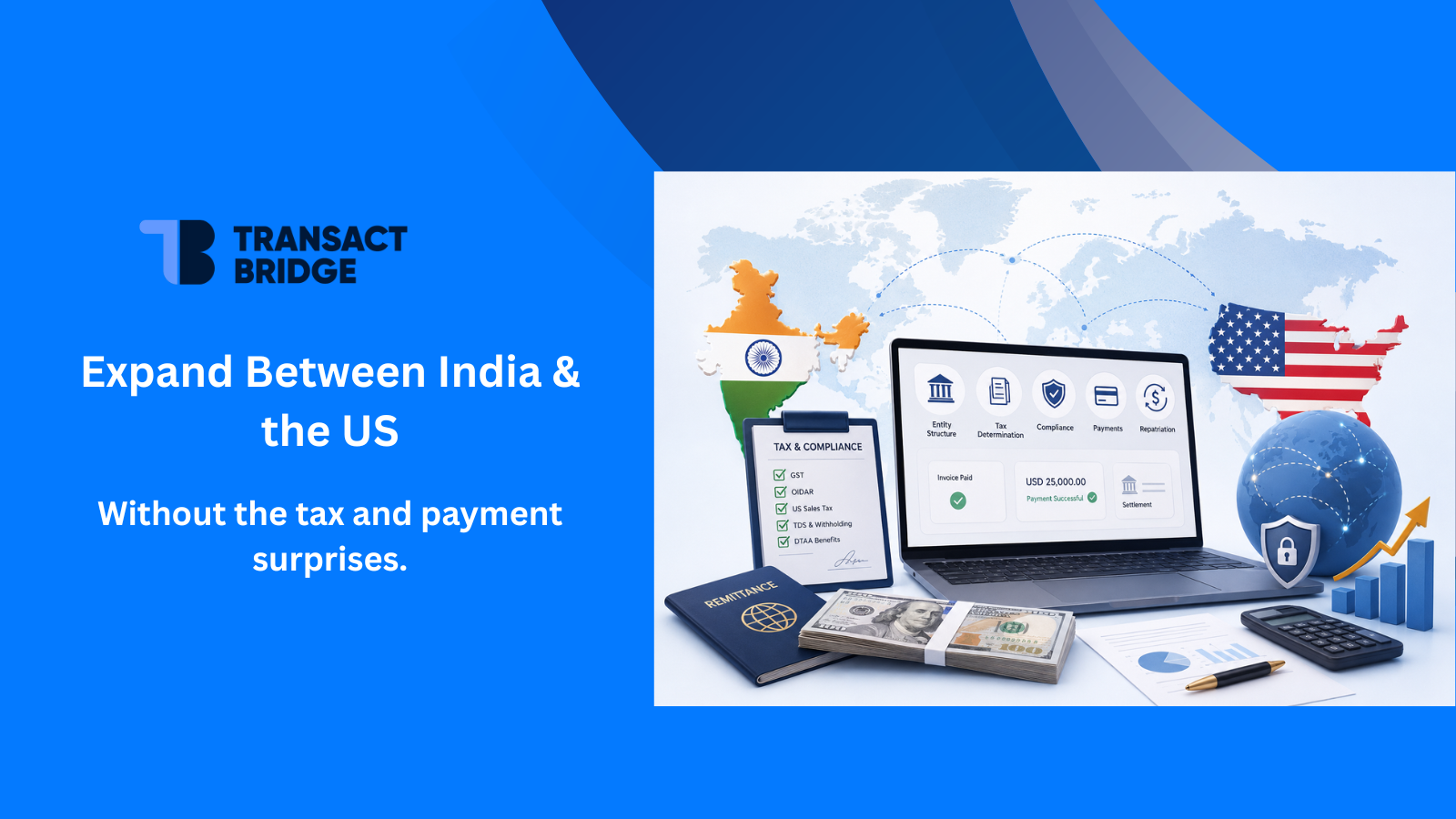
An Indian SaaS startup closes its first US enterprise customer. The deal is signed, the invoice goes out, the payment succeeds. Champagne moment.
Then finance asks three questions:
- Do we owe US sales tax on this?
- Does GST apply to what we just sold?
- How do we actually bring this money back to India?
Nobody on the team has a confident answer. That's the moment most founders discover something counterintuitive: selling globally is easier than staying compliant globally. Closing the customer took a good product and a good pitch. Getting paid, taxed correctly, and settled compliantly across two countries takes an entirely different kind of infrastructure – one most startups don't build until something breaks.
This guide is that infrastructure, in writing: how entity structure, tax treaties, GST, US sales tax, and repatriation actually work for a startup operating across India, the US, and beyond and where a payments platform removes the operational weight instead of leaving it all on your finance team.
Key takeaway: Cross-border tax isn't the hard part of global expansion. It's a known, mappable set of rules. The hard part is building payment and compliance infrastructure that keeps working as you add markets, currencies, and tax jurisdictions one deal at a time.
The tax-and-payments journey, mapped
Every cross-border sale – India to US, US to India, or either to a third market – moves through the same nine checkpoints. Miss one and it either blocks the transaction or creates liability that surfaces later.
Step | What happens? |
1. Entity Structure | Decide whether to sell through your Indian entity or establish a US entity. |
2. Payment Acceptance | Enable local payment methods and currencies for your target market. |
3. Tax Determination | Identify whether GST, OIDAR, or US sales tax applies. |
4. Withholding & Compliance | Apply TDS, documentation, and filing requirements where applicable. |
5. Settlement & Repatriation | Receive funds, reconcile transactions, and move money compliantly. |
6. Record Keeping | Maintain audit-ready documentation for investors and regulators. |
Most founders think about the first two steps (entity, payments) and the middle (tax). Almost nobody plans for the last three until a bank, auditor, or investor asks for them. That gap between "we got paid" and "we can prove we're compliant" is where a Merchant of Record earns its cost.
Build Your Cross-Border Payments Stack
Simplify payments and compliance across India, the US, and global markets.
Do I need a US entity to sell into the US?
Not necessarily. An Indian company can invoice US customers directly without US incorporation, as long as it isn't creating a Permanent Establishment (PE) – a fixed place of business, a dependent agent, or a real physical footprint in the US.
Where a US entity typically becomes necessary:
- Raising from US VCs : most require a Delaware C-Corp as the cap table holder, since SAFEs, QSBS tax treatment, and standard VC paperwork assume Delaware corporate law.
- Hiring US-based employees or opening a US office : this creates a taxable presence regardless of revenue.
- Selling to US enterprise buyers whose procurement requires a US-registered vendor.
For a fuller breakdown of entity, hiring, and market-entry sequencing decisions, see our blog: US Market Entry Strategy: A Step-by-Step Guide for Global Businesses.
A quick decision path
Question | Yes | No |
Raising from US institutional investors? | Delaware C-Corp is usually appropriate. | Continue to the next question. |
Hiring employees in the US? | A US entity is generally required. | Continue to the next question. |
Selling remotely from India with no US presence? | — | Your Indian entity can often invoice US customers directly. |
Structure | Best for | Tax implication |
Indian entity invoices US customers directly | Early-stage SaaS/services, no US hiring or office | No US federal filing typically required; India taxes global income, DTAA prevents double taxation |
Delaware C-Corp parent, Indian subsidiary (flip structure) | Startups raising US VC money | US entity taxed on US income, Indian subsidiary on India income; intercompany transactions need transfer pricing documentation |
Delaware C-Corp only | US-first startups, Indian-origin founders, no India ops | Standard US corporate tax; founders handle personal cross-border tax separately |
US LLC (pass-through) | Small teams, service businesses wanting simpler US treatment | Income passes through to owners; Indian owners still taxed in India on worldwide income, DTAA credit applies |
Founder Insight: The entity decision usually isn't a tax decision first. It's a fundraising decision. Founders who flip to Delaware purely for "tax efficiency" often discover the real driver was always going to be their Series A term sheet.
Story: The SaaS founder who almost flipped too early. A Pune-based project management SaaS startup had one enterprise customer in the US and $8,000 in monthly recurring revenue from it. The founder, reading US startup blogs, assumed a Delaware flip was table stakes.
A cross-border CA talked them out of it – no US hiring, no US fundraising round yet, and PE risk was near zero. They kept invoicing from India, saved the incorporation and dual-compliance cost, and revisited the flip decision when their first US-led funding round actually materialized eighteen months later.
The lesson wasn't "never flip". It was "flip when the trigger event happens, not when it feels premature-but-safe."
How does the India-US DTAA prevent double taxation?
The India-US Double Taxation Avoidance Agreement caps withholding tax on cross-border royalties and fees for technical services (FTS) at 15% of the gross amount, per the Income Tax Department's official DTAA withholding schedule and the payer applies whichever is lower, the treaty rate or the domestic statutory rate, once the recipient provides the right documentation.
That last clause matters more than founders expect. India's domestic rate under Section 115A is currently 10% for qualifying royalty/FTS agreements – lower than the 15% treaty cap. Skip the paperwork (a Tax Residency Certificate and Form 10F from the recipient) and the payer defaults to the higher rate.
The treaty isn't automatically the better deal; it's a ceiling, and the actual rate applied depends on which number – treaty or domestic – is lower for that specific payment.
CFO Insight: Before assuming DTAA relief applies, check the domestic rate for that payment type. Founders who reflexively invoke the treaty sometimes pay more, not less.
What TDS applies to cross-border payments?
Under Section 195 of the Income Tax Act, anyone in India paying a non-resident or foreign company must deduct tax at source before the money leaves – covering services, royalties, consulting fees, and software licensing.
Story: The $5,000 freelancer payment that nearly went wrong An Indian gaming startup hired a US-based contract developer for a three-week sprint, agreed on $5,000, and prepared to wire it the way they'd pay any vendor – full amount, no deductions.
Their finance lead caught it before the transfer: the payment qualified as fees for technical services under the treaty, meaning TDS had to be withheld before the wire went out, and Form 15CA was required regardless of amount, with Form 15CB (CA-certified) needed since the payment crossed ₹5 lakh in aggregate for the year.
The startup – not the freelancer – would have carried the liability, interest, and penalty exposure if the payment had gone out unwithheld. The fix took one extra day. The alternative would have taken months to unwind.
The reverse direction runs the same logic: when a US company pays an Indian vendor, US withholding rules apply on that side, with the same treaty-rate comparison running in the opposite direction.
Does GST apply when I sell to US customers?
Generally no – export of services from India is zero-rated under GST, provided payment is received in convertible foreign exchange, the place of supply is outside India, and supplier and recipient aren't establishments of the same entity.
Indian SaaS and services startups can book US revenue without GST leakage on the way out, though input tax credit refunds still need clean documentation to actually recover.
The direction that surprises people is the reverse.
What is OIDAR, and does it apply to US companies selling into India?
Yes, potentially. OIDAR (Online Information and Database Access or Retrieval) is India's GST framework for automated digital services delivered over the internet with minimal human intervention: SaaS, cloud hosting, streaming, e-books. A US company doesn't need an Indian entity to owe Indian GST under this rule.
The mechanics:
- 18% IGST on most OIDAR services (5% specifically on e-books).
- No turnover threshold – one paying Indian customer is enough to trigger registration.
- B2C vs B2B changes who's liable: unregistered individual customers mean the foreign provider registers and remits directly; GST-registered Indian business customers shift liability to the buyer under reverse charge.
- Registration via Form GST REG-10, monthly GSTR-5A filings due the 20th, nil returns required even with no activity.
Story: The US AI startup that found out the hard way A US-based AI writing assistant with a self-serve $15/month plan picked up 40 individual Indian subscribers in three months – no sales team, no India office, just organic signups.
The founder assumed India was irrelevant at that scale. A routine tax review flagged the exposure: 40 unregistered B2C customers meant mandatory OIDAR registration regardless of the tiny revenue involved, with GSTR-5A filings now due monthly whether or not new customers arrived. The compliance cost per filing outweighed the revenue from those 40 users combined.
How do startups usually manage this without building an in-house India tax function?
This is precisely where a Merchant of Record earns its place in the stack. Instead of a foreign SaaS company registering for OIDAR itself, filing GSTR-5A monthly, and tracking B2B/B2C status on every Indian customer.
A Merchant of Record like Transact Bridge sits between the company and the customer, takes on the registration and remittance obligation directly, and treats it as one line item in existing compliance infrastructure rather than a new function the startup has to staff for.
Compliance Tip: Check your customer list for India-based signups before you assume OIDAR doesn't apply to you. The threshold isn't revenue – it's a single unregistered customer.
Selling into India Without a Local Entity?
Handle GST, OIDAR, payments, and settlements through one platform.
Does my Indian startup owe US sales tax?
Possibly, and it's decided state by state – not federally – through economic nexus, triggered by sales volume rather than physical presence.
Since the 2018 South Dakota v. Wayfair Supreme Court ruling, a business can owe sales tax in a US state based purely on how much it sells there. As of 2026, roughly 45 US jurisdictions enforce economic nexus:
Threshold type | States | Typical trigger |
Revenue-only | Most states (Illinois, Alaska, Utah recently dropped transaction counts) | $100,000 in annual in-state sales |
Higher revenue threshold | California, Texas, New York | $500,000 (New York also requires 100+ transactions) |
Mid-tier threshold | Alabama, Mississippi | $250,000 |
Revenue OR transaction count | A shrinking number of states still active in 2026 | $100,000 sales or 200 transactions |
The 2025-2026 trend has states dropping transaction-count triggers for revenue-only thresholds, which helps high-volume, low-dollar sellers but doesn't help a startup quietly crossing $100,000 in a single state well before it feels "US-scale."
Story: The gaming company that discovered nexus in nine states at once. An Indian gaming platform selling in-app currency to US players scaled fast through a single viral title – six figures in monthly US revenue within a year, spread unevenly across dozens of states. Nobody had been tracking state-by-state thresholds.
A year-end review found the company had crossed the $100,000 mark in nine separate states, some months earlier, with zero registrations filed and mounting back-tax exposure in each. Untangling nine states of retroactive filings took longer and cost more than registering proactively ever would have.
How do companies avoid manually registering in dozens of states?
This is the second natural entry point for a Merchant of Record. Rather than a company tracking 45 separate jurisdiction thresholds, registering state by state as each is crossed, and filing returns on a rolling basis, an MoR model shifts that liability onto the platform itself.
Transact Bridge, operating as Merchant of Record for transactions that flow through it, takes on the calculation, collection, and remittance of US sales tax directly, so nexus tracking becomes the platform's job rather than a spreadsheet someone on the finance team maintains by hand.
Investor Insight: Back-tax exposure from missed nexus is exactly the kind of liability that shows up in diligence during a funding round. Clean state-by-state compliance history is worth more to a Series A investor than founders usually assume.
Scale in the US with Confidence
Simplify payments, sales tax, and cross-border operations from one platform.
How do I repatriate money from the US back to India?
It depends whether the money is personal or business, because FEMA treats them differently.
Individual remittances : a founder personally moving money – fall under the RBI's Liberalised Remittance Scheme (LRS), capped at USD 250,000 per financial year for permitted purposes without prior RBI approval.
Business remittances : a US subsidiary sending dividends, royalties, or fees back to an Indian parent, or the reverse – follow separate current and capital account FEMA rules, routed through an RBI-authorized dealer bank, without that same flat dollar ceiling. What's constant across both: Form 15CA (self-declaration) and, above ₹5 lakh in taxable remittance, Form 15CB (CA-certified) are required before the transfer, tied to a valid RBI purpose code.
Founder Insight: The $250,000 LRS figure gets misapplied constantly – founders assume it caps how much their startup can bring home. It doesn't. That number is personal. Business repatriation runs on documentation accuracy, not a dollar ceiling.
What a Merchant of Record actually takes off your plate and what it doesn't
A tax advisor and a payments platform solve different layers of the same problem, and conflating them is where most founders either overspend on advisory retainers or under-invest in payments infrastructure.
Entity structure & DTAA positioning → Tax advisor / CA
Treaty documentation (TRC, Form 10F) → Tax advisor / CA
GST & OIDAR registration + filing → Merchant of Record can absorb this
US state sales tax registration → Merchant of Record can absorb this
TDS withholding on outbound payments → Shared: platform can calculate, advisor confirms treatment
Local payment acceptance (UPI, cards) → Payments platform
Currency conversion & settlement → Payments platform
Repatriation documentation (15CA/15CB) → Shared: platform provides transaction records, advisor files
Most global Merchant of Record platforms were built around US and EU tax infrastructure, with India treated as a bolt-on – no native UPI support, no GST-native invoicing, settlement routed through workarounds rather than direct rails.
Transact Bridge was built the other way around: as a PSP, Merchant of Record, and Seller of Record with payments across India, US and global markets supported natively from the start, not layered on afterward.
For a founder running India and US revenue lines simultaneously, that's the difference between one platform handling GST-compliant invoicing and OIDAR filing on one side and US sales-tax-compliant checkout on the other, versus stitching two vendors together and reconciling the gap manually.
Key takeaways
- Entity choice follows fundraising and hiring plans, not just customer location. Selling into the US doesn't require a US entity by itself.
- The DTAA caps withholding at 15% for royalties/FTS – but the domestic rate can be lower; check both before assuming treaty relief wins.
- TDS under Section 195 applies before money leaves India, with Form 15CA (and 15CB above ₹5 lakh) as proof.
- Indian service exports are GST zero-rated, but selling digital services into India as a foreign company can trigger OIDAR registration with zero revenue floor.
- US sales tax is state-by-state, most triggering at $100,000 – and it compounds silently across states if untracked.
- The $250,000 LRS cap is personal, not corporate : business repatriation runs on FEMA documentation, not a dollar ceiling.
- A Merchant of Record absorbs the transaction-tax layer : GST, OIDAR, US sales tax calculation and remittance while entity structuring and treaty positioning stay with your tax advisor.
The hardest part of expanding between India and the US isn't understanding one regulation. It's managing two tax systems, multiple compliance obligations, evolving payment requirements, and different customer expectations without slowing growth.
The startups that scale successfully don't wait until compliance becomes a problem. They build the right operational foundation early — one that lets payments, tax collection, invoicing, settlement, and regulatory requirements work together as they enter new markets, instead of solving India and the US as two separate problems with two separate stacks.
Whether you're selling from India into the US, from the US into India, or expanding globally, treating payments and compliance as one connected system is often the difference between scaling confidently and rebuilding your infrastructure every time you enter a new market.
Transact Bridge was built for exactly that — one PSP, Merchant of Record, and Seller of Record covering payments across India, US and global markets, so the operational foundation doesn't need rebuilding each time you cross a border.
Ready to Expand Across India, the US & Global Markets?
One platform for payments, compliance, and Merchant of Record services.
FAQs
Does an Indian startup need a US entity to sell in the US?
No. An Indian startup can sell directly to US customers without forming a US company, provided it does not create a Permanent Establishment (PE) through employees, offices, or dependent agents in the US. A US entity typically becomes necessary when raising US venture capital, hiring locally, or meeting enterprise procurement requirements.
Do I need to register for GST if I only have one Indian customer?
Yes. Under India's OIDAR (Online Information and Database Access or Retrieval) rules, a foreign digital service provider must register for GST even if it has only one unregistered B2C customer in India. There is no minimum turnover threshold. Merchant of Record platforms such as Transact Bridge can manage OIDAR registration, tax collection, and ongoing compliance.
What's the difference between B2B and B2C GST liability under OIDAR?
The GST liability depends on the customer type. For B2C sales to unregistered Indian customers, the foreign supplier must register and remit GST. For B2B sales to GST-registered businesses, the tax liability generally shifts to the buyer under the reverse charge mechanism.
Does my business need to collect US sales tax?
Possibly. US sales tax applies when your business creates economic nexus in a state by exceeding its sales threshold, even without a physical presence. Most states use annual revenue thresholds, while some apply additional transaction-based rules. Monitoring nexus is essential to avoid future tax liabilities.
How does the India-US Double Taxation Avoidance Agreement (DTAA) work?
The India-US DTAA helps prevent the same income from being taxed twice. It sets maximum withholding tax rates for specific income types, including royalties and fees for technical services, while allowing eligible businesses to claim treaty benefits by providing documents such as a Tax Residency Certificate (TRC) and Form 10F.
Does TDS apply to a one-time freelancer payment under $5,000?
Yes, it can. Under Section 195 of the Income Tax Act, TDS may apply to payments made to non-residents regardless of the payment amount if the income is taxable in India. Form 15CA is generally required, while Form 15CB becomes applicable once taxable remittances exceed the prescribed threshold.
Is the USD 250,000 LRS remittance limit per transaction or per year?
The USD 250,000 Liberalised Remittance Scheme (LRS) limit applies per financial year, per individual. It covers personal outward remittances and does not apply to business repatriation. Cross-border business transfers instead follow FEMA regulations and documentation requirements.
Can a Merchant of Record handle cross-border tax compliance?
Yes, but only for transaction-level compliance. A Merchant of Record (MoR) can calculate, collect, and remit taxes such as GST, OIDAR, and US sales tax while managing invoicing and payment compliance. Entity structuring, DTAA planning, and corporate tax strategy still require professional tax advice.
What's the difference between a Merchant of Record and a Payment Service Provider?
A Payment Service Provider (PSP) processes payments, while a Merchant of Record (MoR) becomes the legal seller for the transaction. An MoR takes responsibility for tax collection, invoicing, compliance, refunds, and regulatory obligations, making it a better fit for businesses selling across multiple countries.
What happens if a startup ignores cross-border tax compliance?
Ignoring cross-border tax compliance can result in penalties, interest, delayed settlements, and regulatory action. Missing OIDAR registration, failing to collect US sales tax after creating economic nexus, or overlooking TDS obligations can create liabilities that often surface during audits, fundraising, or due diligence.