What Is Net Profit? The Complete Guide to Calculating, Improving, and Protecting Your Margins Across Global Markets
Published on: Mon 22-Jun-2026 06:00 PM
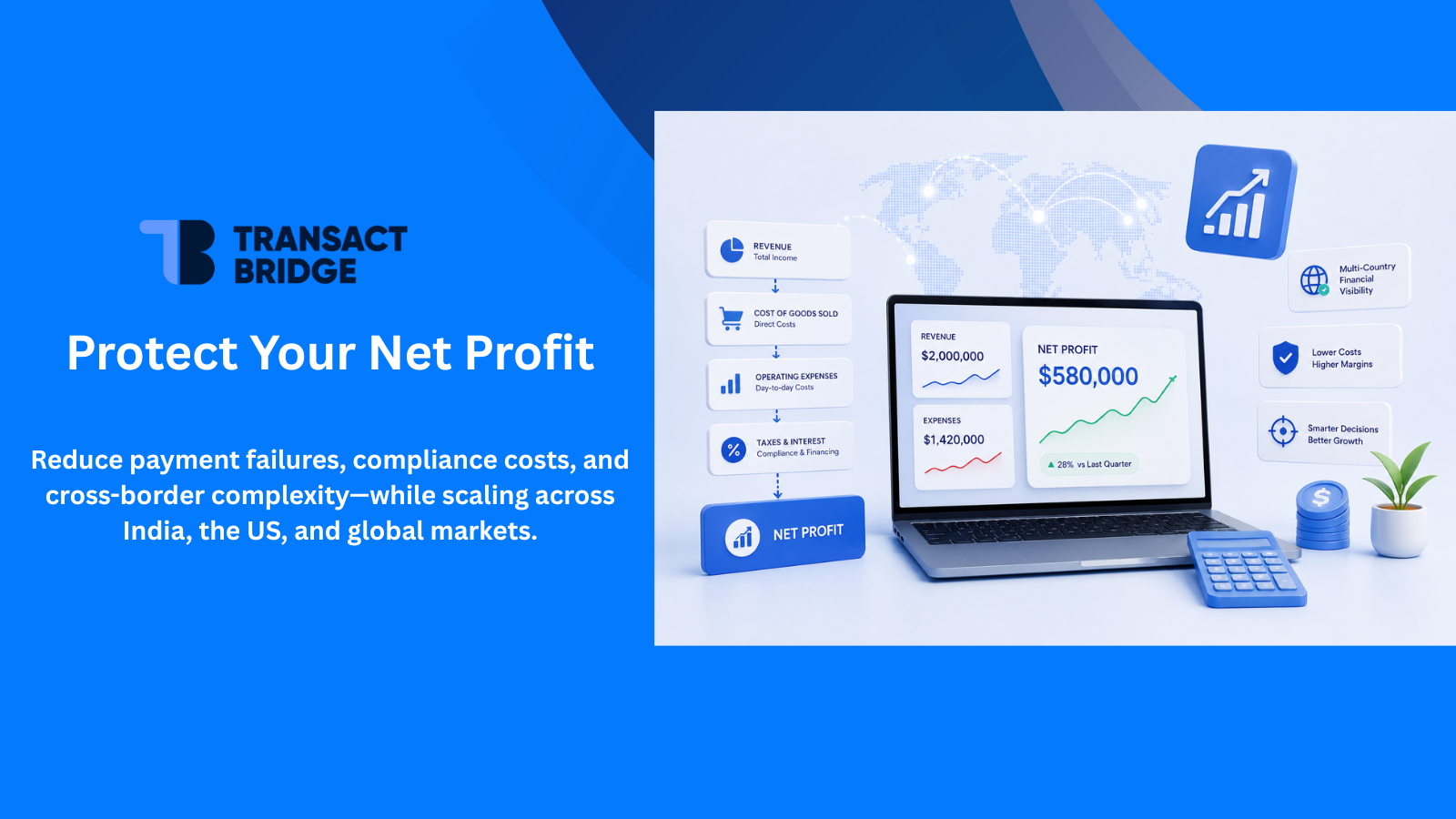
Quick answer: Net profit is the amount of money a business keeps after deducting all expenses including operating costs, taxes, interest, payment processing fees, and compliance costs from total revenue.
Formula:
Net Profit = Total Revenue − Total Expenses
For most businesses, this number represents the true measure of profitability. However, for B2B companies selling across borders, the figure on the income statement often tells only part of the story. Currency conversion costs, local tax obligations, payment failures, and compliance overhead can quietly reduce margins across every market you operate in.
This guide covers the net profit formula, step-by-step calculations, practical examples, the difference between gross and net profit, and proven ways to improve your business's profitability.
What Is Net Profit
Imagine two SaaS companies. Company A closes the quarter with $2 million in revenue. Company B closes with $1.2 million. On paper, Company A looks like the bigger win.
Then the expense lines come in. Company A spent heavily on customer acquisition, ran into a wave of failed international payments, and absorbed unexpected GST penalties in a new market. After expenses, Company A nets $80,000. Company B, leaner and more disciplined about where it sells and how it collects payment, nets $310,000.
Company B is the more profitable business by a wide margin despite having less than half the revenue.
This is exactly why net profit, not revenue, is the number investors, lenders, and acquirers look at first. Net profit (also called net income, net earnings, or "the bottom line") is what remains of your revenue after every single expense has been deducted such as cost of goods sold, operating expenses, interest, taxes, depreciation, and one-off costs.
It sits at the very bottom of your income statement, which is exactly where the name comes from.
How Profit Is Calculated
Revenue
↓
Gross Profit
↓
Operating Profit
↓
Net Profit (Bottom Line)
Why Net Profit Matters
- It tells you how much money is actually available to reinvest, distribute to shareholders, or hold as a financial buffer.
- It's one of the most closely examined metrics during due diligence, loan applications, and investor evaluations.
- For early-stage and scaling B2B companies, it shows whether the business model remains profitable after accounting for all operating costs.
- Tracked month over month, it reveals whether margins and unit economics are improving or quietly deteriorating.
A business can grow revenue by 40% year over year and still be less profitable than it was the year before. That gap between top-line growth and bottom-line performance is where most operational inefficiencies and financial leaks exist.
Selling across borders? See how Transact Bridge helps protect your margins — Talk to an Expert
The Net Profit Formula
There are two correct ways to express the net profit formula, and most blogs only give you one.
Version 1 : the standard formula:
Net Profit = Total Revenue − Total Expenses
Version 2 : the gross income version:
Net Profit = Gross Income − Total Expenses
The difference matters. Total revenue is just sales revenue (units sold × price). Gross income includes total revenue plus any non-operating income; interest earned on cash reserves, income from a subsidiary, gains from selling an asset, or other miscellaneous income streams. If your business has any income outside core sales, Version 2 gives a more accurate picture.
There's a third way analysts often express it, working down from gross profit:
Net Profit = Gross Profit − Operating Expenses − Interest − Taxes − Other Expenses
This version is useful because it mirrors exactly how an income statement is structured, line by line which makes it easier to spot where money is actually being lost.
Net Profit vs. Gross Profit vs. Operating Profit
Quick Comparison
- Gross Profit: Measures product or service profitability after subtracting the cost of goods sold (COGS).
- Operating Profit: Measures operational efficiency after deducting operating expenses but before interest and taxes.
- Net Profit: Measures total business profitability after accounting for all expenses, including interest, taxes, and one-time costs.
This is the single most common point of confusion in financial reporting, and getting it wrong skews every decision downstream. Here's the breakdown:
Metric | Formula | What it tells you |
Gross Profit | Revenue − Cost of Goods Sold (COGS) | How efficiently you produce/deliver your core product or service |
Operating Profit (EBIT) | Gross Profit − Operating Expenses | How profitable the core business is, before interest and tax |
Net Profit | Operating Profit − Interest − Taxes − Other Expenses | What's actually left for the business after everything |
Think of it as three filters, each one stricter than the last:
Gross profit answers: "Is my product/service profitable to deliver?"
Operating profit answers: "Is the day-to-day business profitable, ignoring financing and tax structure?"
Net profit answers: "After absolutely everything including taxes, debt, and one-off costs, did the business make money?"
A company can have excellent gross margins (60%+ is common in SaaS) and still post a thin or negative net profit if operating costs, interest on debt, or tax burden are high. This is precisely why net profit, not gross margin, is the figure that determines whether a business is actually sustainable.
How to Calculate Net Profit: Step-by-Step
Net Profit Calculation Process
Step 1
Calculate Total Revenue
↓
Step 2
Add Other Income (if applicable)
↓
Step 3
Calculate Total Expenses
↓
Step 4
Subtract Total Expenses
↓
Net Profit
Calculating net profit isn't mathematically hard. The formula is one subtraction. The real work is in gathering accurate inputs, especially if your revenue and costs span multiple countries, currencies, and tax regimes.
Step 1: Calculate total revenue
Total Revenue = Quantity of goods/services sold × Unit price
For subscription or B2B SaaS businesses, this typically means MRR/ARR plus any one-time fees, implementation charges, or upsells recognized in the period.
Step 2: Add non-operating income (if using the gross income method)
This includes interest income, FX gains, and other miscellaneous revenue not tied to core sales.
Step 3: Total your expenses.
This is where most of the complexity and most of the errors happen. Your expense list typically includes:
Cost of goods sold (COGS) : raw materials, hosting/infrastructure costs, direct delivery costs
Operating expenses : salaries, rent, marketing, software subscriptions
Payment processing costs : gateway fees, currency conversion charges, failed-transaction costs
Compliance and tax-handling costs : GST/VAT filing, local tax advisory, statutory reporting
Research and development
Depreciation and amortization
Interest on loans or credit lines
Income tax
One-off/non-recurring costs such as legal settlements, restructuring charges
Step 4: Subtract.
Net Profit = Total Revenue (or Gross Income) − Total Expenses
The result can be:
- Positive: Net Profit
- Negative: Net Loss
Both outcomes are informative. A planned net loss during a growth-investment phase is very different from an unplanned loss caused by poor cost control or margin leakage.
Worked Examples With Real Numbers
Example 1: Enterprise-scale calculation (using gross income)
Here's how the formula plays out at scale, using a structure similar to what you'd see in a public company's income statement:
Line item | Amount |
Revenue | $110,360,000 |
Other income | $1,416,000 |
Gross income | $111,776,000 |
Research & development | $14,726,000 |
Sales & marketing | $17,469,000 |
General & administrative | $4,754,000 |
Income tax | $19,903,000 |
Cost of revenue & other operating costs | (remainder) |
Total expenses | $95,205,000 |
Net Profit | $16,571,000 |
$111,776,000 − $95,205,000 = $16,571,000
This is the multistep version typical of larger companies with diversified income and detailed expense reporting across multiple categories.
Example 2: A simpler B2B scenario
A mid-sized B2B company closes its quarter with:
- Sales revenue: $60,000
- Sale of an old asset: $3,000
- Operating expenses: $25,000
- One-off legal settlement: $2,000
Total Revenue = $60,000 + $3,000 = $63,000
Total Expenses = $25,000 + $2,000 = $27,000
Net Profit = $63,000 − $27,000 = $36,000
That's a healthy 57% net profit margin but notice how a single $2,000 one-off cost or a handful of failed transactions could meaningfully move that number for a business this size. At smaller transaction volumes, every line item carries more relative weight.
Example 3: Indian SaaS Business
An Indian SaaS company reports the following for a financial quarter:
Line Item | Amount |
Revenue | ₹50,00,000 |
Payment Processing Fees | ₹1,20,000 |
GST Compliance & Tax Advisory | ₹40,000 |
Marketing Expenses | ₹10,00,000 |
Employee Salaries | ₹20,00,000 |
Other Operating Expenses | ₹5,00,000 |
Total Expenses | ₹36,60,000 |
Net Profit | ₹13,40,000 |
Calculation
Net Profit = Total Revenue − Total Expenses
₹50,00,000 − ₹36,60,000 = ₹13,40,000
This example highlights why businesses should look beyond revenue growth. Payment processing costs, GST compliance, and operating expenses directly affect the bottom line. Even if revenue increases, higher transaction fees, tax obligations, or customer acquisition costs can significantly reduce net profit.
For businesses selling across India and international markets, regularly tracking these expense categories helps identify margin leakage and make better pricing, expansion, and payment infrastructure decisions.
Why Net Profit Margin Matters More Than the Raw Number
A $50,000 net profit means something completely different for a company doing $200,000 in revenue (25% margin) versus one doing $5 million in revenue (1% margin).
Net Profit Margin = (Net Profit ÷ Total Revenue) × 100
Industry | Average Net Profit Margin |
SaaS / Software | 15–25% |
E-commerce | 5–10% |
Professional Services | 15–30% |
Manufacturing | 8–15% |
Gaming & Digital Content | Highly variable (often 10–25%) |
Note: These benchmarks are indicative only. Actual net profit margins vary based on business model, company size, growth stage, geography, pricing strategy, and capital structure. For example, many growth-stage SaaS companies run near breakeven or negative while prioritizing scale over profitability, and gaming/digital content margins are often compressed by payment failure rates and platform fees if not actively managed.
Net profit margin is the metric that lets you compare profitability across time periods, business units, and even competitors regardless of scale.
A consistently positive and improving net profit margin signals to investors and lenders that management is allocating capital well not just generating revenue. A declining margin, even alongside revenue growth, is one of the earliest warning signs of operational inefficiency.
Hidden Costs That Reduce Net Profit for Cross-Border B2B Companies
Most net profit guides assume a business operates in a single market with a single currency and one tax regime. Cross-border businesses face additional costs that can quietly reduce profitability even when revenue continues to grow.
1. Payment Failures
International payment processors often don't support local payment methods such as UPI, RuPay cards, or net banking. Failed checkouts mean revenue is lost before it even reaches the income statement, reducing both total revenue and net profit.
2. Foreign Exchange (FX) Conversion Costs
Every cross-border transaction involves currency conversion, settlement fees, and FX spreads. According to the Financial Stability Board's 2025 Cross-Border Payments Progress Report, only 35.4% of cross-border payments settle within one hour and for B2B transactions, fewer than 45% settle even within a full business day. That delay isn't just an operational inconvenience, it's working capital sitting idle, directly reducing the cash available to run and grow the business.
3. GST, VAT, and Regulatory Compliance
Selling internationally introduces ongoing compliance obligations, including GST, VAT, sales tax, RBI reporting, FEMA requirements, and local statutory filings. Whether handled internally or through external advisors, these costs directly reduce net profit.
4. Entity Setup and Local Operations
Expanding into a new country often requires establishing a local entity, opening bank accounts, engaging legal advisors, and maintaining ongoing administrative operations. These upfront and recurring expenses increase the cost of market expansion.
5. Chargebacks and Fraud Management
Disputes, fraudulent transactions, and chargebacks create direct financial losses while also increasing operational costs for investigation, customer support, and risk monitoring.
6. Failed Subscription Renewals
For SaaS and subscription businesses, failed recurring payments lead to involuntary churn. Authentication requirements, expired cards, and unsuccessful retries reduce recognized revenue month after month.
These costs are eating your margins silently. See how a Merchant of Record fixes this — Book a Free Consultation
How a Merchant of Record (MoR) Helps Protect Net Profit
A Merchant of Record centralizes payments, tax handling, compliance, and local payment acceptance under a single provider instead of a patchwork of local banks, gateways, and advisors. In practice, this means each of the six cost categories above gets addressed directly rather than managed reactively:
- Payment failures are resolved through localized payment methods such as UPI, cards, wallets, net banking, ACH, and international rails, so transactions complete instead of bouncing at checkout.
- GST, VAT, and regulatory compliance handled end-to-end, including GST, RBI, FEMA, and TDS filings, removing the need for in-house compliance teams or fragmented local advisors.
- Entity setup and local operations eliminated, since the MoR acts as the local legal seller, letting businesses enter a market without registering an entity first.
- Failed subscription renewals reduced through smart retry logic and locally compliant authentication flows that recover revenue that would otherwise be lost to involuntary churn.
- Chargebacks and fraud management centralized under one risk and dispute workflow instead of per-market processes.
Transact Bridge operates this model across India, the US, and global markets which is what turns the framework above into a measurable net profit outcome: higher recognized revenue from fewer failed transactions, and lower operating expense from simplified compliance, payments, and cross-border operations.
Ready to stop managing payments, GST, and compliance across five tools? See How Transact Bridge Works →
How to Improve Net Profit: 7 Practical Levers
If your net profit isn't where you want it, here's where to look first.
Reduce overhead. Audit insurance, software subscriptions, office costs, and marketing spend against industry benchmarks. Overhead creep is gradual and easy to miss until it's reviewed against peers.
Tighten inventory and resource control. For product businesses, knowing which SKUs drive margin (and which tie up cash without returning it) is one of the fastest ways to improve net profit without touching revenue at all.
Revisit pricing, don't just match competitors. Copying competitor pricing without understanding your own cost structure is one of the most common ways B2B companies erode margin. Move toward data-driven, value-based pricing instead.
Cut unprofitable products or service lines. Every underperforming SKU or service tier carries hidden carrying costs such as warehousing, support overhead, or engineering maintenance, beyond the obvious lack of revenue.
Renegotiate direct costs. Supplier and vendor contracts are rarely optimized after the first negotiation. Revisiting them annually, with current volume as leverage, is low-effort and high-impact.
Reduce payment-related leakage. For any B2B company selling across borders, this is often the single highest-leverage fix: improving payment acceptance rates, reducing FX costs, and minimizing compliance penalties can move net profit margin by several points without touching the product or pricing at all.
A common cause of low acceptance rates is failing to support local payment preferences businesses entering India, for example, often lose customers simply because they don't accept UPI or local wallets. Localizing payment methods by market is usually the fastest way to close this gap.
Track net profit monthly, not just quarterly or annually. Businesses that review net profit margin monthly catch small leaks such as a spike in failed transactions, an unexpected compliance cost, a vendor price increase, before they compound into a quarterly surprise.
Key Takeaways
Net Profit Formula: Net profit is calculated as Total Revenue − Total Expenses (or Gross Income − Total Expenses) and represents the true bottom-line profitability of a business.
Net Profit vs. Gross Profit: Gross profit, operating profit, and net profit measure different stages of profitability. Understanding the difference leads to better financial and business decisions.
Net Profit Margin Matters: A company's net profit margin provides a more meaningful measure of performance than the raw net profit figure because it enables comparisons across different business sizes and time periods.
Cross-Border Costs Impact Profitability: Payment failures, currency conversion, compliance obligations, and entity setup costs can significantly reduce net profit for businesses operating across India, the US, and global markets.
Improve Net Profit Strategically: Sustainable profit growth comes from reducing structural costs such as failed payments, compliance overhead, and operational inefficiencies not simply cutting expenses across the board.
Net Profit FAQs
What is the formula for determining net profit?
Net Profit = Total Revenue − Total Expenses. If you have non-operating income (interest, asset sales, subsidiary income), use Gross Income − Total Expenses. Instead see "The Net Profit Formula" above for a worked example of when that distinction matters. Once you have the number, dividing it by revenue (net profit margin) usually tells you more than the raw figure alone.
How do you calculate total profit?
"Total profit" is most commonly used interchangeably with net profit — total revenue minus all expenses across the accounting period.
What's the difference between net profit and net profit margin?
Net profit is a dollar (or rupee) amount. Net profit margin is that amount expressed as a percentage of revenue, which makes it comparable across companies and time periods.
Can net profit be calculated from a balance sheet?
Not directly. Net profit comes from the income statement (also called the profit & loss statement), not the balance sheet. However, retained earnings on the balance sheet change based on net profit over time, so the two are connected. To calculate net profit itself, you need revenue and expense data from the income statement for the specific period.
Why is my revenue growing but net profit isn't?
This usually points to rising costs outpacing revenue growth, increased customer acquisition cost, payment failures suppressing realized revenue, compliance penalties, or margin-thin pricing used to win market share. It's one of the most common patterns in fast-scaling B2B companies, especially those expanding into new geographies without localized payment and compliance infrastructure.
Is a negative net profit always bad?
Not necessarily. The distinction is whether the loss is intentional and controlled such as deliberate investment in market expansion or structural, like chronic payment failures or compliance costs eating into otherwise healthy unit economics. Intentional losses usually come with a visible path back to profitability; structural losses tend to persist or worsen until the underlying cause is fixed.
Is net profit the same as net income?
Yes. In most financial statements, net profit and net income refer to the same metric. They both represent the amount of money a business retains after deducting all expenses, including cost of goods sold (COGS), operating expenses, interest, taxes, depreciation, and one-time costs, from total revenue. The terms net earnings and the bottom line are also commonly used interchangeably.
Can net profit be negative?
Yes. A negative net profit is called a net loss. It occurs when a company's total expenses exceed its total revenue during an accounting period. While early-stage startups may intentionally operate at a net loss to invest in growth, a persistent negative net profit can indicate pricing, cost management, or operational challenges.
What expenses reduce net profit?
Net profit is reduced by every cost incurred in running the business, including:
- Cost of goods sold (COGS)
- Employee salaries and benefits
- Rent and utilities
- Marketing and advertising expenses
- Software and infrastructure costs
- Payment processing and transaction fees
- Currency conversion and foreign exchange charges
- GST, VAT, sales tax, and compliance costs
- Interest on loans and other financing costs
- Depreciation, amortization, and one-time expenses
The higher these expenses are relative to revenue, the lower the net profit. For B2B companies selling across borders, several of these, payment processing, FX conversion, and compliance costs, carry additional layers of complexity worth understanding separately (see "Hidden Costs for Cross-Border B2B Companies" above).
What's a good net profit margin for a B2B SaaS company selling internationally?
There's no single number, but the benchmarks above (15–25% at maturity) assume domestic-only cost structures. Cross-border B2B SaaS companies typically see that range compressed by a few points due to FX conversion losses, international payment failure rates, and market-specific compliance costs (GST, VAT registration, etc.).
A company in this category sitting persistently below 10% isn't necessarily unhealthy. It's worth checking first whether the gap is structural (the cost of doing business internationally) or fixable (the kind of payment and compliance leakage covered in the levers above) before assuming the business model itself is the problem.
Selling in India or the US?
Find out exactly how much payment and compliance costs are reducing your net profit — Talk to a Transact Bridge Expert →