How an AI-Powered SaaS Tool Went From Zero Paying Customers to a Global Revenue Engine
Published on: Sat 13-Jun-2026 09:04 AM
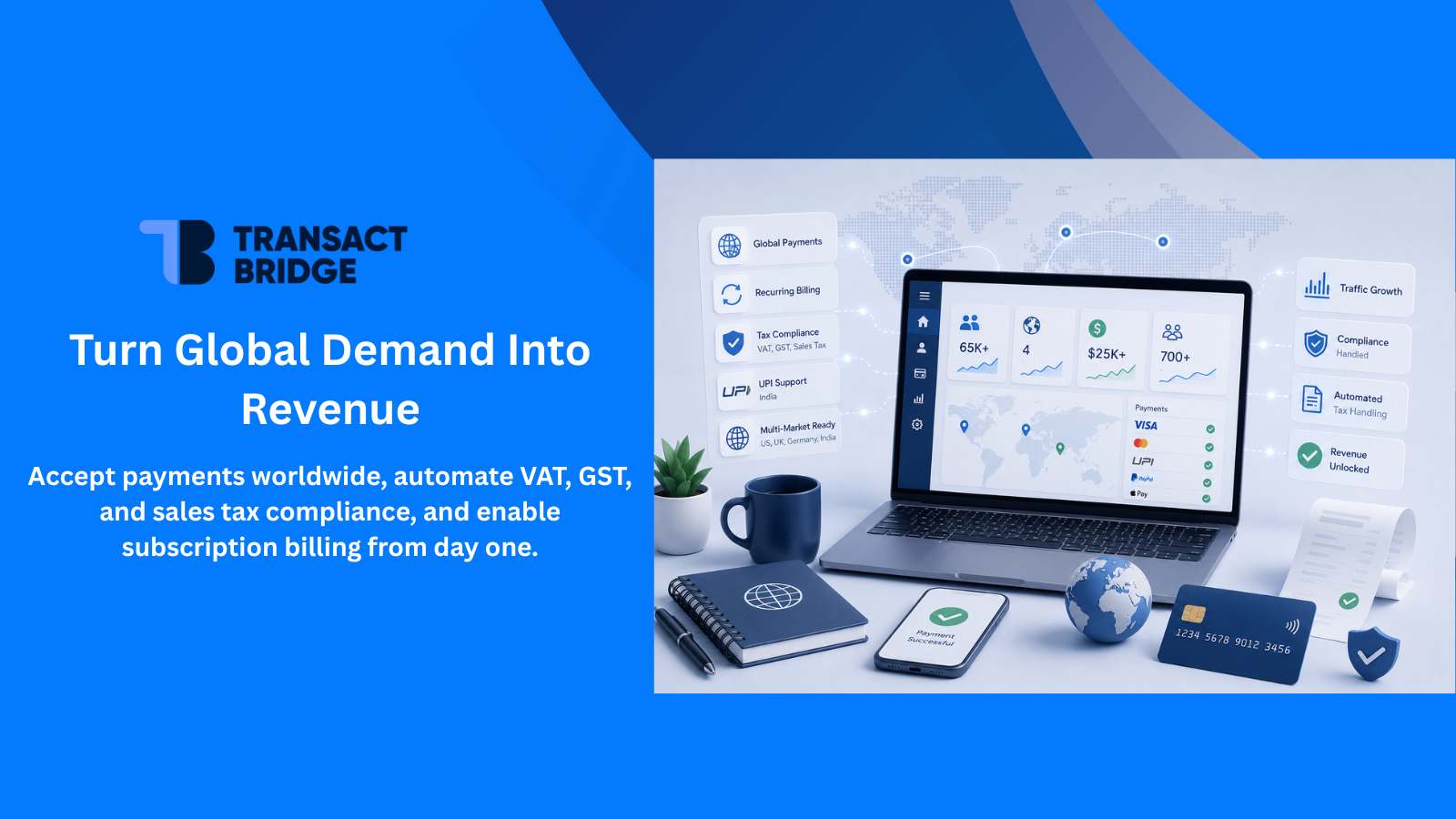
A solo-founded AI SaaS platform built to make professional 3D web design accessible and affordable had cracked product-market fit through organic social growth.
- Product priced between $25–$200, competing against agency quotes of $5,000–$10,000
- Grew to 30,000+ social media followers through consistent content
- A single viral moment drove 170,000 visits and 65,000 signups
- Users spanning the US, Germany, UK, and India
But despite real demand across four major markets, the business had zero paying customers. Transact Bridge solved this by enabling global payments, recurring billing, and multi-jurisdiction compliance without the founder having to touch any of it.
The Global Opportunity They Couldn't Monetise
The product wasn't the problem. Distribution wasn't the problem either.
The viral moment proved demand was real with 1.6 million views, 170,000 visitors, 65,000 signups, all organic, all unpaid.
But when users tried to pay, nothing worked.
The platform had no reliable way to accept payments from the US, Germany, or the UK. Recurring subscriptions couldn't be set up. And as international users started converting, a new problem surfaced: multi-country tax compliance; VAT, GST, sales tax, jurisdiction-specific regulations that a solo college founder had no bandwidth to navigate.
The demand existed. The rails didn't.
What Was Breaking the Funnel
A closer look revealed the gap wasn't one problem, it was several, stacked:
- No payment infrastructure capable of serving US, UK, and European markets simultaneously
- No recurring billing system designed for SaaS subscription models
- Zero tax compliance coverage across applicable jurisdictions VAT, GST, sales tax unaddressed
- No UPI support for the Indian user base, despite it being a key market
- Every spike in traffic produced signups, not revenue because checkout didn't work
In short: the product had global distribution but no global payment capability.
The Shift: Full-Stack Global Payments via MoR
Rather than building payment infrastructure market by market, a process that would have taken months and significant capital , the founder integrated Transact Bridge as the Merchant of Record.
One integration replaced what would have been:
- Multi-country payment gateway setups
- Separate recurring billing infrastructure
- Tax registration and remittance across jurisdictions
- Ongoing compliance monitoring
Transact Bridge took ownership of:
- Global payment acceptance across key markets
- Recurring subscription billing
- Tax collection and remittance (VAT, GST, sales tax)
- UPI support for Indian customers
- Compliance across all applicable jurisdictions
The founder retained full control over the product, pricing, and user experience.
What Changed on the Ground
The integration was completed in a single session- documentation, implementation, approval, and first test payment all within the same day.
- Global Markets Unlocked Immediately: US, Germany, UK, and India all live from day one
- Recurring Billing Activated: Subscription infrastructure enabled for the first time, making the SaaS model viable
- Tax Compliance Automated: VAT, GST, and sales tax handled entirely without founder involvement
- UPI Enabled: Indian users could pay using their preferred payment method
- Checkout Started Converting: Traffic that previously produced zero revenue began generating paying customers
The Outcome: From Zero to a Scalable Revenue Business
The impact wasn't incremental. It was foundational.
- 0 to 700+ paying customers across multiple countries
- $0 to $25,000 in monthly recurring revenue
- 4.5x growth in monthly traffic from 30,000 to 170,000 visitors
- A viral surge of 1.6 million views translated into revenue, not just signups
- Tax and compliance overhead: zero, fully handled by Transact Bridge
- Time to first payment: same day as integration
The business went from an unfunded side project with no revenue infrastructure to a functional, scalable SaaS without hiring, without legal overhead, and without building payments from scratch.
What Made It Work
The founder didn't need to:
- Register entities across multiple countries
- Navigate VAT or GST compliance independently
- Build or maintain payment infrastructure
- Integrate multiple gateways for different geographies
The MoR model compressed what typically takes months into a single working session.
With one integration, they unlocked:
- Global payment acceptance
- Subscription billing that actually works
- Full regulatory coverage across markets
Footnote
The product was always ready. The market was already there. All that was missing were the rails. Once payments worked, so did the business.