
The 9 Best Recurring Payment Systems for SaaS & Global Businesses (2026)
Published on: Wed 01-Jul-2026 04:04 PM
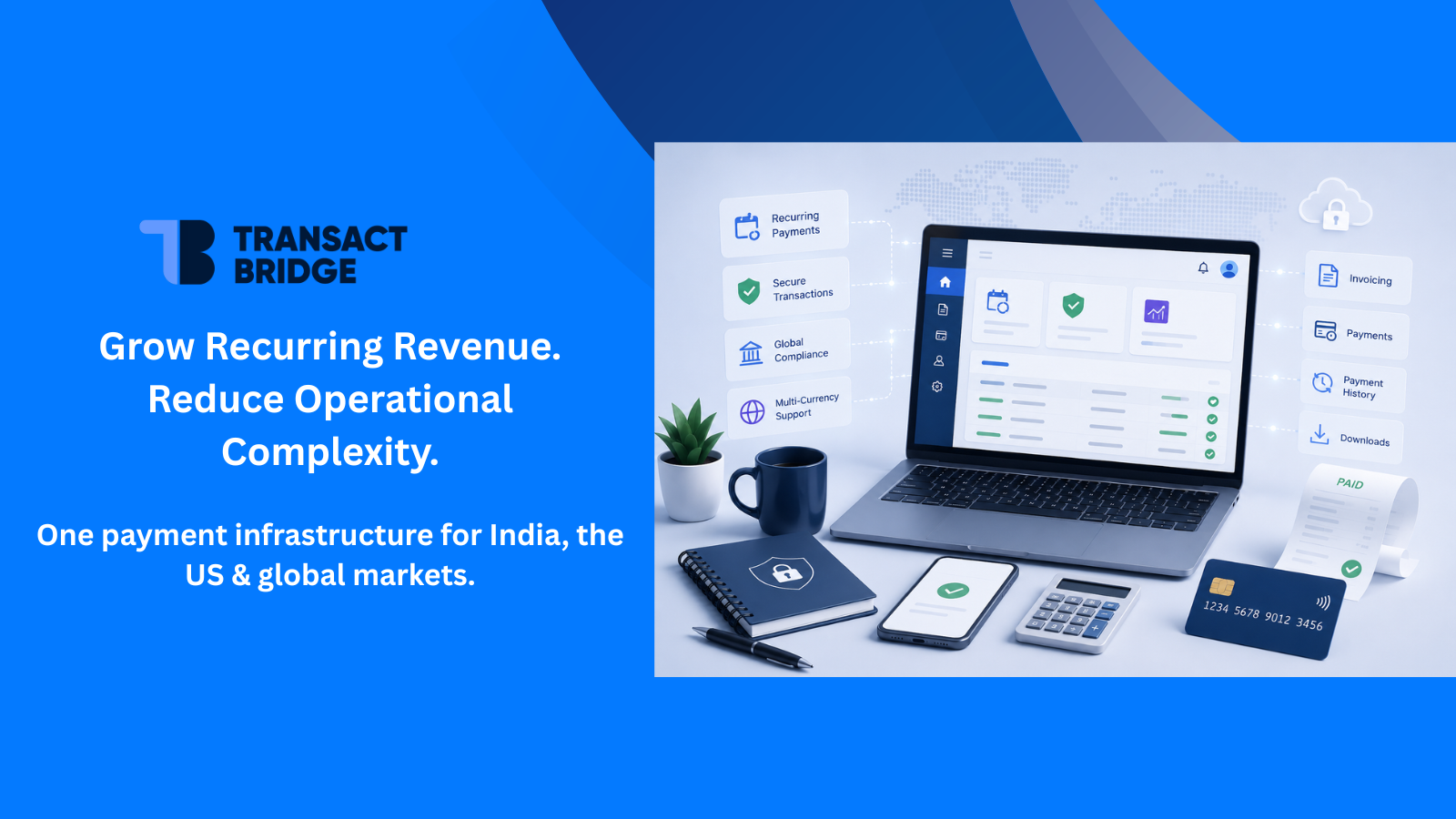
Quick answer: The best recurring payment systems in 2026 fall into three categories: subscription billing platforms (Zoho Subscriptions, Maxio), Merchant of Record platforms (Paddle), and payment infrastructure built for specific corridors (GoCardless for ACH). For businesses that sell across India, the US, and global markets, collecting UPI, ACH, and cards while staying compliant with GST and US sales tax -most of these tools only solve part of the problem. That's the gap this guide is built to map.
Failed payments alone cost subscription businesses an estimated $129 billion in lost revenue in 2025, according to industry-wide subscription economy research. Involuntary churn - people who wanted to keep paying but got blocked by a declined card, an expired mandate, or a tax mismatch now accounts for 40–68% of all subscription cancellations, depending on the vertical. Picking the wrong recurring payment system doesn't just cost you a monthly fee. It costs you customers who never meant to leave.
This guide breaks down the 9 platforms actually worth evaluating in 2026 where each one wins, where it quietly falls short, and why the India-US-global corridor specifically breaks tools that were built for a single market.
What is a recurring payment system?
A recurring payment system is software that automatically charges a customer on a repeating schedule - monthly, annual, usage-based, or metered without requiring them to manually pay each cycle. But "recurring payment system" is used loosely to describe three genuinely different things, and confusing them is the single most common reason companies pick the wrong tool:
Type | What it actually does | Who owns tax & compliance | Examples |
Payment Service Provider (PSP) | Processes the transaction - moves money from card/bank to your account | You do | Stripe (standard), Braintree, Square |
Subscription billing platform | Manages plans, invoicing, dunning, upgrades/downgrades but needs a PSP underneath it | You do | Zoho Subscriptions, Maxio |
Merchant of Record (MoR) | Becomes the legal seller of your product, handles billing, payment, tax collection, and remittance as one bundled service | The platform does | Paddle, Transact Bridge |
Merchant of Record vs payment gateway- the practical difference: A payment gateway (or PSP) moves the money and stops there. You're still the legal seller, which means you register for VAT in the EU, sales tax in dozens of US states, and GST in India and you file all of it yourself, or pay a separate compliance tool $50–500/month to help.
An MoR takes on that legal liability entirely: it appears on the customer's bank statement, collects the right tax in the right jurisdiction automatically, and pays you a net amount after fees and tax are already handled.
This distinction is the reason a "best recurring payment systems" list has to separate MoRs from billing tools, comparing a billing platform's price to Paddle's price without adjusting for what each one actually includes is comparing a car to a car-plus-insurance-plus-registration.
At-a-glance: all 9 platforms compared
Platform | Type | Merchant of Record? | India (UPI/GST) | US (ACH/Sales tax) | Starting price |
Transact Bridge | MoR + billing | Yes | Native UPI AutoPay, GST-handled | Native ACH, sales tax-handled | Usage-based,as low as 3%. |
Paddle | MoR + billing | Yes | UPI supported, no local entity | US via card/ACH, tax handled | 5% + $0.50/transaction |
Maxio | Billing (B2B SaaS) | No | Needs separate PSP | Needs separate PSP | From $599/mo |
Zoho Subscriptions | Billing only | No | Via a separate PSP integration | Needs separate PSP | Free–$299/mo |
Stripe Billing | Billing + PSP | No (unless Managed Payments) | UPI via Stripe India | Native ACH | 2.9% + $0.30/transaction |
GoCardless | PSP (bank debit) | No | No UPI | ACH specialist | Pay-per-transaction |
PayPal | PSP | No | Limited | Widely used | 2.9% + $0.30/transaction |
Braintree | PSP | No | Limited | Good US coverage | 2.59–3.49% + $0.49 |
Square | PSP | No | No | US/retail-first | 2.9%+30¢ / 3.5%+15¢ |
Selling into India and the US? Talk to Transact Bridge
What actually matters when you're evaluating these platforms
Most comparisons of these platforms stop at pricing and feature checklists. If you're selling into India, the US, or both, four other factors decide whether a platform actually works day-to-day:
1. Local payment method coverage, not just currency support.
Supporting "INR" is not the same as supporting UPI AutoPay. In 2026, UPI AutoPay mandates account for roughly 60% of all recurring payment mandates in India, having overtaken card-based mandates, and NPCI data shows AutoPay volumes growing over 35% year-on-year. A platform that only offers card checkout in India is fighting the market's default behavior.
2. Who owns tax compliance, and how automatically.
For India, that means understanding OIDAR classification, GST reverse charge on inbound SaaS purchases, and zero-rated export invoicing under LUT for outbound sales.
For the US, it means tracking economic nexus across up to 45 taxing states, most now triggered at $100,000 in annual revenue with no transaction-count exception, following Illinois's move to drop its 200-transaction threshold effective January 2026, joining Utah and Alaska in eliminating transaction-count exceptions.
Get either wrong and you're either overpaying tax you didn't owe, or under-collecting tax you'll be billed for retroactively with interest.
3. Settlement speed and failure recovery.
Involuntary churn- payments that fail due to expired cards, mandate limits, or bank declines rather than a customer choosing to leave- is the largest controllable revenue leak in subscription business.
Automated dunning and retry logic alone can recover 25–40% of failed payments, according to subscription-industry benchmarking research.
4. Total cost of ownership, not the headline rate.
Paddle's 5% + $0.50 looks more expensive than Stripe's 2.9% + $0.30 until you price in the $50–500/month a separate tax compliance tool would cost, plus VAT/GST registrations in every jurisdiction you sell into, plus the engineering time to maintain it. For a company selling in three or more tax jurisdictions, the "expensive" MoR option is frequently the cheaper one in total.
How to choose the best recurring payment system for your business
Skip the feature tour and answer these four questions. They determine the category of tool you need before you compare individual vendors:
How many countries do you sell into today, and in the next 12 months?
One country -a specialist PSP (an India-first PSP for India-only, Stripe/Square for US-only) is usually enough. Two or more, especially spanning India and the US → the calculus shifts toward an MoR or a platform built for that specific corridor.
Do your customers expect UPI, or only cards?
If any meaningful share of your revenue is or will be Indian customers, card-only checkout is leaving money on the table, UPI AutoPay is the default expectation, not an edge case.
Who do you want legally responsible for tax - you, or the platform?
If you'd rather not track GST export documentation and US economic nexus yourself, you want a Merchant of Record. If you have (or plan to hire) in-house finance capacity to own that, a billing platform + PSP combination gives you more control at a lower headline rate.
How much engineering time can you spend on payments, versus your product?
Billing platforms like Zoho Subscriptions or Maxio require you to also integrate and maintain a PSP. MoR platforms and unified infrastructure (Paddle, Transact Bridge) trade a higher per-transaction fee for less engineering upkeep.
Quick decision matrix
If you are... | Best-fit category | Example |
US-only, domestic customers | US PSP or billing + PSP | Stripe, Square, GoCardless (ACH) |
Global, but not India or US specifically | Merchant of Record | Paddle |
B2B SaaS with complex billing logic, single market | Billing platform + your own PSP | Maxio, Zoho Subscriptions |
India and US, now or on the roadmap | Unified India-US-global infrastructure | Transact Bridge |
Feature comparison by compliance dimension
This is the table worth bookmarking. It's organized by the specific capability, not the vendor, so you can see exactly where each platform's coverage stops:
Capability | Transact Bridge | Paddle | Zoho Subscriptions | Stripe Billing | GoCardless |
UPI AutoPay (native) | Yes | card-first | No | via Stripe India | No |
ACH (native) | Yes | card/ACH | No | Yes | Yes |
GST export/reverse-charge handling | Yes | tax handled, not India-specific | No | No | No |
US sales tax / nexus tracking | Yes | Yes (as MoR) | No | via Stripe Tax add-on | No |
VAT (EU) | Yes | Yes | No | via add-on | Direct Debit only, no tax handling |
Merchant of Record option | Yes | Yes | No | No (unless Managed Payments) | No |
Multi-currency settlement | Yes | Yes | display only | Yes | limited, bank-debit-focused |
Best fit | India + US + global | Global SaaS, no India depth needed | Zoho-ecosystem billing, single market | Engineering-led, single market | ACH-heavy US/EU collections |
The 9 best recurring payment systems in 2026
Before comparing individual platforms, consider how each handles payment methods, recurring billing, tax compliance, settlement, and international expansion. The right choice depends on where your customers are and how you plan to grow.
1. Transact Bridge : Best for businesses selling across India, the US, and global markets
Most platforms on this list were built to solve one side of a two-sided problem: either they're strong in India and weak or absent in the US, or they're strong in the US/EU (Paddle, Stripe) and treat India as an afterthought, supporting cards but not the UPI AutoPay rails that now carry the majority of India's recurring payment volume.
Transact Bridge is built the other way around: India, the US, and global markets are the starting requirement, not a later expansion.
What that looks like in practice:
- Native UPI AutoPay mandates for Indian customers not a card-only workaround- alongside NetBanking and card rails
- Native ACH and card support for US customers, with economic nexus-aware sales tax handling as revenue scales across states
- GST aware invoicing that correctly applies zero-rated export treatment (LUT) for outbound India-to-global billing and reverse-charge handling for inbound OIDAR purchases
- Multi-currency settlement so a single business can bill an Indian SaaS customer in INR and a US enterprise customer in USD from one subscription engine, without stitching together two separate payment stacks
- Merchant of Record option for businesses that want compliance liability handled entirely, or a payment-infrastructure-only mode for teams that want to own their own billing logic
Custom pricing: Contact for a quote tailored to your volume and market mix. Transaction fees start as low as 3%.
Best for: SaaS companies, exporters, and digital businesses with customers in both India and the US (or expanding into both) who are currently running two disconnected payment stacks, one for domestic India collections, one for global/US billing, and reconciling them manually.
The honest trade-off: if your business only ever sells within a single market (only India, or only the US, or only the EU), a specialist tool built for that one corridor may have deeper niche features. Transact Bridge's advantage compounds specifically when you're operating across the India-US-global boundary, which is exactly the boundary that breaks most of the platforms below.
2. Paddle : Best established Merchant of Record for global SaaS
Paddle popularized the modern MoR model for software companies and now serves over 6,000 SaaS and app businesses. As MoR, Paddle becomes the legal seller, automatically calculating, collecting, and remitting sales tax, VAT, and GST across 100+ jurisdictions.
Pricing: 5% + $0.50 per transaction- higher than a raw PSP rate, but bundled with tax compliance that would otherwise cost $50–500/month separately plus registration overhead.
Where it's strong: Checkout conversion, subscription lifecycle management, fraud protection, and genuinely global tax coverage.
Where it falls short for this positioning: UPI is supported for Indian transactions, but Paddle operates without a local entity in India, meaning Indian founders selling domestically (not just exporting) don't get the same depth of local-rail support or India-specific compliance nuance that an India-first platform provides.
3. Maxio : Best for B2B SaaS with usage-based pricing
Maxio (formerly SaaSOptics/Chargify) is built specifically for B2B SaaS with variable and usage-based pricing configurations.
Pricing: Essentials from $599/month; Growth/Scale on custom quotes.
Where it's strong: Flexible pricing configuration (stair-step, variable, hybrid), strong revenue analytics.
Where it falls short: Entry pricing is steep for early-stage teams, and again no MoR layer, so international tax remains your responsibility.
4. Zoho Subscriptions : Best budget option inside the Zoho ecosystem
Zoho Subscriptions is a natural fit for businesses already using Zoho CRM, Books, or Inventory, with plans starting free for small subscriber counts.
Pricing: Free (20 subscriptions) up to $299/month (5,000 customers); custom Enterprise above that.
Where it's strong: Cost, ecosystem integration, ease of setup for straightforward subscription models.
Where it falls short: India payment methods route through a separate third-party PSP integration rather than native support, and there's no built-in path to US tax compliance.
5. Stripe Billing : Best for engineering-led teams that want full control
Stripe remains the default choice for teams with strong engineering resources who want maximum flexibility over checkout and billing logic, supporting 135+ currencies and 100+ payment methods.
Pricing: 2.9% + $0.30 per transaction (standard); additional 1.5% surcharge plus 1% conversion fee on international cards.
Where it's strong: Developer experience, ecosystem, raw processing cost.
Where it falls short: Standard Stripe is a PSP, not an MoR - your business remains the legal seller and owns VAT/GST/sales tax registration and filing across every jurisdiction unless you separately adopt Stripe's managed-payments product.
6. GoCardless : Best specialist for bank-debit recurring payments
GoCardless focuses specifically on direct bank debit, ACH in the US, Direct Debit in the UK/EU, which typically has lower failure rates than card payments for recurring billing because it isn't subject to card expiry or reissue.
Pricing: Pay-per-transaction, bank-debit-specific rates.
Where it's strong: Bank-debit reliability and lower involuntary churn from card-related failures.
Where it falls short: No UPI support, and it's a single-rail specialist rather than a full multi-market billing platform.
7. PayPal : Best for global brand recognition and buyer trust
PayPal's ubiquity still matters for consumer-facing subscriptions where checkout trust affects conversion.
Pricing: 2.9% + $0.30 domestic; +1.5% for international transactions, plus currency conversion fees.
Where it's strong: Brand trust, broad global acceptance.
Where it falls short: Limited depth on modern India rails (UPI) and no MoR/tax-compliance layer.
8. Braintree : Best for PayPal-ecosystem businesses wanting more payment methods
A PayPal company, Braintree blends card and digital-wallet acceptance with mass payout capability across 200+ countries/regions.
Pricing: 2.59% + $0.49 (cards/wallets); 3.49% + $0.49 (Venmo).
Where it's strong: Payout flexibility, PCI Level 1 compliance.
Where it falls short: Same gap as PayPal - strong in the US, thin on India-specific recurring rails.
9. Square : Best for US-based businesses with in-person + online hybrid needs
Square extends beyond pure recurring billing into a full commerce ecosystem - POS, e-commerce, and appointment booking - with card-on-file recurring billing built in.
Pricing: 2.9% + $0.30 (card on file) or 3.5% + $0.15 (invoiced) per transaction.
Where it's strong: Businesses that need recurring billing alongside in-person payments.
Where it falls short: US/retail-first design with no meaningful India or cross-border subscription infrastructure.
When should you choose a Merchant of Record instead of a billing-only platform?
Many businesses evaluating recurring payment systems eventually compare Merchant of Record platforms with traditional billing platforms. Here's how to decide which model fits your business.
Stay with a billing-only platform + your own PSP if: you're selling into one or two markets, your finance team already owns tax registration and filing, and what you actually need is sophisticated plan logic - proration, multi-tier pricing, complex upgrade/downgrade paths. Paying an MoR's 5%+ fee for tax handling you don't need is money spent on a problem you don't have.
Switch to a Merchant of Record if: you're adding new countries faster than your finance team can register for tax in them, you're spending more engineering time on compliance edge cases than on product, or a recent audit/penalty just made "we'll figure out tax later" an expensive mistake.
The switch cost is real - most MoR migrations take 4–8 weeks with a parallel-running period, and stored payment methods typically don't transfer, meaning customers re-enter cards on their next billing cycle - but it's a one-time cost against an ongoing compliance burden.
The India-US-specific version of this question: a billing-only platform paired with a general-purpose PSP can be made to work for India-US billing, but only by bolting on an India-focused PSP for UPI and a separate tax tool for US nexus tracking - three vendors instead of one, three sets of failure points, three reconciliation processes. That stitching cost is exactly what a platform built for the India-US-global corridor from the start is designed to remove.
Not sure which model fits? Send us your current stack and we'll tell you straight. Schedule a call
Why India and the US each break a generic payment stack
The India side: it's not just currency, it's rails and compliance
A short example. Say a Bengaluru-based SaaS company signs up its first 50 customers- 30 in India, 20 in the US. The founder initially wires up Stripe for the US customers and assumes it'll work for India too.
Two problems surface almost immediately: Indian customers overwhelmingly expect to pay via UPI AutoPay, not cards- UPI AutoPay mandates now represent roughly 60% of India's recurring payment volume, and card-only checkout quietly depresses conversion for domestic customers who've never set up a recurring mandate any other way.
Second, GST treatment differs by customer: domestic Indian customers need standard 18% GST on the invoice, while the US customers, if invoiced in USD and paid via foreign remittance, qualify as zero-rated exports under Section 16 of the IGST Act but only if the founder files the right documentation (LUT, FIRC evidence) to prove it. Miss that paperwork, and a genuinely zero-rated export can get treated as a taxable domestic sale during an audit.
This is precisely the kind of dual-track compliance a single India-only or single-US-only platform isn't built to route automatically.
Stop losing conversions to card-only checkout — see UPI AutoPay in action
The US side: economic nexus doesn't wait for you to notice
A short example. A US-based subscription business crosses $100,000 in cumulative sales into a new state - say, Illinois, without tracking it closely. As of January 1, 2026, Illinois dropped its 200-transaction exception entirely, so hitting the $100K revenue threshold alone now triggers a registration and collection obligation, regardless of how few individual transactions got you there.
Most states have converged on this same $100,000 revenue-only model (with outliers like Texas and California sitting at $500,000). Non-compliant SaaS businesses lose an average of 4.3% of revenue to back taxes, penalties, and interest once a state catches the gap which is a much more expensive outcome than collecting the tax correctly from day one.
The takeaway for both sides: compliance isn't a back-office afterthought you bolt on later- it's a feature of the payment stack itself, and it needs to be automatic, not something a founder discovers during an audit.
Key takeaways
- "Recurring payment system" covers three different products - PSPs, billing platforms, and Merchant of Record platforms and comparing their headline prices without adjusting for what's actually included is the most common evaluation mistake.
- UPI AutoPay now carries the majority of India's recurring payment volume (~60% of mandates), so India support that stops at card checkout will underperform with domestic customers.
- Involuntary churn from failed payments costs the subscription economy an estimated $129 billion a year automated retry/dunning logic recovers 25–40% of that, making payment reliability a retention lever, not just a checkout feature.
- US economic nexus thresholds no longer require high transaction counts- most states trigger registration at $100,000 in revenue alone, and non-compliance costs the average SaaS business 4.3% of revenue.
- Businesses selling into both India and the US need a platform built for that specific corridor from the start - stitching together an India-first tool and a US/global-first tool creates reconciliation overhead that a unified platform like Transact Bridge is built to eliminate.
The Bottom Line
Single-market businesses have good options above GoCardless if you're ACH-heavy, Stripe or Square if you're purely US-based. The decision gets harder the moment "and" enters your roadmap: India and the US, this quarter and next year's expansion.
That's when reconciling two separate payment stacks, two compliance regimes, and two failed-payment recovery systems becomes the actual cost center, not the per-transaction fee on whichever tool you picked.
If that's where you are, talk to Transact Bridge about what a single India-US-global payment stack would look like for your specific customer mix.
Ready to consolidate two payment stacks into one? Talk to Transact Bridge
FAQs
What is a Merchant of Record?
A Merchant of Record (MoR) is the legal entity that sells your product to the customer on your behalf. It appears on the customer's bank statement, takes on responsibility for calculating, collecting, and remitting sales tax, VAT, and GST across jurisdictions, and pays you a net amount after fees and tax obligations are handled- removing the need for you to register as a taxable seller in every country you sell into.
Merchant of Record vs payment gateway - what's the actual difference?
A payment gateway (or PSP) only moves money from the customer's card or bank account to yours; you remain the legal seller and own all tax registration, collection, and filing. A Merchant of Record becomes the legal seller itself, bundling tax compliance, fraud liability, and dispute handling into the transaction.
Do I need a Merchant of Record if I sell to both India and the US?
Not strictly, you can assemble a PSP plus separate tax tooling for each market. But the compliance burden compounds quickly: India requires correctly distinguishing domestic GST-liable sales from zero-rated exports (with LUT documentation), while the US requires tracking economic nexus across up to 45 states with different revenue thresholds. An MoR or a platform purpose-built for both corridors reduces that to one system instead of two parallel compliance efforts.
How does UPI AutoPay work for subscription billing?
UPI AutoPay lets a customer authorize a recurring e-mandate once through their UPI app (via Intent, Collect, or QR flow), after which scheduled debits happen automatically. Per NPCI's e-mandate rules, the customer receives a pre-debit notification and the actual charge occurs at least 24 hours later- a deferred-capture model, unlike instant card charges.
Do billing platforms support UPI payments natively?
No, billing-and-subscription-management platforms are not payment processors. They require a separate PSP to actually accept UPI, ACH, or cards. The billing platform manages the invoice and plan logic; the underlying PSP handles the payment rail.
How to accept recurring payments internationally without setting up tax registrations everywhere?
The two paths are: (1) use a Merchant of Record platform that takes on the legal-seller role and handles tax remittance across jurisdictions, or (2) use a payment-infrastructure platform (like Transact Bridge) that automates jurisdiction-aware tax treatment - GST export/reverse-charge logic for India, economic nexus-aware sales tax for the US - without requiring you to manually track thresholds in dozens of jurisdictions yourself.
What's the difference between recurring billing and a subscription Merchant of Record?
Recurring billing describes the mechanics of charging a customer on a schedule. A subscription Merchant of Record is a specific business model where the platform, not you, is the legal seller for those recurring charges, the billing mechanics are the same either way, but who owns the compliance liability differs.
Is UPI Autopay only useful for India-only businesses?
No, any business collecting from Indian customers, including global SaaS companies with an Indian customer base, benefits from supporting UPI AutoPay, since it's the default recurring-payment expectation for the majority of Indian digital consumers and B2B buyers alike.


