Should You Expand Your SaaS to the US or Stay India-First? A Decision Framework for Founders
Published on: Fri 10-Jul-2026 01:26 PM
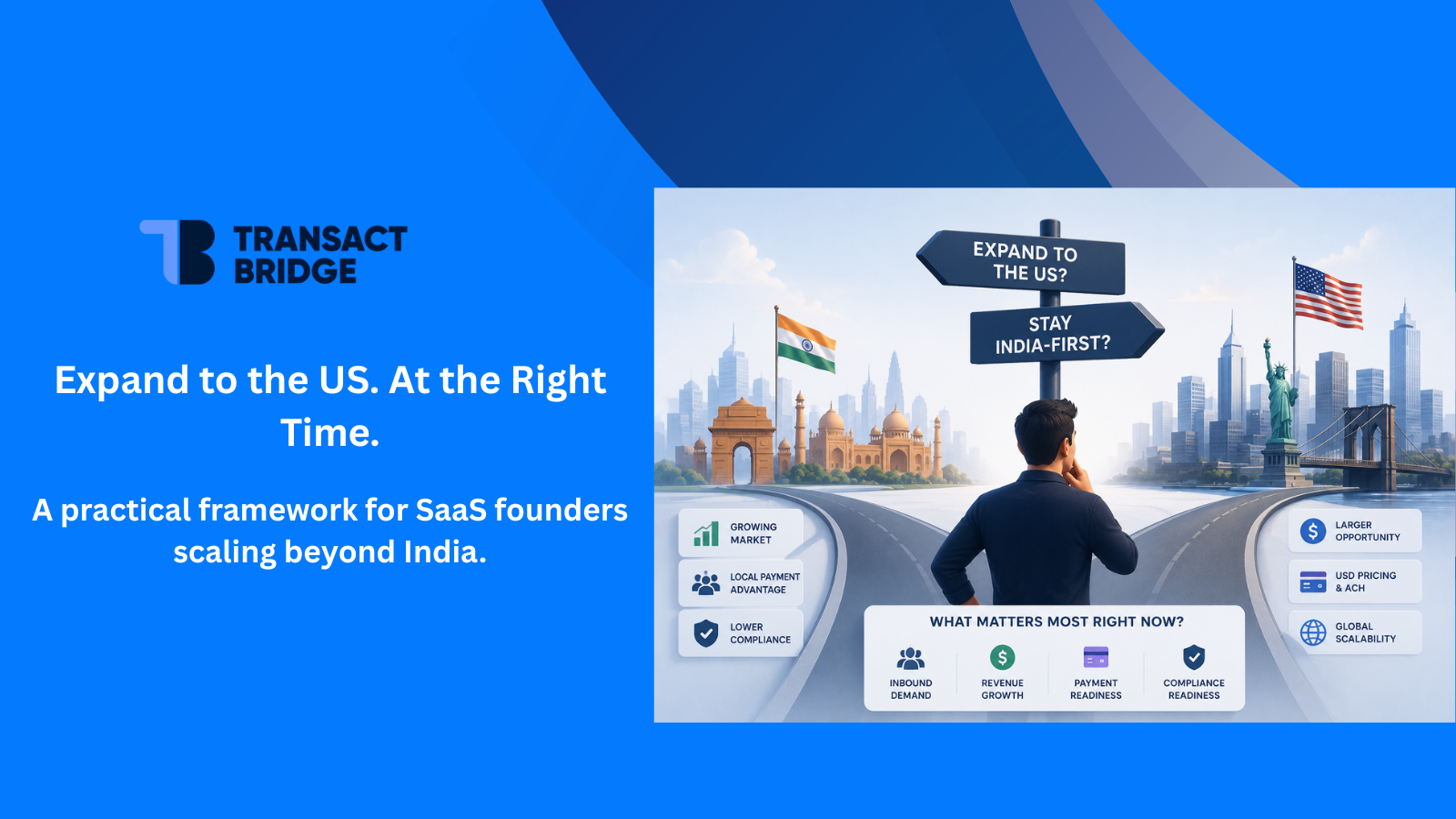
Every founder we talk to eventually asks some version of the same question: is it time to go after the US market, or am I leaving money on the table by not doubling down at home? Usually the question shows up right after a few unexpected US sign-ups land in the dashboard, or a competitor announces a "global expansion" round.
Quick Answer
Expand your SaaS to the US when three things are true at once – US buyers are already finding you without you marketing to them, your India growth has started to plateau relative to how much of the market you've actually captured, and you can bill in USD without needing to build a US entity from scratch. If none of those are true yet, staying India-first and going deeper is usually the better trade.
Key takeaways:
- Don't confuse US demand with US readiness. Inbound sign-ups are a signal, not a green light on their own.
- Validate demand before you incorporate. Entity formation is a later decision, not a prerequisite.
- India-first is often the faster, more capital-efficient path, not a smaller ambition.
- Billing infrastructure (USD pricing, ACH support, tax handling) has to work before GTM spend, not after.
- Use a Merchant of Record to validate the market before you build or fund a US entity.
Are you actually ready? A quick scorecard
Before the reasoning behind all this, a fast way to self-diagnose:
Check | Yes | No |
Inbound US demand without active marketing | ☐ | ☐ |
Can price and bill natively in USD | ☐ | ☐ |
Can accept ACH, not just cards | ☐ | ☐ |
Have a plan for sales tax / economic nexus | ☐ | ☐ |
India ICP and messaging validated well enough to adapt, not rebuild | ☐ | ☐ |
0–2 yes: stay India-first for now. 3–4 yes: soft-launch with USD pricing and an MoR, hold off on hiring. 5 yes: you're ready for a real GTM push.
The rest of this walks through why that scorecard works the way it does, and how to act on wherever you landed.
Scored 3 or Higher? See What a Soft Launch Actually Looks Like
Transact Bridge lets you enable USD pricing and start billing US customers through an MoR — without a US entity, without new compliance overhead.
The binary is the trap
Founders tend to frame this as India vs. the US, like picking a side. That framing is where most expansion mistakes start. These aren't two versions of the same market. They run on different payment rails, different tax logic, different sales cycles, and different signals of buyer trust.
Treating "expansion" as a single yes/no decision skips past the actual variable that matters: whether your infrastructure can support a second market before your ambition does. A workable SaaS expansion strategy has to start from operational readiness, not market size alone.
And the India opportunity alone isn't small enough to justify skipping this step. NASSCOM's 2026 Strategic Review puts India's tech sector on track to cross $315 billion in revenue in FY26, growing around 6.1% year-on-year, and NASSCOM's own SaaS ecosystem coverage points to the domestic SaaS segment reaching $50–70 billion in annual revenue by 2030.
Staying India-first isn't settling for a smaller ambition. It's a different growth path– one a lot of founders abandon too early chasing unproven US demand.
What actually separates "ready" from "not yet"
Before any of the tactics – pricing, hiring, entity formation– four questions do most of the work of answering this for you.
Is the demand inbound, or are you manufacturing it? Organic sign-ups, support tickets, or sales inquiries from US-based domains and IPs are the strongest signal there is. Cold outbound into a market you've never tested isn't expansion. It's speculation with a bigger budget attached.
Where are you on the India curve? If you're capturing under 10% of your realistic India TAM in your category, the growth math still favors depth over breadth, a second market won't fix a penetration problem. If you're past 30–40%, a second market genuinely changes your ceiling.
Can you separate "selling to the US" from "incorporating in the US"? This is the one founders get wrong most often. The two aren't the same decision, and treating them as one is what delays expansion that could've started months earlier. More on how to unbundle them below.
Does your pricing survive currency exposure? If it's INR-only or manually converted, US buyers notice and for enterprise buyers specifically, that reads as a maturity signal, not a minor detail.
If you're saying yes to the first and last of these but no to the middle two, you're not ready for a GTM push. You're ready to fix infrastructure.
A founder's actual decision path
Here's how expanding SaaS to the US tends to play out, once you strip away the strategy-deck version of it.
Question | If Yes | If No |
Do you already have inbound US demand (trials, sign-ups, demo requests) without active US marketing? | Continue to the next question. | Stop – Stay India-first. Reassess US expansion in 6–12 months. |
Is your India revenue still growing consistently quarter over quarter? | Stop – Soft-launch the US: enable USD pricing and use a Merchant of Record. Delay hiring and entity setup. | Continue to the next question. |
Can you already price, invoice, and collect payments in USD? | Continue to the next question. | Stop – Fix your billing and payment infrastructure before expanding. |
Do you have 3–6 referenceable US customers? | Commit to full US expansion with a dedicated sales hire, repeatable GTM process, and evaluate whether a US entity is now justified. | Run a lean, inbound-only pilot before investing further. |
Start with whether you have consistent inbound demand from US buyers – sign-ups, trials, inquiries – without actively marketing there. If you don't, the answer is simple: stay India-first, and revisit this in six to twelve months.
If you do have that signal, look at your India revenue. Still growing well, quarter over quarter? Then a soft launch is enough. Enable USD pricing and a Merchant of Record, but hold off on a dedicated US hire or entity formation. If India's growth has stalled instead, that's your cue to push further, provided you can already price, invoice, and collect in USD. If you can't, the problem isn't your GTM. It's your billing. Fix that first.
Once billing works and you have somewhere between three and six reference-able US customers, that's when a full GTM motion – dedicated hire, formal sales process, entity evaluation – actually makes sense. Skipping straight there from "we got a few sign-ups" is how founders end up with compliance debt and an underused sales hire in the same quarter.
Why the two markets don't behave the same way
It's worth being specific about what changes, because "the US is a bigger market" undersells how different the operating mechanics actually are.
India | United States | |
Dominant payment rails | UPI, net banking, cards | ACH, corporate cards |
Buyer trust signals | Relationship, fast response, WhatsApp support | SOC 2, security questionnaires, G2/Capterra reviews |
Typical SMB sales cycle | 2–4 weeks | 3–6 weeks |
Typical enterprise sales cycle | 3–6 months | 4–9 months, often longer with procurement/security review |
Tax framework | GST – single national system, one regulator | State-by-state sales tax, no federal sales tax |
What triggers a tax obligation | Turnover-based GST registration | Economic nexus – sales volume into a state, regardless of entity or presence |
The practical effect shows up at the point of payment more than anywhere else. Nacha, which governs the ACH Network, reported 35.2 billion payments worth $93 trillion moving through it in 2025, with B2B volume growing nearly 10% that year.
If your checkout doesn't support ACH – if it's card-only, or worse, defaults to INR pricing for a US visitor – you're not losing the deal on price. You're losing it before the buyer even evaluates the product, because the checkout itself signals "not built for us."
Key Insight: Most founders assume a failed US deal comes down to pricing or competition. More often, it comes down to the payment experience itself. A checkout that doesn't recognize a US card, or a currency mismatch, kills trust before the sales conversation even starts.
The compliance trap nobody budgets for
This is the part that gets skipped in most conversations about US expansion for SaaS companies, and it's the part that actually costs money later.
In the US, there's no federal sales tax. Every state sets its own rules, and the trigger that matters most is economic nexus, not incorporation. Since the 2018 Supreme Court decision in South Dakota v. Wayfair, Inc., most states require you to register and start collecting sales tax once your sales into that state cross a revenue threshold, commonly around $100,000, though this varies by state and is worth confirming against current state guidance before you rely on it.
The part that catches founders off guard: this applies whether or not you have a US entity, US employees, or a US bank account. Pure sales volume can trigger the obligation on its own.
Compare that to India, where GST is a single national framework with one regulator – genuinely simpler by design, even if it doesn't feel that way day to day. The US swaps simplicity for fragmentation: fifty different thresholds, rates, and filing calendars, none of which announce themselves until a state sends a notice.
This is exactly the gap a Merchant of Record is built to close. An MoR is legally the seller of record, which means it handles sales tax collection and remittance across every state you sell into, without you standing up US entities or a compliance function to track fifty separate thresholds.
For a founder validating demand, that's the difference between spending the first six months on GTM and spending them untangling nexus exposure you didn't know you had. It's also, practically, what makes multi-currency pricing and localized payment methods possible without building separate billing stacks for each market.
Don't Find Out About Nexus From a State Notice
Transact Bridge acts as your Merchant of Record, handling sales tax collection and remittance across every US state you sell into – while keeping GST-compliant billing running for India.
Entity vs. Merchant of Record: what actually changes
If you do decide to move forward with international SaaS expansion, this is usually the first real fork in the road.
Merchant of Record (MoR) | US Local Entity | |
Setup time | Days to weeks | Months (incorporation, banking, tax registration) |
Upfront cost | Low | High – legal, accounting, registered agent fees |
Who owns tax/compliance | The MoR, as legal seller of record | You, across every state you sell into |
Best for | Validating demand, early-stage expansion | Companies with proven US revenue needing direct banking, US payroll, or investor requirements |
Cost if it doesn't work out | None – you simply stop | Entity dissolution is its own compliance process |
The honest sequencing for most founders: start with an MoR, prove the market is real, then evaluate entity formation once revenue actually justifies the fixed cost of maintaining one. Founders who reverse this order – entity first, demand second – end up carrying compliance overhead for a market that hasn't proven itself yet.
If you're revisiting the scorecard from the top of this piece, this is usually the point where a 3–4 score turns into a 5. Once billing, tax, and demand all line up together.
A realistic timeline, if you move forward
Month | Focus |
1 | Validate demand – track inbound signal, don't spend on it yet |
2 | Enable USD pricing |
3 | Connect a Merchant of Record for billing and tax compliance |
4 | Land first paying US customers through inbound/content only |
6 | Begin a limited, paid US GTM motion |
12 | Revisit the scorecard – commit to a dedicated hire and evaluate entity formation, or scale back to India-first |
India-first vs. US-first: the honest trade-off
Staying India-first
- Faster sales cycles, lower CAC, an existing playbook that already works
- No new compliance burden to absorb
- Real headroom left – the domestic SaaS opportunity alone is projected in the tens of billions by 2030
- The trade-off: a lower growth ceiling that can cap how investors benchmark you against global SaaS comps
Expanding to the US
- Access to higher-ACV buyers and a much larger addressable market
- A stronger fundraising narrative for global investors
- The trade-off: compliance debt compounds quietly if nexus and tax obligations are ignored, and CAC plus longer sales cycles can erode margins if they're not modeled upfront
Three founders, three different calls
A Bangalore-based project management SaaS saw a handful of US sign-ups and reacted immediately – hired a US sales rep, launched paid US ads. Eighteen months later, they'd crossed economic nexus thresholds in four states without registering, triggering back-tax notices, while India growth stalled from divided attention. The failure wasn't expanding. It was expanding on inbound signals without billing infrastructure underneath it.
A Chennai-based HR-tech platform saw the same kind of signal – steady US trial sign-ups from content that wasn't even US-targeted – and handled it differently. They enabled USD pricing, routed US sales through a Merchant of Record, and kept India as the primary GTM focus. Two quarters later, US revenue was material enough to justify a dedicated hire, with zero compliance backlog, because tax collection had been correct from the first dollar.
A spiritual-tech platform serving Indian creators looked at US expansion early and walked away from it. Their India TAM was under 15% penetrated, and buyer behavior in their category was unproven in the US. Two years later, they're a category leader in India with cleaner unit economics than most "global-first" peers from the same funding cohort.
Same starting signal in all three cases – a few unmarketed US sign-ups. What diverged was billing infrastructure and how honestly each team read their own India numbers before reacting.
Where founders get this wrong most often
A few patterns repeat often enough to call out directly: treating expansion as a marketing decision instead of a billing and compliance one; assuming a US entity is required before you're legally allowed to sell to US customers (it isn't); ignoring economic nexus until a state sends a notice; pricing in INR and manually converting instead of pricing natively in USD; hiring a US-based salesperson before validating any inbound demand; and probably the most expensive one, letting India growth slip while resources shift toward a second market that hasn't proven itself yet.
Where Transact Bridge fits into this
Most of what actually blocks Indian SaaS founders from expanding to the US isn't demand. It's infrastructure. Transact Bridge is built for exactly this transition – USD pricing, ACH and card acceptance, and US sales tax compliance, on the same platform that handles GST-compliant invoicing and UPI-native billing for India, so India-first growth doesn't quietly get deprioritized while you're testing US demand. The goal isn't to push every founder toward expansion. It's to make sure the decision comes down to real market readiness, not a billing limitation you hadn't noticed yet.
Payments Across India, the US, and Global Markets – One Platform
Transact Bridge handles USD and INR billing, tax compliance, and payment acceptance so the decision to expand comes down to real market readiness, not a billing gap you hadn't noticed.
FAQs
Should I expand my SaaS to the US?
Expand when you have consistent inbound demand from US buyers, your India growth has plateaued relative to your addressable market, and you can bill in USD without building a US entity first. If those three conditions aren't met yet, deepening India penetration typically produces better near-term returns.
Should SaaS founders focus on India first?
For most early-stage SaaS companies, yes. India offers faster sales cycles, lower CAC, and a domestic SaaS market projected to reach $50–70 billion by 2030. India-first isn't a small ambition. It's a different growth path that a lot of founders abandon too early in favor of unproven US demand.
When should a SaaS company expand to the US?
The strongest signal is organic inbound demand –sign-ups, trials, or sales inquiries from US buyers without active US marketing. A revenue plateau in your home market and the ability to bill in USD are the other two conditions that typically justify moving forward.
Is the US the right first international market for an Indian SaaS company?
Often yes, thanks to English-language product-market fit and category maturity, but "right" doesn't mean "immediate." The right sequencing is validating US demand through inbound signals before committing GTM spend.
What do founders need to prepare before expanding to the US?
USD pricing and billing capability, a way to accept ACH and card payments, awareness of economic nexus for the states you're selling into, and support coverage that reaches at least US Eastern business hours.
How do I expand my SaaS to the US without setting up a local entity?
A Merchant of Record can legally sell on your behalf, collect and remit US sales tax, and handle USD billing, all without you incorporating in the US. This is the standard path for validating a market before committing to entity formation.
Do I need a US entity to sell SaaS to US customers?
No. You can sell to US customers, collect payment, and stay tax-compliant through a Merchant of Record without forming a US company. Entity formation becomes relevant later, typically once you need direct US banking relationships or have investor requirements tied to a US entity.
How do Indian SaaS companies collect payments from US customers?
Most rely on a payment platform or Merchant of Record that supports USD pricing, card payments, and ACH – the dominant B2B payment rail in the US. Relying on India-only rails like UPI isn't viable for US buyers.