Global Ecommerce Expansion 2026: What You Actually Need Before Entering a New Market
Published on: Thu 21-May-2026 05:41 PM
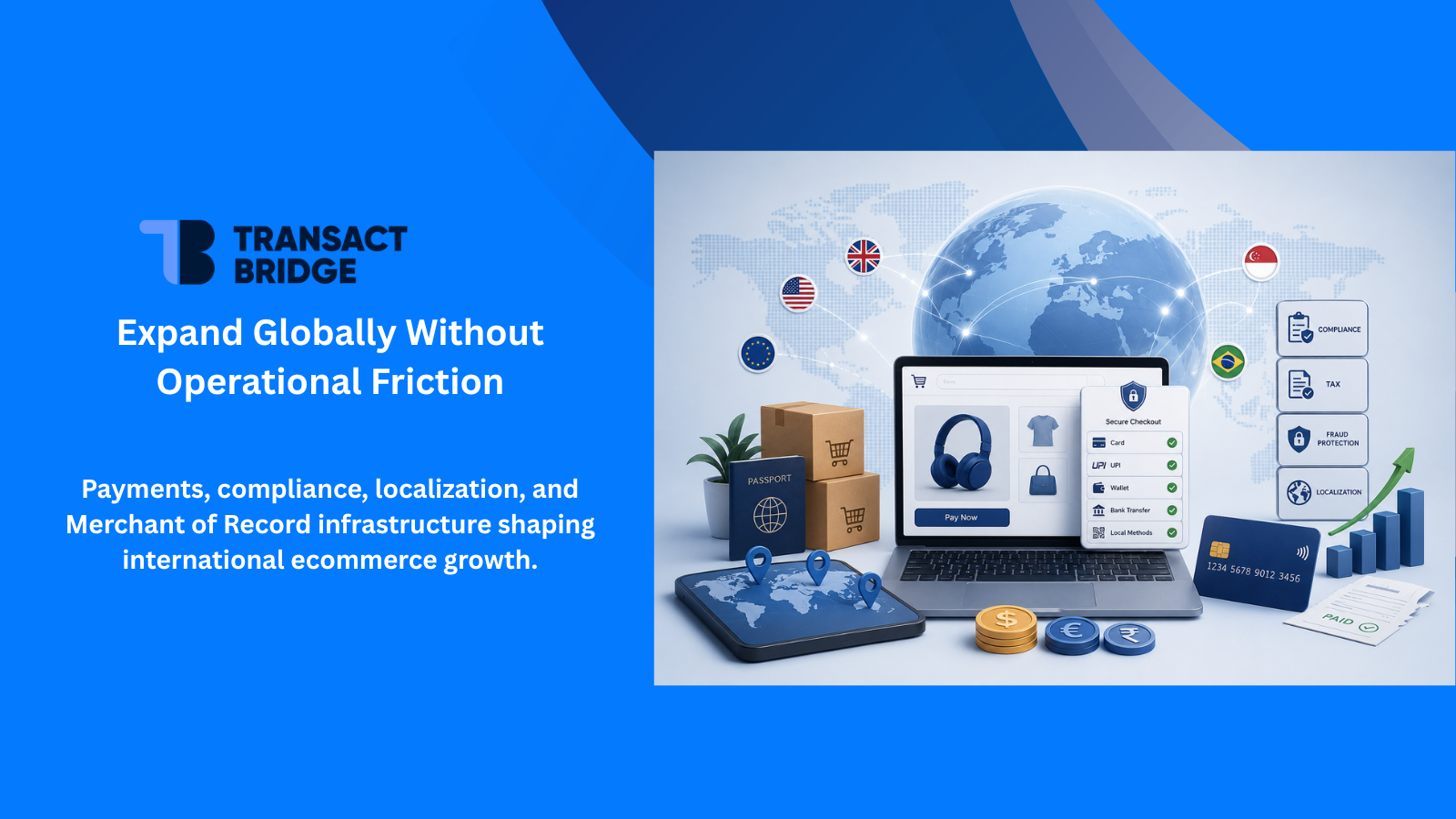
Global ecommerce expansion is no longer limited by demand. It is limited by infrastructure readiness. Cross-border ecommerce is projected to surpass $7.9 trillion globally by 2030, but many businesses still struggle to scale internationally because their payment, compliance, and operational systems were never built for global transactions.
In 2026, global market access is no longer just about launching a storefront or enabling international shipping. Businesses face failed international checkouts, payment authorization losses, regional compliance delays, currency conversion friction, and rising expansion costs that directly impact revenue and speed-to-market.
The companies scaling globally today are the ones building localized payment experiences, faster market access, and infrastructure that reduces friction across the entire transaction journey.
Why Infrastructure Readiness Determines Global Expansion Success
Global ecommerce expansion in 2026 is no longer limited by customer demand. It is limited by how prepared a business is to operate internationally at scale.
Many companies enter new markets assuming international growth is mainly a logistics challenge. In reality, the biggest expansion barriers now appear after customers reach checkout.
Businesses today must manage:
- International ecommerce payments
- Local payment preferences
- Multi currency pricing
- Global ecommerce compliance
- VAT and GST obligations
- Fraud prevention
- Settlement infrastructure
- Regional data privacy requirements
- Subscription billing complexity
- Localization across customer journeys
This operational complexity is growing faster than most businesses expect.
Research continues to show that checkout friction remains one of the biggest barriers to international conversion. Failed transactions, unfamiliar payment methods, unexpected FX costs, and slow payment authorization rates frequently reduce revenue even when customer demand is strong.
For example, an ecommerce brand entering Brazil may generate strong customer demand but still experience high checkout abandonment if Pix payments are unavailable or international card approvals remain inconsistent.
At the same time, consumer expectations have changed dramatically.
Customers now expect global brands to provide localized commerce experiences that feel native to their region. A buyer in India expects UPI support. Customers in Brazil increasingly prefer Pix. European consumers rely heavily on bank transfers and regional payment systems, while Southeast Asian markets continue shifting toward mobile wallets and QR-based payments.
Modern consumers expect:
- Pricing in local currencies
- Familiar payment methods
- Mobile-first checkout experiences
- Transparent taxes and fees
- Faster payment approvals
- Trusted regional payment flows
Without these localized experiences, even well-known brands often experience lower conversion rates and higher cart abandonment.
Why Businesses Need Faster Global Market Access in 2026
This is where infrastructure readiness becomes critical.
Many businesses still rely on fragmented payment systems, disconnected regional providers, manual compliance workflows, and slow onboarding processes that delay expansion timelines and increase operational overhead.
Traditional international expansion models often require:
- Local entity setup
- Banking partnerships
- Regional tax registration
- Compliance onboarding
- Merchant verification processes
These requirements can slow international launches by months.
As a result, businesses are increasingly prioritizing faster Global Market Access (GMA) through scalable infrastructure models that simplify payments, compliance, localization, and operational management across regions.
Many businesses now rely on Global Market Access (GMA) Services to accelerate international launches while reducing operational, payment, and compliance overhead across multiple markets.
In 2026, successful global expansion depends less on simply entering new markets and more on how efficiently businesses can operationalize international commerce infrastructure from day one.
Companies that reduce friction across payments, compliance, localization, and settlements are scaling globally faster than businesses relying on fragmented expansion systems.
The Biggest Mistakes Businesses Make During International Market Expansion
Expanding without local payment methods
One of the fastest ways to reduce international conversion rates is relying only on card-based checkout experiences.
Consumer payment preferences vary significantly across regions. A checkout flow that performs well in the US may underperform in India, Southeast Asia, or Europe if local payment methods are unavailable.
A subscription platform expanding into Southeast Asia may acquire users successfully but struggle with recurring revenue retention if mobile wallet support and localized recurring billing flows are not optimized for regional payment behavior.
Without localized international payment processing, businesses often face:
- Higher checkout abandonment
- Increased payment failures
- Lower authorization rates
- Weak recurring billing performance
- Reduced customer trust
Supporting local payment methods is now a critical part of any successful global expansion strategy.
Assuming consumer buying behavior is universal
Many businesses assume international customers purchase products the same way across markets. In reality, buying behavior differs significantly by region.
Key differences often include:
- Mobile-first vs desktop-first purchasing
- Checkout trust expectations
- Subscription adoption patterns
- Refund preferences
- Payment timing behavior
For example, some markets prioritize speed and convenience, while others focus more on payment security and refund transparency.
Successful international market expansion depends on understanding regional buying behavior; not just translating a website.
Ignoring global ecommerce compliance complexity
Global ecommerce compliance has become far more complex in recent years.
Businesses expanding internationally may need to manage:
- VAT and GST requirements
- AML and KYC obligations
- Cross-border transaction regulations
- Merchant verification standards
- Digital services taxation
Ignoring compliance requirements can create serious operational risks, including delayed settlements, regulatory exposure, and blocked transactions.
Compliance is no longer a backend process handled after expansion. It is now a core part of international growth infrastructure.
Scaling before market validation
Many businesses expand into too many regions too quickly without validating demand, payment performance, or operational readiness.
This often results in:
- Unsustainable acquisition costs
- Weak localization performance
- High operational complexity
- Fragmented reporting
- Low customer retention
A successful global expansion strategy is usually phased, data-driven, and operationally scalable rather than aggressively expanding into every market at once.
Why Payment Infrastructure Determines Global Expansion Success
International ecommerce payments directly impact conversion rates
International ecommerce payments are no longer just operational systems. They directly influence revenue growth, customer retention, and international scalability.
Every additional layer of checkout friction increases the risk of failed transactions and lost revenue. Even small payment inefficiencies can significantly impact conversion rates at scale.
Common payment-related growth barriers include:
- Payment authorization failures
- Cross-border transaction declines
- Poor mobile checkout experiences
- Currency confusion
- Subscription payment failures
- Limited regional acquiring support
Businesses that optimize cross border payments ecommerce infrastructure often improve:
- Checkout completion rates
- Authorization success rates
- Customer trust
- Recurring billing performance
- International retention
- Revenue predictability
In global ecommerce expansion, payment performance optimization has become a direct revenue driver rather than just a backend operational concern.
Local payment methods are becoming mandatory
Alternative payment methods global consumers prefer are reshaping modern ecommerce infrastructure.
Some of the most important payment ecosystems now include:
- UPI in India
- Wallet ecosystems across Southeast Asia
- Instant bank transfers in Europe
- QR-based payment systems
- Account-to-account payment networks
In many regions, consumers trust local payment methods more than international card networks. Businesses that fail to support these ecosystems often experience lower conversion rates, higher checkout abandonment, and weaker customer trust despite strong market demand.
As a result, global payment solutions increasingly focus on localized payment acceptance rather than relying only on traditional card processing.
Multi currency payment processing improves customer experience
Customers are significantly more likely to complete purchases when pricing is displayed in their local currency.
Multi currency payment processing improves:
- Pricing clarity
- Checkout trust
- Purchase confidence
- International conversion rates
It also helps businesses reduce cart abandonment caused by unexpected FX conversions, unclear final pricing, or inconsistent settlement experiences.
For example, customers shown USD pricing in European markets often abandon checkout when final settlement values fluctuate due to FX conversion fees or unclear local tax calculations.
Today, localized pricing and multi currency payment processing are becoming core components of a scalable global payment solution rather than standalone ecommerce features.
Cross border payment challenges businesses underestimate
Many businesses underestimate the operational complexity of managing cross-border payments at scale.
A gaming company scaling internationally may process transactions across multiple PSPs and acquiring partners, but without centralized payment visibility, reconciliation delays and inconsistent authorization rates can significantly affect revenue forecasting accuracy.
Common challenges include:
- Settlement delays
- FX conversion losses
- Inconsistent authorization rates
- Reconciliation fragmentation
- High transaction fees
- Multiple payment provider dependencies
Without scalable global payment infrastructure, finance and operations teams often struggle with fragmented transaction visibility, delayed settlements, and rising operational overhead.
As businesses expand into additional regions, these inefficiencies can directly impact revenue forecasting, operational scalability, and customer experience.
Building scalable global payment infrastructure
Modern global payment infrastructure requires far more than a standard payment gateway.
As businesses expand internationally, payment complexity increases across currencies, regions, acquiring networks, fraud systems, and settlement workflows. Without scalable infrastructure, even high-growth businesses can experience rising payment failures, delayed settlements, fragmented reporting, and declining authorization rates across international markets.
For example, without payment orchestration, international transactions may route through suboptimal acquiring networks, increasing cross-border payment failures and reducing revenue recovery at scale.
Similarly, businesses operating across multiple payment providers often struggle with:
- Inconsistent authorization performance
- Fragmented reconciliation workflows
- Limited transaction visibility
- Higher operational overhead
- Slower dispute resolution
- Weak recurring billing performance
These operational inefficiencies directly impact conversion rates, customer retention, and international revenue growth.
To reduce friction, businesses increasingly rely on:
- Payment orchestration platforms
- Smart transaction routing
- Regional acquiring infrastructure
- API-driven payment integrations
- Automated reconciliation systems
- Unified cross-border payment reporting
A scalable global payment solution helps businesses improve authorization success rates, reduce failed payment costs, optimize settlement visibility, and deliver more consistent checkout experiences across international markets.
As cross-border commerce becomes more complex, integrated global payment infrastructure is becoming essential for businesses that want to scale internationally without creating operational bottlenecks across payments, compliance, finance, and customer experience teams.
Global Market Access Requires More Than Translation
Localization is the difference between traffic and revenue
Many businesses confuse translation with localization.
Translation changes language. Localization changes the entire customer experience.
Successful global expansion requires businesses to align with regional purchasing behavior, pricing expectations, checkout preferences, and communication styles; not just translate website content.
Effective localization typically includes:
- Regional messaging alignment
- Cultural purchasing psychology
- Local pricing expectations
- Localized checkout solutions
- Region-specific payment behavior
- Mobile-first user experiences
Businesses that localize effectively often outperform competitors with larger marketing budgets but weaker customer experience infrastructure.
Localized checkout and trust directly impact conversion
Localized checkout solutions play a major role in international conversion performance.
Customers are more likely to complete purchases when checkout experiences include familiar payment flows, local currencies, trusted payment methods, transparent pricing, and region-specific authentication standards.
Trust also becomes a critical factor in international commerce. Customers evaluate businesses based on:
- Checkout familiarity
- Pricing transparency
- Refund and return clarity
- Security reassurance
- Local support availability
- Regional credibility signals
For subscription businesses, these challenges become even more important. International subscription billing often requires region-specific optimization for recurring payments, retry logic, currency fluctuations, and regulatory billing requirements.
Businesses that invest in localized customer experiences and scalable subscription infrastructure typically improve customer retention while reducing involuntary churn across international markets.
The Hidden Compliance Challenges of Selling Internationally
Global tax compliance ecommerce businesses cannot ignore
Global tax compliance ecommerce requirements have become one of the biggest operational challenges for businesses scaling internationally.
Companies selling across borders may need to manage:
- VAT registration
- GST collection
- Cross-border tax reporting
- Digital services taxation
- Regional invoicing standards
For example, a SaaS platform launching in multiple international markets may spend months managing local tax registration, payment onboarding, and compliance approvals before processing its first transaction. Merchant of record infrastructure helps reduce this operational delay significantly.
As international transaction volumes grow, manual tax workflows often become unsustainable and increase the risk of reporting errors, compliance gaps, and operational inefficiencies.
For many businesses, weak global tax compliance ecommerce infrastructure can lead to settlement delays, regulatory penalties, onboarding issues, and transaction restrictions that directly impact revenue operations.
Regulatory requirements continue to expand globally
Governments worldwide are increasing regulatory oversight for digital commerce and international payments.
Businesses expanding globally increasingly encounter:
- AML obligations
- KYC verification requirements
- Merchant onboarding regulations
- Regional transaction monitoring frameworks
Compliance readiness is now directly tied to Global Market Access. Businesses that cannot meet regional compliance standards often experience onboarding delays, payment activation issues, or restricted market access.
As a result, global tax compliance ecommerce strategies are becoming a core part of international expansion planning rather than a backend finance process.
Data privacy regulations are reshaping global commerce
Data privacy regulations continue influencing global ecommerce infrastructure decisions.
Businesses operating internationally must increasingly manage:
- GDPR compliance
- Data localization laws
- Consumer consent requirements
- Cross-border data transfer restrictions
Weak compliance infrastructure can significantly increase operational risk, delay international launches, and create long-term regulatory exposure across multiple regions.
Compliance delays often slow international expansion
Many businesses underestimate how compliance bottlenecks affect global scaling.
Operational delays commonly occur during:
- Market onboarding
- Merchant verification
- Payment activation
- Settlement approval
Without scalable compliance infrastructure, businesses may face settlement freezes, delayed approvals, restricted transactions, and slower international rollout timelines.
Companies that automate compliance workflows and strengthen global tax compliance ecommerce processes generally achieve faster Global Market Access than businesses relying on fragmented manual operations.
Why Merchant of Record Solutions Are Becoming Essential in 2026
Merchant of Record infrastructure is becoming a growth enabler for global expansion
As international ecommerce, SaaS, subscriptions, gaming, and digital commerce continue scaling globally, businesses are increasingly struggling with the operational burden of managing regional entities, tax compliance, payment infrastructure, and cross-border regulatory requirements independently.
Traditional international expansion models often require:
- Local entity setup
- Regional tax registration
- Banking partnerships
- Merchant onboarding
- Compliance approvals
- Ongoing legal and operational management
These processes can significantly delay international launches while increasing infrastructure costs and operational complexity.
This is why merchant of record solutions are becoming a critical part of modern global expansion strategy.
A merchant of record (MOR) manages the operational infrastructure required to process international transactions compliantly across multiple markets. This typically includes:
- Payment processing
- Tax calculation and remittance
- VAT and GST management
- Fraud prevention
- Chargeback handling
- Compliance management
- Merchant liability coverage
Unlike traditional payment service providers (PSPs), a merchant of record platform also assumes operational and regulatory responsibility for the transaction lifecycle across supported regions.
Why SaaS, gaming, and subscription businesses increasingly rely on merchant of record services
For SaaS platforms, gaming companies, subscription businesses, creator platforms, and digital product providers, global expansion often creates significant operational friction.
Managing recurring billing across regions, maintaining local compliance readiness, handling international tax obligations, and optimizing payment authorization rates across multiple payment ecosystems can quickly become resource-intensive.
Without merchant of record infrastructure, businesses frequently experience:
- Slower market launches
- Higher compliance overhead
- Delayed payment activation
- Increased operational costs
- Fragmented international payment operations
- Lower recurring payment performance
- Reduced revenue recovery from failed transactions
Merchant of record services help reduce these bottlenecks by centralizing payments, compliance, tax handling, and operational management within a unified global infrastructure model.
As a result, businesses can often:
- Launch internationally faster
- Reduce entity setup costs
- Improve operational scalability
- Simplify global tax compliance
- Accelerate payment activation
- Optimize subscription billing performance
- Improve international revenue operations
Merchant of Record vs traditional international expansion models
Traditional expansion models typically involve building fragmented regional infrastructure market by market. Businesses may need separate payment providers, local banking relationships, compliance workflows, and tax operations across every geography.
Instead of establishing separate regional entities before validating market demand, many digital-first businesses now use merchant of record solutions to test international markets faster while maintaining centralized payment and compliance operations.
This approach often increases:
- Infrastructure overhead
- Operational fragmentation
- Compliance complexity
- Reconciliation inefficiencies
- International launch timelines
Merchant of record platforms simplify these workflows by consolidating:
- Global payment infrastructure
- Cross-border ecommerce compliance
- Tax operations
- Settlement management
- International transaction processing
- Revenue reporting workflows
For many digital first businesses, the ability to sell globally without local entity setup has become a major competitive advantage in 2026.
Instead of investing heavily in regional operational infrastructure before validating demand, businesses can use merchant of record solutions to accelerate Global Market Access while maintaining centralized operational control.
As global commerce becomes increasingly infrastructure-driven, merchant of record services are evolving from a compliance convenience into a strategic growth layer for international revenue expansion.
Building an Effective Global Expansion Strategy in 2026
Validate market opportunity before scaling
An effective global expansion strategy starts with operational validation; not just market demand.
Before entering a new region, businesses should evaluate:
- Regional demand and customer acquisition economics
- Local payment behavior and preferred payment methods
- Regulatory and compliance requirements
- Localization readiness
- Competitive positioning
- Regional acquiring and settlement feasibility
Many businesses expand too quickly without validating payment performance, compliance readiness, or localization infrastructure, which often creates operational inefficiencies later.
A successful global expansion strategy balances revenue opportunity with infrastructure readiness from the beginning.
Prioritize markets strategically
Not every international market should be approached simultaneously.
Businesses should prioritize regions based on:
- Revenue potential
- Payment ecosystem maturity
- Regulatory complexity
- Local acquiring availability
- Operational scalability
- Long-term retention opportunity
Strategic regional sequencing helps businesses reduce operational strain while improving rollout efficiency across payments, compliance, and customer experience infrastructure.
This approach also allows companies to optimize authorization rates, settlement workflows, and localized commerce experiences market by market.
Build cross-border ecommerce solutions that scale
Modern cross border ecommerce solutions require tightly connected infrastructure across multiple operational layers.
This often includes:
- International payments
- Tax automation
- Fraud prevention
- Subscription billing
- Localization systems
- Compliance workflows
- Reporting and reconciliation infrastructure
Disconnected systems create scaling inefficiencies quickly, especially as businesses expand into multiple currencies, payment ecosystems, and regulatory environments.
As international operations grow, businesses increasingly need integrated cross border ecommerce solutions that centralize payment visibility, operational reporting, and compliance management.
Expansion infrastructure must Scale with revenue growth
International growth increases operational complexity at every stage of expansion.
Businesses need infrastructure capable of supporting:
- Settlement visibility
- Automated reporting
- Reconciliation management
- Multi-market payment operations
- Unified customer experiences
- Regional compliance management
A scalable global expansion strategy depends on infrastructure that can support increasing transaction volumes, expanding payment ecosystems, and regional operational requirements without creating friction across finance, compliance, or customer experience teams.
Businesses that invest early in scalable international ecommerce solutions are generally better positioned to expand efficiently while maintaining operational control and profitability across global markets.
Global Ecommerce Expansion Trends Defining 2026
AI-driven localization and commerce personalization
AI is rapidly transforming how businesses approach global ecommerce expansion.
Companies are increasingly using AI to improve:
- Dynamic localization
- Personalized checkout experiences
- Regional pricing optimization
- Fraud detection
- Customer retention modeling
The operational impact is significant. Businesses can now adapt customer experiences based on region, payment behavior, device usage, and purchasing patterns in real time.
As international competition increases, AI-driven localization is becoming a major differentiator for improving conversion rates, reducing checkout friction, and increasing customer retention across global markets.
Real-time payments and alternative payment methods are reshaping global commerce
Real-time payment ecosystems and alternative payment methods are changing how international transactions are processed worldwide.
Wallets, QR payments, instant bank transfers, and account-to-account payment systems continue expanding rapidly across emerging and developed markets alike.
This shift is improving:
- Transaction speed
- Settlement visibility
- Checkout convenience
- Payment authorization performance
- Mobile commerce adoption
Businesses that support regional payment ecosystems are often able to improve international conversion rates while reducing payment failures and checkout abandonment.
As a result, localized payment acceptance is becoming a core part of modern global payment infrastructure.
Payment orchestration and integrated infrastructure are becoming standard
As international operations grow more complex, businesses are moving away from fragmented payment stacks and disconnected regional systems.
Payment orchestration platforms are helping businesses improve:
- Smart transaction routing
- Authorization success rates
- Multi-provider management
- Operational visibility
- Reconciliation efficiency
At the same time, embedded finance infrastructure is integrating payments, wallets, financing, and subscription management directly into ecommerce ecosystems.
This operational shift allows businesses to scale internationally with greater flexibility, lower infrastructure overhead, and stronger payment performance across multiple markets.
Merchant of record solutions are accelerating global market access
Merchant of record solutions are becoming a key infrastructure layer for businesses expanding internationally in 2026.
Instead of managing regional entities, tax onboarding, compliance operations, and payment infrastructure independently, businesses increasingly rely on merchant of record platforms to simplify global expansion.
This helps organizations achieve:
- Faster market launches
- Reduced compliance overhead
- Simplified tax management
- Faster payment activation
- Lower operational complexity
For SaaS, gaming, subscriptions, digital products, and cross-border ecommerce businesses, merchant of record infrastructure is helping accelerate Global Market Access while reducing operational friction across international markets.
Global Ecommerce Expansion Checklist for 2026
Before expanding internationally, businesses should evaluate whether their infrastructure is prepared to support payments, compliance, localization, and operational scalability across multiple markets.
Payments infrastructure
- Local payment method coverage
- Multi currency payment processing
- Cross-border payment optimization
- Regional acquiring support
- Subscription billing optimization
- Payment authorization monitoring
- Settlement visibility across markets
Compliance and tax readiness
- Global ecommerce compliance processes
- Global tax compliance ecommerce workflows
- VAT and GST management
- AML and KYC readiness
- Regional regulatory monitoring
- Merchant verification infrastructure
Localization and customer experience
- Localized checkout solutions
- Pricing in local currencies
- Mobile-first checkout optimization
- Region-specific payment experiences
- Transparent taxes and fees
- Local trust and security indicators
Operational scalability
- Fraud prevention systems
- Automated reconciliation infrastructure
- Unified operational reporting
- Multi-market transaction visibility
- Regional customer support readiness
- Cross-border operational scalability
Businesses that address these areas early are generally better positioned to scale revenue internationally while reducing operational friction, payment failures, and compliance-related expansion delays.
The Way Forward
Global ecommerce expansion in 2026 is increasingly driven by infrastructure readiness rather than market demand alone. Businesses that scale successfully across international markets are investing in global payment infrastructure, localized checkout experiences, compliance automation, multi currency payment processing, and faster Global Market Access.
As cross-border commerce becomes more competitive, operational efficiency now directly impacts conversion rates, payment success, customer retention, and revenue growth. Businesses relying on fragmented systems and manual workflows often struggle to scale internationally.
The companies that grow fastest are the ones reducing friction across payments, compliance, localization, settlements, and customer experience.
Platforms like Transact Bridge help businesses simplify international ecommerce payments, Merchant of Record operations, Global Market Access, and compliance infrastructure through scalable global expansion solutions.
FAQs
What is global ecommerce expansion?
Global ecommerce expansion refers to the process of selling products or services across international markets using scalable payment, compliance, localization, and operational infrastructure. It helps businesses reach global customers while supporting region-specific commerce experiences.
What are the biggest cross-border payment challenges?
The biggest cross-border payment challenges include payment authorization failures, currency conversion issues, settlement delays, high transaction costs, fraud risks, and lack of local payment methods. These issues can directly impact conversion rates and customer experience.
What is a Merchant of Record?
A merchant of record is a third-party entity that handles payment processing, tax management, compliance, fraud prevention, and liability on behalf of a business. Merchant of Record solutions simplify international selling and reduce operational complexity.
How do businesses sell globally without local entities?
Businesses can sell globally without local entity setup by using a merchant of record platform. This allows companies to manage international ecommerce payments, compliance, taxes, and localized checkout experiences without establishing separate regional entities.
Why are local payment methods important?
Local payment methods improve customer trust, checkout familiarity, and conversion rates. Consumers prefer payment options they already use and trust, such as UPI, wallets, bank transfers, and QR-based payments specific to their region.
What is Global Market Access (GMA)?
Global Market Access (GMA) refers to the infrastructure, compliance, payments, and operational capabilities that help businesses enter and scale in international markets faster. Global Market Access (GMA) Services simplify expansion by reducing onboarding, compliance, and localization barriers.