How a Global Spiritual Tech Platform Turned India Traffic Into Revenue Without Setting Up Locally
Published on: Mon 08-Jun-2026 11:56 AM
Client Overview
A US based spiritual and digital wellness platform had built a strong global presence with India emerging as one of its fastest growing audiences.
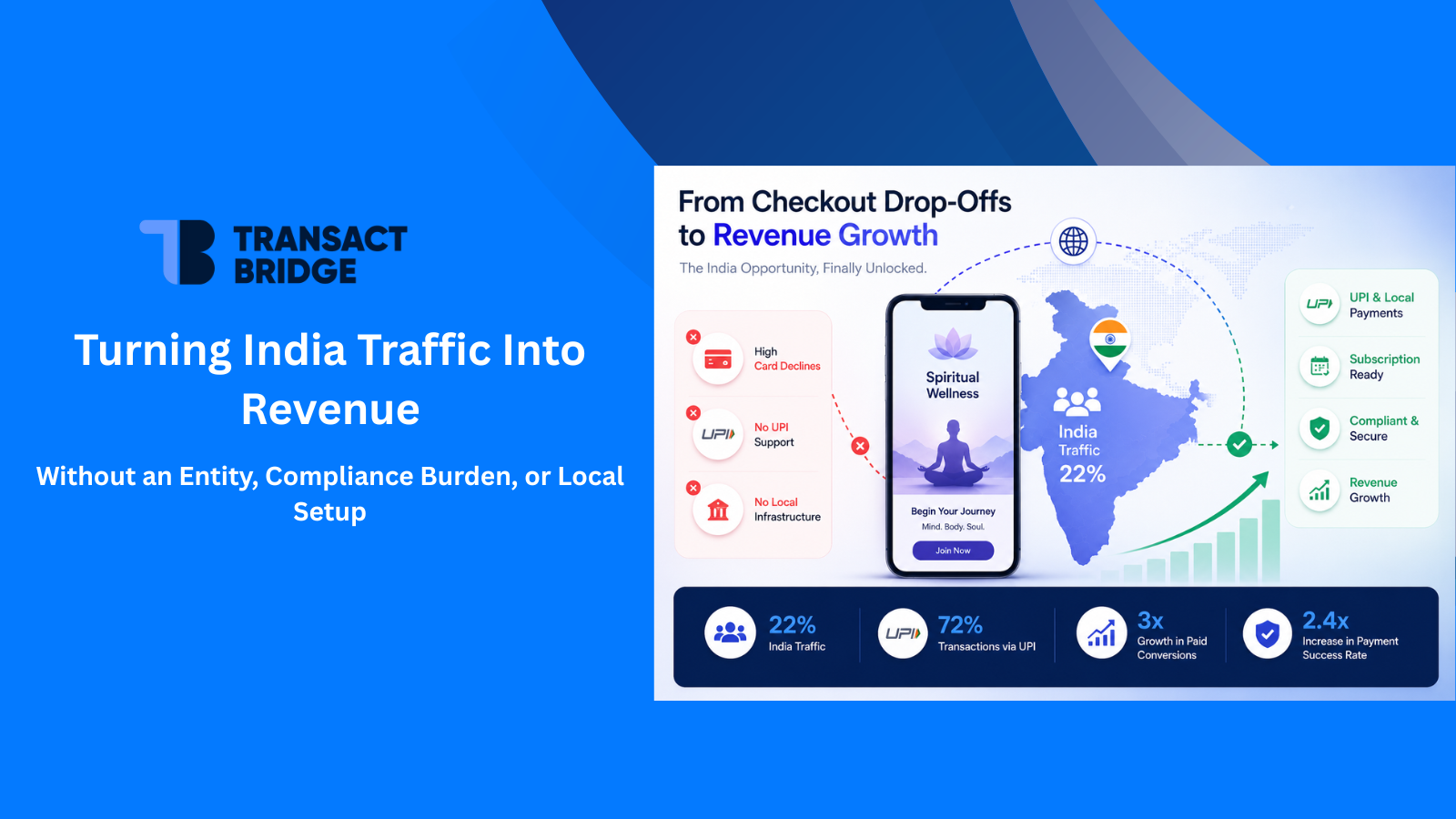
- 22% of total traffic was coming from India
- Over 1.5 lakh monthly Indian users engaging with content
- High session time and repeat visits
But despite this traction, revenue from India was disproportionately low.
Transact Bridge helped the company unlock this demand by enabling local payments, compliance, and subscriptions without setting up an entity in India.
The India Opportunity They Couldn’t Capture
India wasn’t just another geography, it was already a high-intent market.
Over a span of 6–9 months, the company observed:
- 3.2x growth in India traffic
- 28% of free users upgrading intent coming from India
- India contributing less than 4% to total revenue
This mismatch triggered a deeper funnel analysis.
What they found was unexpected:
Over 60% of Indian users were dropping off at checkout
Users were reaching the payment page.
They were attempting to pay.
But transactions weren’t going through.
What Was Breaking the Funnel
The issue wasn’t demand, it was infrastructure.
A detailed breakdown revealed:
- International card failure rates crossed 58–65% post RBI tokenization changes
- 0% UPI support, despite UPI contributing 80%+ of India’s digital payments
- No Indian entity, blocking access to domestic payment gateways
- Subscription failure rate ~40% due to lack of compliant recurring systems
- Refunds and disputes spread across 3+ fragmented systems with no unified visibility
In simple terms:
The client had built distribution in India but not the ability to transact.
The Shift: Full-Stack India Enablement via MoR
Instead of building India infrastructure from scratch (which would take 6–9 months),
The company partnered with Transact Bridge as its Merchant of Record (MoR).
This allowed them to go live in under 3 weeks.
Transact Bridge became responsible for:
- Payment collection
- Regulatory compliance (GST, RBI norms)
- Currency conversion and settlement
- Refunds, disputes, and reporting
All while the client retained full control over product, pricing, and user experience.
What Changed on the Ground
Post integration, the checkout experience aligned with how India actually pays:
- UPI + Local Payment Methods Enabled
Within the first month, 72% of India transactions shifted to UPI - Card Success Rates Improved
From ~35–40% to over 78% success rate - Recurring Billing Stabilized
Subscription success rates improved from ~60% to 90%+ - Dynamic Routing Reduced Failures
Payment failures dropped by over 45% across rails - Unified Ops Layer Introduced
100% visibility across refunds, disputes, and settlements
The Outcome: From Leakage to Revenue Engine
The impact was both immediate and compounding:
- 46%+ reduction in checkout drop-offs
- 2.4x increase in India payment success rate
- 3x growth in paid conversions from India within 60 days
- Monthly revenue from India grew from ~$25K to ~$110K in one quarter
- India’s contribution to global revenue increased from ~4% to 12%+
- 0 local entity, 0 compliance overhead
Most importantly:
India shifted from an underperforming funnel
to a predictable, scalable revenue market
What Made It Work
The company didn’t need to:
- Set up a legal entity
- Open local bank accounts
- Hire compliance teams
- Or rebuild their payment stack
Instead, the MoR model compressed what typically takes quarters into weeks.
With a single integration, they unlocked:
- Local payment access
- Regulatory coverage
- Operational efficiency
Footnote
India was never a demand problem.
It was an access problem.
Once the rails were fixed,
revenue followed.