International Payment Methods Explained: How to Accept Payments Globally
Published on: Thu 04-Jun-2026 05:59 AM
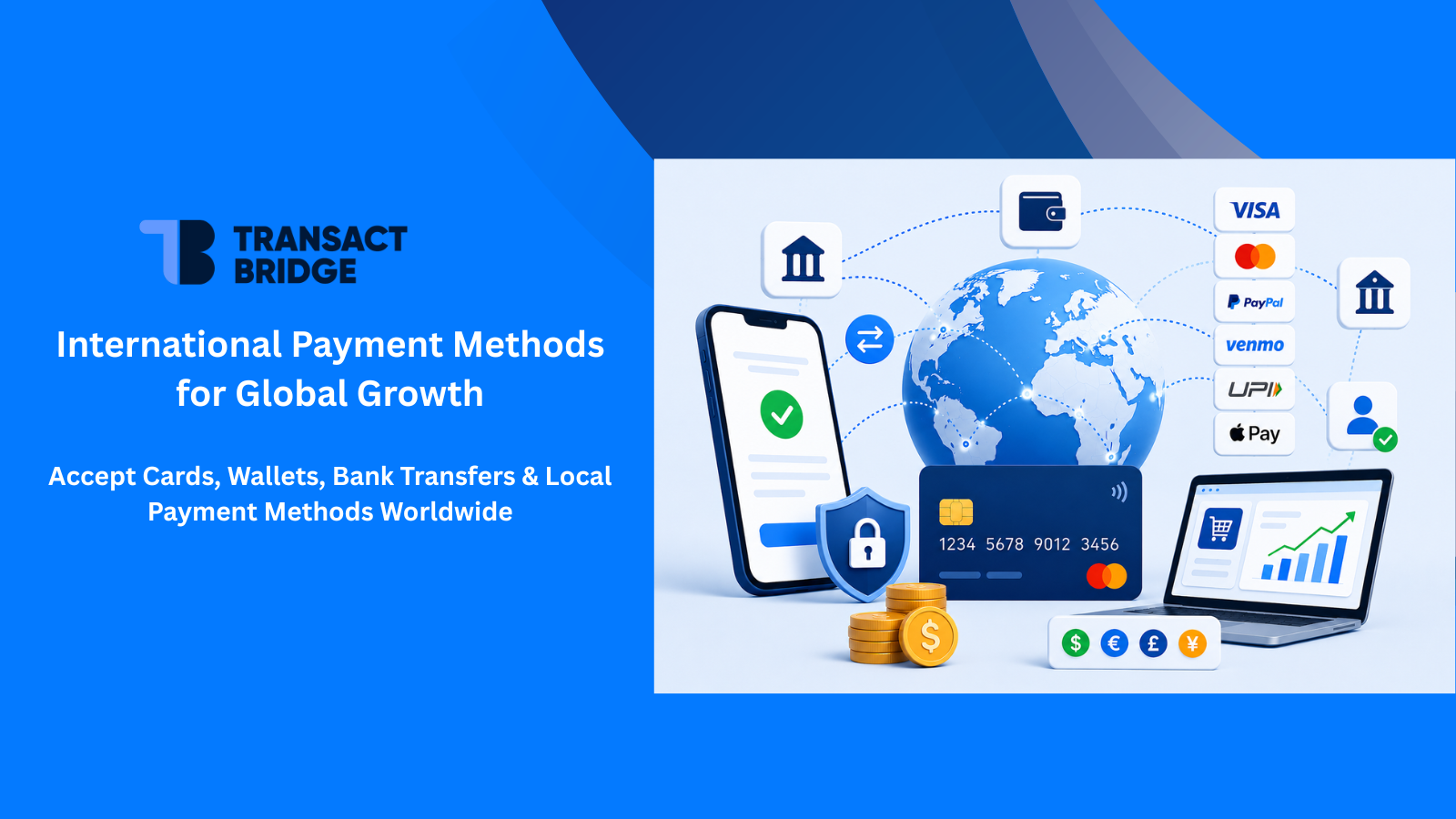
Cross-border payments or international cross border payments are growing at a pace most businesses are not prepared for.
According to McKinsey's 2025 Global payments revenue is projected to reach $3 trillion by 2029, up from $2.5 trillion in 2024. Yet cross-border payment failure rates remain between 15% and 25%, compared to just 1–5% for domestic transactions. The reason is simple: many businesses expand globally with payment methods that do not match local customer preferences.
International payment methods are the tools, networks, and payment rails that enable transactions between parties in different countries. For ecommerce businesses, SaaS companies, marketplaces, and exporters looking to accept payments globally, choosing the right payment methods directly impacts conversion rates, payment approval rates, and international revenue growth.
This guide explains the main international payment methods, regional payment preferences, payment gateway selection, common challenges, and best practices for accepting payments globally.
What Are International Payment Methods?
An international payment is a financial transaction where the sender and recipient are based in different countries. Unlike a domestic payment which moves within a single banking system, currency, and regulatory framework, an international payment must cross currency boundaries, pass through intermediary institutions, and satisfy the compliance requirements of multiple jurisdictions simultaneously.
Types of International Payment Methods
Businesses can accept international payments through several payment methods, each suited to different customer preferences and transaction types.
The most common international payment methods include:
- Credit and Debit Cards : Visa, Mastercard, American Express, and other global card networks.
- International Bank Transfers: Direct account-to-account payments using networks such as SWIFT.
- Digital Wallets: Wallet-based payments such as PayPal, Apple Pay, and Google Pay.
- Local Payment Methods: Country-specific payment rails preferred by local consumers.
- Remittance Platforms: Services designed for international money transfers and payouts.
While cards remain the most widely accepted payment method globally, local payment methods often generate higher conversion rates because customers prefer familiar and trusted payment experiences.
Payment Gateway vs Payment Processor
These two terms are often used interchangeably, but they serve different functions:
| Component | Role |
| Payment Gateway | Authenticates, authorises, and routes payment transactions. |
| Payment Processor | Executes the movement of funds between financial institutions. |
Many modern payment platforms combine both capabilities, but understanding the distinction helps when evaluating international payment providers.
How an International Payment Works
A typical international payment follows these steps:
- Customer initiates payment at checkout.
- Payment gateway authenticates and routes the transaction.
- Acquiring bank processes the payment request.
- Currency conversion occurs if required.
- Funds travel through SWIFT or a local payment network.
- Settlement occurs in the merchant's designated currency.
International Payments vs. Domestic Payments at a Glance
| Factor | Domestic | International |
| Speed | Seconds to 1 day | Seconds to 5 days |
| Failure Rate | 1–5% | 15–25% |
| FX Cost | None | 0.5–3% spread |
| Intermediaries | 1–2 | 2–5+ |
| Regulatory Burden | Single jurisdiction | Multiple jurisdictions |
The failure rate difference is one of the most underappreciated challenges in international payments. Cross-border transactions, including card payments, bank transfers, and digital wallet payments, are subject to stricter fraud screening, additional compliance checks, and currency-related validation rules that do not exist in most domestic payment environments. As a result, legitimate transactions are more likely to be declined. One of the most effective ways to reduce these failures is through local acquiring, which allows transactions to be processed closer to the customer's banking network.
Main Types of International Payment Methods
There is no single best international payment method. The right choice depends on your market, transaction size, customer type, and how much speed and cost matter for each use case. Here are the six types that matter for any business operating across borders.
1. SWIFT Bank Transfers
SWIFT (Society for Worldwide Interbank Financial Telecommunication) is the global messaging network that banks use to coordinate international money transfers. It is not a bank itself and does not move funds; instead, it securely transmits payment instructions between more than 11,000 financial institutions across 200+ countries.
A typical SWIFT transfer takes between one and five business days and may cost $15–$50 per transaction, excluding any fees charged by intermediary banks. Because payments often pass through multiple correspondent banks before reaching the destination, costs and settlement times can vary significantly by corridor.
SWIFT remains the preferred option for large B2B transactions, international supplier payments, and markets where no local payment alternative exists. While payment messaging has become significantly faster, settlement times still depend on the banks involved and the destination country's financial infrastructure.
2. International Payment Gateways
An international payment gateway is the digital infrastructure that processes card payments and alternative payment methods across borders in real time. It sits between the merchant and the banking network, handling authentication, fraud screening, currency conversion, and routing in milliseconds.
The critical point that most comparisons miss: gateways that route transactions through a local acquiring bank in the customer's country consistently achieve 10–15% higher authorisation rates than gateways processing purely on a cross-border basis. When a transaction is processed locally, it looks like a domestic payment to the issuing bank with lower risk profile, higher likelihood of approval. This single factor can have a larger impact on international revenue than any other part of the payment stack.
International payment gateways are the right foundation for ecommerce businesses, SaaS companies, digital platforms, and any business where checkout conversion directly drives revenue. Transact Bridge provides access to 180+ countries and 135+ currencies through a single integration, with local acquiring in key markets to protect authorisation rates.
For businesses accepting payments over the phone or via invoice, common in B2B and professional services, a virtual terminal payment gateway allows card-not-present transactions without a physical checkout.
3. Local Payment Rails and Alternative Payment Methods
Local payment rails are payment networks that operate within a specific country or region, entirely outside the global card infrastructure. They are not alternatives in the sense of being second-best. In many markets, they are the primary payment method used by the majority of consumers.
The numbers make the case plainly. India's Unified Payments Interface (UPI) accounted for 55% of all e-commerce payment volume in 2024 and grew 42% year-on-year in H2 2024. Brazil's Pix processed 68.7 billion transactions in 2024, a 52% increase year-on-year, with each transaction settling in under ten seconds, 24 hours a day, seven days a week. In Europe, SEPA Instant became mandatory for all EU banks from January 2025, enabling euro-denominated settlement across 36 countries in under ten seconds.
For businesses seeking an international payment gateway in India, the ability to process both UPI and card payments through a single integration is a key consideration, avoiding the need to manage separate domestic and cross-border payment providers.
Offering only cards in markets like India or Brazil is not a neutral strategy. Research consistently shows that shoppers abandon checkout when their preferred payment method is unavailable. Localising payment methods at checkout can lift conversion by 15–30% in markets where card penetration is low.
Popular Local Payment Methods by Market
| Market | Popular Payment Methods |
| India | UPI, RuPay, Net Banking |
| Brazil | Pix, Boleto Bancário |
| Netherlands | iDEAL |
| Poland | BLIK |
| Germany | PayPal, SEPA Direct Debit |
| China | Alipay, WeChat Pay |
| Kenya | M-PESA |
| United States | Credit Cards, PayPal, Venmo |
Key takeaway: The most effective international payment strategy is not offering every available payment method. It is offering the payment methods customers already prefer in each target market.
4. Digital Wallets
Digital wallets store payment credentials and enable one-tap or QR code checkout without the customer entering card details at each transaction. The convenience factor is significant, but the more important point for merchants is that wallet preference is market-specific and non-negotiable.
In China, Alipay and WeChat Pay are the default payment infrastructure for most consumers. WeChat Pay had over 1.3 billion users as of 2025. In Southeast Asia, GrabPay dominates Singapore and Malaysia; OVO and Dana lead in Indonesia; GCash is the primary digital wallet in the Philippines.
In Kenya, M-PESA is not a payment app, it is how millions of people conduct all financial activity, because mobile money became widespread before bank accounts did. In Europe and North America, Apple Pay and Google Pay are growing rapidly in digital checkout, and buy-now-pay-later options like Klarna are taking meaningful share in retail.
The practical implication: check which wallet dominates each target market before you build your checkout. Offering the wrong wallet or no wallet is a measurable conversion problem.
5. Wire Transfers and Cross-Border Remittance
Wire transfers are direct bank-to-bank transfers for moving money internationally outside the card network. For business-to-business payments, paying overseas suppliers, disbursing cross-border payroll, settling with international partners, wire transfers remain common. The category also includes specialist remittance platforms like Wise and Payoneer, which have built faster, cheaper corridors by routing through local rails rather than correspondent banking chains.
The cost and speed advantages of specialist providers over traditional bank wires are substantial. Where a bank wire might cost $30–$50 and take three days, a platform routing through local rails can deliver the same transfer for a fraction of the cost, often same-day. For businesses managing high volumes of international supplier or payroll payments, this difference adds up quickly.
Comparison: International Payment Methods
| Payment Method | Speed | Cost | Best For | Global Coverage |
|---|---|---|---|---|
| SWIFT Transfer | 1–5 Days | High | Large B2B Payments | Excellent |
| International Payment Gateway | Real-Time | Medium | Ecommerce & SaaS | Excellent |
| Local Payment Rails | Seconds | Low | Consumer Payments | Regional |
| Digital Wallets | Real-Time | Low–Medium | Online Checkout | Strong |
| Wire Transfer / Remittance | Hours–Days | Variable | Payroll & Supplier Payments | Strong |
How to Choose the Best International Payment Gateway
The international payment gateway you choose determines your coverage, your authorisation rates, your FX costs, and your compliance exposure. These are not small variables.
Basic Payment Gateway vs Global International Payment Gateway
| Feature | Basic Payment Gateway | Global International Payment Gateway |
| Multi-Currency Support | Limited | Extensive |
| Local Payment Methods | Card-focused | Cards, wallets, bank transfers, local rails |
| Local Acquiring | Usually unavailable | Available in key markets |
| FX Optimisation | Basic conversion | Competitive FX and local settlement |
| Cross-Border Authorisation Rates | Lower | Higher through local processing |
| Compliance Support | Limited | PCI DSS, PSD2, AML, KYC support |
| Global Coverage | Selected countries | Broad international coverage |
Businesses expanding internationally typically benefit from a global payment gateway because it combines local payment support, local acquiring, currency management, and compliance infrastructure within a single platform. These capabilities directly influence checkout conversion rates, payment approval rates, and the overall customer experience.
Compare Transact Bridge for your market →
What Is a Merchant of Record and Where Does It Fit in International Payments?
A Merchant of Record (MoR) is the legal entity that takes on the responsibility of selling to the end customer, including tax calculation, VAT or GST remittance, compliance with local consumer protection laws, and chargeback liability. When a business uses an MoR platform, the MoR appears as the seller of record on the customer's receipt, not the business itself.
MoR vs Payment Gateway: Key Differences
An international payment gateway processes transactions. It routes payments, manages currency conversion, and improves authorisation rates. It does not assume any tax or compliance responsibility; those obligations remain with the merchant. An MoR platform goes further: it absorbs the entire legal and financial relationship with the customer, including indirect tax filings across jurisdictions, refund liability, and fraud exposure.
The practical distinction: if your business needs to register for GST in India, collect VAT in Germany, and file sales tax across US states, an MoR handles all of that on your behalf. A payment gateway does not.
When Does a Business Need an MoR?
An MoR model is typically the right fit for SaaS companies and digital product businesses selling subscriptions globally, where indirect tax obligations span multiple countries and managing compliance in-house would require significant legal and operational overhead. Businesses selling physical goods, services with local fulfilment, or operating at enterprise scale with dedicated tax and legal teams generally find that a global payment gateway combined with local compliance infrastructure is a more cost-effective and flexible approach.
For businesses that sell across both digital and physical channels, or that need payment method depth beyond what most MoR platforms support, including real-time payment rails across Asia, Latin America, and Africa, a global payment gateway with built-in compliance infrastructure often covers more ground than an MoR alone.
7 Criteria for Choosing an International Payment Gateway
Here are the seven criteria that matter most.
1. Currency and Country Coverage
Check specific markets, not headline numbers. A gateway claiming support for 180 countries may not offer the currencies or local payment methods your customers actually use.
2. Local Payment Method Support
Does the gateway support wallets, bank transfers, and local payment rails in addition to Visa and Mastercard? Customer payment preferences vary significantly by market.
3. Local Acquiring
Routing transactions through a local acquiring bank significantly improves authorisation rates, making it one of the most valuable gateway capabilities.
4. FX Transparency
Some gateways hide their margin within the exchange rate rather than displaying it as a separate fee. Compare the FX spread against the interbank rate to identify hidden currency conversion costs.
5. Compliance Infrastructure
Look for built-in support for PCI DSS, PSD2 Strong Customer Authentication, AML, and KYC requirements. A gateway that manages compliance reduces operational complexity and risk.
6. Settlement Speed
Settlement times can range from seconds to several days. Providers connected to local payment rails generally settle faster than those relying on correspondent banking networks.
7. Integration Flexibility
Assess API quality, ecommerce platform plugins, webhook support, and developer documentation. A flexible integration reduces implementation effort and improves long-term scalability.
Single vs Multi-Gateway: Cross-Border Payment Processing Strategy
Most growing businesses are better served by a single, well-chosen global gateway than by managing multiple integrations. A single gateway means consolidated reporting, one integration to maintain, and one commercial relationship to negotiate. Multi-gateway strategies add redundancy but also complexity. They are typically justified only at enterprise transaction volumes.
Transact Bridge vs Other International Payment Gateways
Most global payment providers process cross-border transactions. The difference between them comes down to where they acquire, which local payment methods they actually support, how they handle currency, and what compliance burden they leave with the merchant.
Stripe and PayPal are widely used and developer-friendly, but both operate primarily on a cross-border acquiring model. Transactions processed outside the customer's home country face the higher decline rates described earlier in this guide, and local payment method support, particularly for India, Southeast Asia, and Latin America, is limited relative to the payment volume those markets represent.
Adyen offers strong local acquiring across Europe and North America, with good multi-currency infrastructure. Its setup and minimum volume requirements are enterprise-oriented, making it less practical for mid-market businesses or those entering high-growth markets like India without an established transaction base.
Transact Bridge is built specifically for businesses entering high-growth international markets where card-only processing is not enough. The platform combines in-market processing in key corridors, native support for local payment rails (UPI, Pix, SEPA Instant), 135+ currencies, and built-in PCI DSS and AML compliance, all through a single integration.
For businesses where authorisation rate, payment method coverage, and compliance overhead all matter at once, that combination is difficult to replicate by piecing together multiple providers.
International Payment Methods for Small Businesses
Small businesses face a different set of challenges when accepting international payments. Transaction fees that make sense at enterprise volume can erode margins on smaller ticket sizes. Setup complexity that a large team can absorb becomes a genuine barrier when you're a team of five.
The priorities for a small business accepting international payments are: low per-transaction cost, minimal integration effort, multi-currency support from day one, and a gateway with strong regional coverage in your top two or three markets rather than trying to cover everywhere at once.
The right payment methods for online businesses selling internationally come down to three factors: which payment rails dominate your target market, whether your gateway processes transactions in-market, and how transparent the FX pricing is.
For ecommerce small businesses, digital payments for small businesses don't need to be complex. The most practical starting point is an international payment gateway that bundles regional payment support, transparent FX pricing, and compliance infrastructure in one integration. This avoids the cost and complexity of managing separate providers for each market.
Why International Payment Failure Rates Are Higher Than Domestic Payments
Cross-border payment processing is more complex than domestic payment processing because transactions often pass through multiple banks, currencies, payment networks, and regulatory frameworks. During cross-border payment processing, issuing banks apply stricter fraud checks and risk scoring, making legitimate transactions more likely to be declined. As a result, international payments typically experience higher failure rates than domestic transactions.
The most common failure points break down into six areas; each with a specific fix.
High transaction failure rates
Cross-border payments fail at a rate of 15–25%, compared to 1–5% for domestic transactions. The root cause is that issuing banks treat cross-border transactions as inherently higher risk. The fraud scoring is stricter, and currency mismatches between the cardholder's billing currency and the transaction currency trigger additional automated declines.
The solution is local acquiring, routing transactions through an acquirer in the customer's country, as explained in the gateway section above. Authorisation rates recover to near-domestic levels.
Losing sales to payment failures? See how local acquiring through Transact Bridge reduces decline rates. Get a demo →
Currency conversion costs
FX costs are often the most invisible line item in international payment processing. A spread of 2–3% embedded in the exchange rate does not appear as a fee on a statement, but it accumulates quickly across volume.
The practical response is to choose a gateway with transparent, interbank-rate FX, and to use multi-currency accounts to hold and settle in local currencies rather than converting at every transaction.
Compliance complexity
Three compliance frameworks affect most businesses processing international payments. PCI DSS v4.0 became mandatory in March 2024 and applies to any business that stores, processes, or transmits card data globally. PSD2 Strong Customer Authentication is a legal requirement for all electronic payments within the European Economic Area, mandating two-factor verification. AML and KYC obligations vary by jurisdiction, transaction type, and business category.
The practical solution for most businesses is to work with a gateway that owns compliance infrastructure rather than building and maintaining it independently. The cost of getting this wrong, in regulatory fines, blocked transactions, and reputational damage, far exceeds the cost of choosing a compliant partner.
Fraud and chargebacks
Global e-commerce fraud losses reached $56 billion in 2025 (Juniper Research). Cross-border card-not-present transactions are disproportionately targeted because they are statistically harder to authenticate. The countermeasures are 3D Secure authentication, mandatory in Europe under PSD2, recommended everywhere, tokenisation of stored payment credentials, and real-time fraud scoring at the gateway level.
Missing local payment methods
Cart abandonment caused by an unavailable payment method is a preventable loss. A customer who reaches checkout and does not see iDEAL in the Netherlands, UPI in India, or Pix in Brazil will, in a significant proportion of cases, not complete the purchase. Adding the relevant local payment methods in each market is not a feature enhancement. It is a basic requirement for operating in those markets.
Settlement delays
SWIFT transfers can take one to five business days. For businesses managing international supplier payments or cross-border payroll, that delay creates real cash flow complications. The answer is to route through local payment rails wherever they exist. Pix, UPI, and SEPA Instant all enable instant cross-border payments, settling in seconds around the clock. Choosing a gateway with local rail access removes the delay at source.
Industry-Specific Advantages of a Dedicated International Payment Gateway
A standard gateway handles transactions. A purpose-built global payment platform solves different problems depending on the business model. The gap is widest in the following sectors.
Ecommerce
Cart abandonment caused by an unrecognised card scheme or missing local payment method is an immediate, measurable revenue loss. For cross-border ecommerce, the combination of local acquiring, local currency pricing, and local payment rail support directly determines checkout conversion. A standard gateway that processes everything cross-border cannot replicate that outcome regardless of how it is configured.
SaaS and Digital Platforms
SaaS businesses billing subscribers across multiple countries face recurring authorisation failures that compound every billing cycle. A gateway with in-market acquiring infrastructure and intelligent retry logic, combined with multi-currency invoicing, materially reduces involuntary churn caused by failed renewals. Standard gateways typically lack the local network presence to address this at the root.
Marketplaces and Multi-Seller Platforms
Cross-border marketplaces need to collect from buyers in multiple currencies and pay out to sellers in different countries, often on different timelines. An international payment gateway built for this use case handles multi-currency split payments, local payout rails, and FX settlement in a single workflow. Patching this together from a standard gateway plus separate payout and FX providers adds cost and reconciliation complexity at every transaction.
B2B and Export Businesses
For businesses collecting large international payments from corporate buyers, SWIFT remains a common default. A gateway with local network access and virtual IBANs in key markets can replace correspondent banking chains for many corridors, reducing settlement times from days to hours and eliminating per-transaction fees that accumulate at enterprise B2B volumes. The compliance infrastructure, AML screening, KYC, and cross-border reporting, is particularly valuable for businesses moving high-value amounts across jurisdictions where regulatory scrutiny is higher.
How to Accept Payments Globally: A Step-by-Step Guide
Accepting international payments successfully requires more than enabling cross-border transactions. Businesses must support the right payment methods, local currencies, compliance requirements, and payment infrastructure in each target market.
Follow these seven steps to build a scalable global payments strategy.
Step 1: Research payment preferences in your target markets before you build anything. Use the regional breakdown in this guide to identify the top two or three payment methods per market. Verify which of those your gateway supports before committing to an integration.
Step 2: Choose an international payment gateway using the seven criteria above. Prioritise local acquiring capability, multi-currency support, regional payment coverage, and compliance infrastructure. These four factors will have the largest impact on revenue and operational overhead.
Step 3: Enable local currency pricing at checkout. Display prices in the customer's local currency. This reduces friction, builds trust, and has a measurable positive effect on conversion rates. Most gateways support this natively.
Step 4: Add local payment methods in each market. Go beyond cards. Integrate UPI for India, Pix for Brazil, SEPA Instant and iDEAL for Europe, and the relevant wallets for your APAC and LatAm markets. Do this from the start. Retrofitting it later is more expensive.
Step 5: Implement compliance and fraud controls before going live. Ensure PCI DSS v4.0 compliance across your payment stack. Enable 3D Secure for all European transactions. Implement AML screening appropriate to your transaction volume and risk profile.
Step 6: Configure local acquiring and intelligent routing. Set your gateway to route transactions through local acquirers where available. If you are using a payment orchestration layer, configure routing rules to direct each transaction to the highest-performing path for that market.
Step 7: Monitor performance by market, not in aggregate. Track authorisation rate, failure rate, FX cost, and settlement time separately for each market. Global averages obscure market-specific problems. Review monthly and adjust your payment method mix based on data.
Ready to build your global payment stack? Start with Transact Bridge →
Start Accepting International Payments with the Right Gateway
Successful international payments depend on more than accepting transactions across borders. Businesses need the right international payment methods, local payment options, local acquiring, transparent FX management, and reliable cross-border payment processing to maximise approval rates and revenue growth.
As you expand into new markets, choosing a global payment gateway that supports the right payment methods in each market and includes built-in compliance can significantly improve conversion rates while reducing operational complexity.
Businesses that get international payments right with right methods, right gateway, right acquiring see measurably better conversion rates and fewer failed transactions as they scale.
Start accepting payments in 180+ countries One integration. Local acquiring. 135+ currencies. Built-in compliance. See how Transact Bridge works →
FAQs
What are the most common international payment methods?
The most common international payment methods are SWIFT bank transfers, international payment gateways, local payment rails such as UPI in India, Pix in Brazil, and SEPA in Europe, digital wallets including Alipay, WeChat Pay, and PayPal, and wire transfers and remittance platforms. The right method depends on the target market, transaction volume, and business type.
What is the best international payment gateway for small businesses?
The best international payment gateway for small businesses supports multiple currencies, local payment methods, transparent FX pricing, and simple integration. Local acquiring is particularly important because it improves cross-border authorisation rates and reduces payment failures. Businesses should prioritise coverage and ease of use over complex enterprise features.
How do cross-border payments work, and how does cross-border payment processing differ from domestic?
Cross-border payments move funds from a sender's bank to a recipient in a different country, passing through a payment gateway or correspondent banking network along the way. Unlike domestic payments, they involve currency conversion, multi-jurisdictional compliance checks, and routing through either SWIFT or local payment rails. Settlement can take seconds via local rails or up to five business days via SWIFT, depending on the provider and corridor.
What are the best payment methods for small businesses selling internationally?
The best payment methods depend on the target market. Cards provide broad coverage, while local payment methods such as UPI, Pix, and iDEAL improve conversion rates in their respective regions. Small businesses benefit most from a gateway that supports these payment methods through a single integration.
What are local payment methods and why do they matter?
Local payment methods are country-specific payment options such as UPI in India, Pix in Brazil, and iDEAL in the Netherlands. They matter because customers are more likely to complete purchases using familiar payment methods. Supporting local payment options can significantly improve checkout conversion rates in international markets.
How long do international payments take?
International payments take anywhere from a few seconds to five business days, depending on the payment method and corridor. SWIFT transfers typically take one to five business days, while local payment rails such as UPI, Pix, and SEPA Instant settle within seconds. Card payments processed through international payment gateways generally settle within one to three business days.
What fees are involved in international payment processing?
International payment processing involves several fee layers:
- Transaction fee: 1.5–3.5% per transaction
- FX conversion spread: 0.5–3% on top of the mid-market rate
- Cross-border assessment fees: charged by card networks such as Visa and Mastercard
- Correspondent bank fees: $15–$50 per transaction for SWIFT transfers
Using local payment rails instead of SWIFT and choosing a gateway with transparent FX pricing significantly reduces the total cost per transaction.
What is an international payment gateway?
An international payment gateway enables businesses to accept payments from customers in different countries. It processes transactions, supports multiple currencies, manages fraud screening, and connects to local payment methods and acquiring banks.
What is cross-border payment processing?
Cross-border payment processing is the infrastructure that moves money between two different countries. It handles currency conversion, compliance screening, network routing, and settlement into the merchant's account. Managed by cross-border payment providers and processors, it differs from domestic processing in cost, speed, and regulatory complexity. The provider you choose directly determines the reliability, cost, and conversion rate of every international transaction you process.
What payment methods are most popular in different countries?
Payment preferences vary significantly by market. UPI dominates in India, Pix leads in Brazil, iDEAL is the preferred method in the Netherlands, and Alipay and WeChat Pay account for the majority of digital payments in China. In Kenya, M-PESA is the leading mobile payment platform. In the United States, credit cards, PayPal, and Venmo remain the most widely used options. Supporting the dominant local payment method in each target market is one of the most effective ways to improve international checkout conversion rates.