
What Is Payment Authorization and How Does It Work? (India, US & Global Guide 2026)
Published on: Sat 08-Aug-2026 05:09 PM
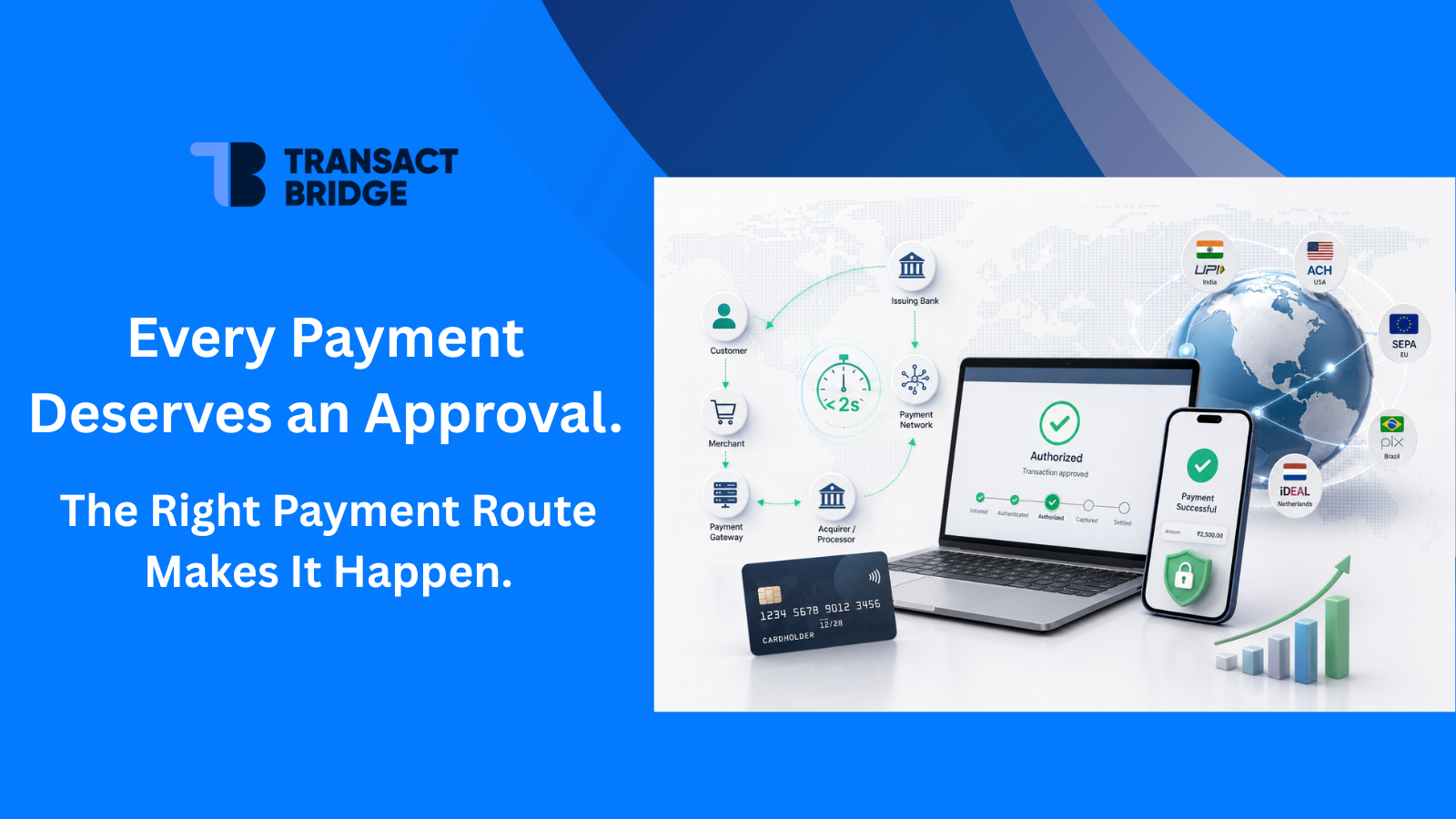
Payment authorization is the real-time process in which a customer's bank or payment network approves or declines a transaction after verifying funds, account status, and fraud risk. Approval places a hold on funds – money moves only at capture and settlement. The exchange completes in under two seconds.
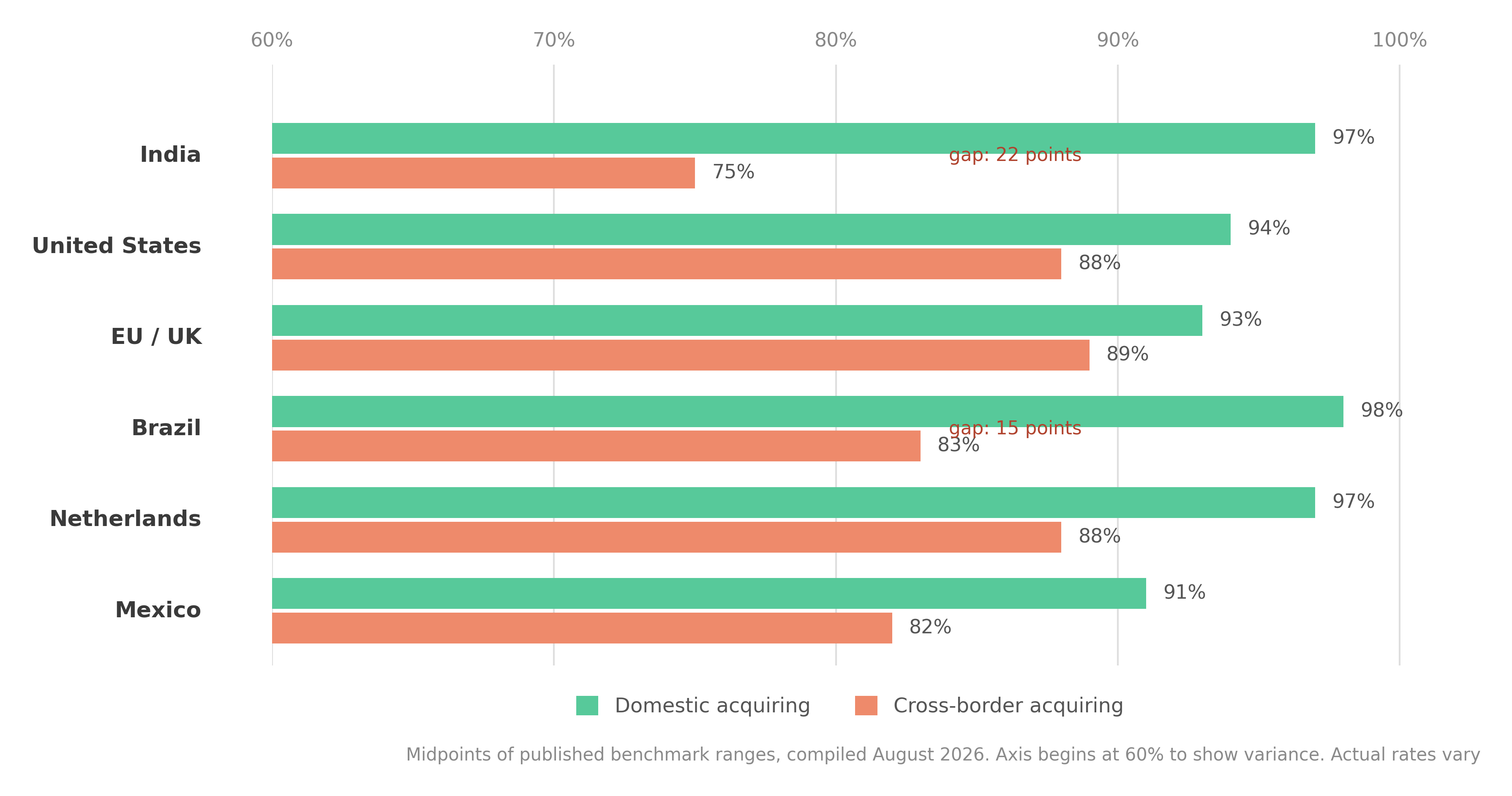
The authorization flow is broadly similar worldwide. Authorization outcomes are not. The same transaction that approves 96% of the time in the US can fail a third of the time in India, because payment methods, authentication mandates, issuer behaviour, and compliance requirements differ by country.
Payment authorization at a glance
Market | Dominant method | Authentication mandate | Domestic approval | Cross-border approval |
India | UPI, then domestic cards | RBI AFA (risk-based, Apr 2026) | 95–99% | 70–80% |
United States | Cards, then ACH | None (AVS/CVV optional) | 92–95% | 85–90% |
EU / UK | Cards, then SEPA | PSD2 SCA via EMV 3DS2 | 90–95% | 85–92% |
Brazil | Pix | Account-level validation | 97–99% | 80–85% |
Netherlands | iDEAL | Bank authentication | 97%+ | 85–90% |
Mexico | Cards, SPEI | Card scheme rules | 88–93% | 78–85% |
That table summarizes the central point of this guide: the strongest predictor of whether a payment authorizes is not the customer's creditworthiness, but whether you are processing locally on the rail they already use.
What is payment authorization?
Payment authorization is the real-time process where a customer's issuing bank or, for non-card methods, the payment network or the customer directly – approves or declines a payment request after verifying account status, available funds, and fraud risk. Approval places a hold on funds but does not transfer money.
Party | Role | Influence over outcome |
Customer | Initiates; may authenticate | Partial |
Merchant | Supplies the data the risk model reads | High |
Payment gateway | Encrypts and transmits the request | Moderate |
Acquirer / processor | Routes the request; sets domestic vs cross-border treatment | High |
Card network (Visa, Mastercard, Amex, RuPay) | Carries the message; sets scheme rules | Indirect |
Local network (NPCI, EPC, BCB) | Governs non-card rails | Indirect |
Issuing bank | Final decision | Absolute |
Expert insight: You cannot control the issuer's decision, but you control roughly 70% of its inputs – data quality, acquiring geography, authentication strategy, credential freshness, and merchant category code. Most merchants optimize none of these and attribute the result to issuer behaviour they assume is fixed. It isn't; it's responding to signals you're sending.
How does payment authorization work?
The payment authorization process moves a request from checkout through the gateway and acquirer, across the payment network to the issuing bank, and returns an approve or decline – usually in under two seconds. Seven steps make up the standard flow, and market-specific rules alter at least three of them.
| # | Step | What happens | Where markets diverge |
1 | Initiation | Customer submits payment, or you charge a stored credential; flagged CIT or MIT | India requires registered mandates for MIT; US permits standing card-on-file |
2 | Capture & encryption | Gateway encrypts credential; network token substituted if in use | RBI prohibits raw card storage in India – tokenization is mandatory |
3 | Authentication | Identity verification, if required | EU/UK: PSD2 SCA. India: RBI AFA. US: none mandated |
4 | Authorization request | Structured message (ISO 8583) with amount, currency, MCC, CIT/MIT, 3DS data, token status | Cross-border flag applied here – the single most consequential field |
5 | Network routing | Acquirer forwards to network, network to issuer | Domestic acquiring routes locally; cross-border adds hops and scrutiny |
6 | Issuer decision | Risk model returns approval or decline code | Indian issuers apply heightened scrutiny to foreign MIDs |
7 | Response & hold | Decision returns; funds held on approval | UPI and Pix skip the hold entirely – funds move immediately |
Payment authorization flow from merchant to issuer
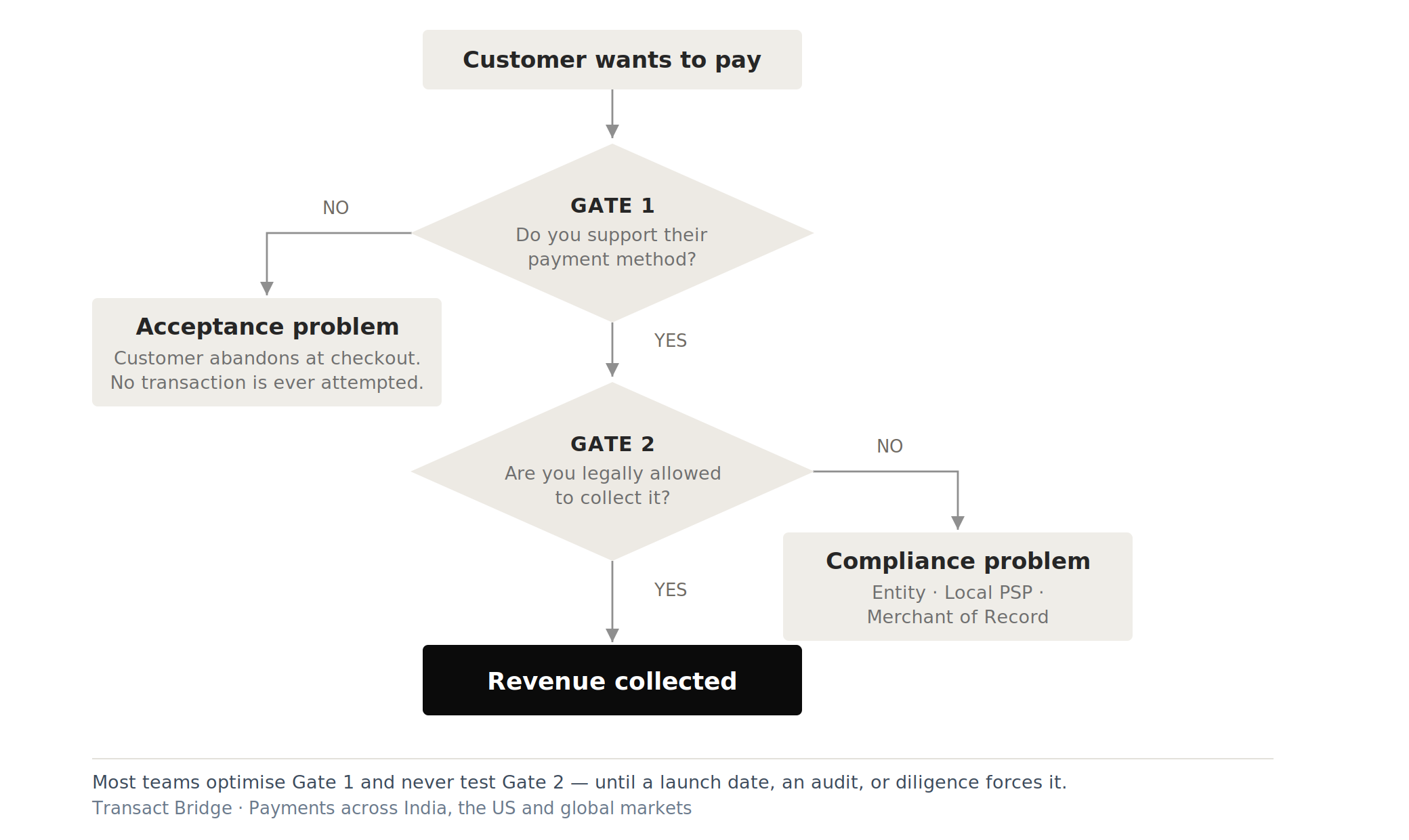
Where revenue is lost during authorization
Many providers normalize dozens of distinct issuer responses into one generic "declined". If you cannot separate insufficient funds from do not honor from stolen card, recovery is impossible – and blind retries erode issuer trust, depressing future approvals.
Payment authorization statistics (2026)
Key figures: UPI technical decline rates run 0.7–0.8%, down from 8–10% in 2016. Cross-border card transactions approve 5–15 points below domestic. False declines cost US merchants an estimated $118 billion annually – more than actual card fraud. Roughly 60–70% of declines are recoverable.
Metric | Figure | Source basis |
UPI monthly transactions (June 2026) | NPCI | |
UPI share of global real-time volume | ~49% | Industry aggregation |
UPI technical decline rate | 0.7–0.8% (target <1%) | NPCI BD/TD reporting |
UPI business decline target | <5% | NPCI |
Domestic card approval, North America | 92–95% | Industry benchmark |
Domestic card approval, India (local acquiring) | 95–99% | Industry benchmark |
Cross-border card approval into India | 70–80% | Industry benchmark |
Reported failure on international cards in India | up to 40% | Merchant-reported |
False decline cost, US merchants | Industry estimate | |
Declines from genuine customers | 60–65% | Industry research |
US shoppers who've had a valid payment declined | 56% | Consumer survey data |
Card declines that are recoverable | 60–70% | Industry research |
Retried transactions successfully recovered | ~1 in 4 | Industry research |
Network tokenization authorization uplift | Visa research | |
Projected chargeback growth, 2025–2028 | +24%, to ~324M/year | Mastercard / Datos Insights |
Pix vs cards, Brazil | Pix now exceeds all card networks combined | Industry reporting |
Figures compiled August 2026. Benchmark ranges vary by vertical and acquirer configuration.
Payment authorization by payment method
Not all payment authorization is card authorization. Cards use issuer approval; UPI uses customer PIN validation via NPCI; ACH relies on documented consent with no real-time approval; SEPA uses a mandate; Pix authorizes in real time at account level. Each model fails differently and recovers differently.
Method | Authorization model | Real-time? | Recurring mechanism | Primary failure mode |
Credit cards | Issuer authorization | Yes | Card-on-file / MIT | Issuer decline, expiry, fraud rules |
Debit cards | Issuer authorization | Yes | Card-on-file / MIT | Insufficient funds, daily limits |
UPI (India) | Customer PIN + NPCI | Yes | UPI AutoPay | Technical decline (~0.7–0.8%) |
Net banking (India) | Bank session authorization | Yes | E-NACH / e-mandate | Bank downtime, session timeout |
ACH (US) | Documented consent (NACHA) | No | Standing authorization | Return codes days later |
SEPA DD (EU) | Mandate-based | No | SEPA mandate | Return up to 8 weeks |
Pix (Brazil) | Real-time account authorization | Yes | Pix Automático | Rare; account-level |
iDEAL (NL) | Bank-authenticated transfer | Yes | Limited | Bank availability |
Wallets | Tokenized, often biometric | Yes | Tokenized card-on-file | Inherits underlying method |
BNPL | Provider underwriting | Yes | Provider-managed | Credit decline |
Three implications operators consistently miss:
ACH "authorization" is a legal concept, not a technical one. Under NACHA rules it means documented consumer consent; there is no real-time approval. Failures arrive as return codes days after you've delivered the service – which inverts the entire dunning model for US subscription businesses.
Real-time rails have no soft declines to recover. UPI and Pix succeed or fail definitively. Retry-based recovery built for cards doesn't transfer; optimization moves upstream into checkout UX and mandate quality.
Wallets inherit what's inside them. A wallet backed by a cross-border card still produces a cross-border card decline. Wallet coverage is not, by itself, an authorization strategy.
Payment authorization software
Payment authorization software is the infrastructure layer that submits, routes, and optimizes authorization requests across providers and markets. It spans gateways, authorization APIs, orchestration platforms, and merchant-of-record providers – which differ less in what they transmit than in who bears the compliance and entity burden.
Layer | What it does for authorization | What it doesn't do |
Payment gateway | Encrypts and transmits the authorization request to your acquirer | Doesn't change your acquiring geography or bear compliance |
Payment authorization API | Programmatic auth, capture, void, refund; webhooks for asynchronous results | Doesn't decide routing strategy for you |
Payment orchestration platform | Routes across multiple PSPs; fallbacks, retries, normalized decline codes | Doesn't remove entity or tax obligations |
Local acquiring | Processes domestically – the largest single approval lever | Typically requires a local entity |
Merchant of record | Combines local processing, compliance, settlement and tax into one infrastructure layer | Less suitable if you require full control of the merchant relationship |
Payment routing determines which acquirer receives a given request – by geography, card type, issuer, or transaction value. Static routing sends everything one way; dynamic routing sends each transaction to the provider most likely to approve it. Payment optimization is the continuous version: measuring approval by segment, then adjusting routing, authentication and retry logic in response.
What a payment authorization system should offer:
- Local acquiring plus dominant local methods – UPI, ACH, SEPA, Pix, iDEAL, SPEI, wallets – not merely cross-border connectivity
- Market-native recurring mandates, not a card-on-file approximation
- Granular, normalized decline codes across every provider
- Configurable routing and retry logic, changeable without engineering cycles
- Tax and compliance coverage – GST/TDS, VAT/OSS, US sales tax nexus, plus RBI AFA and PSD2 SCA conformance
- Multi-currency settlement and analytics segmentable by market, method, issuer and acquirer
- Entity requirements – does this force local incorporation?
That last item usually decides the build-vs-partner question. Everything above it can be assembled market by market; it is the entity, tax and compliance burden that makes assembly uneconomic below significant scale, which is why global payment infrastructure providers exist to collapse it into a single integration.
Why local payment methods improve authorization rates
Local payment methods improve authorization rates because they bypass cross-border card mechanics entirely. A UPI transaction in India or a Pix transaction in Brazil is a domestic account-to-account transfer – no foreign issuer applying elevated risk scrutiny, no currency conversion, no cross-border flag to trigger it.
This is structurally different from optimization. You are not improving the approval rate on a failing rail; you are moving to a rail where that failure mode does not exist.
Method | Market | Why authorization performs better |
UPI | India | Technical decline 0.7–0.8%; no card issuer in the loop |
Pix | Brazil | Exceeds all card networks combined; central-bank operated |
iDEAL | Netherlands | Bank-authenticated; dominant share of Dutch e-commerce |
SPEI | Mexico | Domestic real-time rail; bypasses weak cross-border card approval |
QRIS | Indonesia | Unified QR standard; high mobile penetration |
Net banking | India | Handles high-value transactions above UPI comfort thresholds |
Wallets | Asia, LATAM | Reduces re-entry friction – but inherits funding source risk |
SEPA DD | Europe | Mandate-based; predictable for recurring billing |
There is a second, less obvious reason this matters in India specifically: most Indian consumers hold domestically issued Visa, Mastercard or RuPay cards that are not enabled for international transactions at all. For those customers, the cross-border card path isn't underperforming – it's unavailable.
What this looks like in practice
A US SaaS company charges ₹2,500 to a customer in Bengaluru using her international Visa card.
- The authorization request goes out flagged cross-border, acquired in the US.
- The Indian issuer, applying RBI's Additional Factor of Authentication rules to a foreign card-not-present transaction, requests AFA.
- She is redirected to a bank OTP page. It loads slowly, the SMS takes 40 seconds, the session times out. She abandons.
- The merchant's dunning logic retries the same card three days later. The issuer sees a repeated foreign CNP attempt on a card that already failed authentication and declines outright – this time as 05, do not honor.
- The dashboard records two declines and one churned customer. Nothing in the ledger shows the ₹2,500.
The same customer, offered UPI at checkout, opens her payment app, approves with a PIN, and the payment settles in under three seconds. No issuer risk model, no cross-border flag, no OTP page, no retry.
The transaction did not fail because of the customer, the amount, or the product. It failed because of the route.
Recover the revenue cross-border cards leave on the table
Add UPI and domestic acquiring in India — and stop losing sales to declines that were never credit risk.
What is a payment authorization code?
A payment authorization code is a short alphanumeric string – usually six characters – returned by the issuing bank when it approves a transaction. It confirms the issuer sanctioned that specific amount on that specific account, and serves as the merchant's primary evidence if the charge is later disputed.
Who generates it. The issuing bank, at step six of the authorization flow. Not the gateway, not the acquirer, not the merchant – which is why it cannot be reconstructed after the fact if you fail to store it.
Format. Typically six alphanumeric characters (for example, A1B2C3 or 047291), though length varies by network and issuer. It is unique to the transaction, not to the cardholder or merchant.
Where merchants use it:
- Capture : passed back with the capture request to draw against the correct authorization
- Reconciliation : matching authorizations to settled transactions
- Refunds and voids : referencing the original approval
- Customer service : confirming a charge was approved even if it hasn't posted
- Dispute representment : proving the issuer approved the transaction
Why it matters in disputes. In a chargeback, the authorization code forms part of your compelling evidence: it demonstrates the issuer evaluated and approved the transaction rather than the merchant force-posting a charge. It does not by itself defeat a fraud claim – liability may still shift depending on 3D Secure status – but its absence materially weakens your position.
One caution for multi-market operators: non-card rails don't produce an authorization code in the card sense. UPI returns a transaction reference number via NPCI; Pix returns an end-to-end identifier; ACH returns a trace number. Reconciliation logic built around a six-character card auth code will break the first time you add a local method.
Payment authorization vs authentication vs capture vs settlement
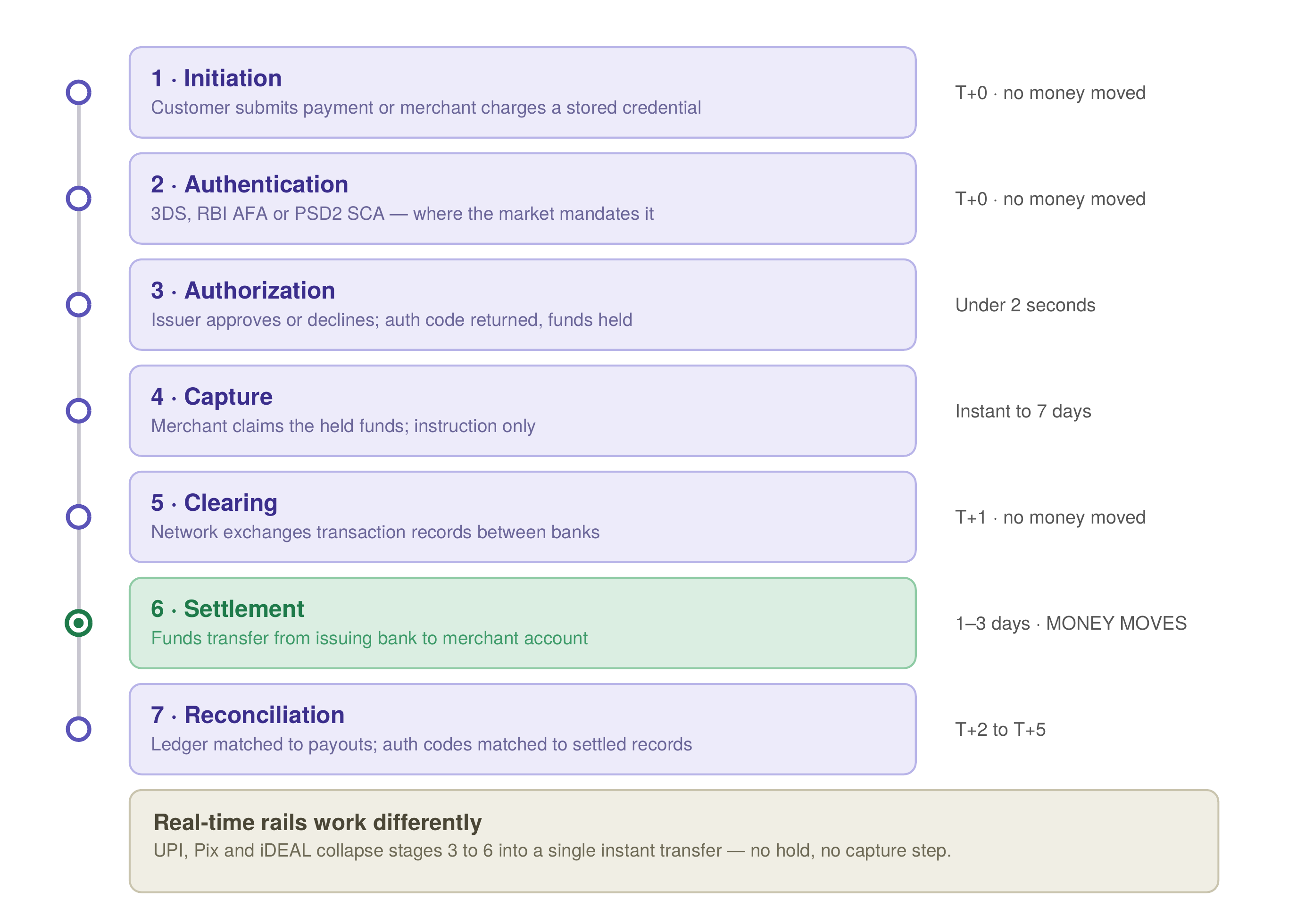
Authentication proves who the customer is. Authorization decides whether the bank will pay. Capture requests the money. Settlement moves it. Only settlement involves an actual transfer of funds.
Authentication | Authorization | Capture | Settlement | |
Question answered | Real cardholder? | Will the bank approve? | Finalize the sale | Move the money |
Decided by | Issuer via 3DS / AFA | Issuing bank | Merchant | Acquirer + network |
Timing | Before authorization | Real time (<2s) | Instant to 7 days | 1–3 days after capture |
Money moves? | No | No – funds held | No – instruction only | Yes |
Reversible? | N/A | Void or expiry | Refund | Refund / chargeback |
Mandatory? | EU/UK yes; India yes; US no | Always | Always | Always |
Why finance leaders should care: revenue is not recognizable at authorization. It becomes recognizable when the performance obligation is met and collection is probable – which ties to capture and settlement, not to the approval code. Teams that treat authorization as revenue systematically overstate bookings and spend the following quarter explaining the variance.
Payment authorization vs pre-authorization
A standard authorization requests approval for a known, final amount. A pre-authorization requests approval for an estimated amount before the final figure is known, holding funds until the merchant captures the actual total. Hotels, car rental, fuel, and usage-based services rely on pre-authorization; most digital businesses do not need it.
Authorization | Pre-authorization | |
Amount known at request? | Yes | No – estimated |
Typical use | E-commerce, SaaS, digital goods | Hotels, car rental, fuel, usage-based billing |
Hold duration | 5–7 days | Up to 30 days in some MCCs |
Capture amount | Equals authorized amount | May differ; incremental auth sometimes needed |
Customer impact | Minimal | Held funds reduce available balance, sometimes visibly |
Available on real-time rails? | Yes | Largely no – UPI, Pix, iDEAL have no hold construct |
Where this becomes an expansion problem
Pre-authorization is a card-rail concept. A business built on variable-amount billing – a hotel platform, a fuel network, a usage-metered API product – cannot simply add local methods and expect the same commercial model to work. Workarounds exist but differ by market: UPI AutoPay mandates a maximum ceiling in India, SEPA Direct Debit with variable amounts and advance notification in Europe, Pix Automatico with amount ceilings in Brazil.
Common failure points. Capturing more than the authorized amount invites a decline or dispute. Capturing after the hold expires forces a fresh authorization when the customer is gone. And an over-large pre-authorization on a debit card can push a customer into insufficient funds on their next purchase, generating support tickets that look like fraud complaints.
Practical rule: delay capture only for a specific reason – post-authorization fraud screening, inventory confirmation, or a genuinely variable final amount. Otherwise capture immediately.
Why do payment authorizations get declined?
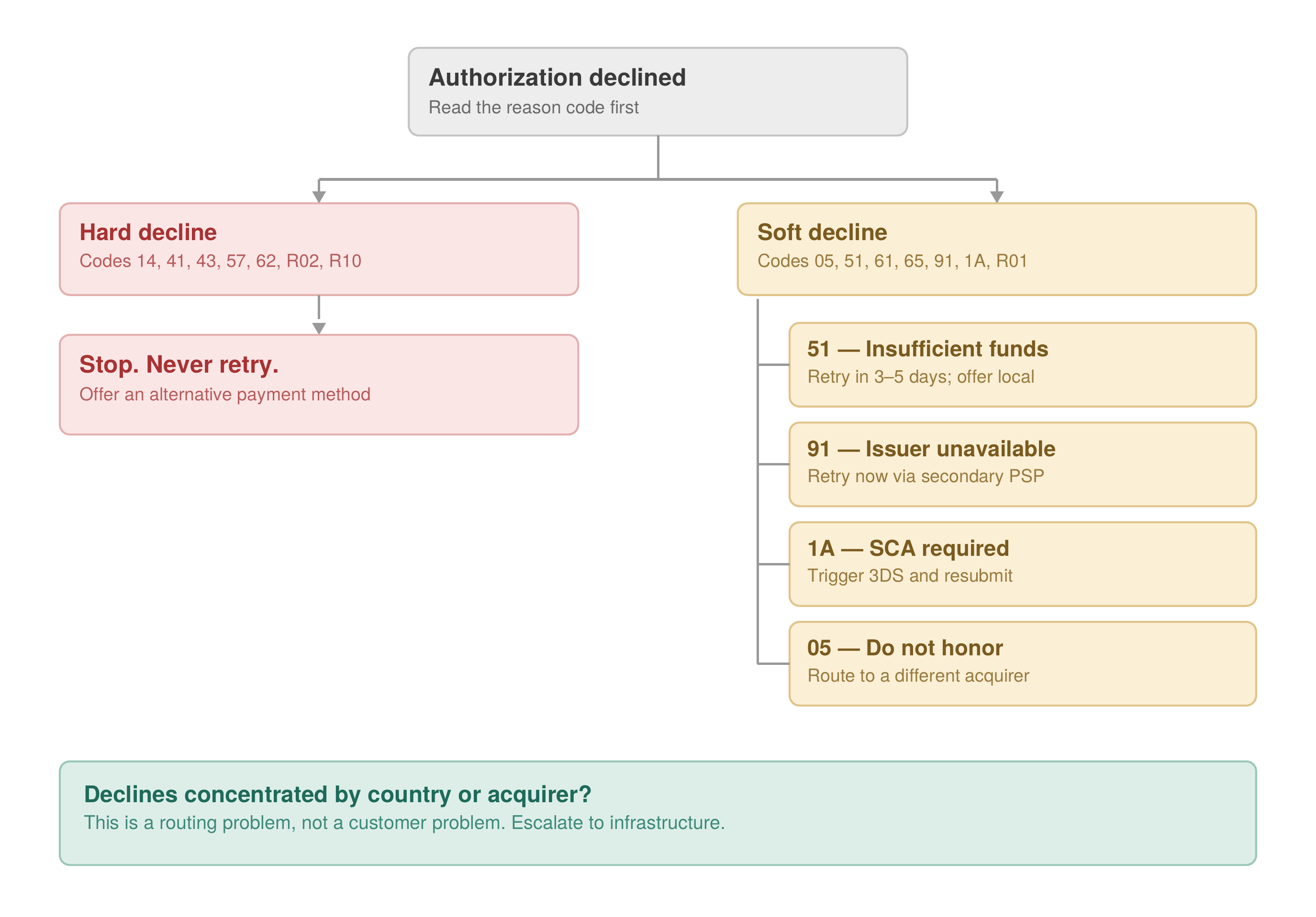
Authorizations fail for insufficient funds, invalid credentials, suspected fraud, issuer risk policy, missing authentication data, incorrect transaction flagging, or cross-border scrutiny. Declines are soft – temporary and often recoverable – or hard, meaning permanent. The issuer signals through a reason code.
Soft decline | Hard decline | |
Examples | Insufficient funds, issuer timeout, SCA required, velocity limit | Stolen card, closed account, invalid number |
Retry? | Yes, with intelligent timing | Never |
Recovery | Substantial | Zero |
Cost of blind retry | Scheme penalties | Fraud flags, fines |
Common payment authorization decline codes
Code | Meaning | Type | Retry? | Best action |
05 | Do not honor | Soft | Sometimes | Route to another acquirer; do not repeat blindly |
51 | Insufficient funds | Soft | Yes | Retry on payroll cycle (3–5 days); offer local method |
14 | Invalid card number | Hard | No | Prompt for correct details |
54 | Expired card | Hard | Update first | Network token or account updater |
91 | Issuer unavailable | Soft | Yes | Retry within minutes, or fall back to secondary PSP |
61 | Exceeds withdrawal limit | Soft | Yes | Retry later or split the amount |
65 | Exceeds activity count limit | Soft | Yes | Retry after 24 hours |
41 | Lost card | Hard | No | Stop; request alternative method |
43 | Stolen card | Hard | No | Stop; flag for review |
57 | Transaction not permitted to cardholder | Hard | No | Often an internationally-disabled card – offer a local method |
62 | Restricted card | Hard | No | Geographic or scheme restriction |
1A | SCA / authentication required | Soft | Yes | Trigger 3DS and resubmit |
R01 | ACH – insufficient funds | Soft | Yes | Re-present per NACHA limits |
R02 | ACH – account closed | Hard | No | Request new bank details |
R10 | ACH – customer disputes authorization | Hard | No | Investigate; consent record may be defective |
U16 / U30 | UPI – technical or timeout decline | Soft | Yes | Retry; usually transient at bank or NPCI |
U69 | UPI – insufficient balance | Soft | Yes | Prompt customer; offer net banking for high value |
Note on code 57. For merchants selling into India this one deserves attention: it frequently indicates a domestically issued card never enabled for international transactions. Retrying achieves nothing; only offering a local method converts the sale.
Roughly 60–70% of card declines are recoverable, and about one in four retried transactions succeeds when retry logic is intelligent – timed to payroll cycles for insufficient funds, rerouted to a secondary provider for timeouts.
Why do authorization rates vary by country?
Authorization rates vary because each market has a different dominant rail, a different authentication mandate, and a different level of issuer trust in foreign merchants. Cross-border transactions typically approve 5–15 points below domestic – considerably worse where local rails dominate.
India. UPI accounts for roughly half of global real-time payment volume, and NPCI publishes both technical and business decline metrics monthly – an unusual level of transparency that lets merchants benchmark precisely. Cross-border card traffic is the outlier, not the norm.
United States. The loosest authentication regime – and often harder for foreign merchants, not easier. Without a mandate, US issuers lean on behavioural signals: AVS results, CVV match, device and IP consistency, MCC, and acquirer country. A non-US merchant billing a US cardholder with an address format AVS cannot parse receives a soft decline that looks random from the dashboard. ACH compounds it: no real-time authorization means failures surface days after service delivery.
Europe. SCA is mandatory, but the regulation defines exemptions – transaction risk analysis, low value, recurring, trusted beneficiary, MIT. Performance is therefore largely an exemption-strategy problem. Challenge everything and lose conversion; challenge nothing and fail compliance.
Emerging markets. Pix in Brazil, SPEI in Mexico, iDEAL in the Netherlands, QRIS in Indonesia. Card-only strategies in these corridors pay more, settle slower, and approve less.
Benchmarks by segment
Segment | Typical | Well-optimized |
Domestic online cards, North America | 92–95% | 95%+ |
Domestic cards, India (local acquiring) | 95–99% | 99% |
UPI (India) | 92–96% blended | 98%+ |
Pix (Brazil) | 97%+ | 99% |
Cross-border cards, general | 80–90% | 90%+ |
Cross-border cards into India | 70–80% | 85%+ |
Tokenized card-on-file | +~4% vs raw PAN | – |
By vertical, higher-friction categories systematically underperform: usage-based AI products trigger velocity rules with frequent variable charges; gaming carries elevated fraud scrutiny and tighter issuer thresholds; EdTech stresses cross-border limits with large one-time payments; creator economy faces MCC ambiguity on micro-transactions; marketplaces multiply MID complexity through sub-merchants; subscription and OTT lose more to involuntary churn from stale credentials than to voluntary cancellation.
Expert insight: Benchmark the segment, not the average. A 92% blended rate concealing 85% on EU-issued cards through one acquirer is a routing problem masquerading as a customer behavior issue. Aggregate reporting is how six-figure leaks survive for quarters.
The cross-border authorization penalty: a worked model
A US-headquartered company at $20M ARR expands into India and Brazil, processing cross-border through its existing US acquirer.
Domestic US | India (cross-border) | Brazil (cross-border) | |
Attempted volume | $14M | $4M | $2M |
Approval rate | 93% | 74% | 82% |
Approved revenue | $13.02M | $2.96M | $1.64M |
Lost to declines | $0.98M | $1.04M | $0.36M |
It loses more absolute revenue on $4M of Indian demand than on $14M of US volume. At the 60–70% recoverability finding, roughly $620K–$730K of the India figure is addressable – not genuine credit risk.
Modelled with local acquiring and local methods – UPI and domestic cards in India, Pix in Brazil:
India (localized) | Brazil (localized) | |
Approval rate | 95% | 94% |
Incremental revenue | +$840K | +$240K |
$1.08M recovered annually – no additional marketing spend, no product change, the same customers who were already trying to buy.
Illustrative model built from published benchmark ranges.
Size the gap against your own numbers
The authorization rate calculator takes under a minute.
The 2026 regulatory timeline
Date | Market | Change | Affects |
1 Apr 2026 | India | RBI risk-based AFA enforceable; minimum two authentication factors | All merchants accepting Indian cards |
1 Oct 2026 | India | Mandatory additional validation for cross-border CNP; issuer BIN registration | Foreign merchants processing cross-border into India |
Ongoing | EU/UK | PSD2 SCA; exemption fraud-rate thresholds | All merchants accepting EEA/UK cards |
Ongoing | Global | Visa Acquirer Monitoring Program thresholds | High-dispute merchants |
2025–2028 | Global | All merchants |
How to improve payment authorization rates
The highest-impact levers are local acquiring, local payment method coverage, and network tokenization – in that order. Tactical optimization matters, but cannot compensate for processing cross-border into a market where local rails dominate.
Lever | Typical impact | Effort | Type |
Local acquiring | +10–20pts cross-border | High (low via infrastructure partner) | Structural |
Local payment methods | Bypasses card failure entirely | Medium | Structural |
Network tokenization | ~+4% CNP | Low | Tactical |
Selective authentication | +2–5pts in SCA markets | Medium | Tactical |
Granular decline codes + intelligent retries | Recovers 1 in 4 retried | Medium | Tactical |
Correct CIT/MIT flagging and MCC | +1–3pts | Low – often free | Tactical |
Account updater / credential freshness | Material for subscriptions | Low | Tactical |
Start at the bottom. Transaction flagging and MCC classification cost nothing and are wrong at a surprising number of companies. Then work upward – recognizing that the top two are not settings, but infrastructure decisions.
Localize without incorporating
Transact Bridge handles local acquiring, compliance, and settlement across India, the US, and global markets — no local entity required.
Localizing without incorporating
The structural levers carry a structural cost: local acquiring has historically required a local entity, local banking, tax registration, and compliance headcount in every market – a 6–18 month project that only pays back at scale.
One approach is using a Merchant of Record (MoR) platform. Providers such as Transact Bridge manage local payment acceptance, compliance, settlement and taxation without requiring merchants to establish local entities – covering UPI and domestic card acquiring in India alongside GST, FEMA and TDS obligations, and cross-border acceptance with multi-currency settlement elsewhere.
The mechanism is worth understanding regardless of provider: a payment gateway transmits your authorization request and leaves compliance and entity structure with you, whereas a merchant of record becomes the legal seller – which changes whose authorization request the issuer evaluates.
When to localize: a decision framework
Localize a market when three or more apply:
- Market is >5% of attempted volume
- Approval rate is >8 points below domestic
- A domestic real-time rail dominates (UPI, Pix, SPEI, iDEAL, SEPA)
- Regulation mandates authentication or data handling you can't satisfy cross-border
- You run recurring billing and the market has a distinct mandate mechanism
- Tax or compliance exposure is unclear or growing
- Support tickets include recurring "payment failed" from that geography
Stay cross-border when: the market is under 2% of volume and untested, approval sits within 3 points of domestic, and cards genuinely dominate locally.
Then verify before launch: local methods supported? local acquiring in place? recurring mandates in local format? Taxes handled? Authentication compliant? Settlement in local currency? soft-decline recovery working?
Expert insight: Most teams focus on checkout design and retry logic because those sit within engineering's control. The larger gains sit in local acquiring and supporting the payment methods customers already trust. In markets like India and Brazil, infrastructure decisions typically move authorization rates by 10–20 points; checkout optimization moves them by 1–3. Sequence accordingly.
What's changing
Network tokenization is becoming default rather than an optimization. Click to Pay improves data quality at authorization. Real-time rails – UPI, Pix, FedNow, SEPA Instant – keep taking share from card authorization entirely. Open banking under PSD3 and India's account aggregator framework point toward bank-authorized payments with near-zero decline rates. And as AI agents begin initiating purchases, the CIT/MIT distinction built around a present human will require rethinking.
To size the opportunity against your own numbers, the authorization rate calculator takes under a minute. For operational depth, see how to increase payment success rates and merchant accounts and payment declines.
Payment authorization is a growth lever, not an operational metric
Declined authorizations are the only form of revenue loss that appears nowhere in your financials. A failed campaign shows up as spend. A churned customer shows up in retention. A transaction that never authorizes shows up as nothing at all – which is why companies tolerate for years a problem they would fix in a week if they could see it.
The compounding effect is what makes it strategic. A 20-point authorization gap doesn't only cost that quarter's revenue; it suppresses measured conversion, which suppresses willingness to spend on acquisition, which suppresses market share in exactly the geographies growing fastest. Companies conclude a market "didn't work" when what didn't work was the payment path into it.
Payment authorization is one of the largest hidden drivers of international revenue. Businesses expanding into India, the US, and global markets should measure approval rates by country, payment method, issuer, and acquiring route – not just as a blended metric. Higher authorization rates improve conversion, reduce involuntary churn, increase marketing efficiency, and create sustainable international growth.
See what your declines are actually costing you
Measure approval rates by market, method, and issuer — not a blended average that hides the leak.
FAQs
What does it mean when a payment is authorized?
An authorized payment has been approved by the bank but not yet paid. The funds are reserved on the customer's account and the merchant holds an authorization code, but no money has moved. The transfer happens later, at capture and settlement.
Is payment authorization the same as payment processing?
No. Authorization is one step inside payment processing. Processing covers the full chain – checkout, authentication, authorization, capture, clearing, settlement and reconciliation. Authorization is only the approve-or-decline moment, which takes under two seconds; the rest can take days.
How long does payment authorization take?
Payment authorization takes under two seconds from request to decision. The hold it creates lasts far longer – typically 5 to 7 days for online retail, and up to 30 days in travel and hospitality merchant categories.
What is a payment authorization hold?
A payment authorization hold is a temporary reduction of the customer's available balance for the approved amount. The money has not left their account. It is reserved for the merchant to claim. Holds expire automatically if the merchant never captures.
Can an authorization be reversed?
Yes. Before capture, a merchant can void the authorization and release the hold immediately. After capture, the equivalent action is a refund. Voids are faster and generate far fewer support tickets than leaving a hold to expire on its own.
What happens if a capture fails or never occurs?
If capture fails, the approval stays valid until the hold expires, so a prompt retry usually succeeds. If capture never happens, the hold lapses and the customer's balance is restored. No notification is sent either way – which makes uncaptured authorizations a common source of unexplained revenue gaps.
Can an approved payment still fail later?
Yes. Approval only means the issuer agreed at that moment. The transaction can still fail at capture, be reversed by an ACH return code days later, be disputed as a chargeback, or lapse if the hold expires uncaptured.
Why do valid payments get declined?
Valid payments get declined because issuer fraud models are probabilistic and tuned conservatively. Unfamiliar geography, mismatched billing data, unusual transaction velocity, or a foreign acquirer can each trip a rule. Industry research finds 60–65% of declines come from genuine customers, not fraudsters.
Does payment authorization affect chargebacks?
Yes, significantly. The authorization code is core evidence in a dispute, proving the issuer approved the charge rather than the merchant force-posting it. Authentication status also matters – a 3D Secure authenticated transaction can shift fraud liability from merchant to issuer.
Why are cross-border authorization rates lower?
Cross-border authorization rates are lower because issuers score foreign-acquired transactions as higher risk by default. They have less history with the merchant, cannot reliably validate the billing address, and face currency conversion friction. The result is typically 5 to 15 percentage points below domestic.
Can payment authorization be optimized without changing PSPs?
Yes, substantially. Correcting merchant category codes, flagging CIT versus MIT accurately, enabling network tokenization, improving AVS data quality, applying 3DS exemptions correctly, and timing retries intelligently can add several points of approval without touching your provider relationships.
Does UPI have authorization holds?
No. UPI settles in real time between bank accounts, so there is nothing to hold – transactions complete or fail outright. UPI AutoPay works differently again, authorizing recurring debits up to a ceiling rather than reserving funds. Pix and iDEAL behave the same way.
Which payment method has the highest authorization rate in India?
UPI. Its technical decline rate runs 0.7–0.8%, with blended merchant success at 92–96%. Domestically acquired cards including RuPay follow at 95–99%. Internationally acquired cards perform worst at 70–80%. Globally the same pattern holds: domestic real-time rails beat cross-border cards by 15–25 points.


