Payment Fraud Prevention Strategies for Gaming, SaaS & Ecommerce Platforms
Published on: Sun 31-May-2026 04:15 AM
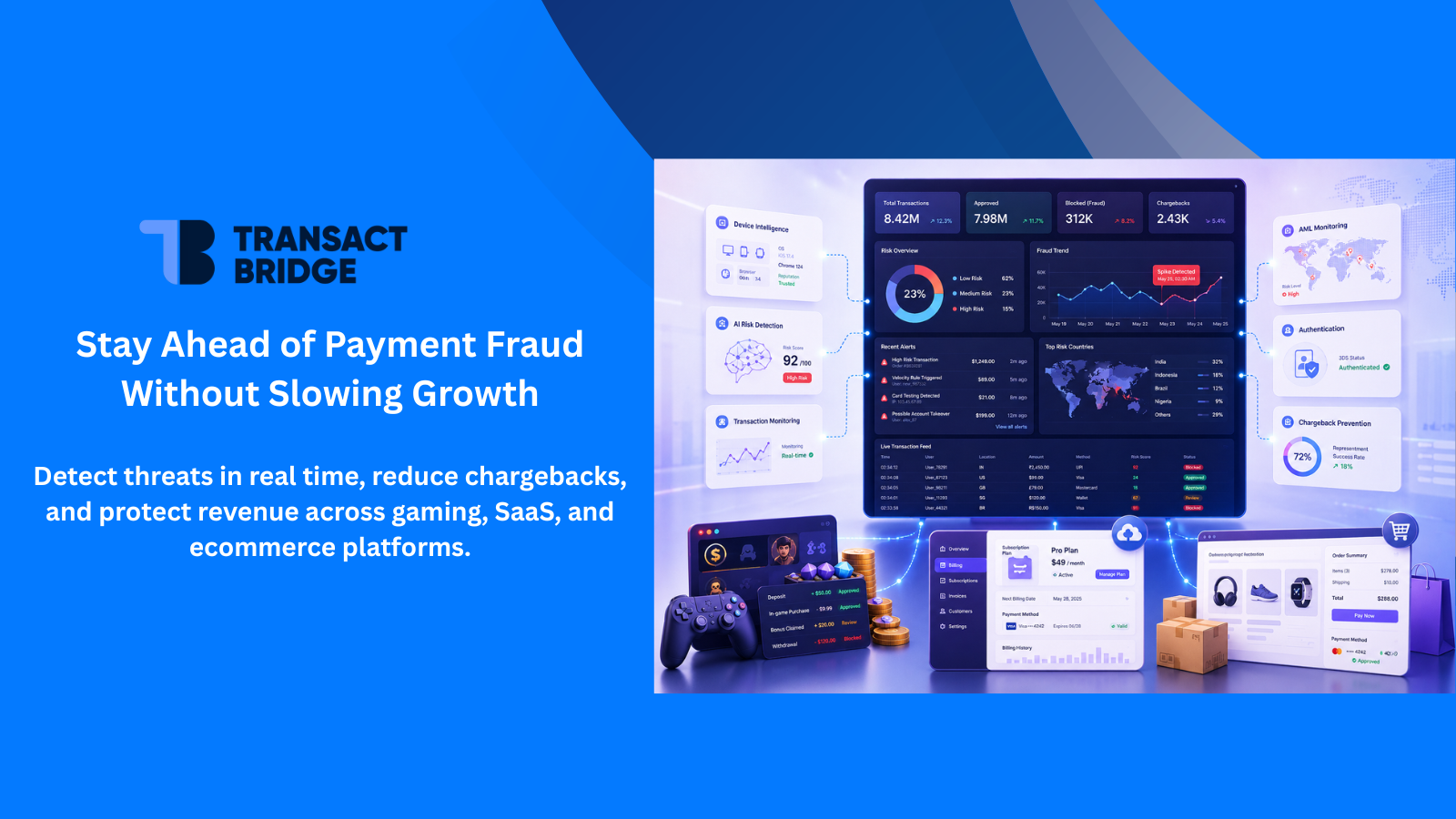
Online payment fraud is accelerating. In 2025, businesses globally lost an estimated 7.7% of annual revenue to fraud; over $534 billion worldwide. Card-not-present (CNP) fraud alone is projected to exceed $10 billion, accounting for nearly 74% of all card payment fraud losses.
For ecommerce, SaaS, and gaming platforms, payment fraud prevention is no longer just about blocking fraudulent transactions. It is about protecting revenue while maintaining high payment approval rates and frictionless customer experiences.
Every false decline can reduce conversions and customer lifetime value, while successful fraud leads to chargebacks, operational losses, and merchant account risk. AI-powered fraud detection and payment gateway security now play a critical role in reducing fraud while maintaining high approval rates.
Whether you operate an ecommerce store, a SaaS platform, or a gaming business, this guide covers every layer of your fraud exposure from AI-powered detection and AML monitoring to payment gateway security and industry-specific prevention strategies and how to address each one.
Quick Summary: Payment Fraud Prevention Explained
- Payment fraud prevention refers to the tools, systems, and processes businesses use to detect and stop fraudulent transactions before payments are approved.
- Online payment fraud is rapidly increasing across ecommerce, gaming, SaaS, and subscription businesses due to card-not-present (CNP) transactions, digital onboarding, and anonymous account creation.
- The three core layers of fraud prevention are instant transaction monitoring, payment authentication, and AI-powered risk scoring.
- Businesses lose up to $3.75 for every $1 lost to fraud when chargebacks, operational costs, and customer recovery efforts are included.
- AI fraud detection and behavioral analytics can reduce fraud losses by 30–50% compared to traditional rule-based fraud systems alone.
- Effective fraud prevention not only blocks fraudulent payments but also improves payment approval rates, reduces false declines, and minimizes checkout friction for legitimate customers.
Want to audit your current fraud stack? Talk to Transact Bridge →
What Is Payment Fraud Prevention?
Payment fraud prevention is the combination of technology, processes, and rules businesses use to detect and stop fraudulent transactions before payments are approved. Unlike chargeback management, which handles fraud after losses occur, fraud prevention works proactively to reduce financial risk as it happens.
Effective payment fraud detection operates in layers. Authentication systems, AI-powered risk scoring, transaction monitoring, device intelligence, and AML screening work together to identify suspicious activity across the payment journey.
Proactive vs Reactive Fraud Management
Most businesses begin with reactive fraud management. It includes identifying fraud spikes, adding manual rules, and responding after losses occur. Proactive fraud prevention uses AI fraud detection, behavioral analytics, and machine learning to identify suspicious patterns before transactions are completed. Merchants using proactive fraud screening often report 30–50% lower fraud losses compared to static rule-based systems.
Fraud Prevention vs Revenue Optimization
Modern payment fraud prevention is not just about security. It directly impacts payment approval rates, checkout experience, customer trust, and revenue growth.
The goal of modern payment risk management is to balance fraud reduction with seamless customer experiences: a tradeoff covered in detail in the False Declines section below.
Why Online Payment Fraud Is Increasing
Several structural shifts are accelerating online payment fraud globally:
- Ecommerce growth has expanded the attack surface. More digital transactions create more opportunities for card testing, checkout abuse, and account fraud. Global ecommerce fraud losses exceeded $48 billion in 2023 and are projected to surpass $91 billion by 2028.
- Subscription economies and recurring billing models create persistent exposure. Bad actors using stolen cards can generate long-term recurring billing relationships before detection occurs.
- Cross-border payments are harder to authenticate. Transactions involving multiple countries, gateways, currencies, and card networks create verification gaps that attackers actively exploit.
- Digital wallets and UPI have introduced new fraud vectors. In India, UPI processed over 20 billion monthly transactions in 2025, while fraud cases linked to UPI rose sharply according to RBI reporting.
- AI-powered fraud attacks are increasing rapidly. Threat actors now use AI to generate synthetic identities, spoof authentication flows, and bypass traditional fraud detection systems.
Why Gaming, SaaS & Ecommerce Businesses Are High Risk
Gaming, SaaS, and ecommerce businesses face elevated fraud exposure because of how digital transactions operate:
- Instant digital delivery removes physical verification layers. Attackers gain immediate access to digital products, subscriptions, or gaming credits once payments are approved.
- Recurring billing and free trial models are frequently abused using stolen cards and fake identities.
- Anonymous account creation allows bad actors to operate at scale across multiple accounts simultaneously.
- High transaction velocity especially in gaming and microtransactions reduces the time available to identify suspicious activity before losses accumulate.
- Global payment acceptance increases cybersecurity and compliance complexity across multiple payment methods, currencies, and regulatory environments.
Common Types of Online Payment Fraud
Understanding how payment fraud actually happens is critical to building an effective fraud prevention strategy. Different fraud types generate different risk signals, transaction patterns, and operational impacts which means businesses need layered fraud detection systems rather than a single rule set.
Card-Not-Present (CNP) Fraud
Card-not-present (CNP) fraud is the most common form of online payment fraud across ecommerce, gaming, SaaS, and subscription platforms. Attackers typically purchase stolen card data from data breaches or phishing campaigns and use automated bots, proxy networks, and low-friction checkouts to test and process transactions at scale.
Merchants often observe:
- Sudden spikes in failed authorization attempts
- Multiple low-value card testing transactions
- High transaction velocity from similar IP ranges
- Unusual checkout behaviour across new accounts
Card testing attacks (BIN attacks) are particularly damaging because a single automated attack can test hundreds of stolen cards within minutes. Core prevention controls include CAPTCHA, velocity checks, CVV verification, AVS validation, and AI-powered transaction monitoring.
Account Takeover (ATO) Fraud
Account takeover fraud typically begins with credential stuffing attacks using leaked username-password combinations from unrelated data breaches. Attackers use residential IPs, device spoofing tools, and automated login scripts to access customer accounts containing saved payment methods, loyalty balances, or stored wallets.
Once inside a legitimate account, fraudulent transactions often appear trustworthy because they originate from real customer profiles with established purchase history.
Common ATO risk signals include:
- Login attempts from unfamiliar devices
- Impossible travel events between locations
- Sudden changes in spending behaviour
- Multiple failed login attempts followed by successful purchases
- Shipping address or account detail modifications
Device fingerprinting, behavioral analytics, IP geolocation monitoring, and adaptive authentication are essential for detecting account compromise before fraudulent payments occur.
Subscription & Recurring Billing Fraud
Subscription fraud heavily impacts SaaS platforms, streaming businesses, and gaming services that rely on recurring billing models. Fraudsters commonly use stolen cards, disposable emails, and virtual payment methods to exploit free trials, promotional plans, or recurring subscriptions.
Operational patterns merchants often detect include:
- Multiple trial accounts linked to the same device
- High signup velocity using temporary emails
- Repeated subscription cancellations after promotional use
- Chargebacks triggered after several successful billing cycles; a common pattern in chargeback friendly fraud, where customers dispute legitimate charges after consuming the service.
Because recurring fraud compounds over time, businesses may continue processing fraudulent subscription renewals for weeks before disputes surface. AI fraud detection combined with device intelligence and recurring billing monitoring helps reduce long-term exposure.
Gaming & Digital Goods Fraud
Gaming platforms face one of the most aggressive online fraud ecosystems because digital assets are delivered instantly and are difficult to recover once transferred.
Attackers commonly:
- Abuse welcome bonuses and promotional credits
- Purchase in-game currency using stolen cards
- Create multiple accounts to exploit reward systems
- Transfer digital assets across secondary marketplaces before chargebacks occur
Gaming operators often notice clusters of accounts sharing similar devices, IP ranges, behavioral patterns, or transaction timing. Promo abuse prevention therefore requires platform-level controls alongside payment fraud systems, including device fingerprinting, account linking analysis, and behavioral monitoring.
Synthetic Identity & Bot Fraud
Synthetic identity fraud combines fabricated personal information with real data elements to create accounts that appear legitimate during onboarding and KYC checks. Threat actors use these synthetic profiles to build trust gradually before executing larger payment fraud schemes.
Bot networks amplify this risk by automating account creation, login attempts, and transaction activity at massive scale.
Common fraud indicators include:
- Rapid account creation spikes
- Identical behavioural flows across accounts
- High payment failure rates from related devices
- Abnormal checkout or login velocity patterns
Transaction anomaly detection, bot mitigation systems, velocity controls, and machine learning-based behavioral analysis are critical for identifying synthetic fraud before financial losses escalate.
AI Fraud Detection & Real-Time Transaction Monitoring
Modern payment fraud prevention has moved beyond static rule-based systems. Traditional rules like “block transactions above $500 from new accounts” are no longer sufficient against AI-driven fraud attacks, bot networks, account takeover attempts, and cross-border payment abuse.
In 2025, 99% of organisations surveyed in the Alloy State of Fraud Report reported using AI within their fraud prevention systems. Mastercard research also found that AI-powered fraud detection helped issuers and acquirers prevent millions in fraud losses through live transaction analysis.
How AI Fraud Detection Works
AI fraud detection uses machine learning models trained on large transaction datasets to identify suspicious patterns and high-risk behavior in real time. Instead of relying only on fixed rules, AI models continuously learn what legitimate customer behavior looks like and flag deviations automatically.
Core AI fraud detection capabilities include:
- Behavioral analytics: Analysing device usage, checkout flow, typing speed, session behavior, transaction timing, and purchase history to identify abnormal activity.
- Adaptive fraud risk scoring: Assigning every transaction within milliseconds based on risk probability.
- Transaction anomaly detection: Identifying unusual spending patterns, account activity spikes, or payment behaviors that differ from normal platform activity.
- Continuous machine learning optimization: Improving fraud accuracy over time using confirmed fraud events, chargebacks, and legitimate transaction feedback.
AI transaction monitoring evaluates every payment against device signals, behavioral history, and transaction patterns simultaneously; identifying fraud that static rules would approve and legitimate transactions that static rules would wrongly decline.
Live Transaction Monitoring for High-Risk Payments
Live transaction monitoring allows fraud decisions to happen before payment authorization is completed. This is critical for ecommerce, SaaS, gaming, digital wallets, and cross-border payment environments where fraud can scale within minutes.
High-risk signals monitored at the moment of transaction include:
- Payment velocity spikes across cards, devices, or IP addresses
- Multiple failed payment attempts or BIN testing attacks
- Suspicious account behavior from newly created users
- Cross-border transactions with inconsistent location signals
- Wallet abuse, bonus exploitation, and mule account activity
- Rapid changes in spending behavior or device identity
Dynamic fraud rules combined with AI-powered monitoring help businesses respond instantly to emerging fraud patterns without relying solely on manual rule updates.
Machine Learning Fraud Detection vs Rule-Based Systems
| Capability | Rule-Based Systems | AI Fraud Detection |
| Detection method | Static if-then rules | Adaptive machine learning models |
| Fraud response | Manual rule updates | Continuous learning from transaction data |
| False declines | Higher due to rigid thresholds | Lower through contextual risk scoring |
| New fraud patterns | Limited until new rules are added | Detects anomalies and emerging threats automatically |
| Scalability | Difficult at high transaction volume | Improves with larger datasets |
| Operational efficiency | Requires heavy manual tuning | Reduces manual fraud operations workload |
The most effective payment fraud prevention stacks combine both approaches: rule-based systems for known fraud patterns and AI-powered transaction monitoring for detecting sophisticated, fast-moving, and previously unseen fraud attacks.
AML Transaction Monitoring & Risk Detection
AML (Anti-Money Laundering) transaction monitoring is a separate but closely connected layer of payment risk management. While payment fraud detection focuses on stopping unauthorized or fraudulent transactions in real time, AML monitoring focuses on identifying suspicious account behavior, money laundering patterns, mule accounts, and illicit fund movement across longer transaction cycles.
For gaming platforms, SaaS businesses, fintechs, digital wallets, and ecommerce marketplaces operating across multiple payment channels and jurisdictions, AML transaction monitoring is both a compliance requirement and a critical operational safeguard.
How AML Controls Affect Payment Approval Rates
Modern AML systems continuously analyse account activity, payment flows, withdrawal behavior, and customer transaction patterns to identify high-risk activity that may indicate financial crime.
Core AML monitoring functions include:
- AML transaction screening: Checking transactions and account holders against sanctions lists, PEP (Politically Exposed Person) databases, and high-risk entity watchlists.
- Suspicious behavior analysis: Detecting unusual deposit-to-withdrawal ratios, rapid movement of funds, layered transactions, and structuring activity designed to avoid reporting thresholds.
- AML transaction monitoring rules: Configurable risk rules tailored to specific customer segments, payment methods, regions, or transaction types.
- Cross-border payment monitoring: Identifying high-risk international payment flows, unusual currency patterns, or transactions routed through high-risk geographies.
- Mule account detection: Flagging accounts that receive and transfer funds rapidly without normal customer behavior patterns.
Fraud Prevention vs AML Monitoring
Although fraud prevention and AML monitoring overlap operationally, they solve different risk problems.
| Fraud Prevention | AML Monitoring |
| Stops fraudulent or unauthorized transactions | Detects suspicious financial activity and money laundering |
| Operates primarily before payment authorization | Monitors account and transaction behavior over time |
| Focuses on card fraud, account takeover, and payment abuse | Focuses on layering, structuring, mule accounts, and illicit fund flows |
| Prioritizes reducing chargebacks and false declines | Prioritizes compliance, reporting, and financial crime detection |
| Optimizes payment approvals and checkout security | Monitors long-term account risk and regulatory exposure |
Modern payment ecosystems increasingly combine fraud prevention, AML transaction monitoring, and live risk scoring into a single transaction intelligence layer.
Payment Gateway Security Best Practices
Payment fraud prevention systems; authentication, fraud scoring, AI monitoring, and AML controls; are only as strong as the payment gateway infrastructure underneath them.
For ecommerce businesses, selecting the right ecommerce payment gateway determines which fraud tools, authentication methods, and compliance controls are available at checkout — making it a foundational fraud decision, not just a technical one. Weak payment infrastructure creates vulnerabilities that even advanced fraud detection systems cannot fully compensate for.
Modern payment gateway security is no longer limited to “secure payments.” Enterprise payment platforms now focus on payment orchestration, smart routing, tokenization, authentication optimization, and checkout conversion performance alongside fraud prevention.
PCI DSS & Payment Compliance
PCI DSS (Payment Card Industry Data Security Standard) is the foundational security framework for businesses that process card payments. It defines how cardholder data must be stored, transmitted, encrypted, and monitored.
For high-growth digital businesses, PCI compliance is the foundation of a broader cybersecurity risk management framework that protects payment data, customer trust, and regulatory standing.
Core PCI DSS controls include:
- Secure network architecture and firewall management
- Encryption of payment data in transit and at rest
- Vulnerability scanning and penetration testing
- Strict access control policies
- Security monitoring and incident response procedures
A PCI compliant payment gateway reduces merchant exposure by handling much of the sensitive payment infrastructure directly. For high-growth ecommerce, gaming, and SaaS businesses, early PCI compliance reduces long-term operational and regulatory risk and is a prerequisite for any payment gateway, acquirer, or card network relationship.
3DS Authentication & Smart Checkout Security
3D Secure (3DS) authentication adds issuer-level identity verification during checkout and shifts fraud liability from the merchant to the issuing bank when authentication succeeds.
Modern 3DS2 authentication improves conversion performance significantly compared to older 3DS flows by passing contextual transaction data directly to issuing banks. Most low-risk transactions now qualify for frictionless authentication without requiring OTP or biometric verification.
Smart authentication systems increasingly use:
- Risk-based 3DS triggering
- Dynamic authentication optimization
- Frictionless authentication for trusted customers
- Adaptive checkout flows based on transaction risk
This balance is especially important for card-not-present (CNP) transactions where excessive authentication can increase checkout abandonment.
For ecommerce and gaming operators, smart 3DS routing is now the primary tool for achieving secure checkout ecommerce performance, reducing fraud liability while keeping legitimate customers moving through payment without interruption.
Tokenization, Encryption & Payment Orchestration
Tokenization replaces sensitive card data with secure non-sensitive tokens that have no exploitable value outside the payment environment. For recurring billing, subscriptions, and stored payment credentials, tokenization is now a mandatory security standard.
Encryption further protects payment data during transmission using TLS 1.2+ and end-to-end encrypted payment flows.
Modern payment orchestration infrastructure adds another security and performance layer by:
- Routing transactions across multiple acquirers
- Applying different fraud rules by region or payment type
- Managing gateway failover automatically
- Optimizing approval rates across payment processors
- Reducing downtime and authorization failures
Large ecommerce, SaaS, and gaming businesses increasingly use orchestration layers to balance fraud prevention, authorization rates, and global payment scalability simultaneously.
Tokenization and encryption together form the backbone of secure payment methods for subscription, gaming, and ecommerce platforms handling high volumes of stored card credentials.
Mobile & UPI Payment Fraud Prevention
Mobile payments and UPI transactions introduce unique fraud risks, especially in high-volume markets like India.
Common UPI fraud patterns include:
- Fake collect requests disguised as refunds
- QR code payment redirection fraud
- SIM swap attacks targeting OTP authentication
- Mobile wallet account takeover
Modern mobile payment fraud prevention therefore includes:
- Device integrity checks
- App attestation systems
- Behavioral biometrics
- Real-time UPI transaction monitoring
- AI-based anomaly detection for payment IDs and device behavior
As mobile commerce and instant payments continue to scale, secure payment gateway infrastructure increasingly depends on combining fraud prevention, smart authentication, orchestration, and checkout optimization into a unified payment security architecture.
Balancing Security vs Checkout Conversion
One of the biggest challenges in payment gateway security is balancing fraud controls with seamless checkout experiences. Excessive authentication steps, aggressive fraud rules, or unnecessary verification flows can increase checkout abandonment, authentication fatigue, and false declines for legitimate customers.
Modern payment infrastructure therefore focuses not only on fraud reduction, but also on payment approval optimization and frictionless checkout performance.
Enterprise payment platforms now use:
- Smart 3DS routing to trigger authentication only on high-risk transactions
- Payment tokenization to secure card data without increasing customer friction
- Adaptive authentication based on transaction risk scores
- Payment orchestration and smart routing to improve authorization rates across gateways and acquirers
- Real-time transaction monitoring that operates silently in the background
The goal is to reduce fraud exposure while maintaining fast, low-friction payment experiences that maximize customer trust, conversion rates, and legitimate payment approvals.
Vertical-Specific Fraud Prevention: Ecommerce, SaaS & Gaming
Different industries face different fraud patterns. Ecommerce, SaaS, and gaming businesses each operate with unique transaction behaviors, customer journeys, and risk exposure, which means fraud prevention strategies must be tailored to the operational realities of each vertical.
Ecommerce Fraud Prevention Strategies
Ecommerce platforms face one of the broadest fraud surfaces in digital payments. Merchants must manage card-not-present fraud, refund abuse, account takeover, promo exploitation, fake customer accounts, and marketplace fraud simultaneously often while maintaining fast, frictionless checkout experiences.
Getting fraud prevention ecommerce strategy right means addressing all of these threat types within a single layered system — not managing each in isolation.
Securing High-Risk Ecommerce Transactions
Not all ecommerce transactions carry the same level of risk. Attackers typically target transactions with operational vulnerabilities such as:
- New customer accounts with no purchase history
- High-value orders with expedited shipping
- Billing and shipping country mismatches
- Multiple failed payment attempts before approval
- Cross-border transactions from high-risk geographies
Merchants often observe fraud spikes during seasonal sales, flash promotions, or high-volume checkout events where attackers blend into legitimate transaction traffic.
Modern ecommerce fraud prevention therefore uses layered risk scoring:
- Low-risk transactions pass through frictionlessly
- Medium-risk transactions trigger silent checks like device fingerprinting or velocity analysis
- High-risk transactions require step-up authentication, manual review, or dynamic 3DS verification
The goal is balancing payment security with checkout conversion rates.
Preventing Refund Abuse & Promo Fraud
Refund abuse is one of the most underestimated ecommerce fraud categories because many cases appear operational rather than fraudulent.
Common merchant pain points include:
- Customers claiming non-delivery while retaining products
- Repeated refund requests across multiple accounts
- Item not as described” disputes after legitimate delivery
- Abuse of return policies during promotional periods
Promo abuse creates a similar revenue drain. Bad actors often create multiple customer accounts using disposable emails, virtual cards, residential proxies, or device spoofing tools to repeatedly claim welcome discounts, referral bonuses, or cashback offers.
Effective promo abuse prevention requires:
- Device fingerprinting across accounts
- Velocity monitoring for promotional redemptions
- Behavioral analytics to identify coordinated abuse patterns
- Restrictions tied to devices and payment methods rather than only customer accounts
Fraud Prevention for Marketplace & Multi-Vendor Platforms
Marketplace ecommerce platforms face an additional layer of risk because fraud can originate from both buyers and sellers.
Common marketplace fraud examples include:
- Fake sellers listing non-existent inventory
- Synthetic merchant accounts created using fabricated identities
- Fraudulent order fulfillment updates
- Rapid withdrawal of marketplace funds before disputes surface
- Collusion between buyer and seller accounts
Operationally, merchants often notice:
- Sudden spikes in refund requests tied to specific sellers
- High dispute rates from newly onboarded merchants
- Unusual transaction velocity from linked seller accounts
- Identical device or IP patterns across supposedly unrelated merchants
Marketplace fraud prevention therefore requires stronger onboarding controls including merchant KYC verification, transaction reserve management, behavioral monitoring, and graduated settlement controls for newly activated sellers.
False Declines: The Hidden Cost of Fraud Prevention
One of the biggest ecommerce fraud prevention challenges is not fraud itself; it is false declines.
False declines occur when legitimate customer transactions are incorrectly blocked by fraud systems. Overly rigid fraud rules, excessive authentication flows, or inaccurate risk scoring can reject valid payments from trusted customers.
Common false decline scenarios include:
- Legitimate international purchases flagged as suspicious
- Existing customers using new devices while traveling
- High-value seasonal purchases triggering manual review
- Cross-border transactions failing issuer authentication checks
For many ecommerce merchants, false declines create larger long-term revenue losses than successful fraud because they:
- Increase checkout abandonment
- Reduce customer trust
- Lower repeat purchase rates
- Damage customer lifetime value
- Reduce payment approval rates during peak sales periods
Modern enterprise fraud prevention systems increasingly focus on approval optimization alongside fraud reduction. AI-powered contextual scoring, smart 3DS routing, and adaptive authentication help reduce false declines while maintaining strong payment security controls.
Effective chargeback prevention sits alongside false decline reduction as a core objective, both require accurate fraud scoring that approves legitimate transactions and blocks fraudulent ones before disputes are filed.
Not sure where to start with fraud prevention? Talk to Transact Bridge. We help gaming, SaaS, and ecommerce businesses build payment fraud stacks that reduce fraud losses without hurting approval rates.
Book a free fraud prevention consultation →
Fraud Prevention Strategies for SaaS Businesses
SaaS payment fraud differs from ecommerce fraud because the financial impact often compounds over multiple billing cycles. A fraudulent subscription that bypasses initial screening can generate chargebacks, support costs, and revenue leakage for weeks or months before it is detected. Effective fraud prevention for SaaS businesses requires protecting the entire customer lifecycle from account creation and free trials to recurring billing and stored payment credentials.
Preventing Free Trial Abuse
Free trial abuse is one of the most common forms of SaaS payment fraud. Threat actors frequently create multiple accounts using disposable email addresses, virtual cards, VPNs, and device spoofing tools to repeatedly access premium features without becoming paying customers.
Common warning signs include:
- Multiple trial registrations from the same device or IP address
- High volumes of disposable email addresses
- Abnormally fast account creation rates
- Repeated sign-ups followed by inactivity after trial expiration
Effective controls include requiring a valid payment method at signup, device fingerprinting, disposable email detection, and velocity monitoring across registrations.
Securing Recurring Billing Systems
The detection signals for recurring billing fraud; unusual subscription patterns, high-velocity signups, and chargebacks after multiple billing cycles; are covered in the Common Fraud Types section above. Once identified, the following controls reduce exposure:
- Tokenizing all stored payment credentials
- Using clear billing descriptors to reduce chargeback friendly fraud, which occurs when legitimate customers dispute valid charges
- Sending renewal reminders before billing cycles
- Monitoring unusual subscription upgrade, downgrade, and cancellation patterns
- Applying risk scoring to high-value or cross-border subscription purchases
Detecting Fake Accounts & Subscription Fraud
Fraudulent SaaS accounts often exhibit behavioral patterns that differ from legitimate users long before payment activity occurs.
Risk indicators include:
- Registrations using newly created or low-reputation email domains
- Automated form completion and bot-driven onboarding
- Account creation followed by immediate high-value purchases
- Geographic mismatches between users and payment methods
- Multiple accounts linked to the same device fingerprint
AI-powered behavioral analytics and real-time transaction monitoring help identify suspicious accounts before they generate financial losses.
Beyond these signals, legitimate SaaS users typically exhibit gradual onboarding behavior — exploring features incrementally, completing setup steps over multiple sessions, and interacting with support or documentation before upgrading. Fraudulent accounts, by contrast, often move directly to high-value features or billing changes within minutes of registration.
Protecting Stored Payment Credentials
Stored payment methods are a valuable target for account takeover attacks. Once attackers gain access to a customer account, they can update payment information, purchase premium services, or exploit recurring billing systems.
To secure stored credentials, SaaS platforms should:
- Use payment tokenization instead of storing raw card data
- Require re-authentication for payment method changes
- Enable step-up verification through OTP or biometrics
- Monitor account behavior for unusual login and billing activity
- Apply device and location-based risk checks during credential updates
For subscription businesses, protecting stored payment credentials is critical not only for fraud reduction but also for maintaining customer trust and payment continuity.
Fraud Prevention Strategies for Gaming Platforms
Gaming platforms operate in one of the highest-risk digital payment environments. Unlike traditional ecommerce, operators must manage both gaming payment fraud and platform abuse simultaneously. Threat actors target payment systems, promotional offers, in-game wallets, and account creation flows, making online gaming fraud a direct threat to revenue, customer trust, and regulatory compliance.
Many gaming operators also require high risk payment processing infrastructure — specialist gateways and acquirers built for elevated chargeback rates, regulatory scrutiny, and cross-border payment volumes that standard merchant accounts cannot support.
Bonus Abuse & Multi-Account Fraud
Bonus abuse is one of the most expensive forms of gaming fraud because it often appears as legitimate customer activity.
Bad actors commonly create multiple accounts using VPNs, residential proxies, disposable emails, virtual devices, and synthetic identities to repeatedly claim welcome bonuses, referral rewards, cashback offers, or free credits.
Common risk signals include:
- Multiple accounts linked to the same device fingerprint
- Similar gameplay patterns across accounts
- Repeated bonus claims from related IP addresses
- Coordinated activity immediately after account creation
Effective controls combine device intelligence, behavioral analytics, VPN detection, and risk-based bonus eligibility rules tied to account verification and player history.
Promo Abuse Prevention for Gaming Operators
Promo abuse is distinct from bonus fraud in that it targets specific promotional mechanics; welcome offers, reload bonuses, cashback schemes, and referral programs; rather than exploiting account structures alone.
Gaming operators commonly face coordinated abuse where groups of players systematically drain promotional budgets using linked accounts, VPNs, and rotating payment methods before triggering chargebacks.
Effective promo abuse prevention requires controls tied to payment identity rather than account identity alone: device fingerprinting across registrations, payment method de-duplication, VPN and proxy detection at bonus redemption, and behavioral scoring that flags abnormal play patterns immediately after bonus activation.
Operators should also apply graduated eligibility rules, linking bonus access to verified account age, deposit history, and KYC status, rather than making promotions available to all new accounts by default.
Wallet Fraud & In-Game Payment Abuse
Gaming wallets and virtual currencies create fraud opportunities that do not exist in most ecommerce environments.
Attackers frequently use stolen cards or compromised payment credentials to purchase gaming credits, transfer value between accounts, and liquidate assets through secondary marketplaces before chargebacks occur.
Operators often observe:
- Rapid deposit-to-transfer behavior
- Multiple wallet transfers between linked accounts
- High-value purchases from newly created accounts
- Unusual withdrawal requests shortly after deposits
Strong controls include transaction monitoring, withdrawal restrictions for new accounts, transfer velocity limits, and KYC verification before cash-out eligibility.
Real-Time Risk Monitoring for Gaming Transactions
Gaming environments generate thousands of transactions per hour, making manual fraud review impossible at scale.
Real-time risk monitoring enables operators to score every deposit, withdrawal, wallet transfer, and purchase before approval. AI-powered fraud detection analyzes player behavior, transaction history, device intelligence, payment patterns, and account activity to identify suspicious behavior instantly.
Key monitoring signals include:
- Unusual deposit frequency
- High-risk payment methods
- Account takeover indicators
- Cross-border transaction anomalies
- Rapid changes in gameplay or spending patterns
Real-time monitoring is particularly important because fraud losses can accumulate within minutes during high-volume gaming activity.
Managing High Transaction Velocity & UPI Fraud
India's gaming industry faces a unique combination of high transaction velocity and growing payment fraud India risks due to widespread UPI adoption.
Attackers increasingly exploit:
- Fake UPI payment confirmations
- Account takeover attacks targeting gaming wallets
- SIM swap fraud to intercept OTP authentication
- Rapid deposit patterns designed to bypass risk controls
To reduce exposure, gaming operators should implement:
- Deposit velocity controls and transaction limits
- AI-powered anomaly detection for payment behavior
- Device fingerprinting and account-linking analysis
- Real-time UPI transaction monitoring
- Integration with NPCI and banking fraud intelligence signals
As gaming transactions continue to grow, combining UPI fraud prevention, behavioral analytics, and real-time risk scoring has become essential for protecting revenue while maintaining a seamless player experience.
Building Your Fraud Prevention Stack & Choosing the Right Partner
Effective payment fraud prevention requires multiple layers of protection working together.
A typical payment fraud detection framework includes the following components:
| Layer | Component | Purpose |
| Identity Intelligence | Device fingerprinting, IP intelligence | Identify the user and device behind every transaction |
| Authentication | 3DS2, MFA, biometric verification | Verify customer identity and reduce unauthorized payments |
| Risk Scoring | AI fraud engine, behavioral analytics | Assess transaction risk in real time |
| Rules Engine | Dynamic fraud rules, velocity checks | Block known fraud patterns and suspicious activity |
| Compliance | AML monitoring, transaction screening | Detect suspicious transactions and support regulatory compliance |
| Payment Infrastructure | PCI-compliant gateway, tokenization, payment orchestration | Secure payment data and optimize payment routing |
| Monitoring | Transaction monitoring software, fraud dashboards | Detect emerging threats and monitor fraud trends |
| Response | Dispute alerting, chargeback management | Reduce fraud losses and improve recovery rates |
Core Components of Modern Fraud Detection Software
The most effective fraud detection software combines multiple technologies to evaluate risk before a payment is approved.
Choosing the right fraud detection software starts with understanding which components your current stack is missing.
Key capabilities include:
- AI fraud detection: Uses machine learning models to identify suspicious transaction patterns and evolving fraud tactics.
- Behavioral analytics: Analyzes customer activity, navigation patterns, device usage, and transaction behavior to identify anomalies.
- Device fingerprinting: Links activity across accounts, devices, browsers, and networks to uncover hidden fraud relationships.
- Real-time transaction monitoring: Continuously evaluates payments, logins, withdrawals, and account activity before fraud occurs.
- Adaptive risk scoring: Assigns risk scores to transactions based on behavioral, transactional, and device-level signals.
The Role of Payment Orchestration & Fraud Prevention APIs
As businesses scale, fraud prevention becomes increasingly dependent on integration and flexibility.
Modern payment ecosystems use payment orchestration to route transactions across multiple gateways, acquirers, and payment methods while applying different fraud controls based on risk profiles.
A dedicated fraud prevention API integrates all of these capabilities covered above in the Payment Gateway Security section directly into payment workflows, giving businesses more control than relying on gateway-native fraud tools alone.
This approach provides greater control than relying solely on gateway-native fraud tools and allows businesses to adapt quickly as fraud patterns evolve.
Choosing the Right Ecommerce Fraud Detection Tools
When evaluating ecommerce fraud detection tools, businesses should look beyond basic fraud blocking capabilities.
Important evaluation criteria include:
- Accuracy of fraud detection models
- Ability to reduce false declines
- Real-time transaction monitoring capabilities
- Support for UPI, cards, wallets, and alternative payment methods
- AML and compliance functionality
- API integration flexibility
- Scalability across markets and transaction volumes
The strongest fraud prevention stacks combine AI-powered detection, payment infrastructure, transaction monitoring, and compliance controls to reduce fraud losses while maximizing legitimate payment approvals and customer experience.
The Future of Payment Fraud Prevention
Payment fraud is evolving faster than static rule sets can respond. In the near term, three trends are reshaping how businesses approach fraud risk. First, AI-generated synthetic identities are becoming harder to detect at onboarding, pushing fraud controls earlier into the customer acquisition funnel.
Second, real-time payment systems; UPI in India, FedNow in the US, and Faster Payments in the UK; are compressing the window for fraud intervention to milliseconds, making machine learning fraud detection non-negotiable.
Third, regulatory pressure around AML and cybersecurity risk management is increasing globally, with regulators in India, the EU, and the UK tightening requirements for digital payment platforms.
Businesses that invest in integrated fraud prevention, AML monitoring, and payment infrastructure now will be better positioned to absorb these shifts without disrupting customer experience or revenue growth.
Book a free fraud prevention consultation →
Frequently Asked Questions
What is payment fraud prevention?
Payment fraud prevention refers to the technologies, processes, and controls businesses use to identify and stop fraudulent transactions before payments are approved. It combines AI fraud detection, transaction monitoring, device fingerprinting, authentication tools such as 3DS2, and risk scoring to reduce fraud losses, chargebacks, and payment disputes while protecting customer experience.
What is a chargeback?
A chargeback occurs when a cardholder disputes a transaction with their bank, forcing a reversal of the payment. For ecommerce, SaaS, and gaming merchants, chargebacks result in lost revenue, dispute fees, and merchant account penalties if rates exceed Visa chargeback or Mastercard thresholds. Chargeback prevention, dispute management, and fraud detection controls work together to reduce chargeback exposure across card payment channels.
What is card-not-present fraud?
Card-not-present (CNP) fraud occurs when stolen payment card details are used for online, mobile, or phone transactions where the physical card is not present. It is one of the most common forms of online payment fraud and frequently affects ecommerce, SaaS, gaming, and subscription businesses.
CNP fraud is particularly difficult to prevent because no physical card verification is possible. Merchants rely entirely on digital signals, behavioral data, and AI-powered risk scoring.
How does AI fraud detection work?
AI fraud detection uses machine learning models to analyze transaction data instantly. It evaluates signals such as device information, user behavior, transaction history, geolocation, and payment velocity to identify suspicious activity and prevent fraudulent transactions before authorization.
What is account takeover fraud?
Account takeover fraud (ATO) occurs when attackers gain unauthorized access to a legitimate customer account, typically through credential theft, phishing, or password reuse. Fraudsters then use stored payment methods, loyalty points, or account balances to conduct unauthorized transactions.
How do gaming platforms prevent payment fraud?
Gaming platforms prevent gaming payment fraud using device fingerprinting, behavioral analytics, velocity monitoring, VPN detection, multi-account fraud controls, and real-time transaction monitoring. Many operators also use wallet monitoring and AML screening to identify suspicious deposits, withdrawals, and bonus abuse activity.
How can ecommerce businesses reduce online payment fraud?
Ecommerce businesses can reduce online payment fraud by implementing 3DS2 authentication, AI-powered fraud detection, device fingerprinting, CVV verification, transaction monitoring, and risk-based authentication. Reducing false declines while maintaining checkout security is a key objective of modern ecommerce fraud prevention.
What is AML transaction monitoring?
AML transaction monitoring is the process of analyzing customer transactions to identify suspicious activity, money laundering, structuring, or mule account behavior. It supports regulatory compliance while helping businesses detect financial crime and high-risk account activity.
What is PCI DSS compliance?
PCI DSS compliance refers to adherence to the Payment Card Industry Data Security Standard, a global framework for protecting payment card data. It includes requirements for encryption, access controls, network security, vulnerability management, and secure payment processing practices.
What is recurring billing fraud?
Recurring billing fraud occurs when stolen payment credentials are used to create subscription or recurring payment accounts. Fraud can continue across multiple billing cycles until the payment method is blocked, creating chargebacks and revenue losses for SaaS and subscription businesses.
How does real-time fraud detection work?
Real-time fraud detection evaluates transactions before payment authorization. Using AI models, behavioral analytics, device intelligence, and dynamic risk scoring, the system determines whether a transaction should be approved, challenged, or declined within milliseconds.
What are the safest online payment methods?
The safest online payment methods include 3DS2-authenticated card payments, digital wallets such as Apple Pay and Google Pay, verified bank transfers, and UPI. These payment methods use tokenization, encryption, and multi-factor authentication to improve payment security and reduce payment fraud.
How do I prevent subscription fraud?
Effective subscription fraud prevention requires payment verification, device fingerprinting, fraud monitoring during free trials, tokenized payment credentials, and AI-powered fraud detection. These controls help reduce chargebacks, account abuse, recurring billing fraud, and false declines.
What is synthetic identity fraud?
Synthetic identity fraud occurs when fraudsters combine fake personal information with real data to create accounts that pass basic KYC checks. Businesses can prevent synthetic identity fraud using behavioral analytics, velocity monitoring, identity verification, and machine learning-based fraud detection.
What is UPI fraud prevention?
UPI fraud prevention involves monitoring and controlling risks associated with India's Unified Payments Interface (UPI). Common controls include transaction monitoring, collect-request validation, device intelligence, behavioral analytics, SIM-swap detection, and NPCI-aligned fraud management processes.