USD Payment Options for Indian Companies: A Complete Guide (2026)
Published on: Wed 03-Jun-2026 03:59 PM
India is now the world's top remittance recipient pulling in $135.46 billion in FY 2025 and outward payment flows grew 17% year-on-year. India's services exports crossed $320 billion in 2024, powered by a booming IT, SaaS, and consulting sector.
For Indian businesses selling globally, understanding the available USD payment options for Indian companies is no longer a back-office concern. It's a revenue decision.
Industries driving demand for USD payment processing include:
- SaaS and subscription businesses
- Software exporters and IT service companies
- Ecommerce brands shipping globally
- Gaming and digital product companies
- Consulting firms and marketing agencies
- Online education platforms
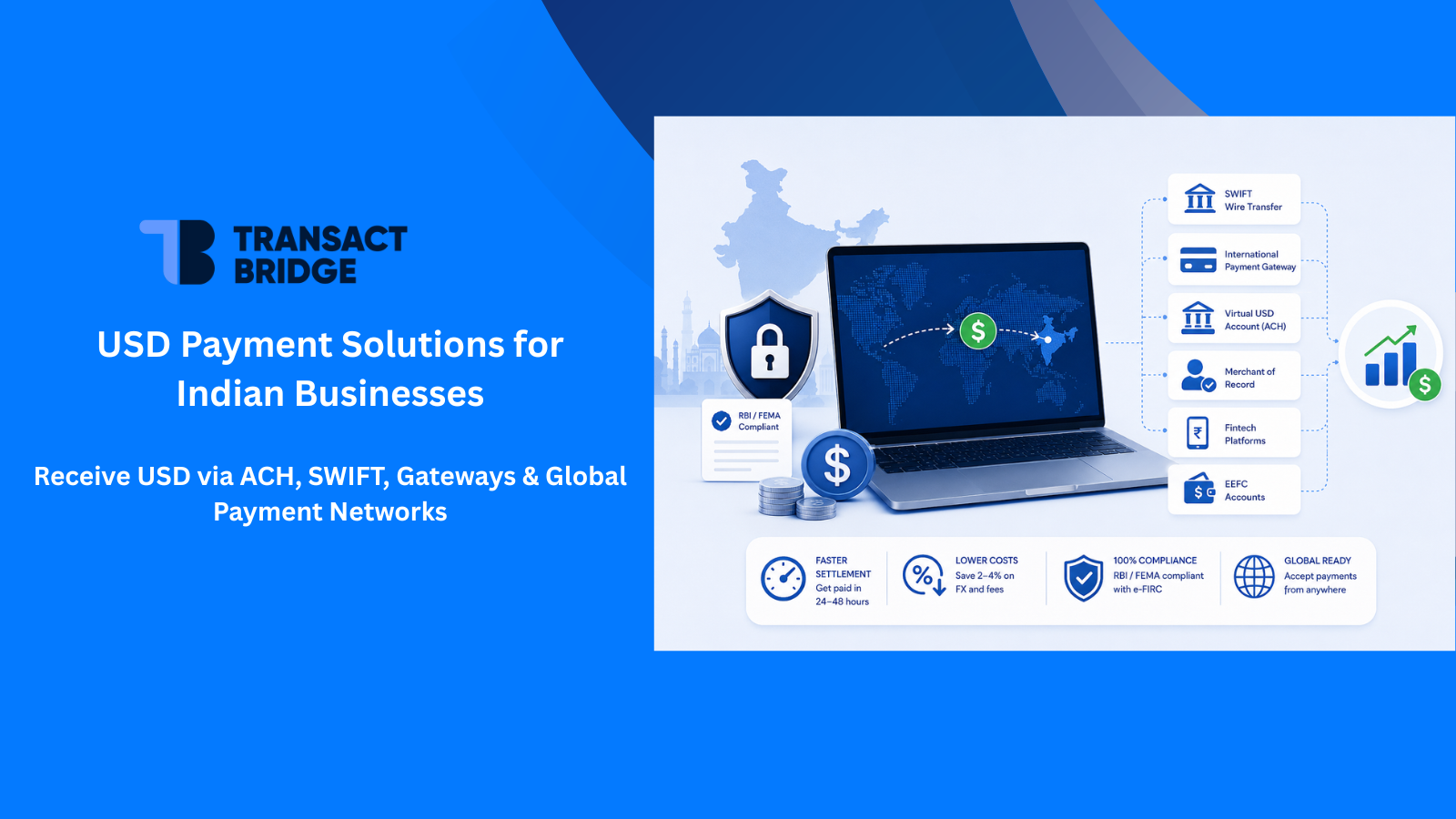
This guide explores the most practical USD payment options for Indian companies, including SWIFT transfers, virtual USD accounts, international payment gateways, Merchant of Record (MoR) solutions, fintech platforms, and EEFC accounts.
Why Receiving USD Payments Is Harder Than It Looks
Most companies discover the real challenges only after they've invoiced their first international client.
High FX costs: Traditional banking channels charge 2–3% on currency conversions. For businesses that also pay foreign vendors, the roundtrip hits 4–6%. On $100,000 of annual revenue, that's $4,000–$6,000 gone before you've spent a rupee.
Settlement delays: Standard SWIFT wire transfers take 3–5 business days to clear. For retainer-based businesses, this creates a recurring cash flow gap every single month.
RBI/FEMA compliance: Every inward remittance must flow through an RBI-authorised AD bank, carry a correct purpose code, and be documented. Get this wrong and penalties can reach 3x the transaction value.
Payment failures: International transactions fail more often than domestic ones, due to issuer restrictions, currency mismatches, and fraud filters. Every failed payment is a client you have to chase.
Limited payment options: US and European clients don't all pay the same way. Forcing everyone into a wire transfer loses you deals.
Multiple payment providers: As businesses expand internationally, they often end up managing separate providers for card payments, bank transfers, local payment methods, currency conversion, and compliance requirements. This creates operational complexity, fragmented reporting, reconciliation challenges, and additional costs. Instead of focusing on growth, finance teams spend valuable time coordinating across multiple platforms.
Transact Bridge handles FX, compliance, and settlement in one platform. See how →
Top USD Payment Options for Indian Companies
1. SWIFT Wire Transfers
The default for most Indian businesses and often not the best choice.
Your US client initiates a wire transfer from their bank. It travels via the SWIFT network to your Indian AD bank (SBI, HDFC, ICICI, Axis), which issues a Foreign Inward Remittance Certificate (FIRC) as proof of receipt.
Best for: Large B2B invoices, enterprise and government buyers, one-time high-value transactions.
What it costs: Sender fees of $15–$45, intermediary bank cuts, plus a 1–2% FX spread at your receiving bank. On a $10,000 invoice, you could absorb $200–$500 in total charges.
What to know: Under FEMA, export service proceeds must be repatriated within 12 months of the invoice date. FIRC is automatically issued and is essential for GST refunds and audits.
Pros
- Universally accepted by banks and businesses worldwide
- Suitable for large-value B2B and enterprise invoices
- Works well for one-time international payments
Cons
- Settlement can take several business days
- Multiple intermediary banks may increase costs
- Limited end-to-end payment visibility and tracking
- Less efficient for recurring or high-frequency billing
SWIFT works. But for high-frequency billing, the fees and delays add up fast.
2. International Payment Gateways
For businesses with online checkout flows, payment gateways are the standard infrastructure.
Platforms like Transact Bridge let Indian businesses accept credit cards, debit cards, digital wallets, and subscription payments from international customers in real time.
Best for: Ecommerce brands, self-serve SaaS, digital products, high-volume low-ticket transactions.
What it costs: 2.5–3.5% per transaction plus FX markup. Most international payment gateways settle funds directly in INR, meaning businesses cannot hold USD balances or choose when to convert currency. This can limit FX optimization opportunities for companies with significant international revenue. They are also generally less suited to large B2B invoices.
What to know: Authorization rates vary depending on customer geography, card issuer policies, fraud screening rules, and payment method support. Businesses selling internationally should evaluate gateway performance across their key markets, as higher authorization rates can directly improve revenue and reduce failed payments.
The opportunity: According to an EY–ASSOCHAM report, India's ecommerce exports are estimated at approximately $4–5 billion annually, highlighting significant growth potential in cross-border digital commerce.
3. Virtual USD Collection Accounts (ACH Route)
This is the fastest-growing method for Indian IT and SaaS companies and for good reason.
Platforms like Transact Bridge give your company a US-based local bank account (routing number + account number). Your client pays via ACH which for them is a standard domestic US transfer. ACH is one of the most widely used electronic payment networks in the United States, making the payment experience familiar and frictionless for US customers. Funds settle into your Indian account within 24–48 hours. .
Best for: SaaS companies, IT service firms, agencies, and any business with recurring US clients.
What it costs: FX fees as low as 0.5–1%, compared to 2–3% via traditional bank SWIFT. ACH payments are free or near-free for the sender. e-FIRC is auto-generated, no paperwork chasing.
The math: On $100,000 of annual USD revenue, switching from SWIFT to a virtual account can save $1,500–$2,500 per year in fees, plus recover 2–3 days of float per billing cycle.
The client experience is better too. Paying you feels like paying any US vendor.
4. Merchant of Record (MoR) Solutions
For digital businesses scaling across multiple countries simultaneously, the Merchant of Record model removes the need to build payment infrastructure market by market.
Under MoR, a service provider becomes the seller of record for your transactions and takes on:
- Payment processing and authorization
- US sales tax, EU VAT, and other local tax obligations
- Chargeback handling and dispute resolution
- Cross-border compliance and regulatory management
- Risk management across markets
Best for: SaaS, software, gaming, and AI companies expanding to the US, EU, and beyond, especially without a local legal entity.
What it costs: MoR fees are typically 4–6% all-in, covering processing, tax, and compliance. Higher than direct processing, but it replaces significant internal overhead.
For Indian SaaS, AI, software, and digital businesses, a Merchant of Record model can eliminate the need to establish local entities, manage global tax obligations, and maintain multiple payment relationships across markets. Instead of building compliance and payment infrastructure country by country, businesses can enter new markets through a single operational framework.
For companies without bandwidth to manage multi-jurisdiction tax and compliance themselves, MoR can be a genuine growth unlock.
5. Fintech Platforms
RBI-approved payment aggregators that automate compliance in the background while offering competitive FX rates.
Recent regulatory developments, including RBI approvals for cross-border payment aggregators, indicate a maturing ecosystem for digital international payment solutions in India.
Best for: Freelancers, consultants, small exporters, and agencies wanting simplicity without sacrificing compliance.
What it costs: Near-mid-market exchange rates, typically 1–2% total cost. Platforms auto-assign RBI purpose codes and generate e-FIRCs removing the biggest manual compliance headache for growing businesses.
Downside: lower transaction limits than bank channels, and some platforms restrict certain business categories.
6. EEFC Accounts (Exchange Earners' Foreign Currency)
If your business pays foreign vendors, buys SaaS tools priced in USD, or hires overseas contractors, an EEFC account eliminates the double-conversion trap.
Indian exporters can retain up to 100% of foreign exchange earnings in USD in an EEFC account without converting to INR. RBI's 2025 FEMA amendment extended the retention window for IFSC-based exporters from 1 month to 3 months giving businesses more flexibility to manage FX exposure.
Best for: Import-export businesses, companies with USD-denominated operating costs, businesses wanting a natural FX hedge.
What it costs: Near zero, you hold and spend in the same currency. Requires an existing AD bank relationship.
Quick Comparison
| Method | Settlement | Typical Cost | Best For |
| SWIFT Wire | 3–5 days | 2–4%+ | Large invoices, enterprise B2B |
| Payment Gateway | Instant | 2.5–3.5% | Ecommerce, self-serve SaaS |
| Virtual USD Account (ACH) | 24–48 hrs | 0.5–1% | IT services, recurring billing |
| Merchant of Record | Instant | 4–6% all-in | Multi-market digital expansion |
| Fintech Platforms | 1–3 days | 1–2% | Freelancers, SMEs, agencies |
| EEFC Account | N/A (holding) | Near zero | Businesses paying in USD |
How Transact Bridge Fits Into Your USD Payment Strategy
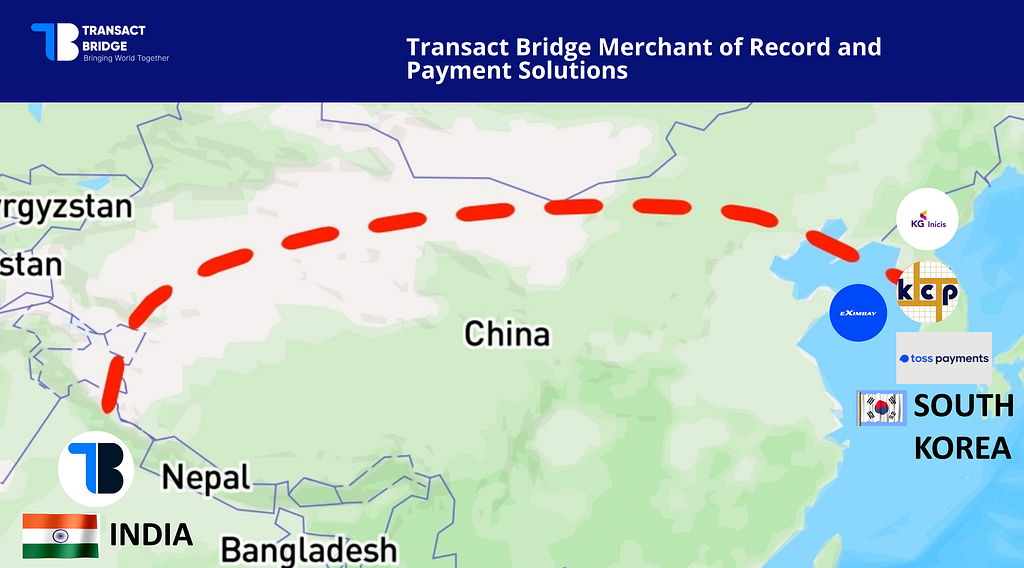
Scaling internationally means payment infrastructure becomes a two-sided problem. You need to receive USD from global clients efficiently, and accept local payment methods when you expand into new markets. Most Indian SaaS, AI, and digital businesses solve the first half but struggle with the second.
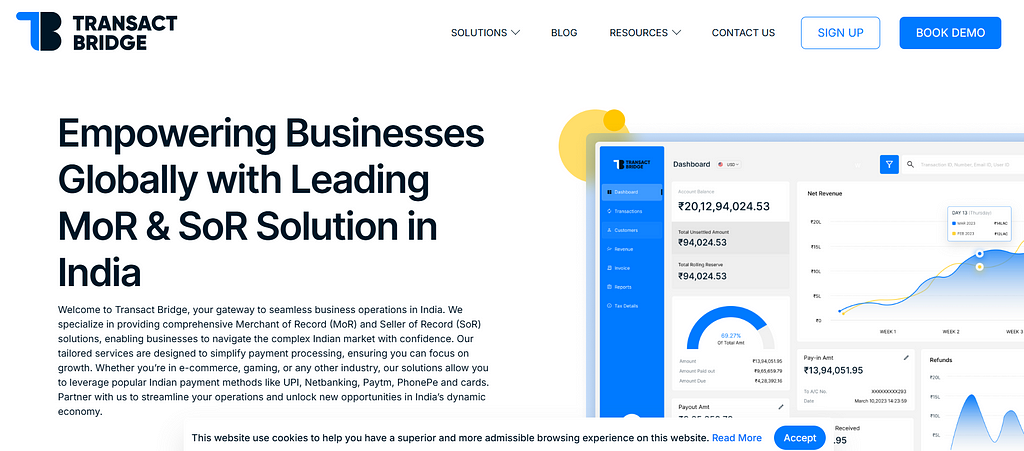
Transact Bridge works as a Merchant of Record for global companies entering India, handling the entire India-side payment stack so you don't have to:
- Local payment methods: UPI, RuPay, net banking, Paytm, PhonePe, and wallets on a single checkout
- No local entity required: GST, RBI reporting, TDS, and invoicing managed end-to-end
- 99.5% transaction clearance rate with AI-driven smart routing
- 100% regulatory compliance: audit-ready, always
Ready to simplify your cross-border payment infrastructure? Schedule a Call →
Why Payment Localization Matters
Accepting international cards is not the same as being ready for international customers.
Payment preferences vary sharply by market. ACH dominates in the US, SEPA in Europe, FPS in the UK. Businesses that only offer wire transfers or cards leave conversion on the table when clients prefer their local rails.
Payment localization for Indian businesses means:
- Higher authorization rates (less friction at checkout)
- Reduced cart abandonment from unfamiliar payment flows
- Stronger customer trust, especially in newer markets
- Lower payment failure rates
The most successful globally-scaling Indian companies build payment infrastructure that adapts to the customer's expectations, not the other way around.
RBI & FEMA: The Non-Negotiables
Regardless of which payment method you choose, every USD inward remittance must be RBI/FEMA compliant:
AD Bank routing: All foreign payments must flow through an RBI-authorised AD Category-I bank (SBI, HDFC, ICICI, Axis, etc.)
Purpose codes: P0802 for software services; P1301/P1302 for professional services. Wrong codes = rejected or delayed payments
FIRC / e-FIRC: Your proof of receipt. Required for GST refunds, income tax filings, and RBI audits. Retain for a minimum of 5 years
Repatriation deadline: Export service proceeds must return to India within 12 months of invoice date
Penalties: FEMA violations attract penalties of up to 3x the transaction value
Which Option Is Right for Your Business?
IT/SaaS with recurring US clients: Virtual USD account via ACH- lowest cost, fastest settlement, best client experience
Large one-off export invoices: SWIFT + EEFC account to hold USD for vendor payments
Ecommerce or self-serve digital product: International payment gateway
Scaling across US + EU simultaneously: Merchant of Record
Freelancer or small agency: Fintech payment platforms with built-in compliance, automated documentation, and competitive FX rates
Company with USD operating costs: EEFC account to eliminate double conversion
The Bottom Line
Most Indian businesses are still paying higher fees and waiting longer than necessary to receive USD payments. Today, options such as virtual USD accounts, international payment gateways, fintech platforms, and Merchant of Record (MoR) solutions provide faster settlements, better customer experiences, and simpler compliance than traditional payment methods alone.
When evaluating your USD payment strategy, look beyond transaction fees. Settlement speed, payment acceptance, compliance management, localization, and scalability all impact how efficiently your business grows internationally.
Setting up the right USD payment infrastructure is a one-time decision that pays off every billing cycle. Talk to the Transact Bridge team to find the right setup for your business. [Contact Us →]