UPI Payment Options for Indonesian Businesses: How to Accept UPI Payments from India Without an Indian Entity
Published on: Sat 06-Jun-2026 12:14 PM
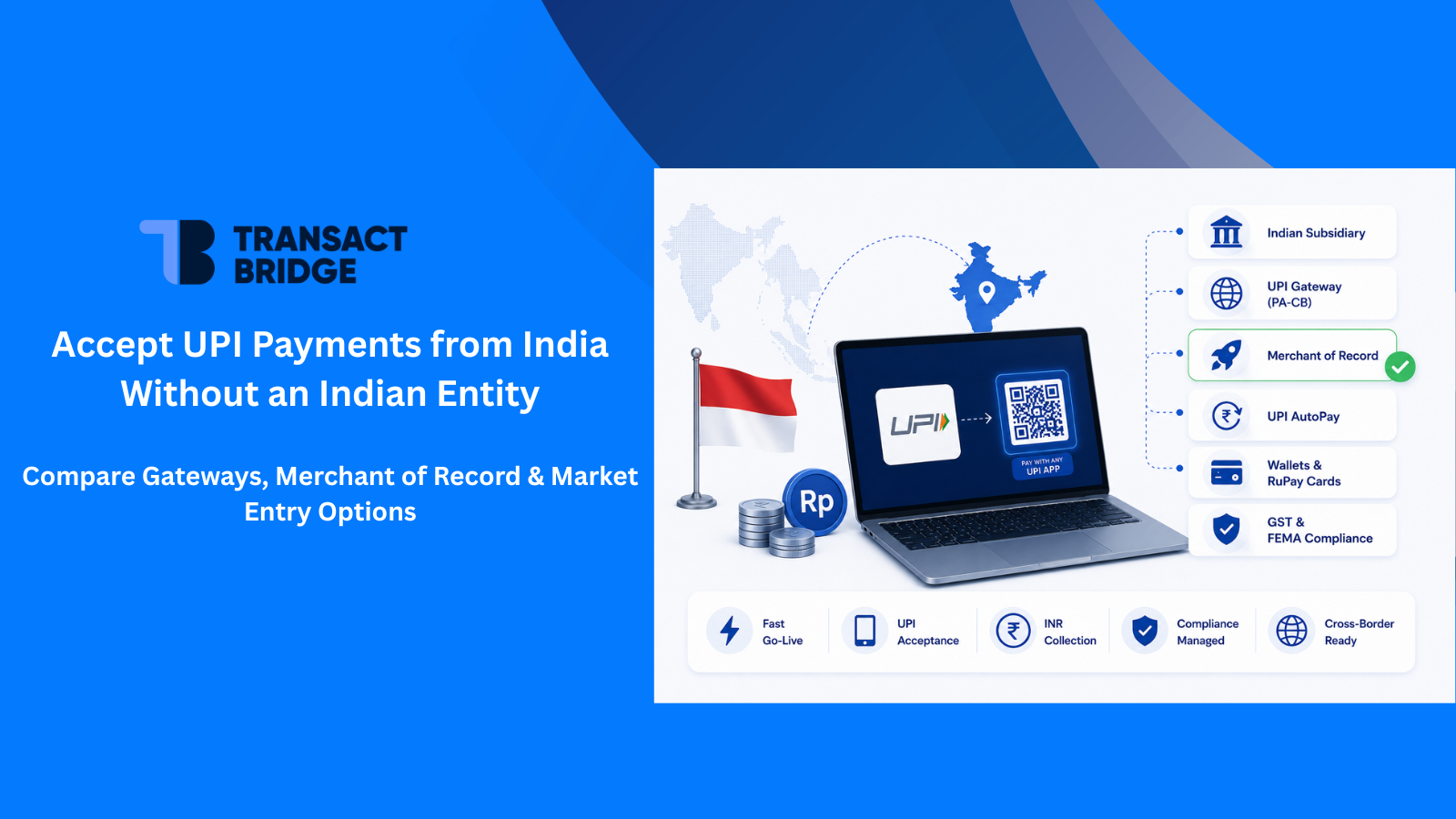
Indonesian businesses now have three realistic UPI payment options: set up an Indian subsidiary, use a PA-CB licensed UPI payment gateway, or use a Merchant of Record.
The Merchant of Record route is fastest with no Indian entity required, live in 3–7 days.
India and Indonesia are connected through a live cross-border payment corridor. UPI processed 19.4 billion transactions in July 2025 alone. Approximately 84% of all digital payments in India. If you sell software, SaaS, AI tools, gaming credits, subscriptions, or digital products in India from Indonesia, those 500 million UPI users are your market.
This guide maps every UPI payment option available to Indonesian businesses today, explains what the QRIS–UPI interoperability corridor actually means for your checkout, and gives you a straight answer on the fastest compliant path to go live.
UPI Payment Options for Indonesian Businesses: Why This Decision Matters Now
Indian customers don't pay the way Western customers do. They pay with UPI. Understanding your options isn't a future decision. Every day without UPI at checkout is revenue leaving to a competitor who has it.
UPI, India's Unified Payments Interface, now handles 85% of the country's digital transactions. 19.4 billion transactions in a single month. That is not a niche payment method. It is the default.
For Indonesian businesses, the three UPI payment options are not equal. They differ in setup time, cost, compliance burden, and how much ongoing operational overhead lands on your team. Picking the wrong one costs months and money. This section lays out exactly what each option involves so you can choose quickly and correctly.
The question is not whether to enable UPI. It is which option gets you there fastest, with the least compliance risk on your side.
QRIS–UPI Interoperability for Indonesian Businesses: What It Actually Means
This is the most important development in Indonesia–India payments in years and the most misunderstood. Read this before evaluating any payment solution.
What the corridor is
Indonesia's QRIS (Quick Response Code Indonesian Standard) and India's UPI are both domestic real-time QR payment systems. The QRIS–UPI interoperability initiative creates a shared corridor between them allowing an Indian consumer to scan a QRIS merchant QR code using PhonePe, Google Pay, or any UPI app, and pay in Indian Rupees, with the Indonesian merchant receiving settlement in Rupiah.
No new hardware. No second QR code. The existing QRIS code works.
Who benefits from QRIS–UPI interoperability as an Indonesian business
The corridor is most immediately useful for physical merchants- hotels, restaurants, retail- accepting payments from Indian tourists. For these businesses, QRIS–UPI interoperability means Indian visitors pay seamlessly without cash or currency exchange.
For Indonesian businesses selling digital products in India from Indonesia- software, SaaS, subscriptions, gaming credits- the corridor matters as infrastructure context. It signals where the two payment systems are heading. But it does not replace what you need today.
What QRIS–UPI interoperability does not do for online businesses
QRIS–UPI interoperability does not mean Indonesian merchants can accept UPI on their website or app without a licensed intermediary. Online UPI acceptance for foreign merchants is governed by the Reserve Bank of India's Payment Aggregator – Cross Border (PA-CB) framework, a separate regulatory track. The interoperability corridor operates between the two national QR systems at the infrastructure level. It does not bypass the PA-CB requirement for digital commerce.
If you are evaluating payment options because you want to sell to Indian customers online, the practical path still runs through a licensed payment partner. The QRIS–UPI corridor is a signal. It is not a shortcut.
How Indonesian Businesses Can Accept UPI Without an Indian Entity
Yes, Indonesian businesses can accept UPI from Indian customers without registering a company in India. This is not a loophole. It is how the modern cross-border payment infrastructure is designed to work.
Two mechanisms make UPI acceptance without an Indian entity possible for Indonesian businesses:
A PA-CB licensed UPI payment gateway for Indonesian merchants provides technical access to UPI, wallets, and cards, but leaves tax compliance, FEMA obligations, and settlement management with you
A Merchant of Record (MoR) becomes the legal seller in India, holds the licences, manages all compliance, and settles funds to your Indonesian bank account
Here is where most Indonesian businesses go wrong: they assume that because they already accept international payments through Stripe or PayPal, they are ready to sell in India. At checkout, Indian customers find no UPI option and leave. Stripe, PayPal, and Adyen do not offer direct UPI acceptance for foreign merchants. That rules out the most familiar global providers immediately.
What remains is a shortlist of India-specialist solutions. The right choice between a UPI payment gateway and a Merchant of Record depends on how much compliance infrastructure your team is willing to manage in-house.
UPI Payment Options for Indonesian Businesses Compared: Gateway vs. Merchant of Record
Option 1: Indian subsidiary
Full legal presence in India. Full access to every payment method, gateway, and banking relationship. Setup takes 6–12 months. Significant upfront legal and accounting investment. Ongoing GST filings, FEMA reporting, RBI registrations before you have validated a single rupee of revenue.
The right structure only for large enterprises that have already confirmed India as a core market and have a local compliance team to run it.
Option 2: UPI payment gateway for Indonesian merchants
A PA-CB licensed UPI payment gateway for Indonesian merchants such as Razorpay's cross-border product gives foreign businesses technical access to UPI, wallets, and cards without an Indian entity. Setup takes 2–4 weeks. You can collect INR and settle in your preferred currency.
The gap: GST obligations, FEMA compliance, e-mandate management for recurring payments, invoicing, and cross-border settlement remain your responsibility. This is the right option if your business has in-house India compliance expertise and wants full control.
Without that expertise, the compliance overhead accumulates quickly, usually invisibly, until a filing deadline or settlement hold surfaces it.
Option 3: Merchant of Record for Indonesia–India UPI payments
A Merchant of Record for Indonesia–India UPI payments such as Transact Bridge, becomes the legal seller in India on your behalf. Setup takes 3–7 days. No Indian entity, no GST registration, no FEMA paperwork on your side.
The MoR holds the necessary licences, manages tax compliance and GST invoicing, handles RBI and FEMA requirements, processes chargebacks, and settles funds to your Indonesian bank account. You get a single integration that activates UPI, UPI AutoPay, wallets, RuPay cards, and net banking simultaneously.
The right option for any business that wants to sell in India without building an India-specific compliance function.
Setup time: Subsidiary 6–12 months · UPI gateway 2–4 weeks · Merchant of Record 3–7 days
Indian entity required: Subsidiary yes · Gateway no · MoR no
GST & tax handling: Subsidiary you manage · Gateway you manage · MoR fully handled
RBI / FEMA compliance: Subsidiary you manage · Gateway you manage · MoR fully handled
INR → IDR settlement: Subsidiary manual · Gateway manual or limited · MoR handled
Ongoing compliance load: Subsidiary high · Gateway high · MoR low
Time to first payment: Subsidiary long · Gateway medium · MoR fast
Over 500 businesses spanning SaaS, gaming, AI tools, EdTech, and digital products have used Transact Bridge's Merchant of Record infrastructure to enter India without an Indian entity.
Not sure which option is right for your business? Schedule a call →
UPI Payment Methods Indonesian Merchants Can Offer
Once you have the right payment partner in place, you can offer Indian customers the same UPI experiences they use every day. There are four payment types, each suited to different business models.
UPI QR payments
The customer scans a QR code using PhonePe, Google Pay, Paytm, or any UPI-enabled banking app and approves payment instantly from their bank account. No card details. No redirects. Instant confirmation. Best for e-commerce, digital product sales, and one-time purchases.
UPI Intent payments
Deep-link payments that redirect customers from your checkout directly into their preferred UPI app on mobile. One tap to approve, then back to your site with payment confirmed. Higher conversion than QR-based flows on mobile. Best for SaaS platforms, mobile apps, and mobile-first checkouts.
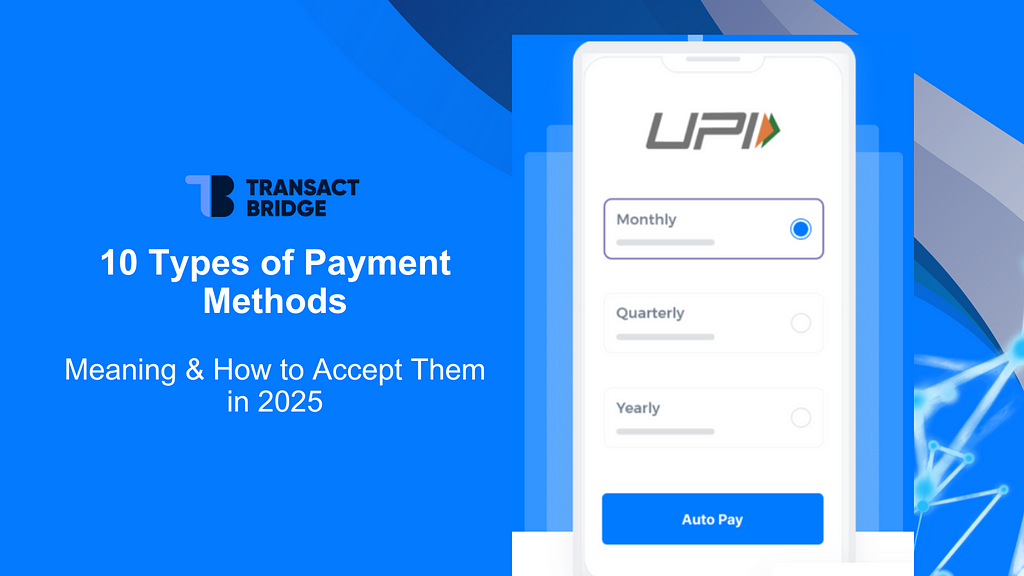
UPI AutoPay for Indonesian Subscription Businesses
UPI AutoPay for Indonesian subscription businesses is the most important payment method to get right. It is the closest equivalent to card-on-file recurring billing in India and in a market where UPI dominates and card penetration is low, it is the difference between a subscription business that retains customers and one that churns them at every renewal.
Here is how the UPI AutoPay mandate flow works from your customer's perspective:
- Customer reaches checkout and selects UPI AutoPay
- They open their UPI app- Google Pay, PhonePe, Paytm, or any UPI-enabled banking app
- They approve a one-time e-mandate authorisation for your billing schedule
- All future payments are collected automatically on the billing date, no re-authentication required
E-mandate limits: Standard UPI AutoPay mandates support recurring transactions up to ₹1,00,000 per transaction, approximately USD 1,200. For higher-value subscriptions, different authorisation flows apply.
Payment failure handling: If a payment fails, the system retries within RBI-defined windows. A Merchant of Record handles retry logic, dunning, and mandate recovery automatically. With a UPI gateway, you manage this yourself.
Why this matters: Indonesian subscription businesses that offer UPI AutoPay see significantly lower churn at renewal than those relying on card-on-file billing. Indian consumers expect it. Its absence is a churn trigger, not a missing feature.
UPI payment links
Generate a payment link and share it via email, WhatsApp, or SMS. No checkout integration needed. Best for consulting services, agencies, and businesses testing Indian market demand before a full integration.
How Indonesian Companies Can Accept UPI Payments: Step by Step
For most Indonesian businesses, the fastest path to UPI acceptance looks like this.
Step 1: Choose your model
No India compliance team? Merchant of Record. The route avoids months of legal setup and lets you validate Indian market demand with real revenue before committing to any permanent structure. Have in-house India compliance expertise? A PA-CB licensed UPI payment gateway for Indonesian merchants is a viable alternative with more direct control over the payment stack.
Step 2: Complete onboarding and KYC
With Transact Bridge, onboarding requires standard business verification — not Indian corporate registration. Company registration documents, beneficial ownership information, business bank account details, and a website review. No Indian entity, local bank account, or Indian tax registration required.
Step 3: Single API integration
One API or hosted checkout integration activates UPI, UPI AutoPay, digital wallets, RuPay cards, and net banking simultaneously. Most teams go from sandbox to live in under a week.
Step 4: Price in INR
Indian customers convert better when they see INR pricing at checkout. Your Merchant of Record handles INR collection and IDR or USD settlement on your agreed schedule.
Step 5: Go live
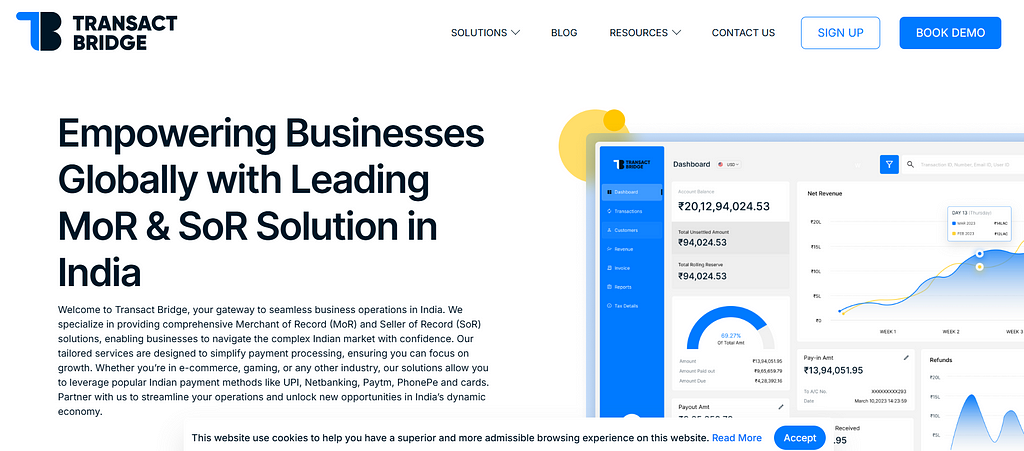
99.5% transaction clearance rate. 99.8% recurring payment stability. No RBI filings, GST returns, or FEMA paperwork on your side. Monitor transactions, refunds, and settlements from a single dashboard.
Indonesian companies that accept UPI payments through Transact Bridge go live in 3–7 days, against 6–12 months for an Indian subsidiary and 2–4 weeks for a gateway that still leaves compliance with you.
Which Indonesian Businesses Need UPI Access Most
SaaS and AI tools: Indian SMBs and developers actively buy software. Card failure rates on international platforms are high without local acquisition. UPI removes that failure completely. The Merchant of Record handles GST complexity on B2B SaaS sales in India automatically.
Gaming and in-game purchases: UPI is the default payment method for Indian gamers. High transaction frequency makes success rates critical. UPI AutoPay handles gaming subscription billing without re-authorisation on each cycle.
EdTech and online learning: India is one of the world's largest EdTech markets. UPI AutoPay for Indonesian subscription businesses in EdTech drives retention in a way card-on-file billing cannot match — because most Indian learners do not have international cards.
Digital products: software, themes, ebooks, downloads: Indonesian businesses that sell digital products in India from Indonesia need instant-purchase payment flows. UPI removes every friction point between intent and completion.
Creator economy: Indian fan communities are large and increasingly willing to pay for digital content and memberships. A Merchant of Record Indonesia–India UPI setup handles the full payment and compliance lifecycle for creator revenue.
Common Mistakes Indonesian Businesses Make When Setting Up UPI
Assuming Stripe or PayPal covers UPI. They do not offer direct UPI acceptance for foreign merchants. This is discovered at checkout, after integration is built.
Confusing QRIS–UPI interoperability with online UPI acceptance. The corridor enables in-person QR payments between Indonesia and India. It does not replace a licensed payment partner for digital commerce.
Choosing a UPI payment gateway without accounting for compliance overhead. A PA-CB gateway gives Indonesian merchants technical UPI access. GST, FEMA, e-mandate management, and settlement remain yours. For businesses without an India compliance function, this cost surfaces unexpectedly.
Running subscriptions without UPI AutoPay for Indonesian subscription businesses. Recurring billing in India without a proper e-mandate infrastructure produces high failure rates at renewal. UPI AutoPay is the standard. Its absence is the problem, not a workaround.
Pricing in USD at checkout. Indonesian businesses that sell digital products in India from Indonesia see higher conversion when prices display in INR. Always show local pricing, regardless of your settlement currency.
Ignoring FEMA compliance. Collecting INR through non-approved routes triggers settlement holds. The costs appear long after the original mistake, and they compound.
The Bottom Line on UPI Payment Options for Indonesian Businesses
India and Indonesia are connected through a live payment corridor. UPI processed 19.4 billion transactions in one month. 84% of India's digital payments. 500 million users. The market is not arriving, it is already buying.
The three UPI payment options for Indonesian businesses,Indian subsidiary, PA-CB licensed UPI payment gateway, or Merchant of Record, are not equal. For most businesses, especially those selling digital products, SaaS, gaming credits, or subscriptions, the Merchant of Record is the only route that gets you live quickly without building an India compliance function from scratch.
Transact Bridge operates as a Merchant of Record for Indonesia–India UPI payments handling UPI, UPI AutoPay, wallets, RuPay cards, net banking, Indian GST, FEMA, RBI compliance, and cross-border settlement in one platform. Trusted by 500+ global businesses. 99.5% transaction clearance rate.
FAQs
What are the UPI payment options for Indonesian businesses?
There are three UPI payment options for Indonesian businesses: (1) establish an Indian subsidiary with full access, 6–12 months setup; (2) use a PA-CB licensed UPI payment gateway for Indonesian merchants, technical UPI access in 2–4 weeks, compliance remains with you; or (3) use a Merchant of Record- legal seller in India, all compliance handled, live in 3–7 days. For most businesses entering India for the first time, the Merchant of Record is the fastest and lowest-risk route.
How can Indonesian companies accept UPI payments without setting up in India?
Indonesian companies can accept UPI payments by partnering with either a PA-CB licensed payment gateway or a Merchant of Record. Neither requires an Indian entity, Indian bank account, or Indian tax registration. A Merchant of Record like Transact Bridge typically onboards Indonesian businesses in 3–7 days.
Which UPI payment gateway works for Indonesian merchants?
Indonesian merchants need a PA-CB licensed UPI payment gateway the RBI licence category that permits foreign merchants to collect Indian payments. Razorpay's cross-border product is one example. A UPI payment gateway for Indonesian merchants gives technical UPI access but leaves compliance, GST, FEMA, and settlement management with you. If you want those handled, a Merchant of Record is the alternative.
Can Indonesian businesses accept UPI from India without an Indian entity?
Yes, a Merchant of Record or PA-CB licensed gateway both make it possible to accept UPI from India without an Indian entity. The Merchant of Record route additionally removes the compliance and tax obligations that sit with the gateway route.
What is the best Merchant of Record for Indonesia–India UPI payments?
The best Merchant of Record for Indonesia–India UPI payments depends on your product type and compliance needs. Transact Bridge is built specifically for this corridor handling UPI, UPI AutoPay, wallets, RuPay cards, net banking, GST, FEMA, RBI compliance, and INR–IDR settlement in one platform.
What does QRIS–UPI interoperability mean for Indonesian businesses?
QRIS–UPI interoperability for Indonesian businesses means Indian consumers can pay at QRIS QR codes using UPI apps primarily for in-person transactions like tourism and retail. For online digital commerce, QRIS–UPI interoperability does not replace the need for a licensed payment partner. UPI acceptance on a website or app still requires a PA-CB gateway or Merchant of Record.
How do Indonesian businesses sell digital products in India without GST registration?
Indonesian businesses that sell digital products in India from Indonesia can avoid Indian GST registration by operating through a Merchant of Record. The MoR becomes the legal seller in India and manages GST obligations on your behalf. Businesses using a gateway or accepting payments directly may carry their own GST obligations depending on transaction volume.
How does UPI AutoPay work for Indonesian subscription businesses?
UPI AutoPay for Indonesian subscription businesses works through a one-time e-mandate authorisation. The customer approves the mandate once in their UPI app; all future payments are collected automatically on the billing date. Standard mandates support up to ₹1,00,000 per transaction. A Merchant of Record manages mandate creation, retries, and recovery automatically.