What Is Carding Fraud? Prevention Strategies for Cross-Border Businesses
Published on: Sat 13-Jun-2026 02:26 AM
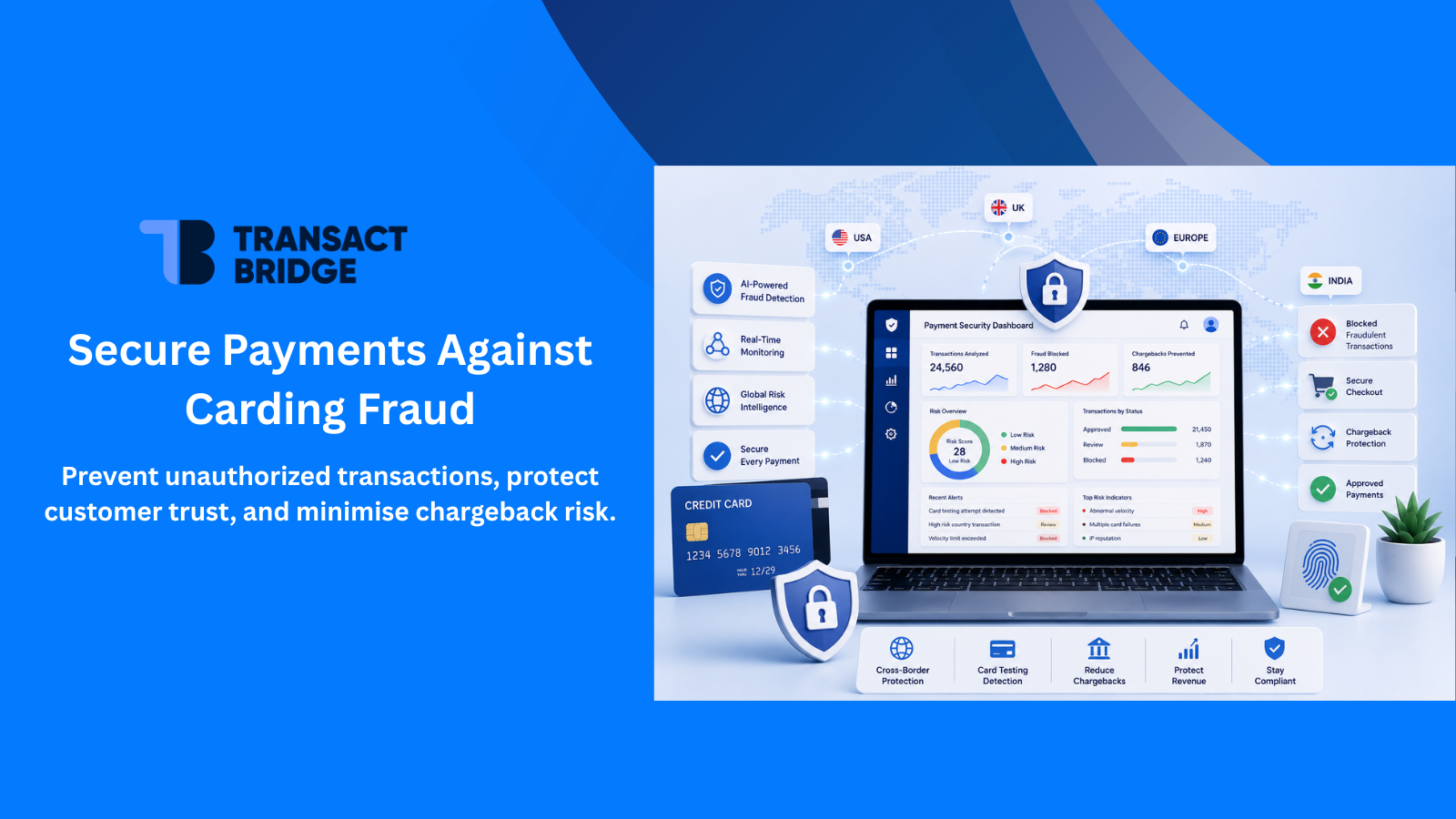
Your payment just went through. So did 847 others in the last four minutes and none of them came from real customers.
That's carding. And if your business accepts payments online across India, the USA, or any global market, it's not a hypothetical threat. It's happening right now to SaaS platforms, e-commerce stores, gaming companies, and digital product sellers who had no idea until the chargeback notices arrived.
Credit card fraud losses worldwide are on track to exceed $43 billion by 2026. A significant chunk of that doesn't come from one dramatic heist. It comes from thousands of automated, invisible attacks quietly draining revenue from businesses that weren't watching closely enough.
This blog explains what carding fraud is, how carding attacks work, why cross-border businesses are especially vulnerable, and the most effective strategies for preventing carding fraud before it impacts revenue and payment acceptance.
What Is Carding Fraud?
Carding fraud is the use of stolen credit or debit card information to test active payment cards and make unauthorized online purchases. Fraudsters often use automated bots to validate stolen card details through small transactions before conducting larger fraudulent purchases, account takeovers, or financial scams.
What makes carding fraud particularly dangerous is its scale and sophistication. Modern carding operations function like organised businesses, using automation, proxy networks, and stolen payment databases to launch thousands of fraudulent transaction attempts across merchants worldwide.
Carding fraud commonly involves:
- Stolen payment card data obtained through data breaches, phishing attacks, malware, or dark web marketplaces.
- Automated card testing to identify active cards that can be used for fraudulent transactions.
- Unauthorized purchases of gift cards, digital products, subscriptions, or high-value goods that can be quickly resold.
- Account takeover and identity fraud using detailed personal information linked to compromised cards.
In underground markets, fraudsters often trade "Fullz" complete identity packages that may include a card number, expiry date, CVV, billing address, date of birth, and other personal details. These records enable not only carding fraud but also identity theft, account takeover, and synthetic identity fraud.
For businesses operating across India, the USA, and global markets, carding fraud is not simply a payment-processing challenge. It can lead to chargebacks, increased fraud-management costs, damaged customer trust, merchant account restrictions, and regulatory scrutiny if left unchecked.
How Carding Works in E-Commerce
Understanding how carding works in e-commerce is the first step to building an effective defence. Every online business from SaaS platforms and AI companies to digital marketplaces and e-commerce stores is a potential target. While attack methods vary, most carding fraud follows a predictable lifecycle:
Data Theft
↓
Card Testing
↓
Fraudulent Transactions
↓
Chargebacks & Disputes
↓
Merchant Losses
Fraudsters first obtain stolen card information, validate active cards through automated testing, use those cards for unauthorized purchases, and leave merchants dealing with chargebacks, operational costs, and increased fraud risk.
Stealing Card Information
Fraudsters known as "carders" harvest card information through:
- Phishing: Fake emails, SMS, or websites impersonating legitimate brands such as banks, UPI apps, e-commerce platforms trick users into entering card details.
- Data breaches: A single hack of a retailer or payment processor can yield millions of card records, packaged and sold in bulk.
- Skimming: Physical devices installed on ATMs or POS terminals silently capture card data during legitimate transactions.
- Keylogging: Malware records every keystroke on a victim's device, capturing card numbers and CVVs during checkout.
- Formjacking: Malicious code injected into legitimate checkout pages captures card details in real time. In December 2024, the European Space Agency's merchandise store was compromised, this way a fake payment page silently harvested customer card data.
- SQL injection: Exploits database vulnerabilities to extract stored card records often hundreds of thousands at once.
- Fake apps and websites: Cloned banking apps and UPI platforms particularly prevalent in India collect credentials from users who believe they are genuine.
- Shoulder surfing: Fraudsters watch victims enter card details at ATMs or checkout counters.
- Brute force attacks: Automated software systematically generates and tests card number combinations.
Once stolen, card data is organised, traded, and sold on underground marketplaces based on factors such as card type, issuing country, available credit limit, and account quality.
A basic card record may sell for only a few dollars, while a "Fullz" package containing a card number, CVV, billing address, date of birth, and other personal information commands significantly higher prices because it enables both carding fraud and broader identity theft schemes.
See how Transact Bridge detects card testing in real time → Book a demo
Card Testing Attacks on Online Businesses
This is the stage where carding fraud directly impacts merchants often before a single fraudulent purchase is completed.
After acquiring stolen card data in bulk, fraudsters do not know which cards are still active. To identify valid cards, they launch card testing attacks on online businesses, using automated bots to process small transactions, typically between $0.01 and $2, across multiple merchant websites simultaneously.
These card testing attacks on online businesses are designed to blend into normal transaction activity while generating valuable intelligence for fraudsters. Even when the transactions fail, the volume alone can create operational and financial challenges for merchants.
For SaaS platforms, e-commerce stores, gaming companies, and digital marketplaces, a single attack can:
- Flood payment gateways with thousands of failed authorization attempts within minutes.
- Push chargeback ratios above acceptable thresholds, often between 0.5% and 1%.
- Trigger increased monitoring, reserves, or processing fee hikes from acquiring banks.
- Lead to merchant account restrictions, suspension, or termination in severe cases.
Many organisations do not recognise carding attacks on SaaS businesses until they receive warnings from payment processors or begin experiencing abnormal chargeback activity. By that stage, fraudsters may have already validated thousands of compromised cards.
For subscription-based companies, preventing carding attacks on SaaS businesses is particularly important because recurring billing systems can become attractive targets for automated card testing campaigns.
Effective payment fraud prevention requires monitoring transaction velocity, authorization patterns, and unusual spikes in failed payments before they escalate into larger fraud events.
Executing Fraudulent Transactions
Once valid cards are identified, fraudsters move quickly to monetise them. Common targets include:
- Digital products and SaaS subscriptions: instant delivery and no physical shipping trail.
- Gift cards and prepaid vouchers: easily purchased and resold within hours.
- Gaming credits and in-game assets: a rapidly growing fraud category across India and international markets.
- High-value electronics: frequently resold through secondary marketplaces.
Account Takeover (ATO) and Synthetic Identity Fraud
Modern carding operations increasingly extend beyond payment fraud.
Using Fullz data, fraudsters may:
- Take over existing accounts (ATO): Access legitimate customer accounts, change billing details, and make purchases that appear to originate from trusted users. For SaaS businesses, account takeover fraud can remain undetected for weeks.
- Create synthetic identities: Combine genuine personal information with fabricated details to create entirely new identities capable of passing basic verification checks.
These techniques allow fraudsters to move beyond one-time transactions and establish longer-term fraudulent activity that is harder to detect and investigate.
Evading Detection
Sophisticated fraudsters build evasion techniques into every stage of the carding lifecycle, including:
- VPNs and proxies that conceal real IP addresses.
- Randomized bots that mimic human behaviour, including mouse movements and browsing patterns.
- Distributed bot networks that spread activity across hundreds of IP addresses.
- Device spoofing that makes each transaction appear to originate from a different device.
For cross-border businesses, these tactics can be especially effective because transactions from multiple countries, devices, and networks are often part of normal business activity.
The Dark Web and the Carding-as-a-Service Economy
Carding is sustained by a thriving underground economy that has professionalised significantly in the last three years.
Dark web marketplaces function like B2B platforms for fraud selling stolen card data, Fullz packages, carding bots, validation services, and cash-out assistance. Some even offer customer support.
What has changed in 2025 is the rise of Carding-as-a-Service fraud tools, stolen data, and operational infrastructure packaged and sold as ready-to-use services, accessible to fraudsters with minimal technical skill. Many of these platforms no longer hide on the Tor network. A growing number operate on the clear web.
This is why carding doesn't slow down. Every time businesses deploy a new prevention measure, the carding community develops a counter. Static, rule-based fraud prevention consistently fails. Adaptive, AI-driven systems are now the minimum standard.
The rise of Carding-as-a-Service means businesses now face more frequent and sophisticated fraud campaigns. Traditional rule-based systems are often unable to stop modern carding attacks, making adaptive fraud prevention essential.
Why Cross-Border Businesses Are High-Value Targets
Generic fraud advice treats all businesses the same. But payment fraud India cross-border operations face a fundamentally different and significantly higher risk profile than businesses that operate within a single market.
Cross-border merchants must manage multiple payment methods, currencies, regulatory frameworks, and customer geographies simultaneously.
While these capabilities enable global growth, they also create additional attack surfaces that fraudsters actively exploit.
Geographic Complexity Creates Blind Spots
For domestic merchants, unusual locations can be a strong fraud signal. For international businesses, they are often part of normal operations.
A company serving customers across India, the USA, Europe, and Southeast Asia cannot automatically flag transactions from unfamiliar geographies. Fraudsters understand these limitations and often use them to bypass traditional fraud controls. This makes cross-border payment security significantly more challenging than domestic payment security.
Multiple Payment Methods Create Multiple Attack Surfaces
Cross-border businesses frequently accept a mix of:
- UPI
- RuPay
- Visa
- Mastercard
- Net Banking
- Digital Wallets
Each payment method has its own fraud patterns, authentication requirements, and dispute-resolution processes. As a result, payment fraud India cross-border environments require broader monitoring and more sophisticated risk controls than single-market operations.
Currency Conversion Can Hide Fraud Signals
International transactions introduce foreign exchange fluctuations, varying transaction values, and region-specific spending behaviours.
These variables can create noise that makes suspicious activity harder to identify. Fraud patterns that would stand out in a domestic environment may appear legitimate within a global transaction stream, creating additional challenges for cross-border payment security teams.
Chargeback Rules Differ Across Markets
Managing disputes across countries adds another layer of complexity.
RBI regulations in India and Visa or Mastercard chargeback frameworks in the USA operate under different timelines, evidence requirements, and compliance expectations. Effective chargeback prevention India USA strategies require businesses to navigate multiple regulatory environments simultaneously while maintaining consistent fraud controls.
For growing SaaS companies, e-commerce brands, gaming platforms, and digital businesses, strong cross-border payment security is no longer optional. As transaction volumes increase across regions, the ability to prevent fraud, manage disputes, and maintain payment acceptance becomes a critical competitive advantage.
Talk to a payments specialist about your India/US exposure- Schedule a call
UPI Fraud and the India-Specific Threat
India processes over 10 billion UPI transactions per month. That scale is an opportunity and a target.
For global businesses entering India, UPI fraud prevention is a distinct requirement, not an extension of a Western card-network fraud stack. UPI fraud affecting merchants includes:
- Fake payment confirmations: fabricated UPI success screenshots used to claim goods without completing payment
- Collect request fraud: fraudsters impersonate the merchant and redirect customer payments
- UPI handle spoofing: IDs that differ from the merchant's by a single character intercept payments
- QR code manipulation: checkout QR codes replaced with fraudulent ones
- Fake banking and UPI apps: cloned apps that harvest credentials from unsuspecting users.
Without India-native fraud intelligence and local banking relationships, these patterns are invisible in a global fraud model.
How Carding Impacts Businesses and Customers
Carding fraud creates financial, operational, and reputational consequences for both merchants and consumers. The impact extends far beyond a single fraudulent transaction.
Business Impact of Carding Fraud
| Fraud Activity | Business Consequence |
| Card Testing Attacks | Increased authorization failures, gateway strain, and processor alerts |
| Fraudulent Transactions | Revenue loss through chargebacks and disputed payments |
| Account Takeover (ATO) Fraud | Customer churn, support costs, and loss of trust |
| Synthetic Identity Fraud | Compliance risks and increased fraud investigation costs |
| High Chargeback Volumes | Higher processing fees, rolling reserves, or merchant account restrictions |
| Repeated Carding Attacks | Increased scrutiny from payment processors and acquiring banks |
Business Effects
- Financial losses: Fraudulent chargebacks are typically borne by the merchant. For SaaS businesses on tight margins, a sustained carding attack can be existential.
- Chargeback ratio penalties: Exceeding processor thresholds triggers fee increases, holds, or account termination.
- Reputational damage: Customers who experience fraud leave reviews and don't return.
- Regulatory compliance risk: PCI-DSS failures from carding incidents trigger fines and mandatory audits.
- Increased processor scrutiny: High fraud rates lead to higher reserves and stricter requirements on every transaction.
Customer Effects
- Unauthorised charges and lengthy account recovery processes
- Identity theft via Fullz data opening new accounts and loans in victims' names
- Damaged credit scores if fraud leads to missed payments or defaults
- Emotional distress and lasting loss of confidence in digital payments
A Brief History of Carding- How Carding Fraud Has Evolved
From Physical Theft to Online Fraud
Carding fraud did not begin online. Early forms of payment fraud relied on physical methods such as stolen wallets, card cloning, and skimming devices attached to ATMs or point-of-sale (POS) terminals. Skimmers were reported to exist around 2002. These attacks gave fraudsters direct access to payment card information, which was then used for unauthorized purchases or cash withdrawals.
As internet adoption accelerated, carding operations moved online. Phishing became more common in the early 2000s. Phishing campaigns, malware, and large-scale data breaches enabled criminals to steal payment card data in bulk. Instead of targeting individual victims, fraudsters could now acquire thousands or even millions of card records at once and sell them through underground marketplaces.
The Rise of Automation
The next major shift was automation.
Card testing bots enabled fraudsters to validate stolen card information at scale by running thousands of low-value transactions across merchant websites. Distributed bot networks reduced the likelihood of detection by spreading activity across multiple IP addresses, devices, and locations.
As carding attacks became more sophisticated, security controls evolved as well. The adoption of chip-and-PIN technology reduced physical card cloning, while e-commerce businesses introduced fraud detection tools, CAPTCHA verification, device fingerprinting, and machine learning-based risk analysis to identify suspicious transactions.
Modern Carding Fraud
Today's carding operations extend far beyond stolen card numbers.
Fraudsters increasingly combine carding fraud with account takeover (ATO), synthetic identity fraud, and AI-powered automation. Fullz data packages containing card information, billing details, and personal identifiers enable criminals to bypass basic verification checks and conduct more complex fraud schemes.
For SaaS platforms, e-commerce businesses, gaming companies, and cross-border merchants, this evolution has changed the nature of payment fraud.
Modern fraud attacks are faster, more automated, and more difficult to detect than traditional carding schemes, making continuous fraud monitoring and adaptive payment security essential for long-term protection.
The Merchant of Record Advantage in Fraud Protection
Most fraud prevention conversations focus on tools. They miss the most structurally impactful decision a cross-border business can make: choosing the right payment model.
When you sell across borders without a local entity, fraud liability, chargeback disputes, and regulatory compliance land entirely on you — without the local infrastructure to manage them effectively. You're fighting cross-border fraud with one hand tied behind your back.
The Merchant of Record model changes the foundation, not just the tooling:
Fraud liability is shared. The MoR absorbs a significant portion of chargeback and fraud risk, reducing direct financial exposure for the merchant.
Disputes are handled locally. Each market has its own documentation requirements, timelines, and regulatory frameworks. RBI compliance in India operates differently from Visa and Mastercard chargeback rules in the USA. A local MoR navigates these natively rather than retrofitting a global system.
Transactions route through local acquirers. Domestic banking infrastructure carries stronger trust signals with issuing banks, resulting in higher authorisation rates and fewer false fraud flags on legitimate transactions.
Compliance is built into the payment layer. Tax obligations, regulatory reporting, and payment security requirements are managed at the infrastructure level rather than added on as afterthoughts.
For cross-border businesses, fraud prevention without a local India entity is structurally limited. Fraud tools are only as effective as the payment infrastructure they sit on — and without local acquiring relationships, compliance coverage, and banking trust signals, even the best detection system underperforms
The MoR model doesn't replace fraud prevention. It makes every Merchant of Record fraud protection investment more effective.
See if the MoR model is right for your business — free consultation
Carding Fraud Prevention for Global Businesses
Effective carding fraud prevention for global businesses is a layered defence. Here is what a complete framework looks like:
- Address Verification System (AVS): Checks the billing address against card issuer records. Foundational, but not sufficient alone.
- CVV enforcement: Confirms physical card possession most stolen databases lack the CVV.
- Card testing attack detection: Monitor for low-value transaction spikes and trigger automatic blocking, not just alerts.
- Real-time transaction monitoring: Evaluates every transaction dynamically against device data, IP reputation, velocity, and history.
- Device fingerprinting: Identifies consistent device characteristics even when IP addresses rotate directly targeting carding bots.
- Velocity checks and rate limiting: Limits payment attempts per IP, device, or card number within a time window applied at both gateway and application layer.
- Behavioural analytics: Distinguishes human browsing patterns from bot behaviour through interaction signals.
- Dynamic risk scoring with MFA: Higher-risk transactions trigger multi-factor authentication without adding friction to low-risk customers.
- Tokenisation and end-to-end encryption: Raw card data is never stored or exposed at any point in the transaction lifecycle.
- Secure data storage with RBAC: Role-based access control ensures only authorised personnel can access card data, with full audit logging.
- CAPTCHA and advanced bot detection: Behaviour-based alternatives like reCAPTCHA v3 detect bots without user friction.
- Incident response protocols: Clear ownership, escalation paths, and processor communication procedures minimise containment time.
- Threat intelligence sharing: Detection systems benefit from fraud patterns identified across the broader merchant community.
- Chargeback prevention- India and USA: Market-specific documentation filed in the right format, to the right timeline. One wrong format means an automatic loss.
- Customer education: Proactively educating users on phishing and UPI collect scams reduces the customer-side attack surface.
How Transact Bridge Protects Your Cross-Border Payments
Preventing carding fraud requires more than transaction monitoring. Businesses operating across India, the USA, and global markets must manage fraud prevention, chargebacks, compliance, and payment performance simultaneously.
Traditional Gateway vs Merchant of Record
| Capability | Traditional Gateway | Transact Bridge MoR |
| Fraud Liability | Merchant | Shared |
| India Compliance | Merchant | Managed |
| Chargeback Support | Limited | Full |
| UPI Fraud Intelligence | Limited | Native |
| Local Acquiring | No | Yes |
Transact Bridge combines fraud prevention, payment optimisation, and compliance management within a Merchant of Record model:
- AI-driven risk engine: Real-time analysis of device fingerprint, IP reputation, transaction velocity, and behavioural signals.
- Smart payment routing: Routes transactions through optimal acquiring networks to improve authorisation rates.
- India-native fraud intelligence: Built to detect UPI abuse patterns, local card testing activity, and market-specific fraud risks.
- PCI-DSS-aligned security: Tokenisation and payment security controls applied by default.
- Chargeback management: Support for dispute handling across both India and US payment ecosystems.
- Compliance management: GST, FEMA, TDS, and invoicing requirements managed within a single platform.
For businesses expanding globally, the goal is not only to stop carding fraud but to build a payment infrastructure that reduces risk while simplifying cross-border operations.
The Bottom Line
The businesses that lose most to carding fraud aren't the ones with no fraud tools. They're the ones with the right tools sitting on the wrong foundation.
A fraud detection system is only as strong as the payment infrastructure beneath it. Without local acquiring relationships, market-native compliance, and shared liability — detection alerts become chargeback losses, and chargeback losses become processor restrictions. The damage compounds quietly until it can't be ignored.
Cross-border growth changes the threat surface permanently. Every new market you enter is a new set of fraud patterns, dispute rules, and regulatory requirements. Businesses that treat fraud prevention as a one-time implementation rather than a structural commitment are essentially resetting their exposure with every expansion.
The question isn't whether your business will be targeted. At scale, it will be. The question is whether your payment infrastructure is built to absorb that pressure without disrupting revenue, customer trust, or processor relationships.
That's the standard worth building to.
Get a fraud risk assessment for your payment stackFAQs
What is carding fraud?
Carding fraud is a form of payment fraud in which criminals use stolen card credentials to verify active payment methods or make unauthorized purchases online. It commonly targets businesses that accept digital payments, particularly SaaS platforms, e-commerce stores, and online marketplaces.
What are Fullz?
Fullz are comprehensive identity records sold on underground forums. Unlike basic card data, Fullz can be used to bypass verification processes, apply for financial products, create synthetic identities, or gain access to existing customer accounts.
How do card testing attacks work?
Card testing attacks are designed to identify which stolen cards remain active. Fraudsters automate thousands of low-value payment attempts across multiple merchants, using the results to separate valid cards from expired or blocked ones.
What is Carding-as-a-Service?
Carding-as-a-Service is a cybercrime business model where fraud infrastructure is rented rather than built. Subscribers gain access to stolen card databases, automated testing tools, proxy networks, and operational support, making fraud more accessible and scalable.
Why are cross-border businesses at higher risk of payment fraud?
Cross-border businesses process payments across multiple countries, payment methods, and currencies. This complexity can make it more difficult to distinguish legitimate customer behaviour from fraudulent activity, increasing exposure to payment fraud and chargeback disputes.
What is UPI fraud and how does it affect merchants?
UPI fraud refers to scams that exploit India's real-time payment ecosystem. Common examples include fake payment screenshots, fraudulent collect requests, QR-code manipulation, and impersonation scams. Merchants may face payment disputes, operational losses, and customer trust issues as a result.
What is a Merchant of Record?
A Merchant of Record is the legal entity responsible for processing a transaction. Beyond payment collection, the Merchant of Record typically manages tax obligations, payment compliance, consumer regulations, and transaction-related risk on behalf of the seller.
How is Transact Bridge different from Stripe Radar for India?
The two solutions address different layers of the payment stack. Stripe Radar focuses primarily on fraud detection, while Transact Bridge combines fraud prevention with Merchant of Record capabilities, local payment infrastructure, compliance management, and operational support for businesses selling in India.
Can I prevent carding fraud in India without a local entity?
Yes. Many businesses enter India through payment partners that provide local payment infrastructure, compliance management, fraud controls, and settlement capabilities without requiring the business to establish its own legal presence in the country.
How can SaaS businesses prevent carding attacks?
The most effective approach combines transaction monitoring, bot mitigation, behavioural analytics, and adaptive authentication. SaaS businesses should also monitor failed authorization rates and unusual sign-up activity, as these are often early indicators of card testing campaigns.
What is the difference between carding fraud and chargeback fraud?
Carding fraud typically involves stolen payment credentials, while chargeback fraud involves disputes initiated after a purchase has already been completed. One targets the payment authorization process; the other exploits the dispute-resolution process.
Can a Merchant of Record reduce fraud risk?
A Merchant of Record can reduce operational exposure to fraud by centralising payment processing, dispute management, compliance requirements, and risk controls. This allows businesses to focus on growth while maintaining stronger payment governance.
Transact Bridge is a PCI-DSS aligned Merchant of Record solution trusted by 1,000+ SaaS, AI, e-commerce, and gaming businesses selling in India, the USA, and global markets.